Monday, May 30, 2011

Jonathan Porritt Ignores Facts

Jonathan Porritt, is a long time Green politician in the United Kingdom. Porritt has been an advocate of stainable development. Porritt version of sustainable development requires that total global energy output be greatly reduced while global poverty be eliminated at the same time. This is possible, Porritt insists, through efficiency and renewable energy. The claim that efficiency can greatly lower energy use is controversial at best. Governments, including the United States Government, have for some time, attempted to encourage energy efficiency through a variety of subsidies, including tax breaks for energy efficiency installations. It would be too much to assert that these efforts have been unsuccessful, but it is clearly the case that these limited success have not demonstrated that energy efficiency will lead to large scale reduction in energy demands.

Despite the evidence of over a generation that energy efficiency does not lead to large demand reductions, environmentalists like Porritt continue that energy efficiency is such a powerful tool, that nuclear power is unnecessary as a fossil fuel replacement. In addition to nuclear power, Porritt touts renewable energy sources.

Porritt recently criticized Green nuclear advocates by asserting:
There are all sorts of widening fault-lines on energy policy within today’s Green Movement. In the good old days, we’d just rub along together happy in the knowledge that for almost all of us energy efficiency came first, reducing the use of fossil fuels and vastly ramping up renewables came next, with nuclear (and carbon capture and storage for that matter) largely seen as a bit of a sideshow.
Porritt does not offer an justification here. He simply chides pro-nuclear Greens for not following the party doctrine. What is the Green Party doctrine?
It’s becoming clearer and clearer that we’re now into a strict fight in terms of those two options. The days when people talked about “co-existence” are long gone; this is now either/or, not both/and. And disturbingly, in every single decision that the UK government has taken over the last few months, it’s clear that they’ve thrown in their lot, yet again, with the nuclear industry. Fukoshima doesn’t seem to have changed that.
Porritt has been a critic of British plans to use nuclear power as at least a partial replacement of coal fired electrical generation technology. Porritt has always portrayed himself as being opposed to nuclear power on practical rather than ideological grounds. The public would not accept nuclear, Porritt has argued, and in addition
the markets will not put up with it . . .
Porritt has not justified his comments on public and market opposition to nuclear power, Yet he fails to not that a majority of the British public supports nuclear power, and numerous studies have shown that nuclear power is more reliable and less costly than renewables.

George Monbiot has recently criticized Porritt:
I don't understand why the nuclear question needs to divide the environment movement. Our underlying aim is the same: we all want to reduce human impacts on the biosphere. . . .

The idea, on which there's also wide agreement within the movement, is that the petrol and diesel used to power cars, buses and trains, and the gas and oil used to heat our houses, should be partly or mostly replaced by low-carbon electricity. That means an increase in electricity supply, even as, with sweeping efficiency measures in all sectors, our total energy consumption falls.

So the only question that divides us is how this low-carbon electricity should be produced. I don't much care about which technology is used, as long as the other impacts are as small as possible, and greenhouse gas emissions are reduced quickly and efficiently. None of our options is easy and painless.
Monbiot demonstrates exactly how disingenuous Porritt's claim that the British Government has thrown in its lot with the nuclear industry by noting that a recent report by the British Committee on Climate Change Which called for a division of future electrical generation,
• 40% renewables

• 40% nuclear

• 15% carbon capture and storage

• Up to 10% gas without carbon capture and storag
Monbiot points out that the committee Climate change report notes,
Nuclear power currently appears to be the most cost-effective of the low-carbon technologies. . . . Although there is a finite supply of uranium available, this will not be a limiting factor for investment in nuclear capacity for the next 50 years.
Monbiot asks Porritt to explain,
• What has the Committee on Climate Change got wrong?

• Could you explain your contention that nuclear power and renewables can't co-exist?

• Do you believe that renewables are a better option than nuclear power in all circumstances? Or would you agree that beyond a certain level of difficulty, of cost, of visual intrusion and other environmental impacts (damming estuaries and rivers, building power lines across rare and beautiful landscapes for example), nuclear becomes a more attractive option?

• If you are to exclude nuclear entirely, what should the mix of electricity generation in this country be?
Porritt is said to be working on a response. However, Porritt's views have never been fact based, so what facts can Porritt offer in his response? The Real problem with the Plan offered by he Committee on Climate Change is its reliance on Renewables to generate 40% of British electricity. The committee probably knew this, but it was politically unacceptable with the pro-Green members of the governing coalition to say so. In fact not only is British wind power already impractical as a major electrical source, but the situation may get a whole lot worse during the next 40 years, due to changes that appear to already be underway in wind patters near the British Isles.
According to government figures, 13 of the past 16 months have been calmer than normal - while 2010 was the “stillest” year of the past decade. . . .

statistics suggest that the winds that sweep across the British Isles may be weakening. Last year, wind speeds over the UK averaged 7.8 knots (8.9mph), a fall of 20 per cent on 2008, and well below the mean for this century, which stands at 9.1 knots (10.5mph).
Although Monbiot has adopted a reasonable approach suggesting the Porritt make lay out his case in response to a number of reasonable questions. There is not a chance that Porritt is going to make a case that will withstand Monbiot's response, and of course this means that Greens are already attacking Monbiot, again.

Saturday, May 28, 2011

More from The Thorium Alliance Conference

There were a number of other interesting presentations at the Third Thorium Energy Alliance Conference. In particular Edward Kee and Colonel Paul E. Roege offered what amounted too complimentary talks.

Edward Kee offered a talk titled, Global Nuclear Power Developments - Asia Leads The Way. Kee noted
Big stories here:
•China’s nuclear build programme is huge – has the potential to shape world nuclear industry for many decades
•Russia internal build of VVER designs will build credibility for export market
•India’s potential buy of imported LWR designs may change the competitive picture, if EPR, ESBWR, or ABWR (or all of these) get orders
•As new nuclear countries make selections, the aggregate world league table will be important
– countries will look for proven designs with real experience and low costs
– will seek a range of support from vendors (government vendors have edge)
Kee also noted that South Korea, China and India were all planning to sell reactors on the global market. Asian reactors cost less than European or American reactors with the Korean APR-1400 costing only 40% of the cost of the French EPR.

Kee notede the effects of the learning curve on reactor costs.
As more units are built, the costs will be lower (some data show that the 5th or 6th unit of a kind are 40% less expensive than the first unit). As many units are built, the low costs become more certain and buyers will face lower project risk.
Reactor users are often reluctant to be the first purchaser of a new reactor design, because it will typically be the most expensive, and carries the greatest perceived risk. Kee stated,
When buyers share (or take) the risk of early unit costs and delays, shouldn’t these buyers also share some of the upside in future units?

Hard to do this in a commercial arrangement.

The difficulty is also convincing a buyer to be a first mover, taking high costs and risks for early units, when the learning from these early units may well benefit other buyers who move later (or perhaps vendors who keep prices higher).

However, when the units are all in one government build programme, the learning curve benefits and capability building may be more fully captured.

Investing in FOAK units provides benefits in lower costs for the fleet build.

The earlier French nuclear build programme is a model for the current government nuclear build strategy.

This is the capacity (in MWe) of new LWR nuclear plants that were placed into commercial operation in France from 1958 to 2002.

The French linked the nuclear power plant build programme to an internal nuclear industrial development strategy.
Kee noted the problems of the American nuclear industry. Lower demand leads to greater risk and higher costs, which in turn leads to lower demand, and suggests that the solution is to be found in Government involvement in nuclear fleet construction.
When a government is able to build its own integrated nuclear supply industry around a government-ordered large nuclear fleet build, it is possible to achieve significant cost reductions. Also possible are reductions in risk and in schedule, as the integrated supply chain is managed as a single economic entity.
Kee, who is known to be researching the effects of small modular reactors (SMRs) on the nuclear market dod not offer observations on that topic.

Colonel Paul E. Roege of the U.S. Army Capabilities Integration Center offered an interesting analysis of the logistic problems confronting the modern U.S. Army and the potential economic benefits of SMRs.
Energy alternatives to produce 50 MW of power in theater
• 3600 gal/hr diesel fuel
• 5 million sq ft of solar array (~100 acres)
• 35t/hr biomass (switchgrass)
• 50 t nuclear reactor
Clearly the Army is interested in the Nuclear choice. Roege pointed some economic advantages of SMRs,
* Total project cost
␣ Smaller plants should be cheaper
␣ Improves financing options and lowers financing cost ␣ May be the driving consideration in some circumstances
* Cost of electricity
␣ Economy-of-scale (EOS) works against smaller plants but can be mitigated by other
economic factors
␣ Accelerated learning, shared infrastructure, design simplification, modular, factory producible,
␣ Cost/KWH- ~ 30-50% less
* Investment risk
␣ Maximum cash outlay is lower and more predictable
␣ Maximum cash outlay can be lower even for the same generating capacity
* Operational Flexibility
␣ Site Selection
␣ Load Demand
␣ Grid Stability
␣ Demand Growth
At the moment, according to Col Roege there are too many competing SMR designs, and many other obstacles to the emergence of of commercial SMRs, but the DoD could emerge as a leader in SMR development. There are clearly national security issues in play, both in terms of energy input into military operations, and in terms of the economic implications of energy technology.

Thursday, May 26, 2011

Third Thorium Energy Alliance marks rapid progress toward fulfillment of dreams

My health, although still not as good as I would like has been improving since my hospitalization last December. I am, however, not in good enough health to travel. This is unfortunate because I would very much have liked to attend the Third Thorium Energy AllianceConference in Washington, D.C., earlier this month. Energy from Thorium has a brief account of the Conference in Energy from Thorium. In addition the Thorium Energy Alliance has posted Power Point Presentations from the Conference on its web page. Judging from the presentations it is probably safe to say that Molten Salt Reactor technology has entered the age of entrepreneurs.

Presentations by Kirk Sorensen, DavidLe Blanc and Charles S Holden indicated that they were either currently involved in entrepreneurial activities or were seeking entrepreneurial opportunities. Kirk has left Teledyne Brown to found a company, Flibe Energy, the purpose of Flibe is to product LFTRs and perhaps uranium fueled MSRs. The relationship between Teledyne Brown and Flibe is not clear, but the money to pay Kirk's salary has to come from somewhere. The Flibe prospectus indicates that the company founders envisage going after such markets as isolated communities, and medical isotopes, as well as stable fission product sales.

Charles "Rusty" Holden probably wants to go after some of the Same Markets Kirk is targeting. Holden's company, Thorenco LLC, is planning to build a 40 MW MSR. The reactor is designed to produce about 15 MWe at maximum. Holden intends to come out of the starting gate with a full LFTR. The reactor is a pool type reactor which involves a large pool of molten coolant salts acting as a thermal sink. I am not a big fan of pool type reactors, although they are safe. This is safety at a cost. The coolant pool will contain 93,200 Liters of coolant salt which will weigh 450 tons. The function of the pool is far from clear since the reactor design includes a dump tank.

The reactor core contains no graphite, Moderation will be by Beryllium in the form of BeF2 in the salts. This is a two fluid reactor with blanket salts doubling as coolants. The core structure uses metal (no doubt Hastelloy N) tubing. With the tubes containing fuel salts surrounded by outer tubes containing coolant salts. Since there is no core core graphite, neutron speed will be relatively bast, likely falling in the Epithermal range. The core is surrounded by a thorium reflector, neutron absorption in the reflector converts some thorium into U-233. The reactor will be a converter, and will require 1600 kilograms of U-233 fissile load, which is an enormous amount given the modest amount of U-233 14 kgs per year, which the reactor will burn,

At this point I will stop, and pronounce Holden's reactor DOA. Too much material goes into it, and too little electricity will come out. Fundamental questions are left unanswered, for example startup. 1600 kgs of U-233 is probably more U-233 than exists in the whole world right now. Where is the U-233 going to come from? There are quite a few more problems and questions. As David LeBlanc noted in his Conference talk, "Softer Spectrum" means "much smaller fissile start up." David is still on the outside looking for an opportunity. In his Conference talk, David noted,
␣ Corporate interest will always be difficult to attract
␣ No lucrative fuel fabrication contracts
␣ Min 15 year return on investment a tough sell to shareholders (no matter how big the return may be)
␣ Existing nuclear players have their choices in place
Money is still the hard part, at least for now. Despite this enormous progress is being made by LFTR/MSR advocates. A month ago, Kirk Sorensen marked the fifth anniversary of Energy from Thorium. At that time a handful of people knew what thorium was. Even fewer knew about Molten Salt Reactors. Kirk set out to educate people using social media tools, and others followed his lead. What Kirk has managed to do is to start a bottom up social movement.

Where are we headed? Japanese Researcher Takashi Kamei of Ritsumeikan University, Kyoto, Japan offered some answers in the wake of the great Japanese earthquake-tsunami of 2011, not to mention the crisis related to Fukushima reactors. Takashi pictures MSRs beginning a rapid increase around 2025and with the number of LFTRs growing more slowly before 2050. He also suggests a growing number of LFTRs after 2035. Takashi estimates a total MSR output of 258 GWe to 317 GWe by 2050. My view is that much more is possible. The future will belong to the dreamers.

Tuesday, May 24, 2011

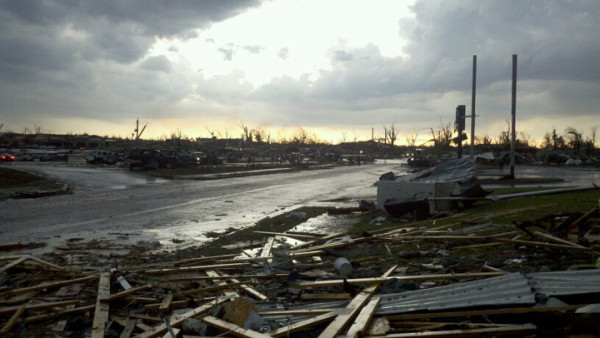
Joplin and Climate Change

I am wondering at what point extreme weather events are going to be seen as harbingers of climate change. Climate scientists have for some time noted that Anthropogenic Global Warming will produce extreme weather events The question is how do we establish that a pattern of extreme weather events is a product of AGW? AGW skeptics can rightly point out that we had extreme weather events before atmospheric CO2 began to increase. Thus extreme climate events are not in themselves evidence that climate change is happening.

What may begin to tip the scales toward acknowledgement of climate change is not the extremity of weather events but their number. If it becomes evident that the number of extreme weather events is increasing, the case for climate change will grow stronger. During the last few years wide scale flooding often accompanied by unusual rain events has appeared to increase. There have been large scale floods in Pakistan, Australia, Europe, and the United States, during the last couple of years. Currently the Mississippi River is flooding and the flood is either the largest in recorded history or the second largest. In addition, in 2010 an extreme rain event 9a thousand year Rain event) triggered flooding in Nashville, Tennessee, and in 2009 an even more unusual rain event (a 10,000 year rain event) triggered flooding in Atlanta, Georgia.

In addition to flooding and rain events, there has been an unusual number of Tornadoes. As of May 23, there have been 1,170 tornadoes reported in the US in 2011. This number includes at several confirmed rare F 5 tornadoes. Three confirmed F 5 tornados occurred on April 27th 2011:
* From Smithville, MS to Shottsville, AL along a 32 mile path
* From Hackleburg, AL to Huntland, TN along a 132 mile path
* In or near Philadelphia, Mississippi along a 29 mile path
Monstrous F 4 or F 5 storms which devastated Tuscaloosa, Alabama, and Joplin, Missouri also occurred during the Spring of 2011.

In addition to extreme rain events, floods and tornadoes, we need to consider droughts and heat waves. In 2007 the Intergovernmental Panel on Climate Change Fourth Assessment Report (IPCC, 2007) noted,
Since 1950, the number of heat waves has increased and widespread increases have occurred in the numbers of warm nights. The extent of regions affected by droughts has also increased as precipitation over land has marginally decreased while evaporation has increased due to warmer conditions. Generally, numbers of heavy daily precipitation events that lead to flooding have increased, but not everywhere. Tropical storm and hurricane frequencies vary considerably from year to year, but evidence suggests substantial increases in intensity and duration since the 1970s.In the extratropics, variations in tracks and intensity of storms reflect variations in major features of the atmospheric circulation, such a
Not only did the IPCC note an increase in the number of extreme weather and climate events during the last 60 years, but foresaw a continuation of this pattern for the rest of this century.

The IPCC forecasts extreme rain and flood events due to increased precipitation that will cause:
* Damage to crops; soil erosion, inability to cultivate land, water logging of soils
* Adverse effects on quality of surface and groundwater; contamination of water supply
* Deaths, injuries, infectious diseases, allergies and dermatitis from floods and landslides
* Disruption of settlements, commerce, transport and societies due to flooding; pressures on urban and rural infrastructures
We cannot be sure yet that the IPCC forecast is coming to pass, but the evidence from the last couple of years strongly suggests that it is. If this pattern continues it is only a matter of time before the public recognizes the full implication of what is happening. At that point even the extreme political right may start indulging in climate alarmism. The real Joplin tragedy may turn out to be that we are not without responsibility for the disaster, yet unwilling to acknowledge our responsibility for it. The time is coming when we will acknowledge it.

Monday, May 23, 2011

Scientific American beyond the Pale of Respectability

As a teenager I use to walk to the Oak Ridge Public Library to read the magazines. Scientific American was always one of my favorites. I regarded SA as more reliable than the Bible. That was long ago. Some time ago Scientific American fell under the editorial control of people holding anti-nuclear views. Let me say first that I am a critic of conventional nuclear technology. I take the view that nuclear power can be inherently safe, and indeed that natural reactors operated at Oklo in Gabon, Africa for hundreds of thousands years without anything catastrophic happening. Scientific American told the story. Not only did more than a dozen reactors operate with out human control for many thousands of years, but their fission products, the infamous nuclear waste, was contained to a remarkable extent, suggesting that the so called nuclear waste problem has been greatly exaggerated by the anti-nuclear crowd. Alex P. Meshik, in the resent SA account of Oklo, tells us
After my colleagues and I had worked out in a general way how the observed set of xenon isotopes was created inside the aluminum phosphate grains, we attempted to model the process mathematically. This exercise revealed much about the timing of reactor operation, with all xenon isotopes providing pretty much the same answer. The Oklo reactor we studied had switched “on” for 30 minutes and “off” for at least 2.5 hours. The pattern is not unlike what one sees in some geysers, which slowly heat up, boil off their supply of groundwater in a spectacular display, refill, and repeat the cycle, day in and day out, year after year. This similarity supports the notion not only that groundwater passing through the Oklo deposit was a neutron moderator but also that its boiling away at times accounted for the self-regulation that protected these natural reactors from destruction. In this regard, it was extremely effective, allowing not a single meltdown or explosion during hundreds of thousands of years.

One would imagine that engineers working in the nuclear power industry could learn a thing or two from Oklo. And they certainly can, though not necessarily about reactor design. The more important lessons may be about how to handle nuclear waste. Oklo, after all, serves as a good analogue for a long-term geologic repository, which is why scientists have examined in great detail how the various products of fission have migrated away from these natural reactors over time. They have also scrutinized a similar zone of ancient nuclear fission found in exploratory boreholes drilled at a site called Bangombe, located some 35 kilometers away. The Bangombe reactor is of special interest because it was more shallowly buried than those unearthed at the Oklo and Okelobondo mines and thus has had more water moving through it in recent times. In all, the observations boost confidence that many kinds of dangerous nuclear waste can be successfully sequestered underground.
There is a safety lesson here for reactor designers, contrary to Meshik. Conventional reactors operate at high pressure, the Oklo reactors operated at low pressure, unconfined steam simply boiled off. It is certainly possible to operate reactors at low pressure, and in fact to do so with greater thermal efficiency than is possible with conventional reactors. This can be accomplished with liquid metals, for example sodium and lead, or it can be accomplished with liquid fluoride salts.

Conventional reactors are reasonably safe especially when compairedd with other energy technologies, including solar and wind. You will not see such comparisons offered by Scientific American, however.

At any rate that anti-nuclear crowd, that controls Scientific American has once again is telling us that nuclear power is unsafe. The anti-nuclear crowd has few facts to base their objections to nuclear power on. In two of the three worse case nuclear accidents, there were no casualties, while people rew killed all the time by following off the tops of wind generator towers, following off the rooves of houses with PV cells, in coal mine and natural gss pipeline explosions, and in oil refinery accidents. The anti-nuclear crowd, however, seems to believe that if someone were to be killed in a nuclear power related accident, they would be far more dead that people killed by accidents related to other energy technologies.

In their imagination he anti-nuclear crowd believes that a nuclear power related accident that will kill millions of people is just waiting to happen. And those people will of course be very dead, unlike the people who fall off their rooves attempting to service PV cells and are killed. Scientific American does worry because,
fossil-fueled power plants shortens the life span of as many as 30,000 Americans a year. Coal companies lop off mountaintops, hydraulic fracturing for natural gas threatens water supplies, and oil dependence undermines the nation’s energy security. Then there is the small matter of greenhouse gas emissions.
However, SA tells us
the public worries about safety—and no wonder. The industry and the U.S. Nuclear Regulatory Commission (NRC) claim that nuclear power is safe, but their lack of transparency does not inspire confidence. For example, an Associated Press investigation in March revealed 24 cases from December 2009 to September 2010 in which plant operators did not report equipment defects to the NRC. The industry and regulators must regain the public’s trust.
So the NRC is the only thing that stands between us and the nuclear accident that will kill millions of people far more than pollution from coal fired power plants kills them now. And according to the anti-nuclear crowd at SA, the NRC is falling down on the job. Yet SA's accout of the AP's supposed investigation of the NRC is itself questionable as "Blubba" points out in a comment,
The Associated Press didn't investigate the industry's failure to report defects, it simply reported on the investigation conducted by the US Nuclear Regulatory Commission's Office of Inspector General. The OIG report put the blame on the NRC for creating confusing and conflicting guidance for what is supposed to be reported by the industry.
The AP story spacifically stated,
The inspector general blames the failures on uncertainty about when to report defects. Operators said they thought they needed to report only when an “event” took place and backup systems did not prevent a breakdown — or in bureaucratic lingo, an “actual loss of safety function.” In fact, the rules require them to report any defect, even if backup systems kicked in.

The inspector general said there was confusion about the rule among at least 28 percent of the nation’s 104 nuclear reactors, based on interviews done from mid-2009 to mid-2010.
Thus the problem was not with the operators at all, it was entirely due to confusing regulations, and can be resolved by clarifying them. Yet SA uses the AP story to imply that regulatory and the failure to report was due to misconduct by operators and regulators.

Fortunately there are a group pf sensible people who support nuclear power and who do not accept everything that Scientific American says about nuclear power without questioning. Freethinker wrote,
We have a potential for nearly unlimited clean power. We can power ships, hospitals and pump water into the desert to make it bloom. We can transport ourselves on the wings of electricity. But, according to the fine editors here, we must be careful, cautious, tread lightly. They tell us that danger awaits in the wings and that a current record of safety is no assurance we will not all die quickly in the future. Is this science? Are the recommendations here forwarded really science? Or is this a knee jerk reaction that preserves the status quo and prevents any real movement forward?

1. How many have died from the amazing disaster at Fukushima?
2. Why did they die and why have more not died?
3. When compared to the safety of any other thing affected by the Tsunami were these reactors safer or more dangerous in terms of people actually killed?
4. If 40 year old designs can withstand the most amazing earthquake and Tsunami known to humanity up to this point, why are we so afraid?

To put it bluntly, I call your bluff. You have not given any reasons, evidence or backing for your call for increased regulatory oversight, but a mish-mash of fear

The nuclear story is that in 50 years nuclear power has proven safer than oil, proven safer than natural gas, proven safer than coal, proven safer than wind, proven safer than hydroelectric, and proven safer than solar photovoltaics. Still Scientific American complains of public mistrust of the nuclear industry because the wording of some of the NRC's regulations are not clear enough for reactor owners to be sure if they are following them. What gives here?

We need to talk about an anti-nuclear propaganda machine, one which distorts facts in order to put nuclear power in the worst possible light. That propaganda machine, of which Scientific American has been a part for he last few years, goes far beyond factual reality. The anti-nuclear propaganda machine tells numerous lies. Scientific American has told numerous lies. For example Scientific American has elevated anti-nuclear propagandist, Jan Willem Storm van Leeuwen, to the level of credible scientific source,

Storm van Leeuwen does not have the credentials to be regarded as a credible source. His work on the nuclear energy payback and the sustainability of nuclear power has never passed a peer review process, for a scientific journal, and has been bombarded with criticism by the scientific community. Yet Scientific American describes Storm van Leeuwen as an "expert" on the Uranium supply who
advises European governments on nuclear issues, . . .
Scientific American uses Storm van Leeuwen as the source of an outrageous lie, that
by 2070, Storm van Leeuwen found, the amount of energy it takes to mine, mill, enrich and fabricate one metric ton of uranium fuel may be larger than 160 terajoules—the amount of energy one can generate from it.
Scientific American disgraced itself by hyping a shoddy, unprofessional hit peice against nuclear power. Mark Cooper, a professional lobbyist who specialized for many years in communication issues, wrote an essay on nuclear costs. Scientific American described Cooper as an economist, he is not. Nor has his so called research on nuclear costs been published by a peer reviewed journal. Scientific American readers did offer a reasonable approximation of a peer review process, however. They unloaded on Scientific American:

Duncan M noted
renewables at 6 cents per kilowatt hour. That's pretty funny, since they require direct production subsidies of 15 cents per kilowatt hour for wind to 35 cents per kilowatt hour for solar, with no reasonable hope those costs will fall significantly

Meanwhile, nuclear is cost-competitive with hydro in Europe.

This magazine doesn't deserve to keep the word Scientific in its name if it's publishing political jeremiads like this.
Rogeregon responded
LOL! Duncan M, I've noticed, more and more, how Scientific American has been taken over by a bunch of ultra-left wingers who seem to be mostly pushing political agendas, rather than actual science!
uvdiv was blunt
This article is criminally dishonest. It brings up a "12c-20c/kWh" cost range for nuclear, and then also cites an MIT study as calling nuclear power "uncompetitive". Which is interesting because I've READ that MIT study, and it concludes the levelized cost for new nuclear power is 8.4 c/kWh - well outside the other range the author quotes. Does the author point out this discrepancy? No; he ignores the inconvenient parts of his own sources, selectively cherry-picking the quotes and datapoints that support his position.

The report is available for free here:

http://web.mit.edu/nuclearpower/

And further when the MIT report calls nuclear power "uncompetitive", it is referring ONLY in comparison with coal and natural gas power, and ONLY when completely ignoring the costs of carbon emissions. In fact, by the studies' numbers, just a very small carbon price would make nuclear as cheap as coal. (2009 update, Table 1)

The cited MIT report also directly conflicts with the "$1.9-4.1 trillion" figure for 100 new reactors. It estimates a capital cost figure of $4/W for new reactors (based on real-world figures from recent reactors in Japan and South Korea, which fell in the range of $2-3/W*, and extrapolating from that with commodity price increases). At the this cost, 100x new 1 GWe reactors would carry a pricetag of $400 billion, which is majorly conflicts with his other (presumably fradulent) numbers. Since when did commercial power reactors reach $41/W???

*These are discussed in a supplementary paper to that report, which is here under "Update on the Cost of Nuclear Power":

http://web.mit.edu/ceepr/www/publications/workingpapers.html

Again, it is despicable that a self-proclaimed "journalist" would so blatantly misrepresent his sources, twist them to support his political ideals.

To append one thing to my comment - I want to preempt any argument that lifetime operation or decommissioning costs explain away the huge discrepancy with that $1.9-$4.1 trillion figure. Construction costs are by far the largest component of nuclear power costs, and other lifetime costs are comparatively trivial. Again citing the same MIT study (the supplement paper): Table 6C compares these. A full 72% of total costs are the initial construction costs (which would be $400 billion for one hundred 1 GWe reactors under this MIT study). A tiny 11% are operation and maintenance costs, 10% are fuel costs, and 7% decommissioning.

Again that paper is available here for free:

http://web.mit.edu/ceepr/www/publications/workingpapers.html
Patrice2 commented
Contrary to the study’s finding that “nuclear power cannot stand on its own two feet in the marketplace” nuclear energy is expected to be among the most economic sources of electricity. To cite one example, an independent comparative study published in January 2008 by the Brattle Group for the state of Connecticut estimated that nuclear energy (at $4,038/kW) may have the highest capital cost, but still produces the least expensive electricity, except for combined cycle natural gas with no carbon controls.

New nuclear reactors have been affirmed as the least cost option for new generation by the Public Service Commission (PSC) in South Carolina, Florida, and Georgia. The analyses supporting the PSC reviews found nuclear to be cost competitive with other forms of baseload generation in addition to helping to address climate change.

Various recently-released academic studies have also found the cost of nuclear energy to be competitive.

It’s useful to think of it like this:

• The cost of building advanced reactors is about the same as advanced coal plants with carbon storage, but nuclear energy has the lowest fuel cost over decades of electricity production.

• By comparison, natural gas plants are relatively cheap to build, but the supply and price volatility is a major drawback. The fuel cost for natural gas plants makes up 90 percent of the power cost. The cost of power from coal and gas-fueled power plants would rise in a carbon-constrained world, further increasing their electricity costs.

A new licensing process, coupled with construction and project management experience from nuclear energy projects globally, will provide useful experience with new reactor designs in the United States.

Put simply, credible estimates of the total cost of new nuclear energy facilities show that electricity from nuclear energy will be competitive with other forms of base load generation.
JimHolf made a point familiar to Nuclear Green readers
It must be noted that while nuclear opponents often claim that renewables are cheaper than nuclear, they are NEVER willing to put that assertion to any kind of market test. Just the opposite. They say they're cheaper, but then insist on policies that prevent any fair market competition between renewables and other means of reducing emissions, including nuclear. Under current/recent policies, renewables are massively more subsidised than nuclear, and there are also outright mandates for their use (regardless of cost or practicality), just in case even those subsidies are not enough. If the relative cost of renewables was anything like this article's study, none of these policies would be even remotely necessary."
"dbakerpe" noted,
The assertion that nuclear will have high long term costs is based on cost overruns on the first generation plants. It false on its face, because those same first generation plants are now the lowest cost power sources on the grid except hydro. Large power projects are built with borrowed money, so the power is always expensive to begin with to pay back the loans. A new nuclear plant will likely last 60-100 years. After the loans are paid back the power will be cheap. If we are going to have a real economy that produces real products, they are the only environmentally acceptable solution.
Finally "sethdayal" offered the following criticisms,
The MIT 4000 a kw is just a (WAG) wild guess based on suspect figures.
1) It is based on a few Asian reactors with some rather dubious conversions to US Dollars.
2) In the middle of the worst depression in a century it assumes without proof that nuclear plant cost inflation is 15%.
3) It assumes 11% cost of money at a time when public power ie governments can borrow at 3%.
4) Ignored are Westinghouse's sale of four ap-1000 reactors for 5.5 billion to China a little over 1300 a kw and Hyperions sale of six of its 25 mw units for $25 million each again $1000 a kw with 45 mw of free heat leftover to warm the town.
5) Ignored also is Westinghouse's contention that with mass production techniques it can produce these reactors for around $1000 a kilowatt. With a World War Two hell bent for leather lets save the planet from global warning type effort ramping up quickly to hundreds of plants opening worldwide every year, costs for mass produced reactors would drop drastically.
5) It assumes every country is like the US where a large portion of costs are a result of an army of attorneys, bureaucrats and insurance companies lined up for and against any proposed private power company nuclear plants.

Renewables cheaper. What a joke.
Amazingly, despite such criticisms, the Editors of Scientific American did not retract their "Mark Cooper" piece.

Clearly then Scientific American cannot be trusted as a source on nuclear power.

Saturday, May 21, 2011

Future Ship Propulsion

Ship propulsion poses one of the more troubling post-carbon problems. It should be noted that ships were once powered by wind energy, sometimes supplemented by oars rowed by slaves. This form of propulsion was very unsatisfactory and renewable energy was replaced by fossil fuel derived energy during the 19th century. There were a variety of motives for phasing out renewable energy.
* Sailing ships required large crews
* Winds were unreliable, making schedules impossible to keep
* Ship size was limited by the limitations of wind power
* Sailing ships were more vulnerable to loss during storms than powered ships
* Wind powered ships had more limited speed
* Wind powered ships were less useful for shipping perishable agricultural products
* Long range travel by wind powered ships was uncomfortable and could take months
Given these factors, it is unlikely that wind energy will successfully replace fossil fuel power in ocean commerce. Solar energy also seems impractical as a means of powering ships. There appears, at present, no serious effort to develop a renewables powered solution to the post carbon shipping problem. The United States Navy is examining expanding the use of nuclear power in its fleet (a tip of the hat to Rod Adams is in order). The Congressional Budget Office has examined the cost effectiveness of conventional nuclear power by the United States Navy. The Navy has fewer costs constraints imposed on it, than commercial shippers do. Thus if something is too costly for the Navy, it is totally impractical for commercial shippers.

The current Naval objection to building nuclear powered surface ships focuses on reactor costs. Conventional nuclear reactors are too expensive.
Estimates of the relative costs of using nuclear power versus conventional fuels for ships depend in large part on the projected path of oil prices, which determine how much the Navy must pay for fuel in the future. The initial costs for building and fueling a nuclear-powered ship are greater than those for building a conventionally powered ship. However, once the Navy has acquired a nuclear ship, it incurs no further costs for fuel. If oil prices rose substantially in the future, the estimated savings in fuel costs from using nuclear power over a ship's lifetime could offset the higher initial costs to procure the ship. In recent years, oil prices have shown considerable volatility; for example, the average price of all crude oil delivered to U.S. refiners peaked at about $130 per barrel in June and July 2008, then declined substantially, and has risen significantly again, to more than $100 per barrel in March of this year.

CBO regularly projects oil prices for 10-year periods as part of the macroeconomic forecast that underlies the baseline budget projections that the agency publishes each year. In its January 2011 macroeconomic projections, CBO estimated that oil prices would average $86 per barrel in 2011 and over the next decade would grow at an average rate of about 1 percentage point per year above the rate of general inflation, reaching $95 per barrel (in 2011 dollars) by 2021. After 2021, CBO assumes, the price will continue to grow at a rate of 1 percentage point above inflation, reaching $114 per barrel (in 2011 dollars) by 2040. If oil prices followed that trajectory, total life-cycle costs for a nuclear fleet would be 19 percent higher than those for a conventional fleet, in CBO's estimation. Specifically, total life-cycle costs would be 19 percent higher for a fleet of nuclear destroyers, 4 percent higher for a fleet of nuclear LH(X) amphibious assault ships, and 33 percent higher for a fleet of nuclear LSD(X) amphibious dock landing ships.
The CBO's cost estimate may be flawed by an overly optimist estimate of the cost of oil, but this is enough to establish that it will be expensive to build a future nuclear powered Navy. We can conclude from this that the cost of conventional nuclear power will impact sea based commerce, and may make the cost of conventional nuclear power impractical.

There are several possible alternative nuclear options which hold the possibility of lowering nuclear costs. These include liquid metal cooled fast reactors, Molten Salt Reactors, Molten Salt cooled solid fuel reactors, and pebble bed reactors. There is some history of liquid metal reactor use for naval purposes. It is not at all clear that liquid metal nuclear technology offers a cost advantage when compared to conventional reactors. In addition the history of liquid metal fast reactor use at sea, suggests reliability problems. In addition there are safety questions about fast reactors. Finally, fast reactors require large inventories of fissionable materials. Large inventories of fissionable materials may limit the number of ships that might be equipped with fast reactors. Thus fast metal cooled reactors may not be the best choice for commercial shipping motive power.

A second alternative nuclear option would involve the use of pebble bed nuclear technology. Gas cooled Pebble Bed Reactors are considered highly safe. However, gas cooled Pebble Bed Reactors have a large core. Large cores increase reactor manufacturing costs. In addition large cores occupy space that could be occupied by cargo or passengers. Liquid salt cooled Pebble Bed Reactors can have far mor compact cores, and manufacturing them would seem to potentially cost less than gas cooled PBRs. Liquid salt cooled PBRs can be refueled with few problems, and require small inventories of fissionable materials compared to fast reactors.

Like Pebble Bed Reactors, Molten Salt Reactors are very safe. They are simple and compact, lowering manufacturing costs. The principal difference between the MSR and the molten salt cooled PBR is that the fuel is disolved in the coolant salt of MSRs, while in molten salt cooled PBRs he fuel in embedded in graphite pebbles. It is easier and probably less expensive to process fission products out of a carrier salt than out of graphite pebbles. Graphite in the MSR core lowers fissionable inventory requirements as it does in PBRs. Thus it would appear that molten salt cooled reactors offer a potentially economical solution to the post-carbon ship propulsion problem.

Thursday, May 19, 2011

Will Natural Gas Save Us?

My message to the BRC became my latest post of the Energy Collective yesterday. It has not collected many readers so far, but it has collected several comments. Kiem commented,
"Disruptive innovation, disruptive technology is called for."

We have it already, its called shale gas. There is so much shale gas it will provide for our needs for the next 200 years. It is everywhere and it is cheap cheap cheap! Wahoo!
I responded,
Kiem, you are right that the story is being told that shale gas is disruptive, however, other stories are being told and they have not been disproven. The stories are that the shale gas reserve is a whole lot less than claimed.shale gas is not nearly as good for carbon mitigation as claimed, and that shale gas is not good for the aquifer water supply. Until these stories are demonstrated false, shale gas cannot be 100% relied on.
Geoffrey Styles responded,
Charles,

Even if all those caveats were correct, and I have reason to believe they're not, shale would still be disruptive, because it is already disruptive. To wit, the quantity of shale gas already being produced, contributing roughly a quarter of US gas output today, has in just a few years: reversed the seemingly inevitable growth of US natgas imports, slashed domestic natgas prices--in the process altering the global market for LNG and enabling gas-fired power to capture significant market share from coal--created a realistic possibility of displacing part of our oil use in transportation with gas, and made some wind power installations less attractive. That's as disruptive as anything I could have imagined a few years ago for this time frame.
Geoffrey usually has good sense, but I cannot agree with these contentio0ns. However, Even if fraking accomplishes everything expected of it by the UnitedStates Energy Information Agency, and the EIA offers by far the most optimistic estimate of farkings impact on future United States natural gas production, fraking will do little more than prevent the decline of the United States's natural gas production. Conventional gas production has already peaked in the United States. Geoscientist, David Hughes, in a recent report from the Post Carbon Institute titled, Will Natural Gas Fuel America in the 21st Century writes,
Even assuming the EIA forecast for growth in shale gas production can be achieved, there is little scope for wholesale replacement of coal for electricity generation or oil for transportation in its outlook. Replacing coal would require a 64% increase of lower-48 gas production over and above 2009 levels, heavy vehicles a further 24% and light vehicles yet another 76%. This would also require a massive build out of new infrastructure, including pipelines, gas storage and refueling facilities, and so forth. This is a logistical, geological, environmental, and financial pipe dream.
Hughes points out the usefulness of Natural Gas:
Natural gas is a very versatile fuel with major uses in all sectors except transportation, where it is mainly used in the pipeline transport of natural gas and to a very limited extent for compressed natural gas (CNG) vehicles (Figure 5). Natural gas is a primary feedstock in the petrochemical industry and underpins the production of nitrogen-based fertilizers, which are responsible for the “Green Revolution” that has improved crop yields by nearly 200% over the past 80 years. Industrial use of natural gas accounted for 32% of its consumption in 2009. Natural gas is also a very useful fuel for distributed use, as in residential and commercial heating applications, and in 2009 these sectors accounted for 21% and 14% of its use, respectively. Electricity generation accounted for a further 30% of U.S. natural gas consumption in 2009, mainly in “peaking” power plants. Peaking plants are used to meet peak electricity demand loads, as opposed to providing base load power, primarily because of fuel costs; however, some of the larger combined-cycle gas plants are used for base loads.
These comments suggest that it may be desirable to conserve natural gas for industrial uses such as the production of nitrogen-based fertilizers rather than use it to generate base load electricity. But even if the government and/or the market do not decide on a conservation stratigy, dramatic increases in natural gas production seem very unlikely, Hughes notes,
U.S. natural gas production hit its all-time high of 21.73 trillion cubic feet (tcf) per year in 1973. Up until the late 1990s, the majority of U.S. gas production came from conventional reservoirs, which are pressurized pools of free-flowing gas trapped beneath impervious seals. Unconventional gas from coalbed methane became important in the early 1990s and was once heralded as a panacea to offset declines in conventional production, although now coalbed methane production is forecast to decline in the future (see Figure 16). Production from unconventional, very-low-permeability reservoirs in the form of tight gas sands and shale gas became significant in the late 1990s and especially over the past six years.
Hughes notes that,
Natural gas production is a story about a race against depletion. Typically, the production from a new conventional gas well will decline by 25% to 40% in its first year, before tapering off to lower yearly declines as time goes by. The overall yearly decline rate of all U.S. gas wells has been estimated at 32% by EOG Resources.25 This means that gas production would decline by a third each year, if no new wells were drilled. Sixty percent of U.S. gas production in 2006 came from wells drilled in the prior four years according to the EOG estimates. Chesapeake Energy has estimated that as of year-end 2007, nearly half of U.S. production came from wells drilled in the previous three years. So in order to keep overall gas supply from declining, drilling activity must be sustained.

Natural gas production is also a story about a rapidly increasing number of producing gas wells and a declining amount of gas produced from each. There are now more than half a million producing gas wells in the United States, nearly double the number in 1990 (Figure 10). Yet the gas production per well has declined by nearly 50% over this period. This is a manifestation of the law of diminishing returns, as a complex infrastructure nearly 100% larger than that in 1990 must be maintained today to achieve a 21% increase in natural gas production.
But what about the argument that the United States has a Huge natural gas reserve? Hughes responds,
In a 2011 report, the U.S. Potential Gas Committee (a non-profit organization made up of members of the natural gas industry) estimated total U.S. gas resources at 1739 tcf of probable, possible, and speculative resources (of which 687 tcf are shale gas) and a further 159 tcf of coalbed methane, for a total of 1898 tcf.31 Coupled with proven reserves of 272 tcf, this indicated a potential of 2170 tcf. It has been widely reported that the United States “has 100 years of gas” even though 2170 tcf, if it could actually be recovered, would last much less in actuality given the proposed ramp-up of shale gas production and the proposed increased use of gas for electricity generation and vehicle transport.

As mentioned earlier, the most important consideration for the outlook of natural gas is not the estimated volumes of potential resources and proven reserves in the ground, it is the rate at which they can be produced to meet present and future demand. Of the potential resources identified by the U.S. Potential Gas Committee, two-thirds are in conventional and unconventional tight sand and coalbed methane reservoirs, sources that are projected to decline in production going forward. Virtually all growth in gas supply in the current EIA reference case is projected to come from shale gas, which constitutes only a third of estimated U.S. gas resources.
Yet, Hughes argues that the long term potential for shale gas production is very poor, A
key aspect of shale gas wells is the high rate at which their production declines. Conventional gas wells typically decline by 25% to 40% in their first year of production, whereas shale gas wells decline at much higher rates, typically between 63% and 85%.42 The initial productivity of shale gas wells can be very high. In plays like the Haynesville Shale in Louisiana, initial rates can be more than 10 million cubic feet per day (Barnett Shale wells are typically much lower at about 2 million cubic feet per day). However, their steep production decline rates suggest that relying on shale gas for a large proportion of U.S. gas production will only exacerbate the “exploration treadmill” problem of the number of wells that must be drilled to maintain production.
Hughes report offers a devastating critique of the "natural gas will save us" canard. Hughes does not simply offer the worst case scenario. He offers us the best case scenario from the EIA and analyzes it, demonstrating in the process that Natural Gas offers more hype than hope. Unfortunately, Richard Heinberg's Foreword to the Hughes' report does not offer us the same high quality. Heinberg tells us,
It is past time for policy makers to get serious about the most important strategy we can and must adopt in order to succeed in this new era—energy conservation. Reducing demand for energy and using energy more efficiently are the cheapest and most effective ways of cutting carbon emissions, enhancing energy security, and providing a stable basis for economic planning.

Unfortunately, energy supply limits and demand reduction do not support robust economic growth. This is probably the main reason why policy makers and many energy analysts and environmentalists shy away from conveying the real dimensions of our predicament. However understandable this response may be from a political perspective, it is one that only compromises our prospects as a nation and a species. There is much we can do to ensure a secure social and natural environment in a lower-energy context, but we are unlikely to take the needed steps if we are laboring under fundamentally mistaken assumptions about the amounts of energy we can realistically access, and the costs of making that energy available.
This is nonsense. Heinberg's contentions about the limitations of the energy supply are not supported by Hughes analysis, and in fact an affordable shift to advance nuclear technology will yield an energy supply that will last for millions of years.

Update: Geoffrey Styles has clarified his views. He definition of Disruptive Innovation is somewhat different than the one I was pressing in the Message to the BRC post on the EC. His concept of a disruptive innovation only requiters, that market related decisions by competitors be effected. Geoffrey wrote,
if that's your definition of disruptive I'd suggest it's far too strict, at least in terms of economic disruption. Because prices are set at the margin, a much smaller erosion of market share than you propose could drastically alter the profitability of the coal industry or the refining industry. Ask refiners whether displacing 7% of their gasoline output with ethanol has affected their margins.
Although Geoffrey is correct that this is an example of disruptive innovation, it does not fit well into lists of disruptive innovations, which focus on replacement technologies:
* Personal computers replacement for Minicomputers, Workstations. Word processors

* Downloadable Digital Media replacement for CDs, and DVDs.

* Mini steel mills replacement for vertically integrated steel mills

* Digital photography replacement for Chemical photography
It would appear that the concept of disruptive innovation needs to be better articulated.

Tuesday, May 17, 2011

A message to the "Blue Ribbon Commission"

We need to boldly go into the uncharted energy future where no one has gone before. Climate scientists tell us that about 70% of our energy resources, currently derived from fossil fuels, need to find substitutes. For many current energy uses including,

      1. Seaborn transportation

      2. Industrial process heat

      3. Peak, backup and load following electricity

renewable substitution seems unlikely, and current nuclear technology is too costly and inefficient. Disruptive innovation, disruptive technology is called for.

Recenty the Reactor & Fuel Cycle Technology Subcommittee of the “Blue Ribbon Commission” wrote,

No currently available or reasonably foreseeable reactor and fuel cycle technologies including current or potential reprocess or recycle technologies have the potential to fundamentally alter the waste management challenge this nation confronts over at least the next several decade.

No blue ribbon. No ribbon at all. Look again.

Monday, May 16, 2011

Confusion will not end for everyone suddenly and at the same time

Confusion will not end for everyone suddenly and at the same time, but as clarity begins to emerge, it will become to more and more people that they have been confused. The likely report of the Secretary of Energy's Blue Ribbon Commission can be expected to reflect confusion, not clarity. And plenty others are confused. Much of the confusion is derived from ideology, and not just Green ideology. Robert Bradley, Jr., of masterresources.org is quite good at spotting the confusion of others, but unlike George Monbiot is unable to see how his confusion distorts his on thinking.

Bradley is correct in thinking that
(e)nergy is the master resource. Without it, other resources could not be produced or consumed. Oil, gas, and coal could not be replenished without the energy to manufacture and power the requisite tools and machinery. Nor could there be wind turbines or solar panels, which are monuments to embedded (fossil-fuel) energy.
Bradley also correctly judges that there are three reasons for
for regulating or subsidizing energy projects.
They are Analytic failure, Market failure, and Government failure. We see in the case of solar and wind generated energy an unending string of analytic failures, These failures have been exposed by analyses of future renewable energy focused plans and by case studies of renewable implementation. I will also argue that Robert Bradley, Jr. despite his success in spotting the analytic failure of others, still exhibits analytic failures of his own.

Market failure can have many sources. Clayton M. Christensen describes the reasons why large businesses fail when confronted with disruptive innovations, in The Innovator's Dilemma. Christensen, notes that businesses often develop new technologies, but often fail to capitalize on their own innovations. When their marketing department investigates the response of their existing customer base to the innovation, they find little interest. What the customer wants is performance improvements in existing technologies. And business theory holds that business success comes from listening to customers, and giving them what they want. Small markets do not justify big investments, and marketing may find that there is not a big market for the innovation. Companies which have large growth targets may not be interested in innovations that do not seem to bring big growth. Further the market effect of disruptive technologies cannot be analyzed because the market does not yet exist, and therefor no data is being generated. Without data, marketing does not have a clue. Most successful businesses do not engage in disruptive innovation. Indeed a disruptive innovation approach may involve what appear financial analyses to be bad financial decisions.

There are lessons to be learned in the rise of Apple during the last decade. Long term business success appears to require some risk taking on "Disruptive Technology." Apple provides an example of why this is the case,
Apple spent nearly as much on development of the iPhone as it did on its Leopard OS, according the company’s 10Q filed with the SEC. From the notes: “In the second quarter of 2007, the Company determined that both Mac OS X version 10.5 Leopard (“Leopard”) and iPhone achieved technological feasibility. During the second and third quarters of 2007, the Company capitalized approximately $27 million and $26 million, respectively, of costs associated with the development of Leopard and iPhone.”
Of course in the long run, Apple was hugely rewarded for its willingness to take a risk, but there are plenty of examples of attempted to develop disruptive innovations which failed, and may have even ruined the would be disruptive innovator. Sometimes disruptive innovators are successful over a period of time, only to fizzle out. For example Polaroid, which introduced an instant picture technology shortly after World War II. Initially Polaroid was extremely successful.
Between1948 and 1978 sales grew 23 percent and profits grew 17 percent, both annually.
Yet Polaroid eventually failed, brought down by a revolution in electronics technology.

Disruptive innovation may lead to mistakes. Steve Jobs suggests,
Sometimes when you innovate, you make mistakes. It is best to admit them quickly, and get on with improving your other innovations.
Many business executives would not be able to accept Steve Jobs idea that making mistakes is part of the cost of doing business.

Disruptive innovations may also be rejected because it is suspected that the innovation will cannibalize sales of existing products. The iPad is doing that to Apple's traditional computer line, but Steve Jobs does not care in the slightest, because the company is growing. Thus there are business forces which tend to drive businesses away from producing disruptive products. Steve Jobs has shown how to build a great company through systematic use of disruptive innovation, and in doing so has illustrated the failure of the market as interpreted by classic businesses.

Yet in its wake Apple is leaving in its wake shattered competitors. In 2008 RIM, Microsoft and Palm dominated the Smartphone business. Today it is Apple. Thus failure is part of the market, businesses fail all the time, and markets may fail as a whole, because most businesses do not accomplish what Apple has.

Finally we have government failure. There is little doubt that Governments have failed in the energy sphere, for example in the development of advanced nuclear technology. The United States Government continues to fail.

Thus I agree with Bradley's analysis that Analysis, the Market and Government itself can all fail. The next stage of Bradley's argument is much more problematic. Bradley makes a number of very questionable claims:
1. Estimated quantities of recoverable oil, gas, and coal have been increasing over time according to the statistical record. Human ingenuity in market settings has and will continue to overcome nature’s limits, leaving in its wake errant forecasts of resource exhaustion. The resource challenge is political: allowing access and incentive so that the ultimate resource, human innovation and entrepreneurship, can expand new energy supplies and multiply its productive uses. Resourceship is a useful term to describe human inguenuity applied to minerals.
2. Energy security in the electricity market is assured by abundant domestic coal and the fact that almost all of U.S. gas imports are from Canada. Most of the oil needed for transportation comes from domestic supplies supplemented by imports from a variety of countries led by Canada and Mexico.
3. The global warming scare is plagued by open scientific questions, economic tradeoffs, and the reality that carbon-based energy is requisite to economic growth. Carbon rationing (via the Kyoto Protocol) is a failed policy for the developed world and a nonstarter for the developing world. Not only have targeted reductions proved to be elusive, the economic costs of carbon rationing are not unlike those from (postulated) deleterious climate change.

First, as any careful reader of The Oil Drum will tell you, the problem is not total reserve, it is the economics of recovery. As reserves shift from big and easily exploited resource blocks, to smaller and more difficult to exploit blocks, it becomes more and more expensive to exploit the resource, until a point is reached at which it requires more energy to recover the resource than is gained by the recovery. Before we reach that point, the total return from recovery efforts will begin to drop, and resource prices will begin to rise. That appears to be beginning to happen with oil. While it has been argued that the price of natural gas will remain at historically low points for decades to come, this appears to be questionable at best.

Secondly, even if the oil and coal comes from North America, competition for North American produced oil and coal will drive its price up. North American origins of oil and gas will not make it cheaper here than elsewhere.

Thirdly, Bradley fails to distinguish policy issues related to Anthropogenic Global Warming (AGW), with the scientific validity of AGW concerns. He is quite correct that carbon rationing is likely to fail, but incorrect in assuming that carbon based energy is required for economic growth. It is possible to substitute a non-carbon energy source for carbon based energy at a cost that would be sufficiently low to drive carbon based energy out of the market, if it is desirable to do so.

Fourth even if fossil fuel sustainability were possible for some time to come were both possible and practical, there are considerable human health and safety costs for doing so. These costs involve the expenditure of real money, but rarely is that expenditure directly reflected in the cost of energy.

Bradley fails to acknowledge the imperfections of the market, and indeed his writings often reflect that imperfection. It is clear that Bradley is an advocate for the fossil fuel industry and that he relentlessly makes its case, but he fails to see the merits of the cases against fossil fuels. He denies peak oil, peak coal, and peak natural gas, as well as the fossil fuel, CO(2), climate change link. Finally he denies the need of disruptive technology. Bradley is much better at spotting the flaws of the renewable advocates than he is at spotting the flaws of the fossil fuel mob. He remains an advocate of business as usual, and fails to ackowedge either the possibility of disruptive innovation in the energy field, or in its necessity. If it requires governmwntal intervention to launch such a disruptive innovation, so be it. Business as usual cannot go on, and business as usual has not produced the innovation.

We are now at the critical point at which confusion is beginning to end, but confusion will not end for everyone suddenly and at the same time.

Saturday, May 14, 2011

The Not Ready for Prime Time Subcommittee Speaks

Blogger is back up. During the last month, major outages have effected Google, Microsoft, Amazon and Yahoo. Most of the problems were due to the cloud or "human error," or both. Unfortunately Google had to delete posts made on May 12, in its effort to restore Blogger. When Brian Wang attempted to restore his deleted posts, Blogger shut down his blog, "due to unusual activity." Fortunately The Energy Collective, keeps an echo of all of my posts, whether or not they are published. I was able to recover my "lost post" from the EC echo. Google has not attempted to shut Nuclear Green down.


During Yesterday's meeting, Reactor & Fuel Cycle Technology Subcommittee punted on first down. The Subcommittee's goals had been to
“to evaluate existing fuel cycle technologies and R&D programs in terms of multiple criteria. Criteria for evaluation should include cost, safety, resource utilization and sustainability, and the promotion of nuclear nonproliferation and counter- terrorism goals.”
The Subcommittee clearly failed to do this. Instead it recommended,
Advances in nuclear reactor and fuel cycle technologies may hold promise for achieving substantial benefits in terms of broadly held safety, economic, environmental, and energy security challenges. To capture these benefits, the United States should continue to pursue a program of nuclear energy RD&D both to improve the safety and performance of existing technologies and to develop new technologies that could offer significant advantages in terms of the multiple evaluation criteria listed in our charter.

No currently available or reasonably foreseeable reactor and fuel cycle technologies including current or potential reprocess or recycle technologies have the potential to fundamentally alter the waste management challenge this nation confronts over at least the next several decade

Put another way – we do not believe that new technology developments in the next three to four decades will change the underlying need for an integrated strategy that combines safe, interim storage of spent nuclear fuel with expeditious progress toward siting and licensing a permanent disposal facility.
Clearly, the Subcommittee was not motivated by
the compelling urge of man to explore and to discover, the thrust of curiosity that leads men to try to go where no one has gone before.
But then I did not expect the Blue Ribbon Commission to offer us a vision of the future.
In order to have a vision, we must be willing to take bod action, to undergo risk, and indeed to risk failure. Unfortunately a fear of failure will most assuredly lead us to the very failure that we fear the most. The Subcommittee recommends a business as usual approach to a society that faces a crisis,
The U.S. government should provide stable, long- term RD&D (research, development, and demonstration) support for advanced reactor and fuel cycle technologies that have the potential to offer substantial benefits relative to currently available technologies in terms of safety, cost, resource utilization and sustainability, the promotion of nuclear nonproliferation and counter-terrorism goals, and waste storage and disposal needs.
Fortunately we have not yet heard the last word on the nuclear future with the Subcommittee's report. We will have other chances.

Friday, May 13, 2011

Monbiot: "We have no idea what to do next."

This post went up yesterday, but due to problems with Blogger, Google took it down, along with all of the other blogger posts. Fortunately I was able to recover the text. Here it is.

So how do we break this system? How do we pursue happiness and well-being rather than growth? I came back from the climate talks in Copenhagen depressed for several reasons, but above all because, listening to the discussions at the citizens’ summit, it struck me that we no longer have movements; we have thousands of people each clamouring to have their own visions adopted. We might come together for occasional rallies and marches, but as soon as we start discussing alternatives, solidarity is shattered by possessive individualism. Consumerism has changed all of us. Our challenge is now to fight a system we have internalized. - George Monbiot


For one thing, environmentalism is a luxury. Just like being a vegetarian is a luxury. When you have to worry about eating - you're not going to be worried about where the food's coming from, or who made your shoes. Poverty, whether planned or not planned, is a way of making environmentalism moot. Even this discussion is a luxury. - Sherman Alexie

I have no doubt that George Monbiot is a brilliant iconoclast. The Icons that he is destroying at the moment are primarily those of the Green Movement. Environmentalists, as a group, do not think things out. Monbiot is a capable and passionate thinker. Yet given what he has seen, Monbiot acknowledges,
We have no idea what to do next.
Some 35 years ago, I briefly became active in the an environmental organization, only to discover, to my amusement, what I called REI consumerism. There are deep paradoxes in the environmentalist movement, and perhaps the deepest paradox is the claim by mainstream environmentalists to be progressive. A progressive wishes to improve the material lot of everyone, but most especially the poor. Mainstream environmentalists see wealth to be evil, and believe that the road to environmental salvation is nearly impoverishment. This is of course nonsense. Monbiot has seen the nonsense, and doesn't like it one bit.

Green environmentalism is about a quest for righteousness, both personal and social. When i was younger, on the roads of the American South, i saw signs that read, Get right with God. The goal of the Green movement is similar, to get right with nature. Social justice demands that the poor get a greater share of wealth, not that the wealthy be reduced to poverty. Thus if getting right with nature means decreasing human wealth, the goals of environmentalism are incompatible with social justice.

George Monbiot understands the paradox. Monbiot tells us,
You think you’re discussing technologies, you quickly discover that you’re discussing belief systems. The battle among environmentalists over how or whether our future energy is supplied is a cipher for something much bigger: who we are, who we want to be, how we want society to evolve. Beside these concerns, technical matters – parts per million, costs per megawatt hour, cancers per sievert – carry little weight. We choose our technology – or absence of technology – according to a set of deep beliefs; beliefs which in some cases remain unexamined.
Monbiot adds,
What the nuclear question does is to concentrate the mind about the electricity question. Decarbonising the economy involves an increase in infrastructure. Infrastructure is ugly, destructive and controlled by remote governments and corporations. These questions are so divisive because the same worldview tells us that we must reduce emissions, defend our landscapes and resist both the state and big business. The four objectives are at odds.

But even if we can accept an expansion of infrastructure, the technocentric, carbon-counting vision I’ve favoured runs into trouble. The problem is that it seeks to accommodate a system that cannot be accommodated: a system which demands perpetual economic growth. We could, as Zero Carbon Britain envisages, become carbon-free by 2030. Growth then ensures that we have to address the problem all over again by 2050, 2070 and thereon after.
Monbiot notes that the effects of an anti-growth approach would be disasterous both for society, and in the long run for the environment itself.
The Lost World
May 2, 2011

Where is the environmental vision that can resist the planet-wrecking project?

By George Monbiot. Published in the Guardian 3rd May 2011

You think you’re discussing technologies, you quickly discover that you’re discussing belief systems. The battle among environmentalists over how or whether our future energy is supplied is a cipher for something much bigger: who we are, who we want to be, how we want society to evolve. Beside these concerns, technical matters – parts per million, costs per megawatt hour, cancers per sievert – carry little weight. We choose our technology – or absence of technology – according to a set of deep beliefs; beliefs which in some cases remain unexamined.

The case against abandoning nuclear power, for example, is a simple one: it will be replaced either by fossil fuels or by renewables which would otherwise have replaced fossil fuels. In either circumstance, greenhouse gases, other forms of destruction and human deaths and injuries all rise.

The case against reducing electricity supplies is just as clear. For example, the Zero Carbon Britain report published by the Centre for Alternative Technology urges a 55% cut in overall energy demand by 2030: a goal I strongly support. It also envisages a near-doubling of electricity production(1). The reason is that the most viable means of decarbonising both transport and heating is to replace the fuels they use with low-carbon electricity. Cut the electricity supply and we’re stuck with oil and gas. If we close down nuclear plants, we must accept an even greater expansion of renewables than currently proposed. Given the tremendous public resistance to even a modest increase in wind farms and new power lines, that’s going to be tough.

What the nuclear question does is to concentrate the mind about the electricity question. Decarbonising the economy involves an increase in infrastructure. Infrastructure is ugly, destructive and controlled by remote governments and corporations. These questions are so divisive because the same worldview tells us that we must reduce emissions, defend our landscapes and resist both the state and big business. The four objectives are at odds.

But even if we ca
n accept an expansion of infrastructure, the technocentric, carbon-counting vision I’ve favoured runs into trouble. The problem is that it seeks to accommodate a system that cannot be accommodated: a system which demands perpetual economic growth. We could, as Zero Carbon Britain envisages, become carbon-free by 2030. Growth then ensures that we have to address the problem all over again by 2050, 2070 and thereon after.

Accommodation makes sense only if the economy is reaching a steady state. But the clearer the vision becomes, the further away it seems. A steady state economy will be politically possible only if we can be persuaded to stop grabbing. This in turn will be feasible only if we feel more secure. But the global race to the bottom and its destruction of pensions, welfare, public services and stable employment make people less secure, encouraging us to grasp as much for ourselves as we can.

If this vision looks implausible, consider the alternatives. In the latest edition of his excellent magazine The Land, Simon Fairlie responds furiously to my suggestion that we should take industry into account when choosing our energy sources(2). His article exposes a remarkable but seldom-noticed problem: that most of those who advocate an off-grid, land-based economy have made no provision for manufactures. I’m not talking about the pointless rubbish in the FT’s How to Spend It supplement. I’m talking about the energy required to make bricks, glass, metal tools and utensils, textiles (except the hand-loomed tweed Fairlie suggests we wear), ceramics and soap: commodities which almost everyone sees as the barest possible requirements.
social collapse in the face of fossil fuel resource depletion does not solve environmental problems,
In east Africa, for example, I’ve seen how, when supplies of paraffin or kerosene are disrupted, people don’t give up cooking; they cut down more trees.
Monbiot thus points to the dilemmas that Greens face.
Let me begin by spelling out, at greater length, the dilemmas we face.

1. Reducing greenhouse gas emissions means increasing electricity production. It is hard to see a way around this. Because low-carbon electricity is the best means of replacing the fossil fuels used for heating and transport, electricity generation will rise, even if we manage to engineer a massive reduction in overall energy consumption. The Zero Carbon Britain report published by the Centre for Alternative Technology envisages a 55% cut in overall energy demand by 2030 – and a near-doubling of electricity production.

2. Low carbon electricity means, to most greens, renewables. They were never well-loved, but now, in the places in which major deployment is taking place, they are provoking something approaching a full-scale revolt. Here in mid-Wales, for example, and in the Highlands of Scotland, public anger towards wind farms and the power lines and hubs required to serve them is coming to dominate local politics. While there are plenty of stupid myths circulating about the inability of wind turbines to produce electricity and about the greenhouse gases released in constructing them, in other respects the opposition to them is not irrational. People love their landscapes, and so they should.

Those of us who support renewables find ourselves in a difficult position: demanding the industrialisation of the countryside, supporting new power stations, new power lines and (for the electricity storage required) new reservoirs. Even offshore power, whose landscape impacts are much smaller, means more grid connections and more storage.

3. The only viable low-carbon alternative we have at the moment is nuclear power. This has the advantage of being confined to compact industrial sites, rather than sprawling over the countryside, and of requiring fewer new grid connections (especially if new plants are built next to the old ones). It has the following disadvantages:

a. The current generation of power stations require uranium mining, which destroys habitats and pollutes land and water. Though its global impacts are much smaller than the global impacts of coal, the damage it causes cannot be overlooked.

b. The waste it produces must be stored for long enough to be rendered safe. It is not technically difficult to do this, with vitrification, encasement and deep burial, but governments keep delaying their decisions as a result of public opposition.

Both these issues (as well as concerns about proliferation and security) could be addressed through the replacement of conventional nuclear power with thorium or integral fast reactors but, partly as a result of public resistance to atomic energy, neither technology has yet been developed. (I’ll explore the potential of both approaches in a later column).

c. Nuclear power divides our movements. Some of the most effective environmental organisations – Greenpeace for example – could not drop their opposition without falling apart.

4. Whichever low-carbon technology we embrace, we help to provide the means by which the industrial economy can keep expanding, even if it does so without a major release of greenhouse gases. This threatens to exacerbate all the other issues that concern us. To prevent this from happening, the replacement of fossil fuels should be accompanied by a transition to a steady-state economy. Herman Daly and Tim Jackson have shown us how this can be done technically. How it can be done politically is, at present, quite another matter.

5. Those who, on the other hand, advocate a return to a land-based economy and the abandonment of industrial society find themselves in conflict with the desires of most of humanity, in both rich and poor nations. They have produced no convincing account of how people could be persuaded to turn their backs on manufactured products, advanced infrastructure and public services.

6. Our reliance on the mineral crunch, which was supposed to have brought the economic engine of destruction to a grinding halt, appears to have been misplaced. The collapse of accessible mineral reserves has not occurred, and shows little sign of occurring within our lifetimes. Capitalism has proved adept at finding new reserves or (in the case of fossil fuels) substitutes for those that are depleting. This takes place at a massive cost to the environment, as exploitation intrudes into an ever wider range of habitats and involves ever more destructive processes. New mineral reserves allow us to continue waging war against biodiversity, habitats, soil, fresh water supplies and the climate.

7. We have no idea what to do next.

8. Partly as a result, we have started tearing each other apart. This is an understandable but unnecessary reaction. Those seeking to protect the landscape are not our enemies; nor are those advocating that renewables should replace fossil fuel; nor are those promoting nuclear power as the answer; nor are those opposing nuclear power. We are all struggling with the same problem, all bumping up against atmospheric chemistry and physical constraints.
We must face up, Monbiot tells us, to the failure of Green narratives,
Green narratives have collapsed precisely because they were unable to withstand the steely quantification demanded by an attempt to get to grips with problems like climate change. Or they have been struck down by circumstance: such as the inconvenient non-appearance of the commodities crunch they predicted. If a new poetic narrative is no better able to answer questions such as how a steady-state economy can be achieved, how low-carbon electricity will be produced, how the Common Fisheries Policy can be reformed or how, in a land-based economy, bricks and glass will be made, it too will collapse. In fact, it will never get off the ground as these questions, once formulated, won’t go away.
The trouble then is the bankruptcy of Green solutions.

Part of the Green dilemma is the failure to think through the issues and opportunities posed by nuclear power. There is an alternative, which might be called the Oak Ridge Paradigm or the Oak Ridge Way. Oak Ridge development of nuclear power was during the 1950's, 60's and 70's far in advance of anywhere else in the world. The Oak Ridge Scientific community took the opportunity to reflect on the human and environmental consequences of those advanced developments. The Oak Ridge paradigm grew out of those reflections. It was my good fortune to encounter the emerging Oak Ridge Paradigm during my year with ORNL-NSF Environmental Studies Program during 1970-1971.

Nuclear Green is no small measure focuses on exploring the Oak Ridge Way. I would invite George Monbiot to join in that exploration.

Followers

Blog Archive

Some neat videos

Nuclear Advocacy Webring
Ring Owner: Nuclear is Our Future Site: Nuclear is Our Future
Free Site Ring from Bravenet Free Site Ring from Bravenet Free Site Ring from Bravenet Free Site Ring from Bravenet Free Site Ring from Bravenet
Get Your Free Web Ring
by Bravenet.com
Dr. Joe Bonometti speaking on thorium/LFTR technology at Georgia Tech David LeBlanc on LFTR/MSR technology Robert Hargraves on AIM High