Friday, June 6, 2008

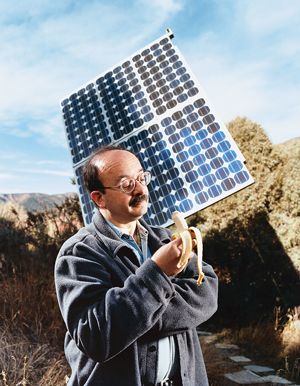
Amory Lovins, Fount of Disinformation

Amory Lovins continues to advance the notion that he is a physicist, even though he he has never earned a degree in physics. Lovins' Wikipedia hagiography states:

Lovins entered Harvard University. After two years there, he transferred to Magdalen College, Oxford, England, where he studied experimental physics. He became a Junior Research Fellow in Oxford’s Merton College, where he studied for two years and earned a master of arts (M.A.).

Rod Adams learned that Lovins MA from Oxford amounts to a complimentary degree, which he received in connection with his academic appointment as a Junior Research Fellow at Oxford. In effect, Lovins had been given quasi-graduate student status at Oxford, without earning a degree.

Lovins, who had some minor academic duties while he was studying at Oxford, was considered a Fellow of an Oxford college. It is an academic irregularity for even a Junior Research Fellow, or as they are called in Oxford, a Don, to not hold any degree, so Lovins, was awarded a complimentary MA. His MA is not an earned physics degree. An earned physics degree would be a MSc.

The claim that Lovins is a physicist then rests on his rather brief career as a physics undergraduate at Harvard, where he dropped out twice, and his career as an Oxford student, where he also studied some physics in addition to his environmental and energy economics studies. Lovins is no doubt a very bright fellow, but his area of "research" cannot be characterized as physics.

At any rated Lovins's fame rest not on his stature as a physicist, but on his work as an energy economist. Now Lovins has even fewer credentials as an economist than he does as a physicist. Clearly then Lovins's pronouncements should not be given an automatic pass without examination.

Lovins recently posted on the internet a 52 page long essay called "The Nuclear Illusion", which he and Imran Sheikh co-authored. They get to the point almost immediately with the following statement:

"In fact, nuclear power is continuing its decades-long collapse in the global marketplace because it’s grossly uncompetitive, unneeded, and obsolete—so hopelessly uneconomic that one needn’t debate whether it’s clean and safe; it weakens electric reliability and national security; and it worsens climate change compared with devoting the same money and time to more effective options."

This clearly then is a statement about the economics of nuclear power, and contains sweeping and highly questionable generalizations. Furthermore many of the statements are falsifiable on their face. For example the statement that "nuclear power . . . weakens electric reliability . . ." is demonstrably false. A cursory review of electrical reliability data in the United States will demonstrate that nuclear reactors are the most reliable source of electrical generation in the United States. The claim that "nuclear power . . . weakens . . . national security" is not supported by any hard data.

Lovins backs his claims about national security with the following claims.

Yet commercial nuclear power is the biggest driving force behind that proliferation, providing do-it-yourself bomb kits—nearly all the needed materials, skills, knowledge, and equipment—in innocent-looking civilian disguise, all concealed within a vast flow of civilian nuclear commerce. Acknowledging nuclear power’s market failure would unmask and hence penalize proliferators by making the needed ingredients harder to get, more conspicuous to try to get, and politically costlier to be caught trying to get, thus revealing the motive for wanting them as unambiguously military. This would make proliferation far more difficult, and easier to detect sooner by focusing scarce intelligence resources on needles, not haystacks.

First, the proliferation cat got out of the bag a long time ago. Israel and India acquired the nuclear technology, on which they based their nuclear bomb program in the 1950's, before civilian nuclear power reactors became an option. Plutonium producing graphite pile reactors are the tool of choice for nuclear proliferation. Graphite pile reactors are not used in civilian power plants. North Korea built several as part of its nuclear program and appears to have recently attempted to export the design to Syria. Lovins establishes no direction connection between the civilian nuclear power industry in the United States and nuclear proliferation, thus his claim linking the two is untested and probably untestable.

What of Lovins's other claims? Is nuclear power in a global market collapse? Lovins states:

"most if not all other countries with big nuclear programs but no effective citizen intervention, such as Canada, Britain, Germany, France, Japan, and the Soviet Union, also suffered substantial nuclear-cost escalation, and their nuclear construction forecasts collapsed in similar fashion.(18)"

Footnote 18 reads as follows: A.B. Lovins, “The origins of the nuclear power fiasco,” pp. 7–34 in J. Byrne and D. Rich, eds., The Politics of Energy Research and Development, Energy Policy Studies, Vol. 3 (Transaction Books, New Brunswick / Oxford), 1986, RMI Publ. #E86-29.

Thus the sole cited source of Lovins's "nuclear power, global market collapse" claim is something Lovins wrote over 20 years ago! What does this claim mean? When Lovins first made the global market collapse claim, a very large reactor building program was underway in France. That program, far from collapsing, was completed and today France receives almost 80% of its electricity from reactors. In 1986 Japan was in a significant reactor building program that continued. The Japanese built about the same number of reactors as the French did, and they currently have at least 8 more new reactors in the pipe line. After 1986 the Chinese completed 11 power reactors, and they have many more - perhaps as much as 60 GWs more - in the pipeline to be completed by 2020. The South Koreans completed 16 reactors after 1986, and plan to build 8 more. Between 1986 and the present, the Indians completed 15 power generating reactors, and they expect to complete reactors producing 20 GWs of power more by 2020. At the end of last year, the British government announced its intention to build new nuclear plants. Thus Lovins's 1986 prediction of a collapse of the nuclear power global market was mistaken, and his uncritical, self-referential repetition of the mistaken 1986 claim can only be characterized as bizarre.

Lovins buttressed his claims with numerous links to other web pages. I decided to test the references which Lovins used to support the statement: "Some advocates of hypothetical new types claim they would be far cheaper. There is no evidence for this." Lovins sited four internet sources to back up his claim, two were dead links. The third linked is to a web page called Noseweek. Noseweek appeared to be a South African Internet Tabloid whose content was behind a subscription wall. The brief public introduction to the hidden story stated that as of December 2005 the South African Energy company Eskom had not attracted investors to its Pebble Bed Reactor project. The fourth link to Nuclear Engineering International yielded the following report:

"Leaked internal documents from South African utility giant Eskom are said to reveal that a business-risk assessment found the planned pebble bed modular reactor (PBMR) to be uncompetitive in the South African market. The assessment, sponsored by Eskom and inadvertently sent to environmental group Earthlife Africa, apparently also warns of excessive costs if Eskom is unable to attract partners to the project."

Thus we have an unsubstantiated report of leaked documents, with a brief account of those documents contents as sole proof for Lovins's statements about the PBMR.

Needless to say, Lovins does not quote from his sources. On a lark, I Googled Eskom and Pebble Bed Reactor. Guess what popped up? A May article in the Mail & Guardian Online which stated:

"United States-based Westinghouse, a unit of Mitsubishi rival Toshiba, already holds a stake along with the Industrial Development Corporation and Eskom."

The article added:

"According to PBMR's 2007 annual report, contributions from foreign and local investors in the project totalled R4,2-billion since PBMR was established eight years ago.

An updated business case has been developed and potential future investors are expected to start their due diligence process within the next financial year," PBMR said in the annual report
."

The real news of the article was that:

"Japanese engineering and heavy machinery maker Mitsubishi Heavy Industries is reportedly considering a ¥10-billion (R746,5-million) investment in South Africa's Pebble Bed Modular Reactor (PBMR)."

Clearly then by May 2008 the South African PBMR has attracted investments and the interest of at least one more large investor. Lovins won't tell us that. Any information which tends to contradict Lovins's 20 year old pronouncement that the global nuclear power market is collapsing does not fit into Lovin's a priori world view, and therefore does not exist in Lovins mind.

Thus Lovins's anti-nuclear report points to missing links, shallow and hidden sources, and what clearly appears to be outdated information. To say that Lovins had "cherry picked" his information on the PBMRs would appear to be an unwarranted compliment to his research technique. Lovins's reports on nuclear power are written with the sole purpose of hiding the failure of his decades old predictions on nuclear power to prove true. In his effort to obscure the truth, Lovins has become a fount of disinformation.

Thursday, June 5, 2008

Bill Hannahan: So where is the fundamental limitation

Introductory Comment: Joe Romm has been barking for his Lovinsesque nuclear limitations Party line all over the Internet. He posted reruns of the Salon "Bomb" on Climate Progress and Gristmill. David Roberts gave a responding bark of delight. But Bill Hannahan is nobodies fool, and he added his own "Fisking" of Romm's arguments in response to Romm's post of on Gristmill.

Bill does first rate work, and his latest comments on Romm deserve a wider hearing. Hence with his permissions I am cross posting them:

So where is the fundamental limitation?
By Bill Hannahan

To say that it is impossible to build nuclear power plants in large numbers is like saying that it is impossible to send a human to the moon; it ignores the fact that it has already been demonstrated.
" Yet nuclear power's own myriad limitations will constrain its growth, especially in the near term. These include:

Prohibitively high, and escalating, capital costs ....

So what would be the cost of electricity from new nuclear plants today? Jim Harding, who was on the Keystone Center panel, was responsible for its economic analysis, and previously served as director of power planning and forecasting for Seattle City Light, emailed us in early May that his own "reasonable estimate for levelized cost range ... is 12-17 cents per kWh lifetime, and 1.7x times that number [20 to 29 cents per kWh] in first year of commercial operation."

At these rates a 1.5GW plant with a 0.9 capacity factor, would earn $3.4 billion in the first year, and $2 billion per year after that.

Operation and maintenance cost are about 2¢ per kWh,

http://www.eia.doe.gov/cneaf/electricity/epa/epat8p2.html ...

and should be less for next generation plants because they're greatly simplified, with fewer pumps, valves, and less piping. To be conservative lets assume that O&M cost doubles. The O&M cost would be $237million per year.

Even at the highest cost estimates the plant would pay for itself within 10 years, and then produce very cheap reliable electricity for another 50 years.

Show us a cost estimate for a 1.5 GW solar or wind array with reliable dispatchable power and a 0.90 capacity factor. Now show us a cost estimate for an array east of the Mississippi river with the same specifications. How many such arrays are in operation now? Where can we review their actual performance, construction cost, O&M cost, reliability, emissions, capacity factor, life expectancy and cost per kWh?

Show us a cost and reliability estimate of the required grid for moving the energy from where wind and solar sources are best to where most people live.

" Production bottlenecks in key components needed to build plants...

Twenty years ago the United States had 400 major suppliers for the nuclear industry. Today there are about 80. Only two companies in the whole world can make heavy forgings for pressure vessels, steam generators, and pressurizers. "

Before the first round of construction that were zero suppliers. There's no reason we cannot build another supply chain. Inherently safe plant designs do not require as much safety related equipment as older plants.

" Very long construction times "

We can dramatically reduce construction time and cost by mass producing floating nuclear power plants.

http://www.atomicinsights.com/aug96/Offshore.html

" Concerns about uranium supplies and importation issues "

This is a red herring; the uranium supply is effectively unlimited.

http://gristmill.grist.org/story/2008/5/2/75132/75324#com ...

" Unresolved problems with the availability and security of waste storage "

Nuclear waste is largely a political and educational problem. The most rational solution for nuclear waste is deep seabed burial, but almost anything will work if carefully implemented.

" Large-scale water use Amid shortages

"few realize that electricity generation accounts for nearly half of all water withdrawals in the nation." At the same time, "existing nuclear power stations used and consumed significantly more water per megawatt hour than electricity generation powered by fossil fuels," "

This is another red herring, and even mentioning it completely destroys the author's credibility. The author talks about water withdrawals, but fails to mention that almost all of that water is returned to the source, in sharp contrast to agricultural withdrawals, in which none of the water in returned. The average reader does not understand the difference between water withdrawal and water consumption. The author deliberately takes advantage of the readers limitation to mislead them. This is totally unethical.

http://gristmill.grist.org/story/2008/5/2/75132/75324/#32 ...

Floating nuclear power plants will use the ocean as a heat sink, and can produce huge volumes of fresh water. The authors vaunted solar thermal plants located in the desert will have a lower thermodynamic efficiency than nuclear plants and will require more fresh water per kWh than the nuclear plant. That water will have to be diverted from other uses, or made from sea water, using energy, and transported into the desert using energy.

The release of huge quantities of water vapor in the desert may result in increased cloud formation and reduced plant output. The author does not mention these very real water problems with his proposed solution.

" High electricity prices from new plants...

Nuclear power is therefore unlikely to play a dominant -- greater than 10 percent --
"

The author's conclusions are based on the assumption that there are other technologies that can produce reliable, predictable, controllable, baseload power at an affordable cost. So why aren't we tearing down coal fired power plants and replacing them with this new technology? Why are countries all over the world building more coal plants?

Denmark has been pushing wind extremely hard since 1979, yet they get most of their electricity from fossil fuel and have the most expensive electricity in the world. Residential electricity in Denmark cost 1.92 DKK/kWh in 2007, 40 cents / kWh. In the U.S. it was about 9 cents / kWh.

http://epp.eurostat.ec.europa.eu/cache/ITY_OFFPUB/KS-SF-0 ...

Wind power in the state of California, was down to 4% on peak for several days during the 2006 heat wave.

http://www.ecolo.org/documents/documents_in_english/Wind- ...

The entire U.S. wind output was down 20% below average during the heat wave while the demand was 20% above average. Nuclear power was 10% above average because outages are scheduled for spring and fall when demand is low.

http://www.eia.doe.gov/cneaf/electricity/epm/table1_1_a.h ...

We should increase R&D to $90 billion per year (only 2.25 cents/kWh) and push every technology as hard as possible. That would include building at least one full scale commercial size plant of every promising technology. Actual performance data would give companies and individuals confidence to make large scale investments rapidly in new and proven technology.

This would accelerate the introduction of practical solutions and is much more sensible than providing feed in tariffs to mass produce expensive immature impractical technology that raises cost enormously while remaining largely dependent on fossil fuel, as Denmark and Germany have proven.

This proposal maximizes the probability that we will develop better technology than fission, which makes it the most anti nuclear recommendation that is practical.
Reducing U.S. emissions is not important. Developing a low cost replacement for fossil fuel that the entire world can afford should be our goal. Wasting money on mass production of impractical expensive systems is counterproductive.

Research and development should not be considered a subsidy. It is an investment in the future, like medical research. Our R&D investment over the last 30 years was barely a token amount; which is a major factor contributing to our energy problem.

Wednesday, June 4, 2008

Acolytes

(Hat tips to the Sovietologist, who referred to Lovins acolytes last year, and to Red Craig who pointed me to an article by Ferdinand Banks, that elaborates the Lovins, Romm link.)

My last post on Joe Ramm raised for me the question about where Ramm is coming from. I had never looked at Romm's Wikipedia page untill this morning. When I did I found that"from 1991 to 1993, he was a researcher at the Rocky Mountain Institute. He co-authored the 1994 Rocky Mountain Institute Report, Greening the Building and the Bottom Line: Increasing Productivity Through Energy-Efficient Design." Romm and Lovins co-authored a Winter 1992-1993 Foreign Affair essay, ‘Fueling a competitive Economy’. s in which the two energy "experts" maintained,
"For example, the Swedish State Power Board found that doubling electric efficiency, switching generators to natural gas and biomass fuels and relying upon the cleanest power plants would support a 54 per cent increase in real GNP from l987 to 2010 – while phasing out all nuclear power. Additionally, the heat and power sector’s carbon dioxide output would fall by one-third, and the costs of electrical services by nearly $1 billion per year. Sweden is already among the world’s most energy-efficient countries, even though it is cold, cloudy and heavily industrialized. Other countries should be able to do better. "

Energy economist Ferdinand E. Banks stated that the statement "and similar contributions are misleading bunkum." Ah well isn't misleading bunkum par for the course for a pseudo-physicist who claims to have repealed Jevons Paradox, and for his follower, who stops thinking whenever his master orders it?

Romm appears to be a Amory Lovins acolyte who follows the masters line no matter how crazy it is..

Romm's frequent cross posting on the Gristmill Blog, is also suggestive. Last year NEI Nuclear Notes made some interesting observations concerning Roberts. The comment first quotes Roberts: "The question is not whether nuclear power is "acceptable" or "good" by some subjective standard -- economic, moral, or otherwise. It's not even whether investments in nuclear power could lead to emission reductions. The question is: what is the maximum amount of climate change mitigation we can get for a given dollar of investment? Nuclear fails that test."

Then NEI Nuclear Notes asks, "where have we heard that before? Oh yeah, Amory Lovins. Roberts quotes him in the post but that last sentence from Roberts above looks like he’s pawning Lovins’ words as his own."

Googling "Roberts and Lovins" brings up multiple instances in which Roberts has serves as a Lovins literary acolyte. Roberts like Romm then should be considered as Amory Lovins' intellectual stooge.

I recently noted that a former California Energy Commissioner John Geesman, Roberts and Romm almost symaltaniously launched very similar attacks on nuclear power. All three focused on cost issues. I had previously done a little research on Karl Rove's use of symaltaniously attacks by Bush administration media stooges, against Al Gore in 2004. The type off to the existence of a coordinated was that numerous media personalities were saying the same thing at the same time. The likelihood that as many as a dozen people would independently have the same idea was low. None of them acknowledged a dependency one someone else for the idea through a quotation, and their language was not consistent with a common literary source. The most likely explanation was that someone had contacted each of them and planted the idea in each head. My suspicion was that the coordinator was Karl Rove.

We must ask then if we are looking at a similar situation, a propaganda campaign conducted by Lovins acolytes, and coordinated by Lovins.

Update: The other shore dropped, the master just posted a 52 page Anti-Nuclear scree.

Joe Romm Bombs on Salon

I once thought Joe Romm to be a man of some intelligence and intellectual depth. His repeatedly took on global warming skeptics, and demonstrated the weakness of their arguments. I was aware that Romm believed that nuclear power could only play a limited role in our energy future, but I believed that with new information, Romm might become an advocate for a more progressive approach for nuclear power. I was quite wrong. I presented to Romm arguments that the LFTR could solve the problems of nuclear power, and he rejected them out of hand, on the grounds that that I was writing about technology that had not been developed yet.

My point with Romm was that the LFTR was promising technology that should be explored as a sustainable energy source that could serve as the basis for the human energy economy into the a very long future. Romm in effect repeatedly dismissed the argument as being not worthy of his consideration. Kirk Sorensen, attempted to run similar arguments past Romm. Both Kirk and I eventually got frustrated with Romm. 

In an article on nuclear power published this week on Salon, Romm sets out his case against nuclear power. Romm is not quite an anti-nuk, but he is a kindred spirit. According to Romm, nuclear power is the "Ishtar" of power generation.

Romm's case against nuclear is fairly simple, "nuclear plants have become so expensive that cost overwhelms the other problems." In contrast to nuclear power, Romm argues that Renewables are far cheaper. Romm tells his readers, " Jigar Shah, chief strategy officer of SunEdison, explained to me that he could guarantee delivery to Florida of more kilowatt-hours of power with solar photovoltaics -- including energy storage so the power was not intermittent -- for less money than the nuke plants cost."

Romm adds, "Many other forms of carbon-free power are already cheaper than nuclear today, including wind power, concentrated solar thermal power and, of course, the cheapest of all, energy efficiency. Over the past three decades, California efficiency programs have cut total electricity demand by about 40,000 gigawatt hours for an average 2 to 3 cents per kilowatt-hour."

Many Salon readers of Romm's nuclear article responded to it in the comment section. In fact these comments are an indicator of the extent to which public opinion has shifted against nuclear nay-sayers like Romm. Jeffrey Radice summed up the general concensus of many Salon readers:

"Romm had his thesis a priori, and pigeonholes the facts to support his opinion."

Radice adds, "It's heartening to see that salon readers are not so gullible to swallow this anti-nuke diatribe without critique."

Brian from Seattle wrote, "this article really just chooses one dimension of policy analysis to beat up on Nuclear power again, which makes little sense. You need a full spectrum of criteria to analyze, then create a final conclusion taking into account all criteria for a particular energy policy. This certainly does not do it."

Bspeakmon noted, "Among the many other problems, Romm seems to think that the only possible nuclear reactor design is a submarine reactor scaled up. Ridiculous.

There are many new designs, . . ."

Willard Roker wrote, "It is time to get pass the knee jerk reaction we have to nuclear power. It is a vast, clean energy source that can produce all the electricity needed by the US and do it in the foreseeable future."

Roker added, "You do more environmental harm just getting oil and coal out of the ground than a nuclear power plant will ever do and when you figure in process and burning nuclear power is many time cleaner. It is time to embrace the future not wallow in the past."

Skeptical Scientist commented sarcastically, "Mr. Romm argues convincingly that it is impossible to generate affordable nuclear power. This is, of course, much like "proving" bumlebees can't fly (er, they do.) Most electricity in France is from nuclear power. Perhaps the "can't do" Americans need to get a helping hand from the "can do" French."

Ssgman noted, "According to my (conservative) calculations, the 2,200 megawatt plant costing 14 billion will generate power at 2.42 cents per kw hour, if it runs for 30 years. If it runs for 50 then it will be almost half of that. A solar installation will cost about $5,000 per kilowatt and that it only runs during daylight so it really costs about 10k. So Romm's math is really wrong."

Many of the Salon commenters seconded Ssgman in questioning Romm's calculations.

Jeffrey Radice complains, "The fact of the matter is that all alternate energy technologies have hidden costs. Romm either purposefully ignores those of solar and wind, or he has seriously underthought these issues."

I might add that Romm has been confronted in the past about his once over lightly approach to renewables' costs, by Kirk Sorensen, by me and by many others.

Radice notes what he describes as a disingenuous statement by Romm:
"In fact, from 2000 through October 2007, nuclear power plant construction costs -- mainly materials, labor and engineering -- have gone up 185 percent!"

Radice asks, "How about providing comparable numbers for the costs of wind and solar construction?" Radice retorts, and then adds, "Is steel not a primary component in wind turbines? How much has the material cost of steel gone up since 2000? I'd be willing to bet well in excess of 185% The same could be said for polysilicon. I would not at all be surprised to find that construction costs for wind and solar per watt have escalated in excess of 185% since 2000. Yes there have been dramatic technological advances improving the efficiency of both power sources, but at what cost?"

Finally Radice castigates Romm, "Casting stones at viable nuclear power while downplaying the inefficiencies of competing wind and solar does nobody a favor."

In addition to the Salon comments, bloggers are beginning to "Fisk" Romm's latest "Bomb."

Clearly then Joe Romm received thrashing at the hands of Salon readers. Romm needs to pay attention to what his critics say. Romm's approach to energy issues is based on confirming his a priori theories, without a careful review of what the data really shows. Romm has been confronted about his intellectual short comings in the past, so his failure to change his views in the face of telling criticism is either a manifestation of arrogance or of intellectual incompetence.  Romm needs to clean up his act, or he will be left behind, just as global warming skeptics are being.

The Salon readers' comments on Romm revealed that there is a well informed group of people who access the internet, and who know far more about energy issues than most policy makers. People like them should undoubtedly be given a voice in future national energy debates and discussions.

Tuesday, June 3, 2008

Who is Afraid of Nuclear Power

This Australian Television program reports on the Australian debate on Nuclear Power. (see Part 1, and Part 2)

Monday, June 2, 2008

Ian Clifford on ZENN Motors and EEStor

Introduction: In addition to Nuclear Power, Nuclear Green focuses on the electrification of transportation. Tyler Hamilton has until now had a lock on the ZENN Motors, EEStor story. But this account recently appeared on GM-Volt. I have seen a lot of red flags about that story, and I put the it into the to be believed when actually seen category. Ian Clifford, ZENN Motors CEO now comes forward with an interview with GE-Volt that offers new insights. Clifford claims that ZENN is working closely with EEStor, however, he admits that ZENN has yet to receive a power unit of EEStor, so the red flags are still up as far as I am concerned.  The extensive comment section following the Clifford interview also reflects a healthy skepticism.

From: GM-Volt
EXCLUSIVE: CEO of ZENN Motor Company on EEStor, EEStor Storage Units, cityZENN, and ZENNergy Drive Systems

ZENN Motor Company is a small Toronto based company currently building low speed lead-acid neighborhood electric vehicles. They have partnered with the secretive Texas company EEStor that supposedly has developed a breakthrough energy storage device. I had the chance for an interview with the CEO of ZENN, Ian Clifford, which follows.

What is the cityZENN?
We announced it at the end of March. We announced it in relation to the commercialization of EEstor’s energy storage technology. EEstor had made an announcement earlier in the year on their agreement with Lockheed Martin. We felt it was time then from a product development perspective to lay out our plans for a highway capable vehicle based on EEStors’ energy storage technology.

So you will use EEStors ultracaps as the sole energy source of the vehicle?
Thats correct. EEstor has these breakthrough energy and power densities, and so I think to call it an ultracapacitor is some respect is a disservice to the technology becasue it is such a breakthrough from existing ultracapacitor technologies. It is certainly a solid state energy storage device so it has the ability to store tremendous amounts of energy and power in a very compact footprint. The way that its designed allows for extremely rapid electronic charging times. If you have a charge situation where you have an EEStor device connected to another EEstor device in a charging station or even in a home, the ability to recharge in minutes as opposed to hours is entirely possible. cityZENN will have several several charging algorithms built into the car as its launched. You will be able to plug it into a regular 110 outlet and it will probably take about 4 hours to recharge or you could plug it into a 220 outlet and it will probably take about 2 hours to recharge.

The performance characteristics are such that we think that this vehicle specifically will meet the driving needs of probably 90% of people in North America, and even more people outside of North America in terms of driving habits. So we’re talking about a car with a 250 mile electric range between charges. You’ve got a highway capable vehicle so 80 mph is our target top speed with full gradability. So you’ve got a car that is absolutely usable in virtually any driving situation. Its not susceptible to cold or heat so you don’t have the technological limitation of chemical batteries. EEStors been testing to millions of cycles in their early cell prototypes so we basically have an energy storage device that is a permanent energy source that is distinct from something that has to be replaced every number of years.

So you’re saying millions of cycles as opposed to the typical 5000 cycles that is a goal for lithium-ion batteries. These devices could go millions of cycles without a decay in energy storage capability?

That’s correct. And that’s typical for capacitors. As a solid-state device they certainly will last and last and last and they’re known for that. So tha’ts one of the similarities that EEStor has definitely.

How did you form the relationship with EEStor, did they contact you, did you contact them. Most automakers are looking a lithium-ion, so how did that come about?

I founded ZENN in 2001 and we started creating a certain amount of profile for the company over 2001 and 2002. To such an extent that EEStor actually found us. I got a call from Dick Weir late in 2002 and he was at the point where he and his partner Carl Nelson were getting ready to commercialize the technology that they had developed 10 years previously. They were looking to find a industrial partner who would be entrusted in purchasing the technology right or rights to purchase their technology fro certain exclusive markets. That’s where the discussion started and we did extensive due-diligence on what they were doing back then. We were completely blown away by what we saw and what we saw the potential for their technology to be.

You felt that that was a superior route than going down the lithium-ion or nickel-metal hydride route?

For a number of different reasons. We were certainly compelled by what was happening in chemical battery technology and the advances that were happening, but they were quite incremental. So no significant breakthroughs and this is going back four or five years. We’ve certainly since seen continued incremental improvements in lithium-ion technology but to date we’ve yet to see a commercialized lithium-ion solution at even 20 kwh of storage. We’re still kind of waiting for that.

There were also other significant differentiators that compelled me to the EEStor technology, and a lot of the were the barrier things. The issue of being able to recharge in the same amount of time that it takes to fill a tank of gas, that was a big consumer barrier. How could you expect mass adoption if people were going to be inconvenienced by charging an electric car. So that was a very big motivator for me.

The volume and weight of the technology. We’re looking at a technology thats 1/4 to 1/3 the size, mass, and volume of a lithium-ion technology for the same energy storage. So suddenly you have an energy storage device that can store enough energy to give a useful range of an electric vehicle without having concerns about being able to crash-test. That always is a very very significant concern.

Are there risks of an electric short with the EEStor system?
That was the other thing I was going to get to, safety. The ability of the architecture that EEStor has developed allows for basically instant discharge to ground. So they’ve got becasue it is solid state the ability to dump that energy virtually instantly. If you look at any chemical battery what do you do with that energy thats caught in a medium that cannot discharge instantly? So that was an important consideration for us, its ability to act as a huge circuit breaker on itself.
I think perhaps the biggest thing and perhaps one of the things thats overlooked the most in the debate thats going on now in the search for energy storage is raw material availability. Its not until very recently that people have started to debate the availability of lithium, the global reserves of lithium. And the implications of potentially millions and millions of electric cars using pretty massive energy storage devices onboard and what that does to the existing global reserves of lithium which are limited. And that word limited I think is an understatement.
So as we we’re looking at technologies we were very very conscious of the scalability of the technology and what we saw with EEStor that was quite profound was their utilization of the raw material barite which has massive global reserves, over 2 billion tons of reserves. Enough if you put it in the context of automobiles, enough to build 10 billion automobiles. Hopefully we’ll never get there. The other implications for EEStor was that they play in a whole bunch of different markets so we saw in their design the ability to meet global energy demand. That was a huge consideration for us.

Do you guys have any working prototype vehicles?
No. Our expectation from EEStor and that’s always been our expectation is that they will deliver a commercial product to us. They will deliver and what they’ve told us is by the end of this calendar year was delivery of an early production commercial unit. I get asked that question all the time and my answer has remained consistent in that I’m not interested in a hand-built prototype from EEStor I’m interested in a commercial grade product that we can order 1 or 2 or 10 million of and not something that they’ve hand built. Thats not relevant to us. The only thing thats relevant is a mass commercialized product. Thats ultimately where the end game is for us.

So you see them doing all of the assembly work on their end and providing you with the packs for production?

Exactly. We have a great relationship with EEStor. We’re very very close to them, our engineering teams are integrated to the extent where we are specking final production product with them. We’ve worked through all the power electronic issues. Were very very comfortable with our costing. The discussions from our perspective are highly advanced. And what we see in terms of their build out, we are certainly one of the few companies and few people who have actually been behind the doors of what they are doing and its so compelling and truly thrilling. Just in terms of the impact that it has on global energy use and foreign fuel dependency and all the other issues that are related to petroleum. I see it as really a turning point.

Looking at the GM example, they get delivery of cells and they test them in their lab. They want to see things on the cell level. Have you seen examples of the EEStor cells behaving as they say they do?

Well the original patent is all based on the lab testing that EEStor did a decade previously. So absolutely as part of our due diligence with EEStor initially all that data was shared with us. So we have a very strong level of confidence that the science works but of course like anyone else the proof is in the final product and so becasue of that we’ve structured our agreement with EEStor based on milestones. So every payment milestone that we have on our technology agreement is based on third party verified data of EEStor achieving the specific milestone as they work towards commercialization. So we’ve been cautious as well. But certainly the build out that were seeing and the level of advancement that they’ve made in the last eighteen months gives us a great level of confidence.

So even though you don’t have a cell in hand you are seeing third party data along the way showing that they are achieving the milestones?
Exactly.

When do you expect to bring the vehicle to market?

We’ve stated that if EEStor stays on schedule to deliver early commercial units to us by the end of 2008 that we will have a fully certified highway vehicle powered by EEStor at the end of 09. We did state publicly that the initial launch for that vehicle will probably most likely be Europe and Asia as distinct from North America. That has mainly to do with the time it takes to certify a vehicle in the U.S. We are not going to engineer a car from the ground up. Were going to partner with a key global OEM on the chassis of the vehicle. So this will most likely be a vehicle that is already certified to certain global standards and then we will work together to integrate what we calla ZENNergy Drive System into the vehicle that would be powered by EEStor.
So have you shown any concept of what the exterior of the car will look like yet?
We haven’t shared that yet. We are still finalizing negotiations, very close to finishing negotiations related to what Ill call the initial cityZENN vehicle. So you can expect some more information on that in the near future from us.

Can you say how many people it will seat?

Yes were anticipating that it will be a five-passenger sedan. Our exclusivity with EEStor’s technology goes up to a 3100 pound curb-weight vehicle which is basically a Toyota Camry or Honda Accord-sized vehicle and smaller. Thats our exclusivity, our non-exclusivity goes to any size passenger vehicle as well. So I would anticipate that it would be a car thats pretty close to our maximum exclusive weight and it would have operating characteristics that you would expect out of a vehicle that size at a retail price that would certainly be competitive with an ICE version. Thats been our target all along.

Is your target less than $30,000?

Yes, exactly. You’ve got to remember that the GM Volt has an electric range of about 40 miles and we would be looking at a 250 mile electric range, without a range extender.

Is the EEStor technology less expensive than lithium-ion cells?

Dramatically. I cant go into specifics on that but suffice it to say that we feel quite comfortable in offering a vehicle with the characteristics I have defined with a price point of $30,000 or less. It is orders of magnitude less expensive than lithium-ion.

Lithium ion is costing $800-$1000 per kwh now and the USABCs goal is $200 per kwh and I guess you’re talking about values less than that?

I wont comment on the $200 per kwh becasue I don’t think thats realistic for any technology to be honest with you. But for lithium-ion I can only see the price going up. Just based on raw materials cost alone. Were going to get into a situation very quickly, the global reserves are such that were going to go into a serious price squeeze going forward if we get into serious large-format lithium ion battery production.

The people at A123 have advised me that there should be enough lithium out there to build more than 2 billion cars, you seem to have a different perspective than that.

Yes, very much so. The studies that we’ve seen and the understanding that we have that to meet capacity even with small scale adoption of plug-in hybrids the lithium reserves would be severely challenged to meet that demand. The lithium reserves are about 17 to 25 million tons. Thats not a lot of raw material. The price has already gone up in the last 8 years. Barite on the other hand which is the core ingredient of what EEStor is doing is incredibly plentiful and available throughout the world. Massive reserves in North America and very easy to get to and extract. This is part of the debate that has not really been articulated yet. Right now without EEStor yet being really commercialized it hasn’t really come to the forefront of the debate.

Why do you think the big companies like GM haven’t embraced this technology?

I think they are learning about it to different degrees, and I know that different companies have taken a look at the technology at different stages. I think ultimately and you see this with lithium technology, they say show us the product. They wont make a decision until they’ve got a commercial battery. And right now there isn’t a lithium ion battery out there at the scale thats required for a commercial product yet. Its very difficult to do. Its a huge challenge.

Is you long-range hope to become a major global player in the automotive market?
We see ourselves more as an enabler. We did announce the cityZENN as a ZENN branded product that we would distribute through large distribution networks. Once again partnering with other organizations. But ultimately we believe our most significant opportunity is the ZENNergy drive and that is an integrated drive system utilizing EEStor as the energy source that we would then joint-venture with any OEM around the world an then create a “powered by ZENN” drive for vehicles that fit within our market in exclusivity. Its kind of like the “Intel inside” model. We intend ZENN and ZENNergy to be synonymous with electric drive and thats the biggest role that we can play globally. And then every OEM is not our competitor, every OEM is our partner.

Is the city ZENN then more of a demonstration so other OEMs will become interested in purchasing the ZENNergy drivetrain system?

Exactly. We don’t need to re-invent the automotive industry, I think we need to re-define it. We don’t need to become a global OEM in order to demonstrate the viability of electric. I think judging from the response we get and certainly the response that you get on your site there is a huge pent up hunger for electrification. It’s remarkable. I think every major and minor automaker around the world appreciates and understands that. I think that ultimately the consumer and technology will drive us to that inevitability which is extremely exciting.

Are you guys planning to offer conversions when you have your ZENNergy system up and running?

We have worldwide exclusive rights to EEStor technology for the conversion of any 4-wheel vehicle on the planet. So absolutely the conversion market is something that is extremely compelling to us. Our plan is to start looking at some of the largest install bases for single platform use in fleet applications. So in NY you think of yellow cabs and black limos, in London taxi cabs, US postal service, you think of very very large install bases. So leveraging our ZENNergy drive we would create kits that would be specific to certain platforms. I think that will be an incredibly exciting market.

You would then be able to offer that to any 4-wheel vehicle?

Yes, any 4-wheel vehicle. Thats our exclusivity. To me thats the access to the 750 to 900 million cars that are on the planet. If you think about it we’ve got this huge investment in raw materials in every vehicle on the road. Depending on who you ask theres something between 20 and 40,000 gallons of water going into every car thats on the road. You think if all of the raw materials, and process materials, and energy that goes into creating this chassis and really the thing that fails in an internal combustion vehicle is the internal combustion system. You take a 5 year old vehicle that has whatever mileage and you create a replacement ZENNergy drive system for that platform, you certainly have another 10 years at least on the chassis.

This all sounds very exciting, but lets face it, it all depends on EEStor actually delivering a product. What is your confidence level that you are going to have a commercial grade EEStor product by the end of 2008?

Were expecting it by the end of the year and I cant state by what date specifically. Our level of confidence is extremely high based on what we are exposed to and certainly the involvement of others in this technology. The involvement of Kleiner Perkins is significant, the involvement of Lockheed Martin is significant. So we have a very very high level of confidence. To the extent that last year we became and equity investor in EEStor as well. So we put our money where our mouth is and invested in the common stock of EEStor as well, so no only do we have a technology agreement with them we also have participation in the other markets that they are developing product for. On the other hand, its not proven until its delivered. Ultimately the proof is in the commercial product. We are obviously making plans to develop solutions based on EEStor so that continues to show our level of confidence in our path.

How many employees does EEStor have?
Thats not publicly disclosed.

Have you guys spoken with GM at all?

Yes, we have. I wont get into any details and to what level we are at, but interestingly a Volt with a ZENNergy drive is a kind of a sexy product. You never know. It would certainly be something we’d love to explore. As I said earlier were a little tiny company and it takes more and more proof of the technology to get the attention of the bigger companies. We’re working at it

So you will tell the world when you get the product this year?

Oh you will know. Theres no question about it. For one thing were a public company and these are material advances in the company and they trigger payments. We intent to let the entire world know of the developments and the final commercializations.


Comments on the Clifford Interview:

Raphael
Anatoly Moskalev wrote on January 20th, 2007 at 2:05 pm
About EEStore supercapacitor hype :
1. The company made claims about dielectric powder parameters - that is it. Claims themselves are likely correct. So they have powder with:
Eps = 18500, Eth = 3 * 10 ^ 6 V / sm, Density = ~ 6 g / sm^3 ( Eth - practical electric field intensity threshold )
For 12 um thickness of dielectric we get Uth = ~3500 V - top practical voltage. From a capacitor formula you could get
C = ~0.2 F / kg resulting to energy density ~1.15 MJ / kg = ~320 Wh / kg
For comparison Tesla Motors battery pack has 5 2 kWh / 450 kg = ~110 Wh / kg
Capacitors formulas from school text books appears well known so after powder parameters verified EEStore CHEMISTS feel safe to make bold claims.
—-
2. But good physicist like me knows very well that capacitors physics under extreme conditions is not textbook straightforward. The dielectric constant involved will stay at indicated value until approximately 30000 V / sm electric field strength. This value is pretty high so measurements unlikely exceed this so they give high Eps value OK.
But to get claimed energy density you need approximately 100 times higher field strength. Getting such field strenght is extremely unlikely in the Eps measurements. But the reality is that exactly in this field strenght region electrical induction gets saturation because it reaches the interatomic field strength. This is well know effect to physicysts but not very widely known phenomenon to general public. Resulted effect on the energy could be described as if dielectric constant gets reduced in the formula. My estimations demonstrates that actual energy density would be 25 - 50 times less than a claim.
Resulted EEStore capacitor would approximately match currently available ultracapacitors by energy density per unit of mass making ~5 times better energy density per unit of volume. As such it would be marginal improvement over existing ultracapacitors technology. It surely would be a order of magnitude improvement for ceramic capacitors so it would have some use. But it would be nothing as bold as EEStore claims.
In 1 - 2 years from now we will see what would be the outcome of EEStore activity. Judgement day for EEStore would come when somebody would build a capacitor and try to store expected energy into it. It would be discovered that above
~100 V voltage would grow with charge much faster than expected and finally instead of ~15 kWh it would be ~0.3 kWh at the highest possible voltage. But powder alone would match all the promises. Who knows - they might even think it is a big discovery of new phenomenon. So they would explain the failure by claiming they run into truly unpredictable effect unknown to science. Irony is that 1947 year physics knows it and today it is forgotten.

nasaman
Returning to the topic, I’ve avoided commenting on EEstor because I’ve been watching work at the Georgia Tech Research Institute of a very similar nature —employing nanotechnology to maximize the capacitance & voltage breakdown of barium titanate. When I last checked, that work had resulted in improving the energy density by less than a factor of 4 — which I believe represents the current state-of-the-art for ultra capacitors.
By contrast, EEstor’s patent says they can increase the energy density of barium titanate capacitors by 1,000:1! The problem with this is that the dielectric strength of barium titanate in its purest form is at best a few hundred volts (say 350V) —not 3,500V as they claim— so the resulting capacitance is reduced by the square of the ratio…..
Therefore the capacitance is 350V/3500V^2 = (1/10)^2 = 1/100th of that claimed by EEstor, so their 52kWh claim becomes only 0.52kWh!

nasaman
142 REFER TO MY POSTS 125 & 127 BEFORE READING THIS:
Those 2 posts were hung up for moderation; since then I’ve talked in some detail with a lead investigator on a research program using BaTiO3 in nanoparticle form VERY similar to the work EEstor claims to be doing —in fact, published just a month after EEstor published its first major claims last year. He said they had been overwhelmed with questions from the press & others about EEstor as a result. I promised not to disclose any opinions or facts revealed to me from our conversation this afternoon. So the following comments are simply MY OWN conclusions based on my own study of the EEstor patent(s) as a physicist and the contemporary work by extremely-competent researchers at this major university…..
1) As many here have expressed, it would be GREAT if if it were true!
2) It defies fundamental physical principals for BOTH the dielectric breakdown to reach 3,500 volts AND the permittivity to remain high
3) The EEstor claim that their BaTiO3 “pore spacing” is reduced or eliminated at low temperatures (~150 C) is not credible
4) Since the energy density (E) of any capacitor is….
E = 1/2 (CV)^2, where C = Farads & V = Volts, a reduction in break-down voltage from 3500V to 350V (much more likely) results in a reduction in E of 100:1, which is credible, but rebutts EEstor’s claims
5) BaTiO3 nanocomposites produced by virtually ANY means are extremely brittle, therefore subject to catastrophic failures due to microcracking; hence the enormous number of plates (substrates) required for capacitors as large as even 1 kWh would be highly prone to shorts (all sections are in parallel, so 1 short kills them all)
6) MY OPINION ONLY: There’s NO con like that when the promoters, scientists or not, are themselves conned —cold fusion is perhaps the most notorious example that comes to mind
Therefore, we can dismiss EEstor and ZENN’s claims out of hand!

Sunday, June 1, 2008

Rod Adams comments and I respond on nuclear waste

There are no dumb nuclear bloggers, and in fact I have a very high respect for the brain power of my peers. So when one of them comments on one of my posts, I look at the comment carefully. Rod Adams looked over my "Keys"which I had cross posted on "Energy from Thorium". Rod liked most of what I had said, but he had some disagreements with my comments on nuclear waste. Rod would have to disagree with me, because it is my view that Rod's favorite reactor, the Pebble Bed Reactor, leaves a mess behind it, after it burns nuclear fuel. At reason for the mess is simple, the Uranium-plutonium fuel cycle is wasteful in the use of nuclear fuel and potential nuclear fuel in both the LWR and the PBR. The Thorium-Uranium fuel cycle used in the LFTR, by contrast makes highly efficient use of nuclear fuel.

Adams stated:

"I do not think that anything that we do will "solve the problem of nuclear waste" since it is not really a problem in the first place.

There are plenty of people in the world with an interest in making it an unsolvable problem; those people will never be satisfied no matter how tightly we wind up the technical details.

My solution is to accept the fact that there is opposition and to try to help the rest of the people understand that the opposition is a body of people with financial interests in slowing nuclear power. That way, the opposition does not disappear, but they become far less effective in changing the way that we need to do business
."

My response:
One major advantages of having an up to 98% burn up rate plus FP recycling is that very little of site construction has to be devoted to post reactor by product storage. The facilities to handle LWR post reactor fuel, are not inconsiderable part of current reactor construction expenses. The fluoride salts FP extraction technology researched and developed at ORNL during the 1950's to 1970's demonstrate that low cost extraction of FPs from nuclear fuel is possible. By separating FPs we change them from "waste" into by products, which have real and/or potential uses in the economy.

I am in complete agreement with the very idea that there is no such a thing as "nuclear waste" in the conventional meaning of the term. Where I differ with Rod is in our evaluation of a once through fuel cycle, which I regard as very inefficient and "wasteful" because it fails to extract more than a small fraction of the potential energy from nuclear fuel. I do see a waste of fuel potential by the once through Uranium fuel cycle.

I discussed the fundamental problem of the uranium fuel cycle in a March post on Nuclear Green. My discussion of the relative merits of the uranium fuel and thorium cycles, rests on the discussion of those cycles in WASH-1097 which makes the issues wonderfully clear.

"The relevant characteristics of the important fissile and fertile isotopes in thermal and fast-spectrum reactors are summarized as follows:

(1) Thermal absorption in U-233 produces more neutrons per neutron absorbed** than does
corresponding absorption in either Pu-239 or U-235.
(2) The neutron production for U-233 is relatively insensitive to change in temperature, but for U-235 and Pu-239 eta decreases as the temperature increases. Thus, the advantage of U-233 over U-235 and Pu-239 is more pronounced in a hard (higher energy) thermal spectrum than in a soft (lower energy) thermal spectrum.
(3) From a nuclear standpoint, the use of U-233 in a thermal reactor makes it possible to achieve
higher fuel conversion ratios and longer fuel burnups than is practical with either U-235 or Pu-239 (Section 2.2).
(4) The higher conversion ratios which can be obtained in thermal-spectrum reactors when using U-233 instead of Pu-239 can result in a significantly better utilization of natural uranium fuel resources with thorium-fueled reactors than with the low-enrichment, light-water cooled uranium-fueled reactors (Section 2.3).
(5) A higher breeding ratio can be obtained with Pu-239 than with U-233 in a very high-energy, fast-neutron spectrum reactor. On the other hand, in a degraded (10 to 100 keV) fast spectrum, U-233 would probably be as good as, or better than, Pu-239. Also, the variation of U-233 and Pu-239 cross sections with energy are such that improved reactivity coefficients would be obtained with the use of U-233 in a large sodium-cooled FBR. This leads to improved nuclear safety characteristics.
(6) The energy dependence of the fast-fission cross sections of Th-232 and U-238 is such that the use of Th-232 would produce an improved reactivity coefficient in a liquid-metal-cooled FBR. The fast fission cross-section of Th-232 is much lower than that of U-238 so that use of the latter leads to much larger conversion ratios in fast-spectrum reactors
."

The inference is clear, even in fast neutron spectrum reactors, the Thorium fuel cycle is more efficient and thus less wasteful than the Uranium fuel cycle. My disagreement with Rod is not about these facts, but about their implications for reactor and especially PBR construction costs. If i am right, the prize for lowest overall reactor construction should be given to the reactor that uses fuel most efficiently, all other things being equal. There is little doubt that if the price of fuel reprocessing is factored into the price of reactor construction the LFTR would be lss expensive than the PBR.   If you do not pay the price of reprocessing, cost are related to the cost of storing and handling of unprocessed post reactor fuel.  

My other disagreement with Rod has to do with the best approach to dealing with opposition to nuclear power.  I believe that the problems of post reactor nuclear fuel, and the problems of reactor safety are real issues that the nuclear community needs to solve.  The best answer to opponents questions about "nuclear safety," and "nuclear waste," is not simply a public education, being able to say, "our reactors are safe and do no produce nuclear waste," is really what, in my view, is required to answer nuclear critics.  

I must add that I have very high regard for Rod's intelligence, integrity and abilities. Rod isan amazingly talented man, and I am very happy that we have him in our camp.

Followers

Blog Archive

Some neat videos

Nuclear Advocacy Webring
Ring Owner: Nuclear is Our Future Site: Nuclear is Our Future
Free Site Ring from Bravenet Free Site Ring from Bravenet Free Site Ring from Bravenet Free Site Ring from Bravenet Free Site Ring from Bravenet
Get Your Free Web Ring
by Bravenet.com
Dr. Joe Bonometti speaking on thorium/LFTR technology at Georgia Tech David LeBlanc on LFTR/MSR technology Robert Hargraves on AIM High