Showing posts with label Anthropogenic Global Warming. Show all posts

Thursday, November 3, 2011

Can Anthropogenic Global Warming be non-Catastrophic?

The denial of something Catastrophic Anthropogenic Global Warming is the latest right-wing front in its attack on climate science. Right winger science deniers have set up a fall back strategy:
Position 1: There is no evidence that Global Warming is happening
Position 2: Global Warming is happening but has natural rather than human causes
Position 3: Global Warming is happening and has human causes, but will not have catastrophic consequences
it should be noted that positions 1 is inconsistent with positions 2 and 3, and position 2 is also inconsistewnt with position 3. But AGW skeptics often argue more than one of these positions at the same time, thus argue what amounts to incoherent arguments.

The skeptical camp has engaged in an all out attack on Michael Mann, those findings lead to the so called Hockey Stick Graf. The hockey stick shows that something dramatic is happening in global climate, something that cannot be explained without recourse to the AGW hypothesis. One reason why AGW skeptics are so upset by Richard Muller's Berkeley Earth Surface Temperature project findings is that the data verified the Michael Mann hockey stick. Of course independently verifying Michael Mann's hockey stick has been something of an industry in Climate Science for some time.

Thus not only does the BEST data show that global temperature is increasing, but it establishes that the rate of increase has recently increased. The increase is global temperature thus becomes a problem to explain. The non-Anthropogenic Global Warming model must explain why the global temperature is rising, in light of powerful processes forcing global temperature in the direction of cooling. The first force for cooling is the earth orbital cycles (Milankovitch cycles), which have been trending towards colling for some time, and are expected to continue the cooling trend for the next 23,000 years. The Milankovitch cycles are widely believed by the scientific community to account for the global glaciation cycles.

In fact there appears to be a divergence between global temperature and the the denial of something Catastrophic Anthropogenic Global Warming is the latest right-wing front in its attack on climate science. Right winger science deniers have set up a fall back strategy:
Position 1: There is no evidence that Global Warming is happening
Position 2: Global Warming is happening but has natural rather than human causes
Position 3: Global Warming is happening and has human causes, but will not have catastrophic consequences
it should be noted that positions 1 is inconsistent with positions 2 and 3, and position 2 is also inconsistewnt with position 3. But AGW skeptics often argue more than one of these positions at the same time, thus argue what amounts to incoherent arguments.

The skeptical camp has engaged in an all out attack on Michael Mann, those findings lead to the so called Hockey Stick Graf. The hockey stick shows that something dramatic is happening in global climate, something that cannot be explained without recourse to the AGW hypothesis. One reason why AGW skeptics are so upset by Richard Muller's the Berkeley Earth Surface Temperature project findings is that the data verified the Michael Mann hockey stick. Of course independently verifying Michael Mann's hockey stick has been something of an industry in Climate Science for some time.

Thus not only does the BEST data show that global temperature is increasing, but it establishes that the rate of increase has recently increased. The increase is global temperature thus becomes a problem to explain. The non-Anthropogenic Global Warming model must explain why the global temperature is rising, in light of powerful processes forcing global temperature in the direction of cooling. The first force for cooling is the earth orbital cycles (Milankovitch cycles), which have been trending towards colling for some time, and are expected to continue the cooling trend for the next 23,000 years.The Milankovitch cycles are widely believed by the scientific community to account for the global glaciation cycles. William Ruddiman attributes the divergence to the early anthropogenic greenhouse gas emissions forcing of climate. This process, according to Ruddiman, dates back 8000 years. Ruddimamn points to forrest clearing and early agriculture as important components in global patterns of GHG emissions and atmospheric GHG concentration over the last 8000 years.

Global (solar) dimming is the mechanism that tends to force climate toward cooling. Meinrat O. Andreae, Chris D. Jones and Peter M. Cox argue,
Atmospheric aerosols counteract the warming effects of anthropogenic greenhouse gases by an uncertain, but potentially large, amount.
this in turn suggests unintended consequences for global garbon controls.
Strong aerosol cooling in the past and present would then imply that future global warming may proceed at or even above the upper extreme of the range projected by the Intergovernmental Panel on Climate Change.
Needless to say, AGW skeptics do not include known cold forcing mechanisms in their account of climate change.

Thus we can and should discount the argument against global warming as unscientific, but arguments against global warming are zombie arguments. A zombie argument is an argument that continues to be used after it has failed factual and logical tests. That is the argument is rationally dead, but continues to be employed by people who are not motivated by a high regard for rationality.

Once the reality of global warming has been established, the argument for AGW comes next. These arguments point to past examples of climate variation, the so called Medieval warm period, that was followed by the so called Little Ice Age. These episodes are not adiquately explained by AGW skeptics, and Ruddimamn explains them nicely from an AGW perspective. Of even greater difficulty to the anti-AGW cause is why the cold forcing mechanisms, the Milankovitch cycles
and global dimming are not having a climate effect. Finally the Mann Hockey Stick points strongly to increased atmospheric CO2 as the major climate forcing mechanism. Thus the anti-AGW argument has failed to explain why climate is not cooling rather than warming, while the AGW theory explains both cooling and warming trends over the last thousand years. Thus the anti-AGW argument fails to survive rational tests. This will not stop anti-AGW advocates from employing zombi arguments against the AGW theory.

Thus we find the last refuge of the AFW opponents, the anti-catistrophic argument. The Blog masterresources.org faithfully parrots the right wing Koch family line of global warming and energy issues. We know that the current Koch party line has embraced the attack on so called Catistropic Anthropogenic Global warming, when we see the recent play that the concept has received in masterresources. In late October E. Calvin Beisner wrote,
The recent announcement of the results of the Berkeley Earth Surface Temperature (BEST) Project by project chairman Richard Muller has caused quite a stir. True believers in catastrophic anthropogenic global warming (CAGW) have greeted it as the final nail in the coffin of dissent. Why? Because it concludes—take a deep breath, now—that “Global warming is real.”
As I have noted the reality of the Michael Mann's hockey stick is also supported by the BEST data, and establishing global warming, places the onus on the Anti-AGW party to come up with a plausible explanation for why global climate is getting warmer, that excludes AGW. Needless to say, Beisner fails to do that. Instead he goes on the attack,
The only thing more stunning and frightening than the idiocy of equating “global warming” with “CAGW” is the failure of so much not only of the public, and not only of the media, but especially of the scientific community—well, okay, the already committed, true-believer “scientific community”—to recognize (admit? expose?) the rhetorical sleight of hand.
Now wait a minute partner, we just witnessed a
rhetorical sleight of hand.
One which came from Beisner, not the “scientific community.” Beisner dies not tell us what he means by CAGW and how he distinguishes it from ordinary AGW and GW. Nor has he indicated what tests should be applied in order to distinguish between AGW and CAGW.

Worst of all Beisner simply ignores evidence that the catistrophic effects of Global warming are already upon us. A recently published paper, Increase of extreme events in a warming world by Stefan Rahmstorf and Dim Coumou, who state,
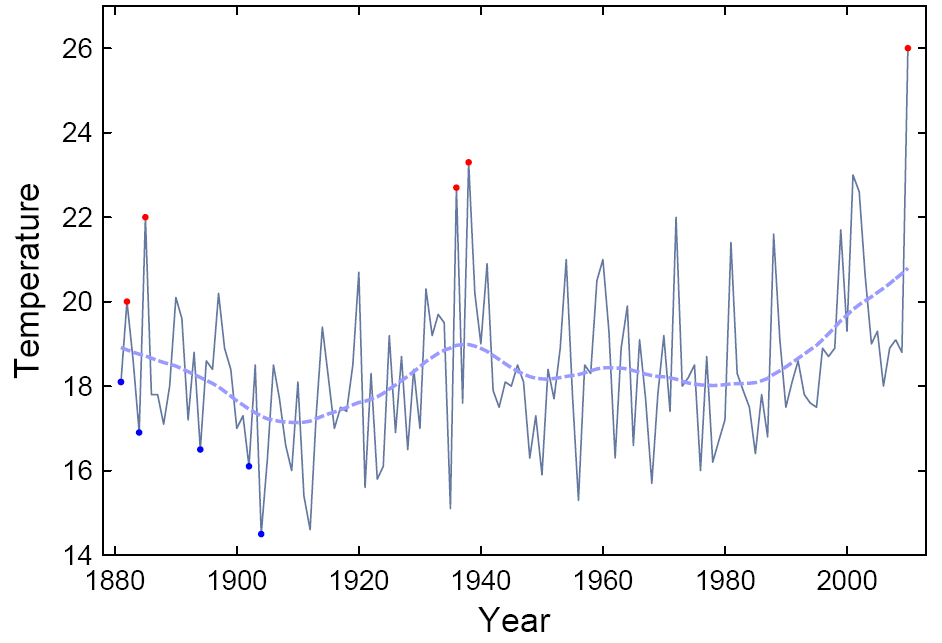
We find that the number of record-breaking events increases approximately in proportion to the ratio of warming trend to short-term standard deviation. Short-term variability thus decreases the number of heat extremes, whereas a climatic warming increases it. For extremes exceeding a predefined threshold, the dependence on the warming trend is highly nonlinear. We further find that the sum of warm plus cold extremes increases with any climate change, whether warming or cooling. We estimate that climatic warming has increased the number of new global-mean temperature records expected in the last decade from 0.1 to 2.8. For July temperature in Moscow, we estimate that the local warming trend has increased the number of records expected in the past decade fivefold, which implies an approximate 80% probability that the 2010 July heat record would not have occurred without climate warming.
If Rahmstorf and Coumou are correct, catastrophic warming is upon us already.

Last year a catistrophic heatwave and drought struck Russia during the Summer. The record heat was so extreme that words like unprecedented and disastrous are appropriate.
Last week, Rahmstorf and Coumou described their article on Real Climate. They reported finding that between 1979 and 2009 the average Moscow temperature increased by 1.4 C. Winter Warming has increased by as much as 4.1 C since 1880. Thus local warming appears to be following a long term trend.

The 2010 Russian heatwave was far from the only extreme heat and drought event during the last decade. In 2003 an extreme heat wave struck Western Europe, killing some where between 35,000 and 50,000 people. Extreme heat waves returned to Western and Central Europe in 2006 and South Eastern Europe in 2007. The North Central United States and nearby areas of Canada were effect by a prolonged extreme heat event in 2006. Australia was affixed by extreme heat in 2008 and again in 2009. In 2010 not only was much of Russia afflicted by extreme heat, but the heat spread to Eastern China, Japan, the UK and the United States. in 2011 an unprecedented extreme heat and drought event struck Texas and surrounding states. The high Houston average heat for august amounted to a thousand year weather event, while during much of the same period Southwestern Asia was experiencing an extreme heat event with temperatures as high as 126 F (52 C) being recorded during August.

In addition, these heat events have taken tens of thousands of lives. In Russia alone, during the 2010 extreme heat waves, an estimated 56,000 deaths could be blamed on heat related causes. The Russian death tole was twice the number of people who died during the 2011 Japanese earthquake-tsunami event. Huge heat and drought crop losses were reported for Russia in 2010 and in Texas and adjacent area in 2011.

Catistropic Anthropogenic Global Warming? Its here. When a hero of the anti-CAGW crowd, Roger Pielke Jr attempted to argue with Rahmstorf and Coumou on Real Climate recently, he was repeatedly clobbered. It is really time for the skeptics to call it a day, unless they are simply in the game for Koch family money.

Wednesday, September 7, 2011

Faustian Bargains and the 80 Year Slow Motion Train Wreck

There are moments when abstract concepts become real, and about our survival. We can call these existential moments. I had my existential moment about global warming in 1971 when I heard Jerry Olson talk about the topic at a very informal gathering of people who worked for the ORNL-NSF Environmental Studies Project. Alvin Weinberg had his existential moment about the same subject at about the same time, and with Jerry Olsen initiating him as well. The same year Alvin Weinberg coined the phrase Faustian Bargain to describe the relationship between society and nuclear energy.

Weinberg first used the phrase "faustian bargain in a 1971 speech. In an 1972 Science article "Social Institutions and Nuclear Energy", Weinberg repeated the content of the 1971 speech. In the article Weinberg wrote,
We nuclear people have made a Faustian bargain with society. On the one hand, we offer -- in the catalytic nuclear burner (breeder reactor) -- an inexhaustable source of energy. Even in the short range, when we use ordinary reactors, we offer energy that is cheaper than energy from fossil fuel. Moreover, this source of energy, when properly handled, is almost nonpolluting. . . .

But the price that we demand of society for this magical energy source is both a vigilance and a longevity of our social institutions that we are quite unaccustomed to. In a way, all of this was anticipated during the old debates over nuclear weapons. . . . . In a sense, we have established a military priesthood which guards against inadvertent use of nuclear weapons, which maintains what a priori seems to be a precarious balance between readiness to go to war and vigilance against human errors that would precipitate war . . .

It seems to me (and in this I repeat some views expressed very well by Atomic Energy Commissioner Wilfred Johnson) that peaceful nuclear energy probably will make demands of the same sort on our society, and possibly of even longer duration.
Weinberg repeated the same message a year later. In the conclusion to his November 1972 Nuclear Safety speech, Weinberg stated,
We nuclear people have made a Faustian bargain with society. On the one hand, we offer - in the breeder reactor - an almost inexhaustible source of energy. Even in the short range, when we use ordinary reactors, we offer energy that is cheaper than energy from fossil fuel. Moreover, this source of energy, when properly handled, is almost nonpolluting. Whereas fossil fuel burners must emit oxides of carbon and nitrogen, and probably will always emit some sulfur dioxide, there is no intrinsic reason why nuclear systems must emit any pollutant - except heat and traces of radioactivity.
Yet Weinberg saw that the benefits of nuclear energy came at a cost,
the price that we demand of society for this magical energy source is both a vigilance and a longevity of our social institutions to which we are quite unaccustomed.
Yet this contention has turned out to be untrue. As I pointed out in a post on this speech, by the time Weinberg delivered it, the molten-salt reactor technology which he had led Oak Ridge scientists in developing was off the table. but that promise has not been forgotten. Yet Weinberg still knew of the unique promise of molten-salt reactor technology.

What exactly was Weinberg getting at with his Faustian Bargain? There are in fact two Faustian Bargains known to literature. The first, found in Marlow's play the Tragic History of Doctor Faistus and Gounod's Opera Faust. In both Faust signs an agreement to obtain the services of Méphistophélès' master Lucifer, during his life, in exchange for the surrender of his soul after death. At the end of the story, Méphistophélès collects on Faust's bargain, dragging him down to hell.

In Marlow's Doctor Faustus, Faustus says,
Si peccasse negamus, fallimur, et nulla est in nobis veritas;

If we say that we have no sin, we deceive ourselves, and there
is no truth in us. Why, then, belike we must sin, and so
consequently die:
Ay, we must die an everlasting death.
What doctrine call you this, Che sera, sera,
What will be, shall be? Divinity, adieu!
These metaphysics of magicians,
And necromantic books are heavenly;
Lines, circles, scenes, letters, and characters;
Ay, these are those that Faustus most desires.
O, what a world of profit and delight,
Of power, of honour, and omnipotence,
Is promis'd to the studious artizan!
All things that move between the quiet poles
Shall be at my command: emperors and kings
Are but obeyed in their several provinces;
But his dominion that exceeds in this,
Stretcheth as far as doth the mind of man;
A sound magician is a demigod:
Here tire, my brains, to gain a deity.
This surely does not express the ambition which Weinberg had in mind in his 1971 speech. The end of that Faust is depicted in Gounod's Opera Faust:


There is another Faust tradition, this one linked to the great German poet, thinker and statesman Johann Wolfgang von Goethe. In a paper written shortly before his death in 2006, Weinberg made explicit his intent to refer to Goethe's Faust.
In Goethe’s play, Faust is assisted and put up to mischief in his endeavors by the devil. This assistance is arranged over the course of the discussion of a number of contract- like arrangements: In the Prologue, Mephistopheles (the devil) suggests to God an experiment with a virtuous human being named Faust. Mephistopheles claims that it will be easy for him to make Faust forget his striving in return for an easy life on Earth. God, reluctantly, agrees to the experiment, knowing that Mephistopheles will fail in his attempts.

Interestingly, Mephistopheles does not explicitly suggest to God a deal that goes beyond Faust’s death. This would be too irreverent towards his master, even for Mephistopheles. God, on his part, does not enter into a contract with anyone else, this would mean to step down to the level of the contract partner. So this preliminary discussion is not a bet or bargain, but in a sense it is part of the ‘‘Faustian Bargain’’.

In Part I of Goethe’s play, Mephistopheles offers Faust a bargain similar to the one that the bridge builders and other innovators were thought to have accepted. His offer, however, is not the experiment he has discussed with God. Mephistopheles suggests to Faust a bargain, his services here on Earth in return for Faust’s soul . . . .

Faust accepts Mephistopheles’s services, leaving open, however, his fate after his death. Instead he offers to make a bet:
Weinberg points our that Mephistopheles encourages Faust to work for greater Energy and speed. The Goal of Goethe's Faust is clearly that of the 18th century Enlightenment,
The restless striving for more power and success derived from knowledge, energy, and other resources; along with the striving for unattainable perfection in love and virtue; are the main themes of Faust II. This Faustian drive is described as an essential element of human existence. It creates wars and suffering, but it is essentially human in the Faustian sense to live for continuous progress.
In Goethe's play, Faust says,
If e’er upon my couch, stretched at my ease, I’m found, Then may my life that instant cease!
Me canst thou cheat with glozing wile
Till self-reproach away I cast, –
Me with joy’s lure canst thou beguile Let that day be for me the last!
Be this our wager!
Weinberg agrees with the economist, Hans-Christoph Binswanger, that Faust's bargain
is that Mephistopheles helps Faust to overcome time, to become immortal by being part of eternal progress, while Faust promises never to rest and never to pause striving for further progress . . . .

In the end Faust’s soul is not left to the devil. The angels, carrying Faust’s remains up into heaven, sing:
"For he whose strivings never cease, Is ours for his redeeming."
Boito depicts the death of Goethe's Faust.

If Weinberg undersood the Faustian Bargain interns of Goethe's Faust, then what was Weinberg striving for? As I have often pointed out in 1971 Weinberg was striving for three things,
* Nuclear safety
* Control over CO2 emissions, which Weinberg understood threatened the future of humanity
* The Development of Thorium Breeding Molten Salt Reactor technology, which Weinberg believed would fulfill his first two goals
In all three goals, Weinberg faced protagonists, Congressman "Chet" Holifield and AEC Reactor Research Director Milton Shaw. Not long after he made the "Faustian Bargain Speech, Weinberg was told by Congressman Hollifeld, that it was time for him to go.

I have attempted to explored the background of Weinberg's Firing on Nuclear Green. Alvin Weinberg was involved in a conflict between National Laboratory Scientists, and the leadership of the Washington DC nuclear elite, including Congressman Chet Hollifeld and AEC Reactor Research Director Milton Shaw. In addition to disagreements over the safety of conventional reactors, the conflict for Weinberg involved a radical approach to reactor safety, which would solve many conventional reactor safety concerns. That approach was embodied in the development of the Molten Salt Reactor. Undoubtedly, what Weinberg had learned from Jerry Olsen in 1971, added to his motivation in the struggle for Nuclear Safety and the development of Molten Salt Reactor Breeding technology. Weinberg's Faustian bargain had as its goal the rescue of humanity, from the consequences of a quest for energy.

During the struggle Washington DC elite were telling the scientists, further striving toward nuclear safety is unnecessary. Weinberg was responding, we have made a deal with society and our side of the deal is not yet complete, and indeed it may take a long time and a lot of hard work to complete. The benefit of the deal to society is a low cost abundant supply of energy. The benefit to scientist are twofold, first they get to explore and to know the secrets of nature. Secondly they get the respect of their fellows for benefiting society by striving to fulfill the bargain.

In 2006 Alvin Weinberg explained,
The image has been used and the phrase quoted over and over again, both because the term was well chosen and because, very often, it has been misunderstood.

The two elements of the Faustian Bargain were both present in the early nuclear enterprise: the temptation of the easy, carefree life it offered (electricity too cheap to be metered), and the bargain it struck (continuous striving was promised). The service electricity provides could be used to pursue progress in all kinds of ways, as long as the obligation was kept to look after the nuclear waste (and, for that matter, other fissionable material as well). If the obligation were shirked, it could, in an extreme scenario, mean the end of humankind.
Weinberg added,
The phrase Faustian Bargain was also misunderstood. The same year that Weinberg’s paper appeared in Science (1972), John W. Gofman wrote an article in which he painted a sketch of what was needed, institutionally, to keep nuclear waste safe (Gofman, 1972). Not only was there a need, in Gofman’s view of the Faustian Bargain, for a perpetual institution (like a priesthood) to look after these wastes, but also everyone had to bow to the whims and wishes of this institution. In other popular publications, the Faustian Bargain was presented not as a human condition, but as a devilish complot by one group of humans to enslave the rest.
The term Faustian Bargain has been used during the subsequent years to characterize many ‘technological fixes’ of immediate problems with potential negative long-term consequences.
Fulfilling the Weinberg's Faustian bargain meant solving all of the problems associated with nuclear power, so that nuclear energy could be made available to the masses without any reason for fear. It also meant solving the CO2 emissions problem.

Weinberg's critics, including Ralph Nader and Amory Lovins were afflicted with a paranoid fear of nuclear power. Even though Weinberg held out the possibility of safe, clean, cheap and peaceful nuclear power as the goal of the Faustian bargain, Nader and Lovins weren't ready to buy the vision. Even if Weinberg's vision could be fulfilled, they weren't buying.

Instead Lovins and Nader held out Fustian bargains of their own. Nether seemed to have experienced the deep existential encounter with Global Climate change that Weinberg had, and both had confused visions of its remedy. Lovins envisioned coal as a non-nuclear bridge to soft energy and thus preferable substitute for nuclear power, that would gradually be replaced by soft energy around 2020. Lovins thus was no opponent of coal to generate electrical power in practice. Thus if anyone ever made a Faustian bargain, Amory Lovins did. Armory Lovins, who was warned about what he was doing by Alvin Weinberg, sold his soul for lumps of coal, and now has lost his soul completely and forever. Lovins soft path failed to offer a path to a carbon free existence, and seemingly never will.

Ralph Nader was always more concerned about the fate of coal miners than about what coal was doing to the environment. Nader's Faustian bargain involved the sale of his soul for government regulation of business and industry. Nader triumphed when General Motors and Chrysler nearly went bankrupt, but his Faustian bargain brought him presidential campaigns that lead to failure in his life's ambition. And for his country, Ralph Nader's crusades have not brought a low carbon non-nuclear coal substitute, and I wonder if he really cares.

Many so called environmentalists, including Ralph Nader, Amory Lovins, David Roberts, Mark Z. Jacobson, and Joe Romm simply ignore problems with "Green energy" solutions. In 2007 I had something of a one sided dialogue with David Roberts, via the comment section of the Grist blog. Roberts relentlessly championed the green technological fixs, and was convinced that renewables and efficiency offered all of the solutions, even when other people raised seemingly raeasonable objections. When those renewable fixes did not make sense, Roberts took big leaps of faith, telling us about miraculous solutions to all the renewable technology problems. I learned quite a lot from the discussion with Roberts, but unfortunately Roberts was not willing to learn anything from me.

Roberts pulled out all of the stops on Green objections to nuclear power. I responded to his objections by pointing out both flaws in Roberts statements of facts, and in his reasoning, as well as the advantages offered by molten salt reactors. Roberts responded by raising the question of scalability and I responded by pointing to the potential for mass production of small MSRs which could be built very rapidly and in large numbers in factors. Roberts appearantly had never heard of factories, and did not understand my point.

I knew about Molten Salt Reactors because my father had worked on the development of the technology over a 20 year period of time at Oak Ridge National Laboratory. Because he was working under contract, neither he nor I stood to gain any money from MSR development. My father had also made a significant contribution to the development of conventional Light Water Reactors.

I did know enough from my father to know that he considered the MSR to be a remarkable reactor that offered many potential advantages over conventional nuclear power plants. He had found working with Molten Salt Reactors difficult and challenging, and he had made significant contributions to the development of MSR technology.

MSR were safe, could, at least in theory, completely eliminate the problem of nuclear waste, would not increase proliferation, and in factories could be built in very large numbers over a short period of time.

There were significant problems with with the Faustian bargain Roberts offered. The United States Government has had efficiency improvement programs for over 30 years, and while these programs have produced small but steady improvements in efficiency, they have not produced the sort of improvements Roberts envisioned. Roberts did not offer good reasons for expecting future rapid improvements in efficiency. Secondly, economist note that big increases in efficiency sometimes produce increased use of energy. In some instances the increase may be greater than the energy saved, while in other instances the increase only partially offsets the energy savings. Thus efficiency gains, although desirable, may not constitute the sort of energy panacea which the Green Faustian bargain claims efficiency to be.

By 2011 the goals of the Green Faustian Bargain are receiving more and more. It has been repeatedly pointed out to Amory Lovins, that the predictions which he made with respect to the soft energy path, have failed to come to pass. In 2011m human energy needs are still wedded to coal, and to other fossil fuels, contrary to Lovins' predictions. Amory Lovins 1976 claim for coal use in the soft path.
Coal use 2001 to 2010, the reality that Amory Lovins refuses to acknowledge.

The 80 year slow motion train wreck

I use the phrase Slow Motion Train Wreck, to describe the inexorable advance of time from the 1971 Spring day when I first heard Jerry Olsen talk about Carbon Dioxide Emissions and Anthropogenic Climate Change. 50% of the time we had to set things aright then has been lost. We seem unwilling to make the commitment to the "Faustian Bargain" our energy
desires requires of us, if we want to survive. We must strive for a post-carbon energy order. If we are unwilling to strive, we will not survive as a civilization.

In a recent Forbes interview with Michael Tobias (MT), University of California-Berkeley Environmental Scientist Dr. John Harte laid out the dangers:
the Intergovernmental Panel on Climate Change (IPCC), summarizes the results of these calculations and concludes that under “business as usual” trends in fossil fuel consumption, by 2050 the planet will on average have warmed between 3 and 8 degrees Fahrenheit. . . . hat warming is the result of both the direct heat-trapping effect of greenhouse gases and certain feedback processes. The latter will increasingly occur in response to the direct warming, causing further warming. As polar and glacial ice melts and snow cover decreases, temperatures will rise as less sunlight is reflected by our planet and more is absorbed by the remaining, darker surfaces. . . . There are many of us in the scientific community who believe that any number of important feedback processes are not being accounted for in the current IPCC projections. For example, from ice core data informing us about temperatures and atmospheric greenhouse gas levels over the past million years, we know that when the planet warms a little from any cause, it responds by releasing from the land and sea to the atmosphere huge amounts of carbon dioxide and methane. These greenhouse gases contribute to further warming. Because this process is not reflected in current climate projections, we can expect that there will be further emissions from our soils and our oceans. These will create additional warming beyond what IPCC currently projects. . . . The evidence for these additional feedback effects is starting to pour in. Rising methane emissions from warming tundra soils and waters are being observed, and field research shows that warmed temperate ecosystems release additional carbon dioxide to the atmosphere.

Forest damage from wildfires and bark beetle infestation, both of which are triggered by warming, will also result in the carbon stored in trees flowing to the atmosphere as carbon dioxide. By some estimates the additional warming could raise mid-century temperatures by as much as 11 degrees Fahrenheit.
For most people on Earth, the threat is not get real, and climate change skeptics deny the very possibility that there is any danger to our well being. The Climate change skeptics are offering a Faustian Bargain along Christopher Marlow's lines, "Sell your soul to the temptation to take it easy. Don't pay attention to the voices of scientists that warn of the dangers of climate change". They are willing to sell their souls for any energy headless of what the bargain will cost them. They are assured by Talk radio that Anthropogenic Global Warming is not real, it is a Liberal hoax. Or they are assured by Amory Lovins and Greenpeace that nuclear energy is a deadly illusion that will not rescue us, we will be saved by efficiency and renewable energy.

We have warnings that post-carbon renewable energy plans are doomed to failure, There are enormous problems with solar and wind as a major human energy source. Even if these problems can eventually be overcome by science, it is unlikely that that will occur before 2050 when scientists like Dr. Harte say that we face big and in many respects very unpleasant environmental changes.


In a response to a pro-reneables comment, I received on Nuclear Green, I noted,
Anonymous, I do not put great stock in NREL (National Renewable Energy Laboratory0 studies, because they tend to pass on Renewable Industry propaganda claims as if they were facts, and consistently downplay the bad news in their data. For example, the latest Eastern Interconnect study clearly demonstrated that rising wind penetration would lead to increased electrical costs, but this was not one of the conclusions that was featured in the press release, or in the executive summary. A preliminary finding of the Western interconnect study of wind and solar has been that renewables will primarily displace CCGTs, while leaving coal largely untouched. Thus the carbon mitigation of high penetration wind and solar was much less than would be assumed if we did not have that information, but the NREL study failed to draw the obvious conclusions about the relative carbon mitigation costs of of renewables verses nuclear. I am not impressed by the 30 GWs of German PV. The capacity factor of German PV is likely to be under 10%. That means that the 30 GWs of PV capacity will probably produce under 3 GW years of electricity every year. Displaced generators are likely to be CCGTs, and German cloud conditions will likely requite a large number of OCGTs to be kept spinning. With the looming shutdown of German nuclear plants, the carbon emissions from the operations of of the German electrical system are likely to rise rather than fall. Thus we must consider the opportunity costs of the German FIT. What Germany will have is a hugely expensive electrical system that will almost certainly produce more CO2 than it does now. If PV farms are as cheap to operate as you claim why do they need such huge subsidies?
Thus the Faustian bargain offered by anti-nuclear environmentalists, like Amory Lovins, does not really lead to heaven. Instead it seems to lead straight to an energy hell, with little energy to cope with increasingly challenging environmental conditions.
The situation we face, a disastrous change in climate caused by human-carbon based energy sources, best be described as a slow motion train wreck. From 1971 when I first learned of AGW till 2050, the date which climate scientists say is the cut off point for avoiding, serious, long term consequences, consequences which I call the train wreck, is 80 years. Hence the 80 year slow motion train wreck.

In a review of "NON-NUCLEAR FUTURES: The case for an ethical energy strategy" by Amory B. Lovins and John H. Price, published in Energy policy in December, 1976, Alvin Weinberg pointed to a Faustian bargain Lovins was offering his readers and society,
Despite its title, the book is not concerned with non-nuclear futures. The reader of a book so named is entitled to get from the authors a reasoned description of a feasible non-nuclear future. The authors excuse this omission with the assertion (p159), 'To show that a policy is mistaken does not oblige the analyst to have an alternative policy.' But this is inadequate. This is not dealing with a hypothetical issue, but a real one. It is not enough to point out the deficiencies of nuclear energy; one must deal with the situation that would arise if Lovins and price were successful in their onslaught: should the society indeed turn away from nuclear energy, what then?
Here Alvin Weinberg exposes Amory Lovins' Faustian bargain with our society. Weinberg Ferrets out Lovins' fundamental assumption about energy and society,
(p xxi), 'Low-energy futures can (but need not) be normative and pluralistic, whereas high-energy futures are bound to be coercive and to offer less scope for social diversity and individual freedom.
Weinberg raised a problem with Lovins' low-energy, high freedom claim, by pointing to an inevitable tradeoff between energy and time. The more energy we have, Weinberg argued, the more freedom we have to control our time. Weinberg pointed to a truth problem in Lovins' argument
So much of the argument is at the border of Science, or even trans-scientific, that one cannot prove the authors to be wrong, any more than one can prove the nuclear advocates to be wrong.
Weinberg put his finger on the greatest single environmental flaw of Lovins' argument, his failure to identify CO2 emissions from energy as a major environmental issue, and his willingness to accept carbon emitting coal as a substitute for nuclear energy. Weinberg wrote,
the authors regard net energy analysis as a convenient device for casting nuclear power in an unfavorable light, a feat they attempt to accomplish by ignoring significant comparisons, - nuclear and non=nuclear of the same doubling time and relative effects of heat release and CO2 release.
In response to Lovins recommending a coal burning bridge between the period when nuclear power was considered acceptable and the time when all energy would come from renewable resources, Weinberg asked,
Can we really ignore CO2 during the coal burning fission free bridge?
Lovins countered that he
worried about the climate effect of the release of CO2
but that nuclear power would not prevent CO2 emissions from high coal use. Clearly then Lovins offered a Faustian bargain with his anti-nuclear energy scheme. In 2010, long after a process which Lovins forecasted would have begun to shift human society from fossil fuels to renewables, coal use for energy continues to rise. If Lovins worried in 1976 about the climate effects of CO2 emissions, he did not worry sufficiently. Lovins Faustian bargain put society clearly on track for a climate disaster, and in 2010 Lovins still has not figured out how to avoid the disaster without nuclear energy. The Lovins Faustian bargain is still in force, and until we are willing to listen to Alvin Weinberg, we will continue to follow Lovins to perdition.

I offer two serenades for those who do not wish to strive to avoid the train wreck:

Monday, October 25, 2010

Encounters with Jerry Olsen

Becky, her mother and I went to see the movie Ghost Bird on last Thursday,. Before the movie started a gentleman introduced himself to us. It was Jerry Olsen. I told Jerry that he was mentioned in Nuclear Green. I believe that Jerry had played a role in 1971 by alerting Alvin Weinberg and the rest of the ORNL staff, which included me at the time, about the relationship of CO2 emissions to a potential global climate change. Jerry acknowledged that Alvin Weinberg had credited him with alerting Weinberg to the CO2 AGW issue, but he stopped short of claiming credit for it. My recollection is that Jerry was the first person to alert me to the problem of Anthropogenic Global Warming (AGW). I told Jerry on Thursday, that he was a celebrity because of his pioneering communications on the issue.

Jerry was a credible scientist. No one in 1971 thought that Jerry was bullshitting about CO2 and global climate change, and scientists who viewed science as the judicious determination of facts, scientists like my father, George Parker, and Alvin Weinberg were quickly convinced that CO2 emissions from energy related sources were a major hazard to the future well being of people on the earth.

This was back before global warming became political. Almost everything that is written on Global Warming denial now focuses on Republican denial. In fact there is a second school of global warming denial, that is even more irrational. This school does not deny the CO2/Anthropogenic Global Warming link, but denies that we have to stop using fossil fuels in order to prevent AGW. This school denies the danger of AGW, arguing that the most effective tool to prevent global warming is too dangerous to use. This school, warns of the dangers of burning fossil fuels, yet at the same time conspires with coal, oil and natural gas companies to support continued fossil fuels use through back door arguments, such as the notion that burning fossil fuels won't hurt if we burn them efficiently, or burning fossil fuels won't cause climate harm if they are used to back up renewables.

In reality supposedly pro-environmental groups such as Greenpeace, the World Wildlife Fund, the Sierra Club, the Friends of the Earth, The Natural Resources Defense Council, and numerous other groups, supported energy policies which in practice were highly favorable to the continued use of coal, oil and natural gas as energy sources. Anti-nuclear spokes persons such as Amory Lovins, and Ralph Nader, greatly exaggerated the risks of nuclear power, while ignoring the disastrous consequences of backing fossil fuels instead of nuclear power.

In 1976 Amory Lovins foresaw that a soft path to post carbon energy. Lovins believed that in the short run coal use would expand as if filled roles which also could be performed by nuclear power, but in the course of a generation soft path energy sources would replace more and more fossil fuels, and by 2010 over half of all energy used to power the United States would come from soft path sources. In fact in 2010 over 90% of American energy still comes from hard path sources.

in a December 1976 Energy Policy review of Amory Lovins book, "NON-NUCLEAR FUTURES: The case for an ethical energy strategy," Alvin Weinberg pointed out the greatest single environmental flaw of Lovins' argument, his failure to identify CO2 emissions from energy as a major environmental issue, and his willingness to accept carbon emitting coal as a substitute for nuclear energy. Weinberg wrote,
the authors regard net energy analysis as a convenient device for casting nuclear power in an unfavorable light, a feat they attempt to accomplish by ignoring significant comparisons, - nuclear and non-nuclear of the same doubling time and relative effects of heat release and CO2 release.
In response to Lovins recommendation of a coal burning bridge between the period when nuclear power was considered acceptable and the time when all energy would come from renewable resources, Weinberg asked,
Can we really ignore CO2 during the coal burning fission free bridge?
Lovins countered that he
worried about the climate effect of the release of CO2
but that nuclear power would not prevent CO2 emissions from high coal use. Clearly then Lovins offered a Faustian bargain with his anti-nuclear energy scheme. In 2010, long after a process which Lovins forecasted would have begun to shift human society from fossil fuels to soft path energy sources such as renewables, coal use for energy continues to rise. If Lovins worried in 1976 about the climate effects of CO2 emissions, he did not worry enough. In 2010 American coal use continued to rise rather than fall as Lovins had forecasted. In addition, Chinese coal used, much of it burned to produce energy for the production of goods destined for the United States, increased dramatically during the last decade. Lovins has never acknowledged that his 1976 soft path forecast proved in 2010 to be utterly wrong, and that his recommendation of a coal burning fission free bridge, has set the world firmly on the road to environmental disaster.

Neither Lovins nor Ralph Nader ever considered the possibility that the consequences of burning fossil fuels might be worse than the consequences of nuclear production of electricity. They are. The casualty rate fro the entire nuclear fuel power cycle is far lower than the casualty rate for fossil fuels. Even in terms of radiation exposure, the public is exposed to far more radiation from fossil fuel related sources, than from Nuclear Power Plants. And of course NPPs emit no more CO2 than wind generators do. In fact, high CO2 emissions from the Solar PV production process make Solar PVs a worse source of CO2 than nuclear plants are. Thus NPPs can play an important role in CO2 mittigation.

Renewables are expensive, it costs more by the kWh to produce electricity from solar or wind than it costs to produce electricity from new nuclear plants. Renewable based future energy acknowledge that there will be a very large gap between expected future energy production from renewable resources and the current level of consumer energy demand. How will that gap be filled, if not by nuclear energy? Not to worry, the renewable energy planners tell us, the gap will be filled by increased energy efficiency which will greatly diminish consumer energy needs. in May of 2009, the Economist noted:
Almost all blueprints for tackling global warming assume that energy efficiency will have a huge role to play. Nicholas Stern devoted a whole chapter to it in the report he wrote on climate change for the British government. In the greenest of futures mapped out by the International Energy Agency, a think-tank financed by rich countries, greater efficiency accounts for two-thirds of emissions averted. The McKinsey Global Institute (MGI), the research arm of the consultancy, thinks that energy efficiency could get the world halfway towards the goal, espoused by many scientists, of keeping the concentration of greenhouse gases in the atmosphere below 550 parts per million.
The Economist also notes that America has become more energy efficient since 1973 a year in which we spent 12% of our gross domestic product on energy. Recently that figure has fallen to 7%. Of course some of that decline in energy use was due to the transfer of energy intensive industries (and jobs) to other countries. Green experts like Amory Lovins insists that an enormous amount of energy use savings that could be accomplished through greater energy efficiency.
Because so much can be done with just technical efficiency, there's a great deal of flexibility -- in how and where people live, what houses look like, how we get around, what our settlement patterns are. For example, it's very straightforward to have uncompromised, normal-sized family cars achieving upwards of 100 miles a gallon, with improved safety and excellent economics. We know how to triple the efficiency of trucks, and we can probably do even better on planes, I think by a factor of six or so better than now.
According to Lovins incredible energy savings that practically pay for themselves as soon as they are installed are available for the American home.
My own house uses 1 percent the normal amount of space- and water-heating energy, and 10 percent the normal amount of electricity. The efficiency upgrades took ten months to pay for themselves in 1983. But if we were building the house now, we'd be able to save another two-thirds of the remaining electricity, and it would probably cost even less to build.
Quite obviously Lovins does not spend much time watching plasma TV's. Lovins doesn't have time to watch TV because it takes all of his time to dream up such bullshit. As a householder I did my own home energy efficiency program in the 1980's and 90's. And while my wife and I were able to effect substantial energy savings we never came close to the energy reduction Lovins claims to have realized. Nor did the energy efficiencies pay for themselves in anything like 10 months.

If my readers are wondering about energy savings investments, solar water heaters would be high on my list for many localities. But there are areas of the country where a cloudy climate makes solar hot water heaters a bad investment, even with tax and power company subsidies. Solar hot water heaters would be a good investment in Snowmass, Colorado, but 10 months is not to believed. Lovins heated the water with the assistance of a second system, one while relied on a lot of bullshit to supplement heat from the sun. A payback period of 10 years would not be unusual for a solar hot water heater. But in some cloudy localities it might take 30 years. The solar heating project in a cloudy community might never pay for itself. Thus when the eco-cheerleaders at Treehugger want to put solar hot water heaters on every roof, they reveal themselves to be exceedingly ill informed. Local climate factors play a far bigger role that Amory Lovins allows in determining the payback time for energy saving technology.

There are other factors that may differ within localities that can effect the value of efficiency. For example, in hot climates shade trees have a cooling effect on buildings, but if you have shade trees, the shade effects the efficiency of solar hot water heaters. While ground source heat pumps are more efficient than air source heat pumps, they are far more expensive to install, and far more expensive to repair.

In addition, unanticipated factors may negatively impact on energy efficiency. For example, the clay soil of North Texas expands during rainy periods and contracts in dry weather. The soil movement can damage home foundations, and this in turn can damaged the effectiveness of home insulation. Thus investments in home energy efficiency might in Dallas include foundation repairs. Doubling home insulation might not pay for itself if the shifting foundation has unseated double pane windows, allowing drafts to enter the home at numerous points. Even repairing the windows might not help, since the next time the foundation shifts, the windows would become unseated again. Repaired foundations can and do shift with new soil movement.

The fact that anyone gives the slightest amount of credence to Lovins energy efficiency argument, represents the triumph of hope over fact and logic. People believe Lovins because it is comforting to do so. As long as they do, politicians do not have to confront the public with unpopular energy choices. Thus Amory Lovins is a hero to every politician who wants to avoid uncomfortable energy related issues. Lovins is not a hero to people who are deeply concerned about the energy future, and for people who have high regard for rigorous standards for truth.

But if Amory Lovins is wrong that efficiency will fill the energy supply gap, then renewable based solutions that rely on energy efficiency to fill the gap between energy demand, and a renewables based energy supply, are likely to fail badly, and to leave society in deep trouble.

The entire renewables, energy efficiency paradigm is built on an intellectual foundation laid by Amory Lovins. Given the importance of Amory Lovins energy theories, relatively little scholarly analysis has been directed toward assessing it. Alvin Weinberg offers deep and telling criticisms of Lovins, often without direct references to Lovins texts. There was a considerable dialogue between Weinberg and Lovins and the mention of Weinberg's name in "The Road not Taken" does not fully indicate the true extent of Weinberg's influence on Lovins. It is Lovins latgely unacknowledged dependency on Weinberg, that makes Weinbery's criticism so telling.

Vaclav Smil should be mentioned among the other scholars who have paid attention to Lovins. Smil's comments on Lovins contain no small expression of accademic sarcasm:
Amory has become a celebrity after wholesaling his fairy-tale of “soft” decentralized small-scale energies as THE solution (with its deep countercultural, Berkeleyish appeal), and it is the first law of celebrity-hood that, right or wrong, coherent or not, you retain the status. Combine that with the just-noted mass scientific ignorance of the population and with Amory’s sleek offerings of no-pain solutions (nothing will cost anything, or as he famously put it, “abating climate change for fun and profit”) and you have new believers signing up every time he speaks. By the way, by this time we all should have been driving nothing but Lovinsian hypercars (something like 200 mpg, made like new Boeing 787s solely from carbon composites) whose conceptual design he launched more than a decade ago; have you seen any?
Smil attributes to Lovins numerous failed predictions including:
1. Renewables will take huge swaths of the overall energy market. (1976)
2. Electricity consumption will fall. (1984)
3. Cellulosic ethanol will solve our oil import needs. (repeatedly)
4. Efficiency will lower consumption. (repeatedly)
Smil, of course, knows all about Jevons and his famous energy efficiency paradox, the paradox which Lovins ignored in "The Road Not Taken."

Thus we have a second type of denial that impacts our ability to deal effectively with climate change. The first type of denial, the denial of the threat that climate change due to CO2 emissions, by the political right. The second type of denial, practiced by some self styled members of the political left, denies the unique potential of nuclear power to mitigate climate change and claims that we can continue to use fossil fuels, while at the same time preventing Anthropogenic Global Warming. The intellectually dubious claims about energy made by Amory Lovins, including his attack on nuclear power, have become major obstacles to mitigation of AGW.

Sunday, July 18, 2010

A hat tip to Joe Romm, Words of warning from Barry Brook

Joe Romm is a confusing figure. He usually is spot on about climate change data, while his pronouncements on energy frequently veer into the total idiocy range. Here we have some data from Joe Romm the smart. Is the sun responsible for climate change? Joe provides us with evidence that it is not.

nasa-solar-fixed.jpg

Now look at the temperature trend:

nasa-2007.jpg

June was, by the way, the hottest June on record. Heat wave records are getting smashed:
temps
“Total number of daily high and low temperature records set in the U.S., data from NOAA National Climatic Data Center, background image © Kevin Ambrose. Includes historical daily observations archived in NCDC’s Cooperative Summary of the Day data set and preliminary reports from Cooperative Observers and First Order National Weather Service stations. All stations have a Period of Record of at least 30 years.”

Barry Brook offers a new view of climate science and its predictions. Barry is a very sober and rational person, and thus it is wise to listen when he writes ,
Under a business-as-usual scenario, which assume a continued reliance on fossil fuels as our primary energy source, these models predict 1.8°C to 6.4°C of further global warming during the 21st century. There is also a real danger that we have reached or will soon reach tipping points that will cascade uncontrollably and take the future out of our hands. But much of the uncertainty represented in this wide range of possibilities relates to our inability to forecast the probable economic and technological development pathway global societies will take over the next few decades.

South Asia as had the hottest heatwave ever this year,

Wednesday, December 9, 2009

The COP15 problem is not climate change skepticism, it is anti nuclear fanaticism

We are in a historic transition period between energy technologies that are clearly failing, and an as of yet uncharted new energy system. As in many moments of major historic transitions confusion reigns. The transition is a product of a double failure of carbon based energy technology. First world production of crude oil appears to either be near a peak or to have have peaked already. Geologists have been telling us for 50 years that this day would come, but the global economic system is not built on foresight. Demand for oil based products can be projected to increase, as consumers in massive emerging economies, China and India, are entering the car market. Thus an upward price pressure on global demand for petroleum will emerge, at a moment global petroleum production has stopped growing. It is clear that other essential carbon based commodes, coal and natural gas, although perhaps not at their peak production levels, will not last forever.

The Anthropogenic Global Warming, caused by the emission of CO2 from natural gasses is the second issue. I am not a AGW skeptic, but I do not see a point in arguing about it. There is no doubt that global temperatures are still increasing. 2009 is the 5th warmest year on record, despite an unusual event which should have a negative impact on global climate. I am referring to the quiet sun, the unusual prolonged minimum of sun spot activity this year. Skeptics who argue for a solar driven warming would be hard pressed to explain the relative lack of apparent climate effect by the current solar minimum.

A second grounds for skepticism rests on a denial of the concept that CO2 is a greenhouse gas. this argument is basically anti-science and is rejected by more sophisticated AGW skeptics. They point to unverified theory about clouds, or suggest that a Medieval Warm Period demonstrates past climatic changes that are not explained by the CO2 warming theory. There is no conclusive evidence that the Medieval Warm Period was a global climate event. But even if the "Medieval Warm Period" was a world wide global climate phenomena, it is not sufficient to demonstrate that the 20th century climate trend was not caused by CO2 emissions. Falsifiability, not the existence of alternative hypotheses is the standard of science, and AGW skeptics have not demonstrated that the CO2-AGW hypothesis is false.

I am not going to argue this, there are plenty of Internet venues where those who are looking for climate debate can find it, and I suggest that those who wish to debate these points seek out venues like Real Climate, Grist or Joe Romm's blog to play their climate debate games. Furthermore, I would not be greatly surprised if the AGW skeptics fold their tents and slip quietly into the night within the next 5 years. Evens, I suspect, will catch up with the skeptics as global heat records are repeatedly shattered.

On Nuclear Green, I simply assume that global climate change is one of several reasons why the Age of Carbon should be swiftly ended. Most AGW skeptics can be reached by arguments such as ending the use of carbon based fuels will lower the cost of health insurance. or will contribute to American long term energy independence. For this reason I am not targeting AGW skeptics in this present post. In fact I share with them a deep concern regarding the protection of human freedom from the excesses of the eco-extremest. I believe that material prosperity is both possible and highly desirable in the post carbon era, and that this prosperity can and should be spread to everyone on the planet. I further believe that the goals of organizations like Greenpeace is to make future human freedom and prosperity impossible.

Paradoxically, the AGW skeptics are not the most serious enemies of AGW mitigation. The eco-extremests are. If AGW skeptics are basically in denial about AGW, they are not in denial about the essential role of nuclear power in a future of energy. Many AGW skeptics harbor rational doubts about the use of renewables in future energy schemes. The Green mainstream remains incapable of anything but a dogmatic hostility toward nuclear power. This anti-nuclear attitude, leads anti-nuclear environmentalists to hugely exaggerate the liabilities of nuclear power as well as engage in self-deceptive denials of the liabilities of renewable generation systems.

My own analysis has lead me to believe that renewables are not the answer to global warming and that the renewable solution would be the ruin human civilization. I am not alone in this. A generation ago, Alvin Weinberg concluded that among renewable options, only solar power had any potential for displacing fossil fuels, and that solar power would be far to expensive.

Weinberg wrote,
The yearly demand for solar electricity (50 x 10l2 kWh to 100 x 1012 kWh) could be met, in principle, by photovoltaic arrays (PV), by power towers (PT), or by ocean thermal energy converters (OTEC). The first two are intermittent, the last is not. If these intermittent systems are small and are backed up by firm power from a grid, they would need little storage; if they stand alone, or if the total demand exceeds what can be met by reliable backup, these systems would need large amounts of storage -say 6 t o 12 days. Electrical storage is much more expensive than heat storage; hence, a priori, we would expect the PV system with full electric storage to be more expensive than the PT, which uses heat storage. . . .

. . . we have not taken into account the varia- tion in solar flux between winter and summer. This is about a factor of 2 to 3, depending on the latitude. Thus to provide firm power, winter as well as summer,might require three times the capital investment incollectors, though not in storage. Thc storage for thc PT system is much cheaper, though it is too early to say whether the PT or PV system itself is the cheaper. Thus if a large PT can be installed complete for as little as $10 per ft2,we might achieve solar electricity at 20 per- cent fixed charges for, say 10 cents per kWh, but this still does not take into account the winter/summer variation. Firm power, winter as well as summer, might cost at least twice as much.

Weinberg laid out his cost estimates in 1977 dollars,
If a PV system, possibly with a light condensing system, can be installed for $10 per square foot
(ft(2)) without storage (this is 15 times cheaper than the present cost of photovoltaic silicon surfaces), then at our average output of 30 kWh per ft(2) per year, the capital cost of the system is about 33 cents per kWh per year; at 20 percent fixed charges, this comes to about 7 cents per kWh; a t 10 percent fixed charge, 3.5 cents per kWh. If the system were supplied with six days' storage and the batteries cost , with one replacement, $40 per kWh, we would add 66 cents per kWh per year t o the capital costs. The total cost of firm electricity would come to 20 cents per kWh and 10 cents per kWh at 20 percent and 10 percent fixed charges, respectively. Actually, even these may be underestimates for a full solar system, since we have not taken into account the varia- tion in solar flux between winter and summer. This is about a factor of 2 to 3, depending on the latitude. Thus to provide firm power, winter as well as summer,might require three times the capital investment in collectors, though not in storage. Thc storage for thc PT system is much cheaper, though it is too early to say whether the PT or PV system itself is the cheaper. Thus if a large PT can be installed complete for as little as $10 per ft2,we might achieve solar electricity at 20 percent fixed charges for, say 10 cents per kWh, but this still does not take into account the winter/summer variation. Firm power, winter as well as summer, might cost at least twice as much.

There dollar has undergone considerable inflation since 1977. A 1977 dollar was worth about $3.61 in2009 dollar buying power. Weinberg also noted that the size of a world wide high energy solar array would pose a huge financial challenge:
The total land required in the 100 x 10(12) kWh per year scenario is about 80,000 square miles.
Weinberg concluded:
To summarize, it would appear that the high solar electric scenario seems to be very expensive; the high biomass scenario seems to use too much land; the high OTEC scenario seems to imply serious cl matic changes. An all-solar future is almost surely a low-energy future, unless man is prepared to pay a much larger share of his to a1 income for energy than he now pays.
My own analysis has focused on more limited cases, but it has pointed too the same underlying cost problem. Solar is too expensive to be practical. These conclusions find further support in the analysis offered by Barry Brook, Ten Trainer, Peter Lang, and others.

Our present problems in fighting global warming are large due to view preached by eco-extreemest that climate change can be prevented through recourse to renewable energy. \Dogmatic anti-nuclear ideology, and the attendant renewables schemes are the real cause of the failure of the Kyoto Protocol. The Kyoto Protocol explicitly rejected nuclear power, the only viable solution to AGW that would protect civilization. The failure of Kyoto was in large measure due that it advocated climate solutions that were simply impossible. Even if Kyoto had not been such an total failure, a report prepared by the IAEA demonstrates that a successful Kyoto would have eliminated far fewer emissions by 2010 than the world's 437 reactors were already eliminating by 2000.

The anti-nuclear fanatics are in no small measure responsible for the failure of the United States Congress to pass much needed climate change legislation this year. Congressional Republicans would by in to a reasonable program to promote nuclear power, with very little actual costs to the tax payers, while the eco-fanatics are doing everything they can to sabotage a pronuclear approach to climate change legislation.

The present Copenhagen conference appears to be headed to an even more disastrous failure than Kyoto. The Copenhagen conference appears to be headed toward buying of poor nations with large bribes, rather than giving them what their people need, access to high levels of energy though low cost nuclear power. This is what India plans to give its people, and there is no excuse for not benefiting the rest of the poor people on earth with a similar plan.

If we are serious about fighting global warming and global poverty, we have no choice but to adopt the nuclear option. We must reject the fanatic misanthropies of the eco-extremests, that will inevitable lead to poverty for everyone, and universal misery.

Wednesday, September 23, 2009

The Road to Copenhagen, Route to Failure

When a true genius appears in the world, you may know him by this sign, that the dunces are all in confederacy against him." - Jonathan Swift
Please consider signing your organization on to a new international effort to prevent nuclear power from claiming any benefits and incentives during the December 2009 UN Climate Change Conference in Copenhagen, Denmark. Called Ni Nucléaire, Ni Effet de Serre (neither nuclear nor the greenhouse effect) in France, where the campaign is based, and Don't Nuke the Climate, in English, the goal is to create a campaign document signed by organizations from across the world to be used in Copenhagen.

Nuclear power has been kept outside of climate change mitigation mechanisms to date. However, some evidence shows that the nuclear lobby could be preparing its comeback in Copenhagen to have this dirty energy labeled as clean or carbon-free and thus benefit from new subsidies. - Beyond Nuclear
Fortunately nuclear power will be represented in Copenhagen. In July, Kirk Sorensen traveled to Manchester, England, where he gave a presentation on the Liquid Fluoride Thorium Reactor, to a pannel that was preparing a report, called the Manchester Report, on alternative AGW mitigation technologies. Kirk talked to the Manchester Report Panel about The Thorium energy cycle, and using the Liquid Fluoride Thorium reactor as a source of low-carbon energy. No doubt this was considered a quite exotic message by the Report Panel, but it appeared to be well received. We will know more when the report is published sometime between now aqnd the beginning of the Copenhagen Conference in December.

It is too soon to expect that Kirk's message, transmitted to the UN conference, will by itself bring about big changes in thinking about climate change mitigation. Still the fact that the message will be presented at all on an international stage.

From the early 19th the end of the 20th century modern society relied on fossil fuels for most of its energy. The reliance on fossil fuels had by the end of the 20th century brought an enormous transformation in human material life. Yje transformation first occurred in Europe and North America, but by the end of the 20th century, the transformation appeared to have spread to Japan and South Korea, and to be spresding to China, India and much of South East Asia. At the same time the fossil fuel sector of the world's economy began to face a double crisis. First the world's fossil fuel resources appear to be reaching or will soon reach the point peak production. Especially in the case of fuel oil, we can expect to see an increase in demand from Asian consumers during the next few years, while many experts believe that wold oil production will peak and then begin to drop.

Coal an Natural gas will noit creat the sort of near run problem that Oil will, but debatyed about the World's coal reserve has started.

The second issue with fossil fuels is that of Greenhouse Gas emissions. Burning Fossil Fuels produces CO2, and armospheric CO2 is a major driver for Anthroogenic Global Warming. Scientist believe that adverse consequences, that could effect ti some, most or even all of the world's population could come about as a result of continued CO2 emissions asa the result of burning fossil fuels.

During the 19th and 20th centuries practices related to and dependent on the burning of fossil fuels, transformed the lives of a large minrity of the human populzation and inpated the lives of most of the human population. Most of the changes were deemed beneficial, but others were viewed as deleterious. A whole way of life emerged that entailed the use of large amounts of energy. Most people thought that such an energy rich would continue in its present form for a long time to come. There was a characteristic set of attitudes, beliefs, symboles and brehaviors that centered around energy and regulated both the individual relationship toward enery, and ordered social life with energy, Those patterns, beliefs, attitudes, behaviors, ad symbols solved most human problems as peoples lives became entangled with energy use. Voices were raised, however, suggesting that the first energy paradigm, the first pattern of attitudes, beliefs, symboles and behaviors engaged with energy.

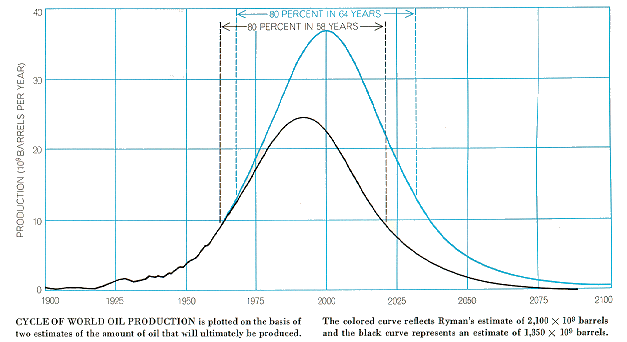
In 1956 Geologist M. King Hubbert predicted that ther production of oil would peak soon and then decline:


A year latter In December 1957 Edward Teller was invited to address the Annual meeting of the American Chemical Society. Teller was at the height of his fame. He was an honest to God celebrity, with reporters at his side, jotting down his comments, photographers snapping his picture, and as disgusting as it might seem now, women volunteering to sleep with him on the basis of his fame. (I know this because a beautify but wayward woman once describe an encounter with Teller to me. She would have slept with Teller had he consented to the arrangement.) He was referred to in the press as the Father of the "H-Bomb." He was also a darling of the American right-wing. No doubt the ACS thought by getting Teller to speak, they had achieved some coup. They must have been a little bit bewildered then when Teller started to talk about carbon dioxide and global climate. Teller told the assembled chemists that continued burning of carbon based fuels would increase the amount of CO2 in the atmosphere, eventually warming the planet to the extent that the polar ice caps would melt, and the resulting rise in sea level would submerge costal cities under water.

Ways of life are forms of being. They do not die quickly and they die with much confusion, We only understand things, the philosopher Hegel told us, after they stop working. By then it is too late to save them. By the 1970's harbingers of the impending death of the fossil fuel energy paradigm had begun to emerge, but its replacement was far from certain. I will in my next post point how the fossil fuel paradigm was able to survive into the next century but probably will not survive much longer.

I hoop to continue my account of the Road to copenhagen before the week is over.

Sunday, June 28, 2009

S-PRISM Scalability a Repose for Steven Kirsch

Steve Kirsch has posted an important statement on the IFR today on The Huffington Post. While Kirsch's statement is something of a breakthrough for Nuclear Power on Huffington Post, It contains a major flaw that Kirsch was unaware of . The flaw is simple. IFR/S PRISM technology is not sufficiently scalable to make a difference in the fight against AGW. I spotted the problem in a paper on the S PRISM fuel cycle. I discussed the scalability problem in a posted a month ago. I am reposting "Scalability and Breeder Start Up." Because I believe that the backers of nuclear power should openly debate their options, I intend to publish more posts on the IFR/S PRISM option, and my questions about it in future Nuclear Green posts.

Scalability and Breeder Start Up
Scalability is a deal breaker in global warming technology. One of the nice things about the LFTR is that it is scalable. You can build them in factories ship them off to coal-fired generation facilities, dig a whole into the ground, plant them, hook um up to the Grid, and turn them on. And then stand back and let them work. Every now and then you might add some thorium and remove some U-233 that would be used to start a new reactor.

Basically you could build as many as you wanted too in the LFTR factory. You would need a start up charge of fissionable material - U-233, U-235, or Pu-239. The start up charge would initiate the chain reaction in the reactor, and begin the breeding process. Later fuel will be derived from breeding, so no further nuclear fuel from external sources would be required to keep the chain reaction going.

The number of start up charges, the material composition of start up charges, and the size of each charge would pose a potential limit on LFTR scalability. LMFBRs would also require start up charges.

Neutron speed would play an important role with faster neutron reactors requiring more fissionable materials to keep a chain reaction going. For example French researchers studying Molten Salt Reactors operating at various neutron speeds found that a Thermal TMSR requited a charge of 790 kgs of U-233 in order to maintain breeding in a 1 GWe reactor. An Epithermal TMSR required 2400 kgs to fulfill the same conditions. While a Fast TMSR required 5200 kgs of U-233. The French also reported that a standard fast neutron reactor - I assume a LMFBR -would require 12,25o kgs of plutonium.

An S PRISM related study "S-PRISM Fuel Cycle Study: Future Deployment Programs and Issues," suggested that as of the year 2000, four hundred tons of plutonium could be recovered from spent nuclear fuel. This in turn would provide enough plutonium to supply start up charges for twenty-two, 1520 MWe S-PRISM facilities with ab output of 33,440 MWe. That is about 12 tons per 1 GWe of reactor capacity.

Clearly then neutron speed has an adverse effect on reactor scalability.

On the other hand neutron speed also influences the fission rate per neutron absorption, this in turn influences neutron production. Pu-239 fissions 25% more often in a fast reactor than in a thermal reactor. On the other hand it still take more Pu-239 to maintain a chain reaction in a fast reactor than in a thermal reactor. Reactor physics tricks and fuel cycle also seem to influence start up charge size.

A recent discussion on the EfT form produced quite a lot of useful information. "Jagdish" reported that
Indian 500MW PFBR is designed to use only two tons of plutonium.

"Honzik" pointed to French research of epithermal/fast Thorium Molten Saalt Reactors. The French, modeling the use of transuranium materials from spent nuclear fuel, in a 1 GB reactor had calculated a need for 7.3 tons of fissile elements (87.5% of Pu (238Pu 2.7%, 239Pu 45.9% , 240Pu 21.5%, 241Pu 10.7%, and 242Pu 6.7%), 6.3% of Np, 5.3% of Am and 0.9% of Cm). Alternatively the reactior would require a start uo charge of 4.6 tons of U-2330.

Lars reported that
The minimum for unity breeding from the French group is 1.5 tonnes u233 / GWe.
Alex P noted:
the french design has an only radial, not axial, blanket, so for comparison I'd think that the fissile start-up in a LFTR with a fully encompassing blanket can be at least one tonn of u-233 per GWe, or even lower
David LeBlanc noted:
The French TMSR design running without graphite moderator needs upwards of 5 tonnes of U233 or 8 or more tonnes of fissile Pu. They could drop this somewhat if they just wanted to barely break even but not very much since they'll start losing too many neutrons that would migrate into the axial reflectors. In designs in which the blanket is nearly fully encompassing you can get by with much lower fissile concentrations. It is only speculation for now but based on early Oak Ridge studies using sphere within sphere designs I think we could probably get things down to 500 Kg of u233 or maybe even lower but 1000 kg is a fine for a conservative estimate. These designs with lower fissile concentration would also be fairly soft spectrums since the salt itself can do a modest job at moderating the neutrons.
The problem of plutonium in nuclear breeding should be noted. In thermal breeders plutonium suffers from poor neutron economy, while in fast neutron reactors plutonium neutron economy improves but does not compensate for the added requirement for fissile material. Radial and axial thorium blankets in a breeder appears to lower fissile demand by as much as 300% (but this principle has been applied in S-PRISIM design).

The S-PRISM design would appear far less scalable than Epithermal or thermal MSRs. David LeBlanc's estimates are based on the use of blankets with Epithermal MSRs. If we estimate that 2 kgs of reactor grade plutonium from spent nuclear fuel about 1 kg of U233, 500 kgs of U-233 would be a similar startup charge to a ton of RGP. Thus the same amount of RGP that will start 33 GWe worth of S-Prism FBRs will also start 400 GWe worth of LFTRs. Clearly the LFTR offers scalability advantages over the IFR/S-PRISM.

Monday, February 9, 2009

Some basic considerations

I don't always lay out my assumptions. I accept the reality of Anthropogenic Global Warming, and have done so since I first heard Jerry Olsen talk about it in the spring of 1971. Jerry was articulate enough to have convinced Alvin Weinberg and just about everyone at ORNL during the 1970's. My father was writing about AGW by the late 1970's and of course you are never going to convince me that my father was a member of a fringe pseudo-scientific cult which the AGW skeptics would suggest.

A great majority of all scientists including climate scientists, are convinced by the evidence for AGW, The credentials of scientists who accept AGW are far more impressive than the credentials of the AGW skeptics. I also find the arguments of climate scientists who accept AGW persuasive, and the evidence for a scientific case against AGW to be weak.

I regard the notion that AGW is a hoax designed to advance a Liberal political agenda to be completely wrongheaded. Chinese scientists operate in a political environment in which state controls far in excess of those attributed to the so called liberal political agenda. They have no motive to want to increase state power beyond those already claimed by the Powerful Chinese Communist party. Yet Chinese scientists accept the reality of AGW, and have recommended that the Chines state integrate AGW as an assumption in areas of state planning, such as future agricultural output.

Chinese climate scientists believe that by 2019 the atmospheric CO2 level will reach between 440 and 429 PPM, and the average temperature in China will rise by 1 degree C. By 2080 chines scientists believe that atmospheric CO2 levels will rise to 721 PPM, without mitigation, with mitigation CO2 levels are still expected to rise to 561 PPM. the Chinese scientists expect 2080 temperature rises by 3.89 degrees C without mitigation and by 3.20 degrees C with mitigation.

What concerns me is the dogmatic certainty of AGW skeptics, that the future projected by the Chinese scientists, as part of Chines agricultural planning must be wrong despite the widespread agreement by climate scientists that it is very probable, and would have serious consequences not contemplated by Chinese agricultural planners.

My goal is to insure that even if the scientists are wrong about AGW, that society would benefit from mitigation efforts, that personal freedom would be enhanced, that the collective wealth would be greatly enhanced, and that the distribution of that wealth would be far more equitable than it is today. As I have said, these goals make me a Liberal, but are not antithetical to a conservative output. If the climate scientists are correct about AGW, my view is that mitigation efforts should be underway in ernest, by 2020, with a goal of transformation electrical production into a post carbon mode by 2020, and at least an 80% reduction of CO2 emissions by 2050. I actually believe that these goals are potentially attainable, provided the Aim High program is adopted. I must add that the Aim High plan is the only plan that would have a reasonable likely hood of complete and successful carbon mitigation by 2050. The Aim High program would also be compatible with my "Liberal" goals,and would contain nothing that reasonable conservatives would find objectionable.

Further by ending American reliance on imported oil, and lowering the price Americans pay for energy, the Aim high program would benefit American businesses. What's there for conservatives not to like?

Thus my assumptions are that the Aim High program would mitigate AGW, but would produce beneficial economic effects even if AGW mitigation were to prove unnecessary. I believe that conservatives out to admit to the possibility that they are wrong about AGW and to to back the AIM High program. The alternative would be that in 2050 Conservatives might discover that they are wrong about AGW, but by 2050 it will be far to late, and conservative will also discover that they and an unprepared society will be up shit creek without a paddle. (Pardon my French)

I believe that the Green program of AGW mitigation through efficiency and renerable energy sources will fail because it is far to expensive and accomplishes far to little. It is also exceptionally illiberal, because it would greatly decrease the amount of wealth producing energy available to society, and increase the cost of that diminished energy, This would create hardships for poor persons and people living on fixed incomes, and would most surly be oppressive to the poorest and most vulnerable members of society. Excuse me but the energy schemes of Amory Lovins and company would oppress the poor and the elderly. Lovins and Joe Romm are reactionaries not progressives. Lovins and Romm basically never take the interests of the poor or the elderly into account, in their energy schemes.

Followers

Blog Archive

Some neat videos

Nuclear Advocacy Webring
Ring Owner: Nuclear is Our Future Site: Nuclear is Our Future
Free Site Ring from Bravenet Free Site Ring from Bravenet Free Site Ring from Bravenet Free Site Ring from Bravenet Free Site Ring from Bravenet
Get Your Free Web Ring
by Bravenet.com
Dr. Joe Bonometti speaking on thorium/LFTR technology at Georgia Tech David LeBlanc on LFTR/MSR technology Robert Hargraves on AIM High