
Showing posts with label IThEMS. Show all posts

Thursday, November 18, 2010

More on the IThEMS Business Plan from Dr. Kazuo Furukawa

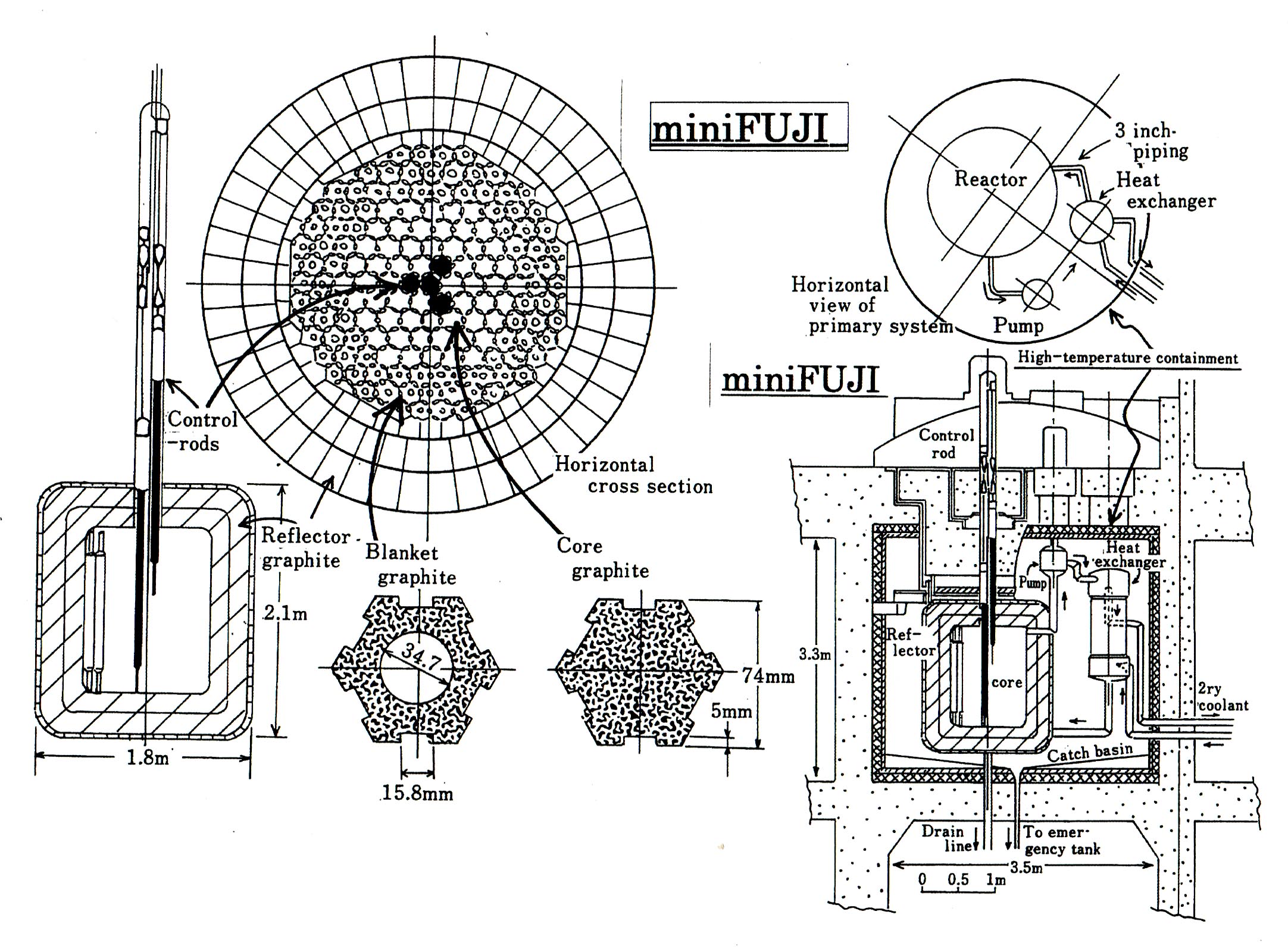
IThEMS represents the first serious attempt to found a business intended to produce Molten Salt Reactors. Dr. Kazuo Furukawa, the designer of the FUJI and Mini-FUJI reactors, has made the realistic decision to use Oak Ridge National Laboratory proven technology, in his initial reactor designs. Although many observers believe that it would take a generation or more to develop mature Molten Salt Reactor, in fact theORNL Molten Salt Reactor Experiment demonstrated that a working MSR was possible with no further R&D investment. The simplicity of the MSR makes quick development and commercialization possible. Thus the IThEMS estimate that it could put a small commercial reactor within 6 years in not unrealistic.

Dr. Kazuo Furukawa is back in Japan, and has sent me a number of interesting documents, The most interesting of which is titled IThEMS Outlook. This document included information on a number of interesting topics including a Memorandum of Understanding between International Thorium Energy & Molten-Salt Technology Inc. (IThEMS), and a number of parties from the Czech Republic who have a prior interest in the development of molten salt nuclear technology.

IThEMS expects further technology development in such areas as:
1 Fuel-Salt loop technology including necessary component tests,
2 Coolant-salt loop technology including necessary component tests,
3 Structural material development and some main components fabrication,
4 Main components design, fabrication and tests,
5 Other relating items technology development.
At last report, IThEMS was also looking for an American business partner, but no possible American partner is mentioned in the IThEMS Outlook report. IThEMS Outlook does report the Mini FUJI business plan.

The plan calls for a Mini-FUJI Reactor R&D investment of $300 million over a 6 year period of time, with sales beginning in the 5th year. By the 7th year sales are anticipated to reach the level of 50 units a year, and that is expected to reach 200 unites a year by the 10th year. Mini-FUJI reactors are expected to produce 10 MWe and sell for $60 million. The initial manufacturing cost is anticipated to be approximately $40 million, and that figure is expected to drop to $30 million as production rises. Sales are anticipated to reach $12 Billion by the 10th year, with an assumed gross profit from sales of 30%. Thus the potential after tax income of IThEMS would run to $2.5 billion. And this would be before IThEMS brings its major product, the 200 MWe FUJI reactor to the market.

Power from the Mini-FUJI is expected to cost $0.061 per kWh to produce, with an anticipated retail cost of $0.11 per kWh in the United States, and $0.22 per kWh in Japan. It should be noted that the mini-FUJI is a micro scale nuclear generation unit that is not intended to produce base load electricity for the grid. The FUJI is intended to produce base load electricity, and can be expected to sell for considerably less per kWh than the Mini-FUJI, yet it still could make a very large profit. Projecting sales figures out another decade, IThEMS could have $200 billion a year in sales, and profits as high as $60 billion, making it, if everything goes according to plan, the largest energy business in the world.

Not I am not claiming that IThEMS will end up as a $200 billion a year business, only that it could if everything goes according to plan. Things, of course, seldom proceed as planned, without some hitches, but IThEMS does have prospects.
Tuesday, October 26, 2010

Dr. Furukawa and Mr.Fukushima Reveal Future Fuji Reactor Plans at ORNL

Monday Afternoon, I drove to ORNL to hear a presentation by Dr. Kazuo Furukawa and Keishiro Fukushima of the "International Thorium Energy & Molten-Salt Technology Inc." (IThEMS). Dr. Furukawa is a distinguished Japanese nuclear scientist who for over a generation has worked to keep international interest in Molten Salt Reactors alive. IThEMS is a vehicle for launching Dr. Furukawa's Fuji reactor technology. Dr. Furukawa and Mr. Fukushima are looking for investors and development partners. They want to build their first prototype, the 10 MW Mini-Fuji in the United States with an American partner doing the prototype construction. The Mini-Fuji is a practical project because uses technology developed at ORNL for the Molten Salt Reactor Experiment (1965-1969). Thus the little research would be involved in prototype development. IThEMS business plans call for the Mini-Fuji prototype to be operational by 2015 and for a larger 200 MW Fuji reactor to follow by 2020. IThEMS plans to market both reactors.

Mr. Fukushima stated that IThEMS is negotiating with Korean Shipbuilders over the potential sale of Mini-Fujis for ship propulsion systems. According to Mr.Fukushima the Korean shipbuilders are in competition with the Chinese, and view mini-Fuji power as potentially offering a competitive advantage. It should be noted that in the long range energy picture decarbonization would require that fossil fuel powered engine technology be replaced by energy from non-carbon emitting source. The options appear to be nuclear power, or synthetic liquid fuel. IThEMS claims that it can build the Fuji for 30% less than conventional water cooled reactors. Thus ship propulsion would appear to represent a market opportunity for the Mini-Fuji. Industrial process heat would be another. The Mini-Fuji would also serve as the energy source for a stand alone nuclear battery system, although that field looks crowded at the moment. The Mini-Fuji would have some advantages over its competitors including superior safety and low cost.

I offered to have lunch with Dr. Furukawa and Mr.Fukushima today, but they were headed south and would be, I surmise, talking with a potential business partner.

Investing in or partnering up with IThEMS would certainly have its risks. The upside for the investor would be to make a ground floor investment for a potentially huge Molten Salt Reactor market. The down side is that IThEMS is basically a start up with no money and no resources. All it really has is an idea and Dr. Furukawa's name.

The Mini-Fuji represents a potential opportunity for the American prototype development partner. First Dr. Furukawa's name does mean something and it offers an entry to a number of research laboratories in Japan, Russia, and Central and Western Europe. Participating in the Mini-Fuji prototype development would be a great opportunity for anyone who wanted to get into the Molten Salt Reactor business. Even if the Mini-Fuji failed as a business opportunity, the prototype development experience could prove invaluable for anyone who was interested in further MSR development.

Friday, July 23, 2010

Fuji Project Seeks $300 Million in Funding for Thorium Molten Salt Reactor Development

The International Thorium & Molten-Salt Technology Inc. (IThEMS),, is incorporated in Japan to advance LFTR development. Its principals include, Dr. Kazuo Furukawa long time Japanese Molten Salt Reactor Researcher whose name is closely connected to the Fuji Reactor concept. Former Japanese Senator, Keishiro Fukushima is the founder and CEO of IThEMS has just announced that it is seeking $300 Million to finance the development of Dr. Furukawa's Fuji reactor. With regard to large amount of plutonium stockpile as resultant product from long period nuclear reactor's operation, with high-level nuclear waste as byproduct, this problem has been surely significant burden to be resolved to every country concerned. In its recent press release IThEMS states:
On July 7, 2010 Professor Kazuo Furukawa, the head of the NPO "International Thorium and Molten-Salt Forum" has announced that a new company which aims to produce a commercially viable thorium nuclear power generation was established. The goal is to make a thorium nuclear power generator capable of producing 10,000 kilowatts and 20,000 kilowatts of electricity for the next five to ten years, respectively.

The company which was established in June is called, "International Thorium Energy & Molten-Salt Technology Inc. (IThEMS)." Its office is in Chiyoda-ku, Tokyo (tel. no. +81-3-3239-2595) with a capitalization of 2 million Japanese yen*. Its president is Mr. Keishiro Fukushima. A total of 300 million US dollars of capital coming from domestic and international companies and investors will be procured in order to produce a small-scale electric generator producing 10,000 kilowatts of electricity within five years.

This generation technology utilizes and involves fluoridized molten-salt to dissolve fluoridized thorium and other materials as liquid fuel. Uranium is not used, thus it is regarded as a safer alternative. Professor Furukawa serves as Chairman and Director of Laboratory of the new company.
IThEMS tells us,
Particular attention to Th-MSR is getting increased due to the fact that Th-MSR has no plutonium production, much less high-level nuclear waste and function of burning plutonium for its elimination.

Such idealistic new power generation system of Th-MSR begins to draw attention from various countries in the world, in view of the nuclear proliferation and terrorism resistance, and safe and stable supply of low cost clean energy which the world significantly demands.
Professor Furukawa believes that the Fuji Reactor can produced electricity at the price of 10 yen/kWh. Dr. Fukushima's cost estimate would make the cost of the Fuji competitive with conventional reactors. But the Fuji is a thorium breeder, and breeder technology is usually considered more expensive than conventional nuclear power plants. There is little doubt that the Fuji can be built. It takes advantage of of ORNL's work on the Molten Salt Reactor Experiment, as well as ORNL's Molten Salt Breeder Reactor R&D work. If there is a flaw in the Fuji concept, it is that the Fuji reactor adheres too closely to ideas ORNL developed 40 years ago, and does not pay sufficient condition to the demands of a potential global market.


What the world wants is a quickly built, low cost reactor. Quick construction requires the use of extensive factory as opposed to field labor. Low cost also points to a factory manufacturing setting. Factory construction would mean transportation to the customer. There are three transportation options for factory produced reactors: By truck, by rail and by barge. International and costal water shipping can also be accomplished by commercial cargo ships. Land transportation points to relatively small reactor size. The overland transportation of large reactor components such as steam generares can be monumental engineering chores.

http://nuclearstreet.com/images/img/steamgen04.jpg

Rapid field construction is also facilitated by reducing the number of parts required to be assembled. All of these factors tend to push designers of factory produced reactors toward a relatively small. light weight reactors. Fuji designs appear to call for a fairly large and complex plants for its electrical output, suggesting that it has not fully evolved toward the factory produced reactor model yet.


The Fuji design could certainly be factory produced. But many aspects of the Fuji design could be reconceptualized to lower costs. For example, the reactor and its attached processing units could be moved under ground. The rest of the facility can be based on a recycled fossil fuel powered generation facility. Other aspects of the design could be simplified and streamlined into a small number of factory producible units. In addition IThEMS has a 8.6 MWe mini or nuclear battery design.

IThEMS has a long term plan that involves a three step approach to development. In the first step, a small MSR prototype will be developed.

The prototype embodies Furukawa's life time of research on MSR design. The Fuji concept calls for what could be described as a single fluid design but with added complexity. It has a long history of gentation, and will probably be the first of several attempts to translate the Molten Salt Reactor into a viable post carbon energy option. Professor Furukawa ambitions are nothing if not grandios. He envisions the Thorium breeding Molten Salt Reactor (the LFTR) to grow into
an industry as large as 10 trillion US Dollars (1,000 trillion Japanese yen) [by] 2060.

Followers

Blog Archive

Some neat videos

Nuclear Advocacy Webring
Ring Owner: Nuclear is Our Future Site: Nuclear is Our Future
Free Site Ring from Bravenet Free Site Ring from Bravenet Free Site Ring from Bravenet Free Site Ring from Bravenet Free Site Ring from Bravenet
Get Your Free Web Ring
by Bravenet.com
Dr. Joe Bonometti speaking on thorium/LFTR technology at Georgia Tech David LeBlanc on LFTR/MSR technology Robert Hargraves on AIM High