
Showing posts with label Lowering Reactor Costs. Show all posts

Thursday, July 23, 2009

A Concluding Unscientific Preface to the Keys, Revised

I began my thinking about reactor manufacture some time ago. There are enormous drawbacks to on site manufacture. First it is a crafts-labor intensive form of manufacture. Craftsmen swarm over the site performing all sorts of tasks. We have pipe fitters installing pipes, welders welding, electricians installing miles of wiring, carpenters building forms. Rebar being installed, forms placed, and concrete poured. Workers are constantly shifting within job sites; they have no assigned station at which tools can be kept handy. Workers require frequent assignment and direction in performing their tasks. Supervisors must constantly move back and forth from their superiors to their subordinates relaying messages and assignments, and monitoring work for progress.

Workers are assigned tasks for which they are expected to use their general repository of work skills, but the tasks may not be performed up to speck, and the supervisor does not have time to notice it, because he or she is too busy moving back and forth, between project managers relaying assignments and information.

Lets look at what can happen. Take the Olkiluoto-3 reactor construction project in Finland. The story is well known: “Flawed welds for the reactor's steel liner, unusable coolant pipes and suspect concrete in the foundation.” The massive construction project is already more than two years late and 25% over budget. An investigation revealed ”The power plant vendor has selected subcontractors with no prior experience in nuclear power plant construction to implement the project. These subcontractors have not received sufficient guidance and supervision to ensure smooth progress of their work.”

This was hardly surprising. Any construction project of that size is an opportunity for human error to flower. Investigators reported:
“[T]he specific quality requirements for constructing a nuclear power plant were not clearly brought up when inviting tenders on concrete supply. The process of designing the concrete composition, concrete manufacturing and the respective quality control measures involved problems in accountability and communication because there were many subcontractors. There was no manager on site with an overall responsibility for the preparation of the base slab and an authority to issue binding orders to all parties. Problems had arisen during minor concreting performed on site, but they did not result in measures for ensuring the smooth implementation of the main concreting. The approved concrete composition was altered during concrete mixing. Deviations in the concrete composition and in concrete pouring were not addressed openly and without delay.”
The root cause then was that no reactor had been built in Finland since the 1980’s, hence no one had experience building a big reactor, and no one really knew what he or she was doing. Furthermore the project clearly got out of control of its managers. The history of reactor construction in the United States and Canada has been one of a consistent pattern of construction taking longer than scheduled, and costing more than planned. Consider now that in the United States, with the exception of TVA and its contractors, no electrical utility has experience with reactor construction in a generation, and the prior performance of utilities was, to say the least, not encouraging. Since the NRC licensing will not be completed for the first reactor project before 2012, the earliest any of the current proposed reactors construction project can be expected to come on line is 2015. Hence we might expect to begin reaping a practical benefit from reactor construction experience about 2015. Hopefully, short, or at least shorter construction periods will teach begin to teach everybody involved by actually doing the work of constructing reactors and learning something from the experience.

Even if accomplished perfectly on site. construction of reactors is expensive and probably always will be. Reactor construction methods are in some cases use technologies that were known to the Romans. Such construction relies on skilled human power, rather than mechanized manufacturing approaches. Thus in an era of increasing construction costs, it become increasingly expensive to build reactors as construction rather than manufacturing projects.

Westinghouse estimates that the construction of AP-1000 reactors require between 16 and 20 million man hours of labor, most of which will be performed by skilled laborers. The most skilled workers for a construction project of this scale would be the engineers and managers who are organizing the work schedules, and assuring a constant flow of up to spects materialsonto the job site. Thus a 1 GW reactor is a massive construction project that requires enormous amount of skill at every level of the project from the utility management to the welders and pipe fitters. In order for a construction plan to work both those who make the plan and those who carry it out must have a precise understanding of what they are doing. Even with perfect planning and organization, the skill level required of workers, the amount of labor involved, and the relatively low degree of mechanization will insure that reactor construction labor costs will remain high.

John Geesman, a former Commissioner and Executive Director of the California Energy Commission, recently wrote a series of essays on the Congressional Budget Office recently released study of nuclear power. While the CBO's study appears flawed, nuclear advocates ought to pay attention to its conclusion, and Geesman's essays (found here, here , here, and here.)

In fact the CBO report reflected a great deal of uncertainty about reactor construction costs. The report noted a range of projected reactor costs from 1.2 to $4.8 million per installed megawatt. and stated: “The breadth of that range reflects the uncertainty associated with the cost of building new nuclear plants in the United States, and is wide enough to capture plausible further increases in construction costs.” Thus inflation was factored in. Critics of nuclear power have ignored the inclusion of inflation in CBO reactor cost estimates, never the less the CBLO report highlights the need to take major steps to control the cost of nuclear power.

It is my view then that the custom, on site manufacture of large reactors by teams of craftsmen under divided and multilevel supervision is an expensive manufacturing system that invites human error. I have not even considered her the possibility for corruption entailed in this construction system.

One of the major arguments against nuclear power as a major replacement of fossil fuel generated electricity, is simply that the difficulties of manufacture, the slow pace, the labor requirements and the cost all conspire against the construction of enough reactors to quickly enough to effectively replace fossil fuel power plants by 2050. It might beaded, that the prospects for windmills replacing fossil fuel generators, are dismal, and the prospect of PV and CSP replacing fossil fuels rely on the same sort of massive construction projects that raises questions about the future of nuclear power.

The question then if I start with a blank piece of paper, or in my case a blank computer screen with the word “Word” in the upper left menu bar, and a self imposed mandate to replace fossil fuel power with post-carbon generated electricity by 2050, how should I proceed?

I felt that several goals were important:
1. Decreasing reactor cost
2. Rapid manufacture
3. The production of as many reactors as were required to replace the use of fossil fuels as energy sources for our society.
4. The highest possible level of reactor safety
5. Resolution of the problem of nuclear waste.

Dr. David L. Goodstein the vice provost, and a professor of physics and applied physics at the California Institute of Technology, published a book titled “Out of Gas: The End of the Age of Oil” in 2004. Goodstein argued that 10,000 (1 GWe) nuclear power plants to replace all the energy we are currently getting from fossil fuels for all purposes, and expresses a justifiable skepticism about our society’s ability to accomplish this goal, at least justified given the way we do business now.

Environmentalist Joe Romm has also recently argued that there would be serious problems replacing fossil fuel power plants with nuclear generated electricity. Romm argues that problems like high reactor construction costs, manufacturing bottlenecks, the slow pace of reactor manufacture, the limited supply of key reactor parts, and alleged water shortages, an alleged shortage or Uranium, and difficulties associated with the supposed problem of nuclear waste, are going to limit the futuire of the nuclear industry.

It is my view that a rethinking nuclear power is required to answer Goodstein's and to a certain extent Romm's arguments. The rethinking assumed that we would need 10,000 GWs worth of electrical generating reactors by 2050, and that goal is achievable is we take certain well defined steps to attain it. In order to accomplish the goal we must change the way we do business in order to accommodate our new circumstances. We must move beyond business as usual if we are going to replace fossil fuels as sources of energy. Changing the way reactors are built is both possible and necessary.

Update July 23, 2009: Some concluding observations

Using Data from the DoE's Energy Information Administration, the Institute for Energy Research has concluded that the 2016 levelized cost of renewable electrical generation sources will carry higher levelized cost than conventional nuclear generated electricity. Thus if the cost of nuclear generated electricity is unacceptably high, the cost of renewable generated electricity is even more unacceptably expensive.
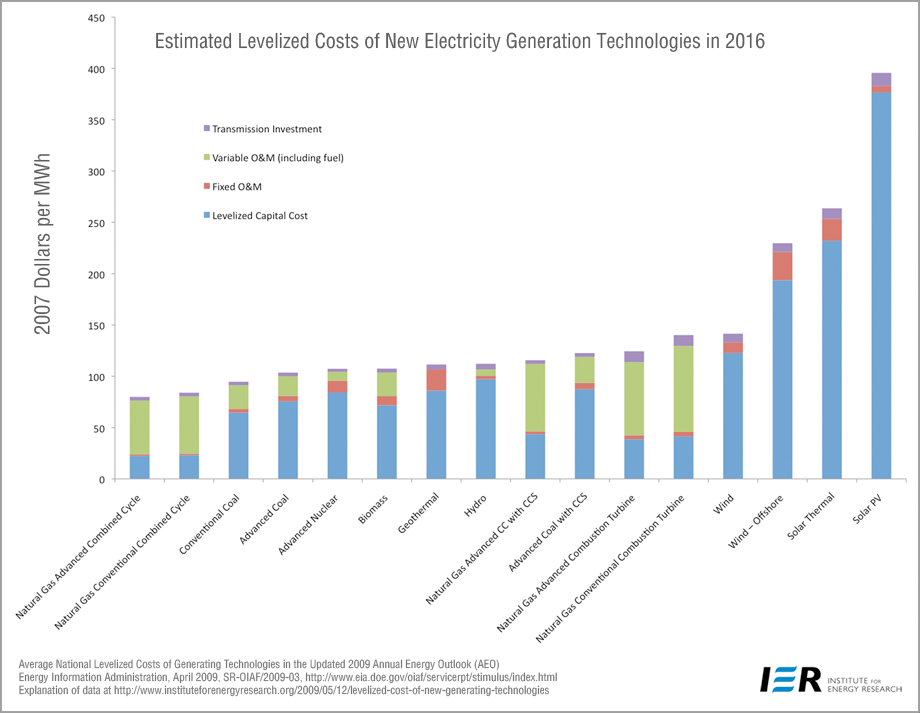
I have chosen to not disagree with the critics of Nuclear power about the various flaws in the current system of nuclear generation of electricity. I do disagree with the contention that the flaws in current nuclear generation technology are fatal, or justify a rejection to current nuclear technology. Rather the flaws of current nuclear technology justify the development of an improved nuclear technology, one whould overcome current flaws. I have pointed to LFTR technology, a radical nuclear technology that might be nothing less than the silver bullit, which energy experts allege does not exist. In the "Keys" series i pointed to approaches to LFTR implementation that would lead to a levelized cost for LFTRs that is far lower than the levelized cost of new conventional nuclear plants. The actual cost of LFTRs will not be not be known for some time to come, but in my "Keys" series, i have demonstrated that there are good reasons for the hope that the levelized cost of LFTR electrical generating facilities will be far lower than the levelized cost of conventional nuclear power pants. Further research will help to establish the accuracy of this picture.

Wednesday, July 22, 2009

The Keys to Lowering Reactor Cost: Some Siting Considerations

Since I wrote this post, my thinking has turned to the use use of LFTRs to re[;ace natural gas fired turbines and combined cycle generators. David LeBlanc's suggestion which was also found in an old ORNL research report, was that stainless steel and other low cost materials could be used in the LFTR with a relatively modest performance penalty in exchange for a cost advantage. It occurred to me, that given the LFTR's already modest cost, that a low cost LFTR could easily replace natural gas generators as peak power producers. I called the Peak generation LFTR the "Big Lots" reactor, after my favorite bargain shopping haunt. The LFTR's negative co-efficiency of reactivity gives it the unique ability to shut off while at maximum coolant temperature. Thus the LFTR enters peak reserve ready to almost instantly spin its turbines to maximum output levels. Thus natural gas fired power plant sites would also be available for LFTR conversions. LFTRs and be air cooled, thus the availability of coolant water would not be an issue, and LFTR can generate electricity at a lower cost than natural gas generation system.

When I first saw Jim Holm's web page, I thoughts what a crazy Idea. Jim wants to convert coal burning power plants into pebble bed reactor sites. The more I think about Jim's idea, the more it makes sense to me. Jim has clearly thought a lot about the problem and siting is a big issue. Jim proposes that the pebble bed reactors be built under ground at these old power plant sites.

There are, of course alternatives to underground siting. Kirk S. wants to site reactors under water. Actually there are actually quit a lot of mobile reactors sited underwater already. They provide the power for atomic submarines. So there are no real technical problems with Kirks concept. Kirk wants to place his under water reactors off shore. Power would be sent to land by a submerged power cable. Unlike atomic submarines the reactor would be unmanned. Remote operators would perform whatever controlling functions would fall to the operators. As I have already noted human control is a major problem for nuclear safety. Thus reactor safety is best handled by the inherent safety features of the LFTR.

Underwater siting would work if for reactors located on the Atlantic, Pacific or Gulf Coasts and for reactors located on the Great Lakes, but It would not work for Utah! Thus even if we locate all our coastal reactors under water we still need to build inland reactors, and there are siting issues. That is where underground sites come in. I will talk more about them shortly.

One major advantage of recycling old power plant sites is that it eliminates the grid hook up problems. Every power station needs to be connected to the grid. In some cases the grid may require significant and expensive modifications to accommodate power from a new power station. This is the case for new nuclear power plants as well as wind farms. Added grid capacity can be expensive, in some cases running to billions of dollars.

To the extent possible, in a crash program to replace old power plants with nuclear generated power, we might want to avoid secondary expenses related to the grid. Later on we might want to upgrade the grid, but the major goal is to stop producing CO2 as quickly as possible, and that is where the investment dollars should go. In addition the old power station is a site that is partially prepared. There maybe useful structures on the site, and the site is laid out for the generation of electricity.

We can see some of the important features in the pictures of TVA's Bull Run Steam plant. I wanted my readers to notice the especially beautiful lake side setting. There is a problem with that setting, however. If you intend to site a reactor or reactors underground, the first question you would have to ask is about the water table. There is a lot of limestone in the area of the Bull Run plant, and I suspect that you would not have to dig very deep to find subsurface water. An under ground reactor that is underneath the Bull Run Steam Plant might end up also being under water, but I do not think that is what Kirk has in mind for his under water reactor sites. So right off we have a problem with the site, but note the adjacent ridge. The inside of the ridge is also underground. Now the ridge may be above the water table, but there may still be a water problem. The ridge is probably limestone, and water may be trickling through it when it rains. It well may be that the Bull Run site is not suitable for underground construction, in witch case you might have to go with plan C. That would be to build a massive containment structure or structures above ground. The Bull Run plant is currently rated at 870 MW. That means that the grid hookup could handle the power generated by up to 9 small 100 MW reactors. Waterside settings for power plants are not at all unusual because even coal fired power plants require cooling water, and locations by rivers and lakes frequently means high water tables.

Aside from cost savings, why then should we think about underground settings? The use of underground reactor sites was originally Edward Teller's idea, and Teller was very much a man of ideas. Teller was truly a nuclear safety pioneer. In the late 1940's Teller was the first chairman of the AEC's Reactor Safeguards Committee. Teller was also concerned about global warming. He warned the 1957 ACS meeting about the CO2/global warming problem. The discovery of the natural underground reactors at Oklo, in Gabon, Africa interested Teller. Teller noted that the fission products produced by the Oklo natural reactors had not moved in over a billion years, and had long since ceased to be dangerous. Teller came to believe that underground siting was the ultimate answer to the problem of nuclear safety. He advocated that reactors be buried at least 200 meters under ground. He was not alone in holding this idea. Andrie Sakharov wrote in his Memoirs, "Plainly, mankind cannot renounce nuclear power, so we must find technical means to guarantee its absolute safety and exclude the possibility of another Chernobyl. The solution I favor would be to build reactors underground, deep enough so that even a worst case accident would not discharge radioactive substances into the atmosphere.”

Other research has shown that underground reactors protect against:
* Attacks by aircraft
* Other forms of terrorist attacks,
* Sabotage and vandalism
* Radiation release in the event of an accident

Teller assumed a deep (200 meters) reactor setting. Research conducted during the 1970's, however concluded that there were cost penalties connected with deep reactors. This conclusion ought to be assessed in light of current construction costs. Wes Myers, and Ned Elkins suggested that past cost research had not evaluated siting in underground salt formations.

Myers and Elkins favored salt formation settings and noted some of the cost benefits:
* Decommissioning costs,through in-situ decommissioning and
disposal
• Transportation costs,through co-located storage/disposal facilities
• Excavation costs, which are ~$20/m3 in salt vs~$40 to $80/m3in
granite
• Facility costs,through elimination of the containment structure
• Reactor costs,through the use of modular reactor
• Site costs for successive reactors, due to the lack of constraints on
lateral expansion in the subsurface
• Security costs, because of the need for fewer guards and physical
protection measures
• Insurance costs,through reduced health and property risks

There would, of course be ways of indirectly recovering the cost of excavating granite. The mined granite could be processed for Thorium. The recovered thorium then run through LFTRs, and the power produced would more than pay the cost of mining, but this approach does not lower upfront costs, and for the near future there are less expensive ways to recover thorium.

It should be noted that Ralph Moir was able to talk Teller into a shallow underground setting for LFTRs, when they collaborated on Teller's last paper. (See Thorium fueled underground power plant based on molten salt technology, Ralph Moir and Edward Teller, Nuclear Technology 151 334-339 (2005)).

Underground siting does hold some promise for limiting siting costs. However, problems such as the presence of ground water should be considered. Siting in salt formations, and in old salt mines holds promise. Underground siting could provide superior protection against attacks by suicide aircraft, and other forms of terrorism. In addition it could provide a means of containing radioactive materials in the event of reactor accidents. Underground siting would be appropriate for smaller Generation IV reactor such as the PBR and the LFTR and has been proposed for both of them. Underground siting then is an interesting and promising option for advanced reactors that requires further research,

Tuesday, July 21, 2009

The Keys to Lowering Reactor Costs: Nuclear Waste

I am at present satisfied that this discussion of the potential effects of the LFTR on the cost of handling nuclear waste presents an adequate picture.

The problem of "nuclear waste" is one which is generated by nuclear technologies which fail to efficiently convert U-238 into nuclear fuel. The ultimate source of the problem is found in the uranium-plutonium fuel cycle, and in the use of reactor technology which fails to burn Pu-239 efficiently, and in fuel cycle technology which fails to efficiently, and cleanly reprocess nuclear fuel in a cost effective fashion. As a consequence of the systemic fuel inefficiencies, added facilities for the handling of used nuclear fuel must be added to reactor construction cost. The nuclear industry regards paying the added construction expenses as preferable to paying for fuel reprocessing, However, since we are taking the "full court press" in examining cost lowering measures to reactor construction, the cost of fuel storage facilities is certainly an issue.

In my previous "keys" postings, I found advantageous in both the PBR and the LFTR as far as cost savings are concerned. But the LFTR has a major advantage in terms of a need for post-reactor fuel storage facility costs, and indeed in virtually every aspect of the fuel cycle. About 98% of the Thorium that enters a LFTR is burned up inside the reactor. The other 2% will come out as Neptunium 237, which has a use. In once through uranium cycle civilian reactors, Most of the original fuel charge remains unused when the fuel is withdrawn from the reactor. In addition significant amounts of the fissionable materials remain in the "spent" fuel, and their presence becomes an issue in post-reactor fuel handling. Post reactor fuel handling is a problem for LWRs and for PBRs. And if anything there are more problems in reprocessing post-reactor fuel from Pebble Bed Reactors, than in reprocessing fuel from LWRs. (Kirk Sorensen discussed LFTR fuel reprocessing here, and here.)

There are, however, added fuel handling expenses that come with LFTR technology. The fuel/carrier/coolant salts of the LFTR are in most designs subjected either continuous or periodic processing. The design requires that several sorts of processing should take place. Each process would require a separate processing unit. These fuel reprocessing units would add to the expense, and complexity of the LFTR. In addition they would create safety issues, and there would be significant problems with servicing and maintaining them.

The economics of fuel reprocessing with LFTR is, however, complex. The reprocessing of LFTR involves the extraction of fission products which are valuable minerals and metals. This in tern creates a second revenue stream from the LFTR, the sale of valuable fission byproducts. While it is doubtful that this revenue stream would by itself return all of the capitol costs involved in LFTR fuel reprocessing, it would at least produce a partial return on the capitol investment, beyond revenues produced by the generation of electrical power.

There are hidden advantages that effect reactor construction costs. By solving "the problem of nuclear waste," the LFTR would go a long way toward undercutting public opposition to nuclear power. If nuclear power is more acceptable to the public, investment risk diminishes. Diminished risk means lower capital costs. Hence the superior fuel processing features of the LFTR may in fact indirectly lower reactor construction costs. It would most certainly lower nuclear fuel cycle costs. There is a public relations benefit to constructing what is perceived as being clean or at least cleaner nuclear power. That benefit does have a cash value, even if it is not directly accounted in assessing the cost of reactor construction.

Followers

Blog Archive

Some neat videos

Nuclear Advocacy Webring
Ring Owner: Nuclear is Our Future Site: Nuclear is Our Future
Free Site Ring from Bravenet Free Site Ring from Bravenet Free Site Ring from Bravenet Free Site Ring from Bravenet Free Site Ring from Bravenet
Get Your Free Web Ring
by Bravenet.com
Dr. Joe Bonometti speaking on thorium/LFTR technology at Georgia Tech David LeBlanc on LFTR/MSR technology Robert Hargraves on AIM High