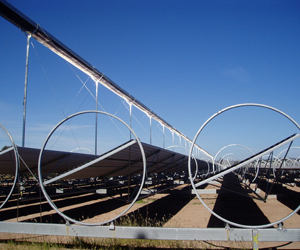
 David R. Mills The Chairman of Ausra, Inc., a developer of concentrated solar power technology, has made some very astonishing claims about the potential costs of his compact linear Fresnel reflector technology
. Indeed,
compared to other CSP technologies, compact linear Fresnel reflector would appear to require far lower material inputs and with them lower construction expensis. Mills claims
The current cost of a CLFR system is approximately US$3000 per kW; we believe it will drop rapidly to US$1500 per kW within a few years as a result of a numerous technical improvements already identified. At a future estimated cost of $1500 per peak kilowatt, this is ($672 - $1456 billion)/0.93 (the 0.93 because we only supplied 93% of power in the case calculated), or about $723 - $1566 billion in capital investment to provide a grid which supplies the great majority of static and vehicular loads.
While I have dismissed most claims about Concentrated Solar Power, i am reserving judgement about Mills claims until demonstrations and cost data from actual projects become available. Elsewhere
Ausra has claimed that it can deliver its CLFR system @ 10.4 cents per kWh with prices dropping to 7.9 cents in three years. Yet Ausra will not tell us how much its 5 MW Bakersfield demonstration facility will cost, but it is reported that Ausra raised &60 million in October to complete the Bakersfield facility, in addition to the $40 million it raised last year. Investors include KERN Partners, Generation Investment Management, Starfish Ventures, Khosla Ventures and Kleiner Perkins Caufield & Byers. According to Ausra, "confidentiality agreements" prevent it from revealing how much the Bakersfield facility actually costs.
Ed Ring of ECOWorld has come up with some interesting numbers on Ausra costs:
Ausra’s Kimberlina (Australia) plant cost $15 million and produces 5.0 megawatts, a cost of $3.0 million per megawatt. Ausra’s planned Carrizo plant, intended to produce 177 megawatts at a cost of $500 million, is estimated to come in at $2.8 million per megawatt. . . . Ausra’s estimated capacity factor, in the only slightly less hot and sunny southern San Joaquin Valley is between 18% and 22%.
Ring has also come up with some information on land use with Austra technology:
Ausra’s Kimberlina plant, at a slightly lower 1,800 full-sun-equivalent hours per year, but a much higher output of 320 megawatts per square mile in full sun, can generate an impressive 576,000 megawatt-hours per square mile per year. Ausra’s planned Carrizo plant, at full scale, projects a somewhat lower 206 megawatts per square mile in full sun, but that still equates to 370,000 megawatt-hours per square mile per year. . . . Ausra’s Carrizo solar field, megawatt-hour vs. megawatt-hour, will consume literally ten times less land than Optisolar’s Sarnia solar field, should not be lost on anyone considering desirable options for utility scale solar development.
This is impressive coming from
Ring who is one of the few sober and reliable observers of the renewables field.
Does Austra's technology represent a breakthrough that is going to make make concentrated solar power a viable replacement for coal, at least in reliably sunny places like the Southwest? We can go to the paper by Austra's David R. Mills (and Robert G. Morgan), and look at the system in greater detail. Mills makes some interesting observations about the generation dynamics of solar power. First the amount of solar heat input into a concentrating system varies by the time of day with maximum heat coming at noon (surprise). Thus if the generator is capable producing 5 MWs at noon it will begin producing 0% of capacity at dawn, will gradually rise to 100% of capacity at noon, and drop off again to 0% of capacity at dusk. Mills and Morgan are so confident of the viability of their concept that they propose to double the heat collection of their system without increasing generator rated capacity. That means that heat input for a considerable pat of the day will exceed the ability to use the heat to to generate electricity at noon. The choice would be to either dump the exra heat or to store it. Storage would be desirable because that would allow power to be generated on demand independently, rather than depending on sun shine.
Mills and Morgan claim,
Very low cost water-based thermal storage is expected to be commercialized within two years using (our?) own technology under development. Thermal storage can actually lower kWh cost because it reduces turbine size required for a given thermal output. In STE designs using storage and no fuel, there is long term also immunity from fuel cost rises.
How much storage do they need to give overnight base load power? Mills and Morgan claim that by tripling their heat gathering installation they can they could store enough energy to provide 16 more hours of electricity. Thy believe that with this system they can satisfy California's energy demands for most of the year. Winter electrical generation would, however be a problem, with a shortfall likely due to the shorter solar day. In Texas the tripled system would encounter shortfalls during both summer and winter, and the gathering system would have to be quadrupled in order to cope with summer peak demands.

So how much is this going to cost? Mills and Morgan are very circumspect about what they tell us. They toss out figures like $3000 per kW with out tying that figure to a capacity factor. I am going to make an educated guess that the $3000 figure is for am around .20 capacity factor system with no storage. Since Ausra’s Carrizo solar field only produces 2/3 the electrical output of the Bakersfield facility per land unit, some energy storage is probably involved. How much? We don't have a hint. Mills and morgan claim technological improvements are in the offing, that will have the cost by KW of output. The most likely way to accomplish this would be by improvements in gathering technology. So either they intend to double energy capture per unit of output through a 33% improvement in capture technology and a 50% increase in land use, or they are going to store a rather modest amount of energy that would allow some power generation on demand.
So how much is base load electricity going to cost using Ausra technology. We can start but taking the$3000 figure and calculating the cost of tripling electrical output. That would take us to $9000. Ouch, that would be overnight costs. If we project things out 5 years, inflation would take us to somewhere around $18,000 per kW. Ouch! Ok let us go to the lower $1500 per kW figure with technological advances. Unfortunately we don't know how that figure is calculated. If it is calculated on the basis of the Bakersfield system, that means that Mills and Morgan believe that with improved technology they could deliver the Bakersfield system at half its current price. If this is a claim about the 3x gathering capacity system it would indeed be impressive, but if we assume the Bakersfield facility is the referent then a 3x facility would come to $4500 per kW, about the current overnight costs for nuclear plants.
There are some other disadvantages. According to information in the Mills and Morgan paper, the 3x California facility would operate at from a little more than 40% of capacity to somewhat more than 60% of capacity depending on the time of the year. This compares to the average of 92% capacity for todays nuks. Thus at the same price the nuclear power plant with the same nameplate output rating would produce significantly more power over a given period of time.
There is an old Jewish saying, "If you are planting a tree and you hear that the Messiah is coming, don't go check on it until you finish planting the tree." Mills and Morgan wrote their paper at a time when they were beating the bushes for money. They had a considerable interest in presenting the best possible case for their product. Yet at the same time, they have a responsibility to potential investors to not misrepresent the risk they might be incurring. They, of course did not mention the taboo word "inflation". That word only applies to the cost of nuclear power plants, and it is absolutely forbidden among renewable supporters to mention inflation in connection to the future cost of renewables, while the same word must always be mentioned in connection with the terrible, horrible nuclear power plants. Mills and Morgan have, of course, honored that tradition. Hay, Kleiner Perkins Caufield & Byers have economists. on staff or under contract They know the score, or at least they should. They should know how to figure things out. Unfortunately, Kleiner Perkins Caufield & Byers' judgement has not been to good lately, and having a would be "soft path" energy provider walk hand in hand through the door with Amory Lovins, might count little to much in their reckoning. We shall see how the Ausra story unfolds.



 Posts
Posts


