Showing posts with label natural gas. Show all posts

Thursday, May 19, 2011

Will Natural Gas Save Us?

My message to the BRC became my latest post of the Energy Collective yesterday. It has not collected many readers so far, but it has collected several comments. Kiem commented,
"Disruptive innovation, disruptive technology is called for."

We have it already, its called shale gas. There is so much shale gas it will provide for our needs for the next 200 years. It is everywhere and it is cheap cheap cheap! Wahoo!
I responded,
Kiem, you are right that the story is being told that shale gas is disruptive, however, other stories are being told and they have not been disproven. The stories are that the shale gas reserve is a whole lot less than claimed.shale gas is not nearly as good for carbon mitigation as claimed, and that shale gas is not good for the aquifer water supply. Until these stories are demonstrated false, shale gas cannot be 100% relied on.
Geoffrey Styles responded,
Charles,

Even if all those caveats were correct, and I have reason to believe they're not, shale would still be disruptive, because it is already disruptive. To wit, the quantity of shale gas already being produced, contributing roughly a quarter of US gas output today, has in just a few years: reversed the seemingly inevitable growth of US natgas imports, slashed domestic natgas prices--in the process altering the global market for LNG and enabling gas-fired power to capture significant market share from coal--created a realistic possibility of displacing part of our oil use in transportation with gas, and made some wind power installations less attractive. That's as disruptive as anything I could have imagined a few years ago for this time frame.
Geoffrey usually has good sense, but I cannot agree with these contentio0ns. However, Even if fraking accomplishes everything expected of it by the UnitedStates Energy Information Agency, and the EIA offers by far the most optimistic estimate of farkings impact on future United States natural gas production, fraking will do little more than prevent the decline of the United States's natural gas production. Conventional gas production has already peaked in the United States. Geoscientist, David Hughes, in a recent report from the Post Carbon Institute titled, Will Natural Gas Fuel America in the 21st Century writes,
Even assuming the EIA forecast for growth in shale gas production can be achieved, there is little scope for wholesale replacement of coal for electricity generation or oil for transportation in its outlook. Replacing coal would require a 64% increase of lower-48 gas production over and above 2009 levels, heavy vehicles a further 24% and light vehicles yet another 76%. This would also require a massive build out of new infrastructure, including pipelines, gas storage and refueling facilities, and so forth. This is a logistical, geological, environmental, and financial pipe dream.
Hughes points out the usefulness of Natural Gas:
Natural gas is a very versatile fuel with major uses in all sectors except transportation, where it is mainly used in the pipeline transport of natural gas and to a very limited extent for compressed natural gas (CNG) vehicles (Figure 5). Natural gas is a primary feedstock in the petrochemical industry and underpins the production of nitrogen-based fertilizers, which are responsible for the “Green Revolution” that has improved crop yields by nearly 200% over the past 80 years. Industrial use of natural gas accounted for 32% of its consumption in 2009. Natural gas is also a very useful fuel for distributed use, as in residential and commercial heating applications, and in 2009 these sectors accounted for 21% and 14% of its use, respectively. Electricity generation accounted for a further 30% of U.S. natural gas consumption in 2009, mainly in “peaking” power plants. Peaking plants are used to meet peak electricity demand loads, as opposed to providing base load power, primarily because of fuel costs; however, some of the larger combined-cycle gas plants are used for base loads.
These comments suggest that it may be desirable to conserve natural gas for industrial uses such as the production of nitrogen-based fertilizers rather than use it to generate base load electricity. But even if the government and/or the market do not decide on a conservation stratigy, dramatic increases in natural gas production seem very unlikely, Hughes notes,
U.S. natural gas production hit its all-time high of 21.73 trillion cubic feet (tcf) per year in 1973. Up until the late 1990s, the majority of U.S. gas production came from conventional reservoirs, which are pressurized pools of free-flowing gas trapped beneath impervious seals. Unconventional gas from coalbed methane became important in the early 1990s and was once heralded as a panacea to offset declines in conventional production, although now coalbed methane production is forecast to decline in the future (see Figure 16). Production from unconventional, very-low-permeability reservoirs in the form of tight gas sands and shale gas became significant in the late 1990s and especially over the past six years.
Hughes notes that,
Natural gas production is a story about a race against depletion. Typically, the production from a new conventional gas well will decline by 25% to 40% in its first year, before tapering off to lower yearly declines as time goes by. The overall yearly decline rate of all U.S. gas wells has been estimated at 32% by EOG Resources.25 This means that gas production would decline by a third each year, if no new wells were drilled. Sixty percent of U.S. gas production in 2006 came from wells drilled in the prior four years according to the EOG estimates. Chesapeake Energy has estimated that as of year-end 2007, nearly half of U.S. production came from wells drilled in the previous three years. So in order to keep overall gas supply from declining, drilling activity must be sustained.

Natural gas production is also a story about a rapidly increasing number of producing gas wells and a declining amount of gas produced from each. There are now more than half a million producing gas wells in the United States, nearly double the number in 1990 (Figure 10). Yet the gas production per well has declined by nearly 50% over this period. This is a manifestation of the law of diminishing returns, as a complex infrastructure nearly 100% larger than that in 1990 must be maintained today to achieve a 21% increase in natural gas production.
But what about the argument that the United States has a Huge natural gas reserve? Hughes responds,
In a 2011 report, the U.S. Potential Gas Committee (a non-profit organization made up of members of the natural gas industry) estimated total U.S. gas resources at 1739 tcf of probable, possible, and speculative resources (of which 687 tcf are shale gas) and a further 159 tcf of coalbed methane, for a total of 1898 tcf.31 Coupled with proven reserves of 272 tcf, this indicated a potential of 2170 tcf. It has been widely reported that the United States “has 100 years of gas” even though 2170 tcf, if it could actually be recovered, would last much less in actuality given the proposed ramp-up of shale gas production and the proposed increased use of gas for electricity generation and vehicle transport.

As mentioned earlier, the most important consideration for the outlook of natural gas is not the estimated volumes of potential resources and proven reserves in the ground, it is the rate at which they can be produced to meet present and future demand. Of the potential resources identified by the U.S. Potential Gas Committee, two-thirds are in conventional and unconventional tight sand and coalbed methane reservoirs, sources that are projected to decline in production going forward. Virtually all growth in gas supply in the current EIA reference case is projected to come from shale gas, which constitutes only a third of estimated U.S. gas resources.
Yet, Hughes argues that the long term potential for shale gas production is very poor, A
key aspect of shale gas wells is the high rate at which their production declines. Conventional gas wells typically decline by 25% to 40% in their first year of production, whereas shale gas wells decline at much higher rates, typically between 63% and 85%.42 The initial productivity of shale gas wells can be very high. In plays like the Haynesville Shale in Louisiana, initial rates can be more than 10 million cubic feet per day (Barnett Shale wells are typically much lower at about 2 million cubic feet per day). However, their steep production decline rates suggest that relying on shale gas for a large proportion of U.S. gas production will only exacerbate the “exploration treadmill” problem of the number of wells that must be drilled to maintain production.
Hughes report offers a devastating critique of the "natural gas will save us" canard. Hughes does not simply offer the worst case scenario. He offers us the best case scenario from the EIA and analyzes it, demonstrating in the process that Natural Gas offers more hype than hope. Unfortunately, Richard Heinberg's Foreword to the Hughes' report does not offer us the same high quality. Heinberg tells us,
It is past time for policy makers to get serious about the most important strategy we can and must adopt in order to succeed in this new era—energy conservation. Reducing demand for energy and using energy more efficiently are the cheapest and most effective ways of cutting carbon emissions, enhancing energy security, and providing a stable basis for economic planning.

Unfortunately, energy supply limits and demand reduction do not support robust economic growth. This is probably the main reason why policy makers and many energy analysts and environmentalists shy away from conveying the real dimensions of our predicament. However understandable this response may be from a political perspective, it is one that only compromises our prospects as a nation and a species. There is much we can do to ensure a secure social and natural environment in a lower-energy context, but we are unlikely to take the needed steps if we are laboring under fundamentally mistaken assumptions about the amounts of energy we can realistically access, and the costs of making that energy available.
This is nonsense. Heinberg's contentions about the limitations of the energy supply are not supported by Hughes analysis, and in fact an affordable shift to advance nuclear technology will yield an energy supply that will last for millions of years.

Update: Geoffrey Styles has clarified his views. He definition of Disruptive Innovation is somewhat different than the one I was pressing in the Message to the BRC post on the EC. His concept of a disruptive innovation only requiters, that market related decisions by competitors be effected. Geoffrey wrote,
if that's your definition of disruptive I'd suggest it's far too strict, at least in terms of economic disruption. Because prices are set at the margin, a much smaller erosion of market share than you propose could drastically alter the profitability of the coal industry or the refining industry. Ask refiners whether displacing 7% of their gasoline output with ethanol has affected their margins.
Although Geoffrey is correct that this is an example of disruptive innovation, it does not fit well into lists of disruptive innovations, which focus on replacement technologies:
* Personal computers replacement for Minicomputers, Workstations. Word processors

* Downloadable Digital Media replacement for CDs, and DVDs.

* Mini steel mills replacement for vertically integrated steel mills

* Digital photography replacement for Chemical photography
It would appear that the concept of disruptive innovation needs to be better articulated.

Sunday, February 27, 2011

Radioactive Radon in the home, natural gas, and the New York Times

Three years ago, Nuclear Green began a thread based on my father's research on radioactive radon in natural gas. A few months after I posted my father's account of his research on radon in natural gas, I posted a discussion of radiation on Barnett Shale titled, "The Radioactive Texans." I argued,
We know thes things:

There are undoubtedly uranium and thorium associated with Barnett Shale.

Radon is a natural daughter product of Uranium and Thorium decay.

Radon is persent in natural gas.

The half life of radon-222 is 3.8 days.
Fron these facts I concluded,
Thus radon from Barnett shale sources could easily travel up a gas well from its Barnett Shale source, travel through local pipe lines, and get consumed in cooking in heating fires within a few hours. Radon exposure is the second leading cause of lung cancer in the United States. Iowa research has shown that "cumulative radon exposure is a significant risk factor for lung cancer in women". "Radon gas is thought to be responsible for 5,000 to 20,000 lung cancer deaths per year in the United States". Thus radioactive radon gas, transported to North Texas homes, from Barnett Shale gas wells, almost next door, constitutes a significant ganger to the health of North Texans. Needless to say, this problem is being ignored gas companies, the governments of Texas, and the United States. Interestingly, it is also being ignored by critics of nuclear power who complain about the radiation dangers of nuclear power, but are unconcerned about the radiation associated with natural gas. How much is radon from natural gas effecting the health of Texans? No one knows.
I followed up posts on my father's research on natural radiation exposures associated with the use of fossil fuels, with a post on the anti-nuclear activist, John Gofman. I noted,
Now there are two curious thing about Gofman's anti nuclear crusade. First he based his commitment upon a theory about the effects of radiation on human health, but his focus was on the relatively most insignificent source of man cause radiation in our society, power reactors. Compared to living in a house with a basement, or cooking and heating with natural gas, reactors brought to surounding neighborhoods much less radiation. In the case of useing coal fired power plants, reactors, greatly deminished environmental exposure to radioisotopes, associated with power production. The second curious thing about Gofman's crusade was that Gofman didn't test his theory with data about illnesses in the neighborhood of nuclear facilities. Working in a nuclear facility is associated with with a longer lifespan, and research investigation has not produced evidence that living close to nuclear plant makes it more likely that people to get sick.

Had Gofman been more rational and consistent, he would have included in his anti-radiation campaign, household use of natural gas, and custom of building houses with basements.

But the greatest paradox is that Gofman's anti-nuclear campaign actually contributed to public exposure to radiation, and radioisotopes. Gofman never opposed the use of coal in relation to radiation dangers, despite the presence of radioactive materials in coal fly ash. Fly ash exposed the public to far more radiation that reactors would. Did Gofman, who was by all acounts a brilliant scientist, not see the wider issues? Or was he so caught up in an irrational and Quixotic opposition to nuclear generation to electrity, that he saw, but did not care?
I generally practice a division of labor approach to nuclear blogging. That I note what other bloggers write about, and focus on topics which get less attention in the nuclear blogging community. This is not the case with Energy from Thorium, with which I view Nuclear Green as offering collaboration. Yesterday the New York Times carried quite and extensive story on the presence of radioactive radium in waste water frm the fracking process. And although this was an extensive story, the word "radon" did not occur in the New York Times story even though it has been known for nearly 40 years that natural gas is a source of naturally radioactive radon in the home, and it is known that farcked gas contains radon. The presence of farcked gas wells close to large domestic natural gas markets, means that natural gas with relatively high concentrations of radioactive radon enter homes along with natural gas used for cooking, heating, and water heating. The radon lingers, enters the lungs of home residents including children, and then it produces beta radiation which can cause cancer, If you do not want to read the whole story, Rod Adams offers a summery and comments. This is vintage Rod Adams, and well worth the read. Rod comments,
The health consequences of frequent exposure radium at high enough concentrations are quite different from those of tritium. Here is another question that begs to be asked - if the Nuclear Regulatory Commission's charter includes protecting the public from the hazards of radiation emitting materials, why aren't the truckloads of waste water from fracked wells subject to NRC monitoring and reporting?

This is not a new issue for the oil and gas industry. Drillers have known for a very long time that their drill bits and other gear that grinds up natural rock formation on the way to finding pockets of hydrocarbons often becomes contaminated with radioactive materials. They also figured out a long time ago that their profits would be put at risk if they had to meet the stringent requirements imposed by the NRC. Petroleum interests worked carefully to ensure that the NRC has no jurisdiction over what they branded as NORM - naturally occurring radioactive materials - associated with oil and gas drilling operations.

Health physicists understand that living tissue has no way to distinguish alpha, beta and gamma radiation into naturally occurring radiation and radiation produced by a human engineered process like operating a nuclear power plant. Legislators, however, are often motivated by wealth and power, not by science or medicine.
Natural gas pipelines offer a quick and deadly vector for radioactive radon from from fracked Pennsylvania gas wells into millions of homes where natural gas is consumed in the North East. The Michigan State University Extension Service tells us,
Radon gas is thought to be responsible for 5,000 to 20,000 lung cancer deaths per year in the United States.

The major sources of radon are: soil that contains radon-releasing material; water and natural gas that has passed through underground areas containing radon; solar-heating systems that use radon-emitting rocks to store heat; granite rock; and uranium or phosphate mine tailings.

Saturday, February 19, 2011

21st Century Nuclear Challenges: 1 Mass Deployment, B. Natural Gas

In the first post of this series , I examined the arguments for the replacement of conventional coal as an energy generation resource. In this post I examine the case for coal substitution by natural gas.

Environmentalists, despite the greenhouse gas dangers associated with natural gas often associated with natural gas often point to natural gas as a replacement for coal. Mark Cooper argues that among the market factors that could end the nuclear renaissance before it begins is
Falling natural gas prices that could stay low for decades, as new technologies have dramatically increased the amount of natural gas that is recoverable;
Cooper claims,
Nuclear power simply cannot compete with low-cost natural gas. In a competitive marketplace, natural gas beats nuclear hands down from a price standpoint. This was a major factor in the collapse of the Calvert Cliffs-3 project in Maryland. Studies have shown that if built the South Texas Project - the next candidate in line for a federal loan guarantee - could not deliver electricity cheaply enough to survive. It is the key factor that has led many of the leading nuclear utilities in the U.S. to abandon plans for construction of new reactors.
Cooper's claim rest on the argument that natural gas prices dropped significantly (by 47%) between 2008 and 2010, after a prolonged rise that saw natural gas prices rise by 400% between 1998 and 2008. Nothing in Cooper's text suggest that natural gas has entered in a decades long period of price stability, and there are reasons for being skeptical about Cooper's claim. Oil Drum commenter Art Berman (aeberman) noted,
Despite four decades of oil shocks and natural gas price spikes, the future looks stable with supply and demand comfortably balanced (Figure 2). Wasn’t it just two-and-a-half years ago that $147 per barrel oil helped push the world into the current global recession? The EIA forecast is as troubling for the smooth and gradual progression of oil and gas prices as it is for the improbably low values of those prices. The history of oil and gas price, supply and demand is characterized above all by volatility but the EIA projection does not reflect this characteristic. Don’t worry, be happy.
"Aeberman" offered an assessment of the claim that natural gas will be available long term at a low price in the Oil Duum:
Shale gas operators have consistently told investors that their projects are profitable at sub-$5/Mcf (thousand cubic feet) natural gas prices. Yet company 10-K SEC filings show that this is untrue. They have invented a new calculus of partial-cycle economics that excludes major capital draws for land costs, interest expense and overhead. They justify these disclosure practices because excluded costs are either sunk or fixed and, therefore, supposedly should not affect their decisions to drill. Their point-forward plans are made at shareholder expense since the dollars spent were very real at the time, and their costs cannot be charged to a profit center other than the wells that they drill and produce.

A multi-year evaluation of production costs for ten shale operators indicates a $7.00/Mcf average break-even cost for shale gas plays in the U.S. taking hedging into account (Figure 1). In other words, shale gas plays are not low-cost but comparable to conventional and other non-conventional projects. Despite claims to the contrary, the gas-price environment has been favorable over this period, in part because of hedging, and poor performance cannot be blamed on price. Over-production has changed this dynamic and hedging will not benefit operators in the second half of 2010 or in 2011, and possibly not for several years forward. This emerging trend will test the shale gas business model and show that it is unsustainable. The same ten companies that we evaluated have cumulative debt of more than $30 billion of which three have combined debt of more than $20 billion.
Not only does "aeberman" raise doubt about the projected cost of natural gas, but he questions claims about the long term natural gas supply,
One Hundred Years of Natural Gas?
"aeberman"asks, and the answers his own question,
Many people now believe that the United States has an abundant natural gas supply that will last for 100 years. While it is true that the resource base is large and that approximately one-third is from shale gas, it is not 100 years of supply at current consumption levels. The Potential Gas Committee’s (PGC) June 2009 report estimated that the U.S. has 1,836 Tcf of technically recoverable gas resources. Technically recoverable resources are different than commercially viable reserves. Nonetheless, a more careful reading of the PGC report reveals that the probable estimate is 441 Tcf and the shale gas component is about 150 Tcf (Figure 5). That resource represents a lot of gas but, at 23 Tcf of annual consumption, it is about seven years of supply, assuming that this was the only gas available. Based on production to date, it is likely that the commercial component of this resource is between 50 and 75 Tcf assuming a $7.00/Mcf gas price.
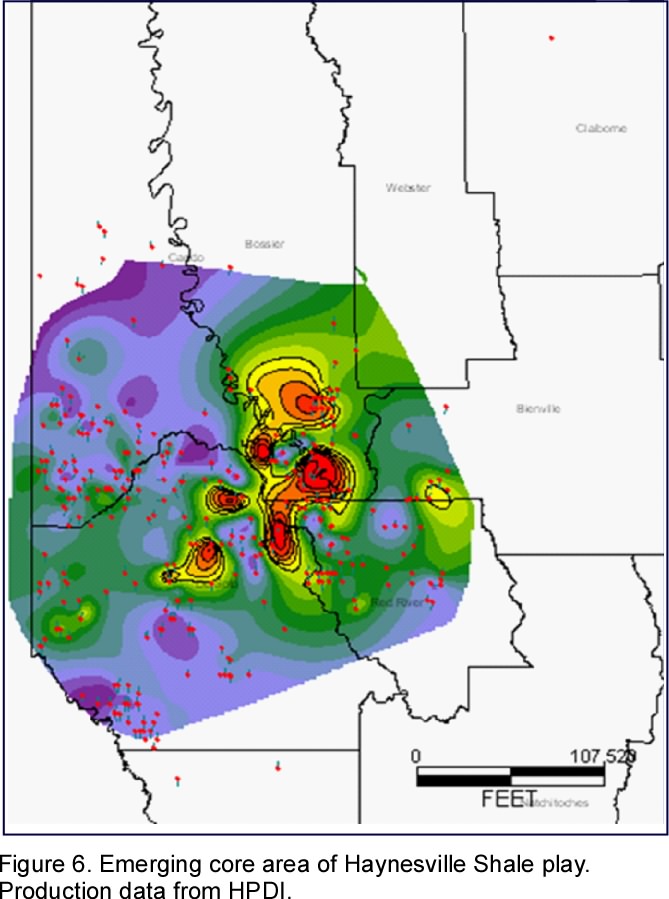
But what about those maps that show shale gas plays extending over large areas?
All shale plays contract to a core area or “sweet spot”. In the case of the Haynesville Shale, the emerging core area represents about 110,000 acres or 5 townships (Figure 6). This is a map of estimated ultimate recovery. The hotter red and yellow colors represent the emerging core area. This area is less than 10% of the total play area in Louisiana that was promoted several years ago as the largest gas field in North America and the fourth largest gas field in the world.
The core areas of shale plays do not look nearly so grand. The Barnett shale gas play illustrates the problem,
high Barnett production volumes are unevenly distributed and many non-commercial wells have been drilled adjacent to excellent wells. The claim of repeatable and uniform results by the shale play promoters cannot be supported by case histories to date.
Shale gas wells cannot be counted on as long term producers of natural gas,
The high shale gas reserve forecasts by operating companies are based on long individual well lives of as much as 65 years. In the Barnett Shale, wells were grouped by the year of completion and evaluated based on current monthly gas production. The percentage of wells from each group that are currently producing less than 1 million cubic feet of gas per month is shown in Figure 9. This gas volume only covers the cost of well compression assuming $5/Mcf without royalty payments or other costs. In other words, 25-35% of wells drilled over the past six or seven years are not paying for the cost of compression so what is the justification for 40-65 years of advertised commercial production?
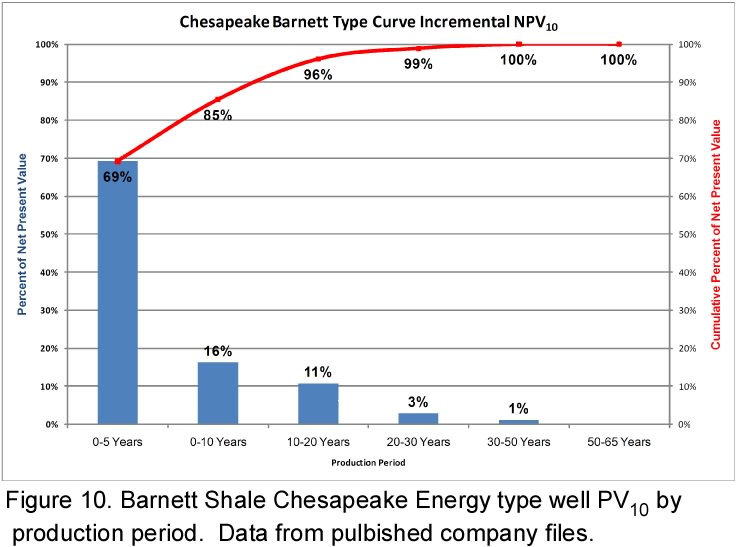
When we examined Chesapeake Energy’s type curve for the Barnett Shale and assumed that all parameters were correct--initial production rate, decline rate, well life, etc.--we found that most of the discounted net present value (NPV10) occured in the first five years and that there is negligible value after Year 20 (Figure 10). The type curve, however, forecasts about half of the reserves in years 20 through 65. Since these volumes have no discounted value, reserves are over-estimated by as much as 100 percent. There is clearly more risk in the shale plays than we are told.
There is growing evidence that the Barnett Shale play is in decline. Drilling has declined, Chesapeake Energy has sold its stAke, and Texas endured a natural gas shortage during a January cold snap. the gas shortage lead to the shutdown of numerous gas fired generating plants as well as shortages of natural gas for heating by residential and comercial customers. The shutdown of Natural Gas fired power plants lead to wide scale rolling blackouts in Texas during the coldest day of the cold snap.

It should be noted that representatives of the natural gas industry did not dispute Berman's contentions, and Cooper has not addressed Berman's analysis. Thus Cooper's claim of a decades long abundant supply of low cost natural gas supply, appears to be questionable at best, as well as contrary to the historic trend in natural gas prices.

Secondly, Cooper's claim that Nuclear power cannot compete with the low cost of natural gas generated electricity not borm out by all analyses. The World Nuclear Association points to a 2010 mstudy by the OECD which found that the international cost of electricity generated by new natural gas facilities was higher than the cost of electricity generated by new NPPs. The WNA reported an electrical generating cost of 4.9 cents per kWh for new US NPPs in 2010, while the cost of electricity produced by natural gas CCGT ran to 7.7 cents per kWh during the same year. Cost estimates were based on a 5% interest rate. At 10% interest the cost of new NPP generated electricity rose to 7.7 cents, while the cost of new CCGT generated electrcity rose to 8.2 cents per kWh.

The WNA reported that several factors significantly impacted nuclear building costs.

These include,
* Building time
* Years in operation
* Reactor size
* interest rate
* number of reactors built in a series
It should be noted that Mark Cooper has simply ignored the WNA's contentions, even though they are based on data from the OECD/IEA. Cooper also fails to consider the effect of the various cost factors pointed to by the 2010 OECD/IEA report. The deliberate withholding of cost complexity data suggests that Cooper was deliberately cheery picking in order to contend that nuclear costs were far higher than may in fact be the case. Cooper appears to pick out the highest estimates of future nuclear costs, while ignoring lower estimates from credible sources, while deliberately ignoring evidence and choosing renewable cost estimates simply on the basis of their claimed lower than nuclear costs, rather than for the presentation of strong evidence.

There is little doubt that a shift to natural gas will lower the emission of greenhouse gas in relationship to coal. Anthracite coal emits about 227 pounds of CO2 per million BTUs of heat, while natural gas emits 115 pounds of CO2 per million BTUs. in addition natural gas fired power plants operate with greater thermal efficiency. British estimates place Coal emissions at 890 Grams per kWh, while natural gas CO2 emissions are rated at 360 grams per kWh. Were CO2 the only greenhouse gas emission associated with natural gas use, the use of natural gas to mitigate the greenhouse effects of coal would be obvious. There are, as we will soon see, complexities which lead to uncertainty about the greenhouse mitigation benefits of natural gas use.

The World Socialist Web site recently took not of severalo recent accidents involving natural gas,
A natural gas explosion in Allentown, Pennsylvania, which killed five and damaged or destroyed scores of buildings last week, is just one of several such deadly incidents in the recent period.
The day after the explosion in the residential Allentown neighborhood, a massive explosion shook eastern Ohio’s Columbiana County. The blast site was in the rural town of Hanoverton. No one was injured, but the resulting fireball could be seen for miles around. Residents of Wilkshire Hills, some 25 miles away, reported seeing the flame.
Just two weeks before the fatal Allentown blast, on January 24, overpressurized gas pipes caused an explosion and fire that damaged close to 20 homes in Fairport Harbor, Ohio, near Cleveland, causing the evacuation of the entire village. While no one was injured in this particular incident, such events point to the enormous possibility for disaster in the gas pipeline infrastructure.
In another incident two days later, a house exploded in Horseheads, New York, in Chemung County, killing a toddler and injuring two others.
The story tells us that un the last few months the following accidents involving natural gas have occirred:,
• September 9, 2010—San Bruno, California—8 deaths, 52 injuries, 50 homes destroyed
• December 29, 2010—Wayne, Michigan—2 deaths, 3 injuries
• January 18, 2011—Philadelphia, Pennsylvania—1 death, 3 injured
• January 24, 2011—Fairport Harbor, Ohio—20 homes damaged
• January 26, 2011—Horseheads, New York—1 death, 2 injured, 1 home destroyed
• February 9—Allentown, Pennsylvania—5 deaths, 47 homes and properties damaged and destroyed
• February 10—Hanoverton, Ohio–brush fire
The wikipedia records the floowing Natural Gs pipeline accidents for the last decade,

2000 A 30 inch diameter natural gas pipeline rupture and fire near Carlsbad, New Mexico killed 12 members of an extended Family camping over 600 feet (180 m) from the rupture point. The force of the rupture and the violent ignition of the escaping gas created a 51-foot-wide crater about 113 feet along the pipe. A 49-foot section of the pipe was ejected from the crater in three pieces measuring approximately 3 feet, 20 feet, and 26 feet in length. The largest piece of pipe was found about 287 feet northwest of the crater. The cause of the failure was determined to be severe internal corrosion of that pipeline. On July 26, 2007, a USDOJ Consent Decree was later entered into by the pipeline owner to do pipeline system upgrades to allow better internal pipeline inspections. (August 19, 2000)[179][180][181]
* 2000 For the second time in 24 hours, a state contractor building a noise wall along the I-475 in Toledo, Ohio struck an underground pipeline, and for a second time the contractor blamed faulty pipeline mapping for the accident. In this incident, the pipe was a six-inch gas pipeline. The crew was digging a hole with an auger for a noise-wall support on September 8, when it hit the underground pipe less than 500 meters from the previous day's incident.
* 2000 A Bulldozer ruptured a 12 inch diameter NGL pipeline on Rt. 36, south of Abilene, Texas, on September 7. A police detective, with 21 years of service, was killed. Nearby, a woman saved herself by going underwater in her swimming pool. Her house was destroyed by the explosion & fire.
* 2001 A 12-inch natural gas pipeline exploded in Weatherford, Texas on March 22. No one was injured, but the blast created a hole in the ground about 5 meters in diameter and the explosion was felt several miles away.
* 2001 On June 13, in Pensacola, Florida, at least ten persons were injured when two natural gas lines ruptured and exploded after a parking lot gave way beneath a cement truck at a car dealership. The blast sent chunks of concrete flying across a four-lane road, and several employees and customers at neighboring businesses were evacuated. About 25 cars at the dealership and 10 boats at a neighboring business were damaged or destroyed.
* 2001 At approximately 5:05 a.m. MST, on August 11, a 24 inch gas pipeline failed near Williams, Arizona, resulting in the release of natural gas. The natural gas continued to discharge for about an hour before igniting.
* 2002 On March 15, a failure occurred on a 36 inch gas pipeline near Crystal Falls, Michigan. The failure resulted in a release of gas, which did not ignite, that created a crater 30 feet deep, 30 feet wide, and 120 feet long. There were no deaths or injuries.
* 2002 On August 5, a natural gas pipeline exploded and caught fire west of Rt. 622, on Poca River Road near Lanham, West Virginia. Emergency workers evacuated three or four families. Kanawha and Putnam Counties in the area were requested Shelter-In-Place. Parts of the Pipeline were thrown hundreds of yards away, around, and across Poca River. The Fire was not contained for several hours because valves to shutdown line did not exist. The Orange Glow from the fire at 11 PM; could be seen for several miles.
* 2003 A natural gas pipeline ruptured near Viola, Illinois on February 2, resulting in the release of natural gas which ignited. A l6-foot long section of the pipe fractured into three sections, which were ejected to distances of about 300 yards from the failure site.
* 2003 On March 23, a 24 inch diameter gas pipeline near Eaton, Colorado exploded. The explosion sent flames 160 meters in the air and sent thousands of Weld County residents into a panic, but no one was injured. The heat from the flames melted the siding of two nearby homes and started many smaller grass fires.
* 2003 Excavation damage to a natural gas distribution line resulted in an explosion and fire in Wilmington, Delaware on July 2. A contractor hired by the city of Wilmington to replace sidewalk and curbing, dug into an unmarked natural gas service line with a backhoe. Although the service line did not leak where it was struck, the contact resulted in a break in the line inside the basement of a nearby building, where gas began to accumulate. A manager for the contractor said that he did not smell gas and therefore did not believe there was imminent danger and that he called an employee of the gas company and left a voice mail message. At approximately 1:44 p.m., an explosion destroyed two residences and damaged two others to the extent that they had to be demolished. Other nearby residences sustained some damage, and the residents on the block were displaced from their homes for about a week. Three contractor employees sustained serious injuries. Eleven additional people sustained minor injuries.[191]

* 2003 On 2 November, a Texas Eastern Transmission natural gas pipeline exploded in Bath County, Kentucky, about 1.5km south of a Duke Energy pumping station. A fire burned for about an hour before firefighters extinguished it. No one was injured and no property damage was reported.
* 2004 On August 21, a natural gas explosion destroyed a residence located at in DuBois, Pennsylvania. Two residents were killed in this accident. The NTSB determined that the probable cause of the leak, explosion, and fire was the fracture of a defective butt-fusion joint.

* 2004 On November 8, a NGL pipeline failed in a housing division in Ivel, Kentucky. The vapor cloud from the leak ignited, seriously burning a Kentucky State Trooper evacuating those living in the area. 8 others were injured and 5 homes were destroyed. The pipeline had 11 previous corrosion failures, and is only 65 miles (105 km) long.
* 2008 A natural gas pipeline explodes and catches fire on February 5, near Hartsville, Tennessee, believed to have been caused by a tornado hitting the facility.
* 2008 On February 15, a 20 inch gas pipeline exploded and burned in Hidalgo County, Texas, closing road FM490.
* 2008 A 36 inch gas pipeline fails near Stairtown, Texas on August 28, causing a fire with flames 400 feet (120 m) tall. The failure was caused by external corrosion.
* 2008 On August 29, a 24 inch gas transmission pipeline ruptured in Cooper County, Missouri. Corrosion had caused the pipeline to lose 75% of its wall thickness in the failure area.
* 2008 Workers constructing a new pipeline hit an existing natural gas pipeline in Wheeler County, Texas, on September 9.
* 2008 A 30 inch gas pipeline ruptured & gas ignited near Appomattox, Virginia on September 14. 2 homes were destroyed by the fire. External corrosion seems to be the cause of the failure.

* 2009 On February 1, a gas pipeline explosion rocked the area 2 miles (3.2 km) east of Carthage, Texas.
2009 Bushland, Texas — Two people were hurt when a natural gas pipeline exploded in the Texas Panhandle. The explosion early Thursday, 5 November, left a hole about 30 yards by 20 yards and close to 15 feet (4.6 m) deep. The blast shook homes, melted window blinds and shot flames hundreds of feet into the air. The home nearest the blast — about 100 yards away- was destroyed. Bushland is about 15 miles (24 km) west of Amarillo.

* 2010 On June 7, a 36 inch gas pipeline explosion and fire in Johnson County, Texas, was from workers installing poles for electrical lines. One worker killed, and six were injured. Confusion over the location and status of the construction work lead to the pipeline not being marked beforehand.
* 2010 On June 8, construction workers hit an unmarked 14 inch gas gathering pipeline near Darrouzett, Texas. Two workers were killed.
* 2010 A construction crew installing a gas pipeline in Roberts County, Texas hits an unmarked pipeline on August 25, seriously burning one man.
* 2010 On August 27, a LPG pipeline sprang a leak in Gilboa, New York, forcing the evacuation of 23 people.
* 2010 A repair crew was working on a corroded gas pipe in Cairo, Georgia on September 28, when the line exploded. One crew member was killed, and 3 others burned.
* 2010 A gas pipeline under construction in Grand Prairie, Texas was running a cleaning pig on October 15 without a pig "trap" at the end of the pipe. The 150 pound pig was expelled from the pipeline with enough force to fly 500 feet (150 m), and crash through the side of a house. No one was injured.
* 2010 A 30 inch gas pipeline fails at Natchitoches, Louisiana on November 30. There was no fire, but the pipeline had a Magnetic Flux smart pig test earlier in the year that indicated no flaws in the pipeline. The deadly 1965 gas pipeline accident occurred on a different pipeline owned by the same company nearby.
* 2010 On December 17, a gas line fire and explosion just outside of Corpus Christi, Texas city limits leaves one person critically injured. A man was working on removing an abandoned pipeline when it exploded, and the man's face was severely burned.
* 2010 A pipeline at an underground gas storage facility in Covington County, Mississippi on December 28, forcing the evacuation of about 2 dozen families for over a week
This is by no means a comprehensive list. It fails to include the 2010 accident at the Kleen Energy Systems power station in Middletown, Connecticut, in whihj 6 people were killed and 27 injured. the power station was partially destroyed.

Clearly nartural gas leaks can be dangerous, but many leaks go undetected. Indybay.org reports:
Further threats include undetected leaks that could release small amounts of natural gas below ground over long time periods that could contaminate watersheds. Eventually the leaking methane would enter the atmosphere and contribute to global warming.
Many environmentalists concerned about climate change have often touted natural gas as an alternative to coal and oil. However, in the event of an undetected pipeline leak, escaped methane becomes a significant greenhouse gas twenty times worse than carbon dioxide . In natural gas pipeline leaks and small ruptures, if the pump pressure is not turned off, raw methane gas will escape until detected. Natural gas also escapes at well sites and from refineries. The yearly underestimate of escaping gas is approximately between 4-6 million tons. Over the last two centuries the atmospheric methane concentration has doubled, much of this likely a result of leaking natural gas pipelines.

The environmental safety record in producing regions and third world nations is not very good when compared to the developed regions that consume the gas. Generally speaking, the longer the pipeline, the more likely there will be leaks undetected for unknown time periods. Since the gas is invisible, natural gas pipeline leaks are more difficult to detect than pipelines leaking oil.

Probable risks of methane leakage, ruptures and explosions were understated in the EIS issued by El Paso Natural Gas Company. Explosions are caused by either internal or external forces causing the pipeline’s shell to rupture and leak methane quickly enough to combust the gas. Lack of repair and improper maintenance of pipelines by negligent pipeline corporations eventually leads to internal corrosion, a known cause of pipeline explosions.
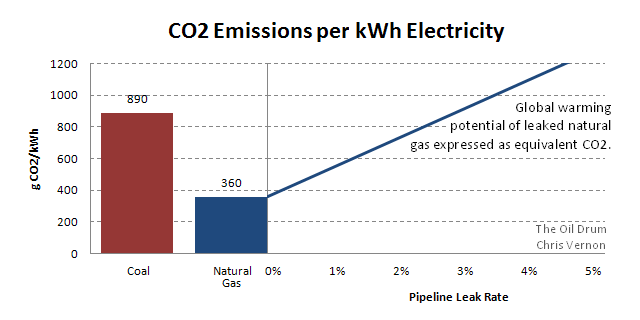
No one knows exactly how much natural gas is leaking into the atmosphere. However, methane the principle gas in natural gas, if a highly potent Greenhouse gas. Climate scientists use a rule of thumb that designates methane 21 times more portent than CO2. Thus even a small amount of methane leaking into the atmosphere could have serious climate implications. Thus the claims of anti-nuclear environmentalists such as Mark Cooper that natural gas is an effective tool for climate mitigation, has been meet by considerable skepticism recently.

Gail Tverberg of the Oil Drum has just offered an assessment of recent findings on methane emissions. She points to an Energy Collective post by David Lewis, titled "EPA confirms high Natural Gas leakage rates." Lewis argued that recent EPA research, and in particularly "GREENHOUSE GAS EMISSIONS REPORTING FROM THE PETROLEUM AND NATURAL GAS INDUSTRY: Background Technical Support Document," suggested a far higher natural gas leak rate than previously estimated. Lewis concludes,
in 2004 the GAO accepted the US gas industry line that leaks were lower than 1%, and looked out at the mayhem going on in the rest of the world (Russia announced it was not flaring at all even as NOAA satellite data proved they were doing "significant" flaring) and in comparison estimated world leakage at 3%. Maybe world data was actually beyond 6%. Why is 10% out of the question? This industry is using natural gas in areas where there is no electric grid as a power source, not by burning it, but as a substitute for compressed air.

In the US, past gas use must have been worse than coal and may even now be worse than coal. It may add up that the historic use of gas in the US to the present has been worse for the climate than if coal had been substituted all along, even if the climate impact is viewed over 100 years.
These conclusions are challenged in post comments by Geoffrey Styles,
From what I read in your postings and comments, inflating the GWP for methane by 30% depends on the findings of one paper and is a matter currently under discussion by some in the IPCC, but not yet in the category of official policy and "settled science." Even so, for argument's sake let's take EPA's 261 MMt of CO2e and ratchet it up by 30% to 339 and add in the indirect and combustion CO2, to get 1339 MMt of CO2e for domestic gas's 20.4% of US energy consumption. Then we also have to up the impact of the methane emissions for coal, increasing its total to 2153 MMt for coal's 22.6% of US energy. That still leaves total CO2e emissions from gas 31% lower per BTU than those from coal. And note that this doesn't factor in the consumption side efficiencies of gas in the power applications that are the main focus of coal displacement, which has CCGTs at better than 50% efficiency, compared to coal in the mid-to-high 30s. No matter how you slice this, it still doesn't come up supporting your assertion that "gas is worse than coal".
But is Styles estimate of the carbon equivalence of the natural gas leak rate is 30% to high, is the lower figure acceptable?

Robert W. Howarth has offered similar conclusions to those offered by Lewis,
We urge caution in viewing natural gas as good fuel choice for the future. Using the best available science, we conclude that natural gas is no better than coal and may in fact be worse than coal in terms of its greenhouse gas footprint when evaluated over the time course of the next several decades. Note that both the National Academy of Sciences and the Council of Scientific Society Presidents have urged great caution before proceeding with the development of diffuse natural gas from shale formations using unconventional technology.
Natural gas has been touted as a low carbon back up to wind generated electricity. Kent Hawkins, an electrical engineer, has challenged the carbon mitigation effectiveness of natural gas backed wind resources. Hawkins views have received further support from Australian Electrical Engineer Peter Lang, (see also here).

The pro-wind blog, Embracing My Planet, has challenged what it describes as Hawkins myths, (See Part I, Part II, Part III, and Part IV). However, the Embracing My Planet posts stop for short of refuting Hawkins detailed arguments. My own view is that there is not enough empirical research yet, to demonstrate that natural gas backed wind is an effective tool for carbon mitigation. Hawkins and Lang have established probable cause exists for skepticism, although they have not brought empirical proof beyond a reasonable doubt. Beyond that they have shown that wind advocates who have called for wind generation systems with natural gas backup, have not demonstrated that such systems are effective carbon mitigation tools. A great deal more research is needed before we can know with anything like certainty that gas backed wind is an effective and reliable tool for fighting global warming.

We must conclude that Mark Cooper's argument for long term low cost natural gas supplies as a low cost alternative to nuclear power is open to question, and the assumption that the use of natural gas generated electricity would offer substantual mitigation to AGW is questionable at best. our conclusion must be that natural gas is not an effective, low cost substitute for nuclear power, and thus nuclear power must be deployed if Anthropogenic Global Warming is to be controlled.

Friday, February 4, 2011

Texas Power Blackouts and Green Energy

My brother David was in his Greenville Texas home, talking with me on the telephone when a rolling blackout cut off our conversation. When we resumed the conversation, David mentioned that not only were there rolling power outages all over texas, but that natural gas shortages were popping up around the state. The two problems, I realized, were connected. It should first be noted that Texas power usage on Febuary 2, 2011 was high but far below Texas peak summer electrical use standards. True it was a winter use record. The previous high of 55,878 megawatts was set Jan. 8, 2010. On even of February 2, 2011 a winter peak use record of 56,334 MW was set. The ERCOT had access to sufficient generation capacity and had a deep history of responding to peak winter electrical demand.

ERCOT admitted that
more than 50 power units, capable of generating about 7,000 MW, were out of service.
ERCOT reports focused on larger coal fired power plants
* Luminant's 568-MW Unit 4 at the Sandow coal-fired power plant in Texas shut on February 2 after a feed water flow low suction alarm. The alarm was triggered by a faulty feed water flow transmitter line that froze. Luminant expected the unit to return later on February 2.

* Texas Municipal Power Authority's 470-MW Gibbons Creek coal plant in Texas shut on February 1 after the cold weather stressed many systems, including electronic level indicators and their transmitters. Specifically, the company said the drum liquid level indicators had frozen. TMPA said it was using heaters to unfreeze the affected systems but did not say when the unit would return.
But the average size of the units that had stopped producing electricity, 140 MWs, suggested that they were natural gas burners. And a story in The Fort Worth Star-Telegram pointed to natural gas,
Atmos had curtailed its supply of natural gas to industrial customers, including natural-gas-fired power plants, he said. Atmos did exactly as its protocol called for, he said, to make sure that residential and commercial users had enough gas pressure.
Troy Fraser, The Chairman of the Texas Senate Natural Resources Committee, Stated that
We didn't have enough gas pressure available to bring up the power plants, . . . In a high-volume usage, the first ones they cut off are the power plants.
Well that tells the story then. Some coal powered units shut down for reasons that were related to the effect of cold on equipment. Normally their backup would come from natural gas fired generators, but natural gas units were experiencing forced shutdowns too. But what about theTexas supplyb of renewable energy? According to the Lubock Avalanche Journal,
Wind generators apparently do not work as well when it is cold. There were enough areas in Texas on Tuesday where the night was clear and cold and the wind dropped, shutting down generating capacity apparently quite rapidly.
While wind generation of electricity was high during the hours of 5 AM to 7 AM on February 2, wind generator output had dropped by the time the blackout reached my brothers house. In addition the windmills are a long way away from the Texas cities where there were rolling blackouts, and 30% to 35% 0f the wind generated electricity generated was lost during its transmission to those cities. So if wind did not rescue Texas on Tuesday Morning, where did the state find help? According to the Dallas Morning News,
Mexico agreed to transmit 280 megawatts of electricity from the border cities of Nuevo Laredo, Reynosa and Piedras Negras, . . .
So renewables were of little help during the blackout, and natural gas, touted by renewable advocates as the the clean energy solution to the problem of renewable intermittent gaps in the electrical supply, turned out to be another weak link in the generation chain. Hence we had more proof, if we needed it, that renewable energy can't cut the mustard.


Friday, June 25, 2010

The End of the Fossil Fuel Era

We are witnessing the end of the fossil fuel era. As of yet few people are aware of the swift foot falls od doom, but it is comming and faster than anyone would believe. I will quickly present two witnesses to the doom of the fossil fuel era. First is the video "Gasland" from a recent PBS program. .Gasland reveals the technological bankruptcy of the natural gas industry, as it attempts to wrest natural gas from stubborn shale formations. Gasland reveals the extent that the natural gas industry has failed to control toxic pollutant byproducts of the fracking process, which it now uses to produce natural gas. Gasland producer Josh Fox states that hydraulic fracturing or fracking “was exempted by the Bush-Cheney Energy Policy Act of 2005 from the United States’ basic environmental regulations, including the Safe Drinking Water Act and the Clean Air Act. Across the country, in states such as New York, and Pennsylvania, where drilling is slated to take place in the Delaware River Basin and New York City’s watershed in the Catskills, or in states where it is already occurring."

Fox adds "Natural gas companies have installed hundreds of thousands of rigs in 34 states, drilling into huge shale fields, tight sands or coal bed seams containing gas deposits trapped in the rock. Each well requires the use of fracking fluid – chemical cocktails consisting of 596 chemicals, including carcinogens and neurotoxins, as well as one to seven million gallons of water, which are infused with the chemicals.”.

Fox continued, “Considering there are approximately 450,000 wells in the U.S., Fox estimates that 40 trillion gallons of chemically infused water have been created by the drilling, much of it left seeping or injected into the ground.”

As bankrupt as the Natural gas technology is only exceeded by the moral bankrupcy of anti-nuclear environmental groups like Greenpease and the Sierra Club who are acting as cheerleader lobbyists for the natural gas industry. Anti-nuclear environmentalist Joe Romm did not flinch in the slightest, when he breathlessly announced
I asserted it now appears likely that, thanks to unconventional supplies, natural gas alone could meet a great deal of the Waxman-Markey CO2 target for 2020 — without requiring gobs of new power plants to be sited and built or thousands of miles of new transmission lines.
Environmental Guru Amory Lovins long has advocated natural gas fired micropower generators, claiming that they are cheaper than nuclear power plants. Lovins has never admitted that there are any bad environmental consequences to farking. The only explanation for why environmentalists would accept the carbon emissions of natural gas, and the environmental consequences of farking, is their ideologically driven opposition to nuclear power.

Here then is Josh Fox's Gasland:

Watch the full episode. See more NOW on PBS.

The unforlding environmental disaster in the Gulf of Mexico is the second nail in the coffin of fossil fuels. As with natural gas, the easily tapped oil resources in the United States are tapped out. The remaining resources are reactively small fields, and deep underwater oil pools, that are exceedingly difficult to recover. It is the difficulty of that recovery which has lead us to the present situation, and it appears that things may well get a whole lot worse before they get better.

Hat tip to Jason of Pro-nuclear Democrat.

Sunday, November 15, 2009

Alternative reduced CO2 wind back up systems

The work of Warren Katzenstein and Jay Apt, Peter Lang, and Peter Hawkins all seems to demonstrate that natural gas beck up of wind generation imposes choices and inefficiencies, that almost or completely the CO2 emissions benefits of wind. It would appear from their work that stand alone natural gas systems using combined cycle gas turbines, are either nearly as efficient at lowering natural gas emissions or actually more efficient as a wind plus open cycle gas turbines. Supporters of wind generation have noted that that wind generators are well matched to hydro-electricity, and indeed that seems to be the case in a few parts of the world, for example Scandinavia where wind generators in Denmark appear to compliment hydroelectricity from Norway and Sweden. In the United States, hydro resources have been almost entirely utilized, and are currently inadequate for wind back up in most high wind areas. Pumped Storage has been suggested, the the high cost of past pumped storage facilities suggest that the cost of nuclear reactors is competitive with the cost of pumped storage facilities with similar rated capacities, while the nuclear facilities would be far more flexible, and produce as much as 2 times as much electricity on an annual basis as pumped storage would. Compressed air energy storage (CAES) is a second form of backup proposed for wind generators. My investigation, however, revealed a surprising problem from CAES, radioactive radon gas would be brought to the surface with returning compressed air. The problem appears to be far more serious than the release of radioactive gases associated with nuclear power generation. My case study of proposed CAES project presented by the Ridge Energy Storage & Grid Services company to Texas State Energy Conservation Office in 2005 showed that 40% of the energy for the project would come from the burning of natural gas. CASE systems are huge geothermal heat pumps, and they return cold air. Humidity in the air freezes, and the ice can damage generator turbines. Heat lost in the CAES process represents lost energy from electricity used to compress the air. In evaluating the cost of wind generated electricity I stipulated
a cost for new West Texas wind of $2250 per name plate KW in 2009. Since the capacity factor of West Texas runs around .40, the adverage output West Texas wind producer can expect to pay $5625 produce KWs of electricity his windmill will average producing. Since only 70% of the electricity entering the CAES facility reaches the consumer, the wind producer must add 30% more capacity to compensate for the energy loss. Thus the price of the wind generated electry entering the CAES facility must compensate the wind producer for something like a $8000 capitol investment for every average kW sold to the CAES facility.
In addition the estimated cost of the Ridge Energy CAES facility was $765 per KW of electrical output, Thus we are looking at an investment of nearly $9000 per kW of electrical capacity and this does not count the cost of new electrical transmission lines from West Texas to energy hungry Dallas. In contrast
the 2008 cost of nuclear power is somewhere between $4000 and $5000 per kW (as opposed to an estimated $8000 to 12,000 figure during the middle of the next decade).
And nuclear plants can be located close to electricity markets. In addition, the nuclear plant would be far more flexible, and would produce more electricity on an annual basis than the wind + CAES combination. In addition I noted an alternative employment of the CAES system that no one seems to have thought of, the used of CAES in in nuclear cooling, that would produce a low cost nuclear CAES combined cycle:
It seems to have escaped the notice of most CASE advocates that CAES casn be teamed with nuclear power plants in innovative ways. Since it is more economical to keep reactors running at full power all night, suplus electricity produced at night could be used to store compressed air. During the day, compressed air can be used to expand the reactors daytime power output by as much as 40%. The air does not have to be heated with natural gas. Indeed the compressed air can be heated from the reactors waste heat, killing two birds with one stone, and conserving the water used for daytime reactor cooling, and the use of compressed air in cooling the reactor, would creat significant water use savings, allowing reactors to run even during drought conditions.
Just a thought, mind you.

I also looked at battery backup for wind, that was of course, way too expensive. In fact it was so expensive that I conducted a thought experiment,
Assume that the system operators chose to back up the 1 GW wind system with nuclear power rather than a redundant wind system plus batteries. The cost of the wind system would then drop to $2.7 billion plus $5 billion for nuclear backup or $7.7 billion. Quite obviously the nuclear backup would be cheaper, but now the wind is totally redundant, because the backup system can operate full time for just the added price of fuel. Thus the purely nuclear system would simply be a lower cost than a reliable wind system. The nuclear system would be more reliable, and could be counted on with a fairly high degree of certainty to produce at 100% of its rated capacity during peak electrical demand summer months.
Thus my conclusion was that Pumped Storage, CAES, and battery backups for wind were more expensive, less flexible, and would produce less electricity over time than electricity producing nuclear reactors.

Sunday, April 20, 2008

The Radioactive Texans


Naturally occurring radioactive material - often referred to as NORM exist everywhere on the earth. Soil itself contains small amounts of slightly radioactive uranium and thorium. As these elements decay naturally, they produce radioactive daughter products including the radioactive gas radon. Not only do radioactive materials exist in the soil, they are also transmitted through the soil ito our bodies. People worry about radiation from nuclear sources, but the truth is that during our life time, people 80% of the radiation we will be exposed to will come from natural sources. Most of the rest of it will come from deliberate human use of radiation, for examples x-rays.

Plants draw radioactive isotopes into their organic structure, ands concentrate them into their tissue. Among vegitable foods know to be exceptionally radioactive are white potatoes, sweet potato, coconuts, spinach, bananas, Brazil nuts, and cocoa powder - a major ingredient in chocolate.

But the radiation danger associated with food does not end in your grocery bag. The natural gas you cook with also contains radioactive radon gas. And this brings me to the topic of the gas from Barnett Shale, that comes from under Fort Worth, Texas.

Shale containes small but significant concentrations of radioactive uranium and thorium. This would most certainly be the case with Barnett Shale. Natural gas is extracted from Barnett shale by hydrolic cracking. As water is injected into natural gas wells a tiny amount of radioactive materials including uranium, and radium get leached into the water. Some of the water inevitably enters the ground water, and the contamination spreads. Sometimes it reaches the surface through water recovery, wells or springs. This is one source of radiation hazard associated with natural gas extraction from Barnett Shale. According to the Denton Record-Chronical, there are 140 radiation cleanup sites in Texas, most involving radioactive materials from natural sources. (see also stories here, here, and here.) Twenty five of those radiation clean up sites are were in Denton, Tarrant, and Wise Counties, areas where gas is extracted from Barnett shale. Radioactive contaminated sites include gas wells and equiptment storage yards. A thousand barrels or radioactive contaminants have been removed from cleanup sites in North Texas, and hundreds of thousands ao barrels of radioactive materials associated with oil and gas radiation cleanup, have been removed from sites in Texas, during the last 20 years.

Gas drilling at D/FW Airport
There is another side to the story which Peggy Heinkel-Wolfe did not touchon in her Denton Record-Chronical stories on Barnett Shale radiation. That is the presence of radon in natural gas. During the 1970's my father, C.J. Baron , Sr., performed an extensive investigation of radon in natural gas. The noted, "since radon has a 3.8-day half-life and several days may be required to move the gas from the wells to the point or use there can be a significant drop in radon concentration during transmission." Thus consumers are partially protected from Radon in their cooking and heating gas, by the gas transmission process.

It was pretty clear from my father's research, that radioactive radon could get into consumer's homes through natural gas, and that the chief barrier that protected consumers was distance. But what if the consumers lived next to the gas wells? It would be clear that given the radiation cleanup problems associated with NORM . Who is in charge of determining the radon content of natural gas in Texas? PEGGY HEINKEL-WOLFE stated, "Texas Railroad Commission rules allow the industry to self-monitor for NORM . . ." How much monitoring do Texas gas suppliers do for radon in natural gas? This cannot be determined by an internet search. Indeed I can find no reference to the topic on the internet.

We know thes things:

There are undoubtedly uranium and thorium associated with Barnett Shale.

Radon is a natural daughter product of Uranium and Thorium decay.

Radon is persent in natural gas.

The half life of radon-222 is 3.8 days.

Thus radon from Barnett shale sources could easily travel up a gas well from its Barnett Shale source, travel through local pipe lines, and get consumed in cooking in heating fires within a few hours. Radon exposure is the second leading cause of lung cancer in the United States. Iowa research has shown that "cumulative radon exposure is a significant risk factor for lung cancer in women". "Radon gas is thought to be responsible for 5,000 to 20,000 lung cancer deaths per year in the United States". Thus radioactive radon gas, transported to North Texas homes, from Barnett Shale gas wells, almost next door, constitutes a significant ganger to the health of North Texans. Needless to say, this problem is being ignored gas companies, the governments of Texas, and the United States. Interestingly, it is also being ignored by critics of nuclear power who complain about the radiation dangers of nuclear power, but are unconcerned about the radiation associated with natural gas. How much is radon from natural gas effecting the health of Texans? No one knows.

Followers

Blog Archive

Some neat videos

Nuclear Advocacy Webring
Ring Owner: Nuclear is Our Future Site: Nuclear is Our Future
Free Site Ring from Bravenet Free Site Ring from Bravenet Free Site Ring from Bravenet Free Site Ring from Bravenet Free Site Ring from Bravenet
Get Your Free Web Ring
by Bravenet.com
Dr. Joe Bonometti speaking on thorium/LFTR technology at Georgia Tech David LeBlanc on LFTR/MSR technology Robert Hargraves on AIM High