
Showing posts with label renewable resources. Show all posts

Thursday, March 11, 2010

Children of the Club of Rome

Sarah Palin's story that Obama's health care legislation called for death panels to determine who would receive medical care, and who would simply be allowed to die in the new medical order, has rightly been described as the lie of the year for 2009. However, a recent post on the Oil Drum by Megan Quinn Bachman tells us that a form of death panels is emerging among people who believe that the Ehrlich/Forrester/Meadows/Club of Rome theory of global collapse of industrial civilization/resources/population . The post, titled "Leading the Way to a Low-Energy Future" describes what Bachman calls lifestyle leaders. Lifestyle leaders are people who are
building gardens, weatherizing their homes, getting rid of their cars, moving off-grid, bartering with neighbors and joining Community Supported Agriculture (CSA)
According to Bachman these lifestyle leaders are pioneering the new order by forging a new set of careers appropriate to the new post civilization order:
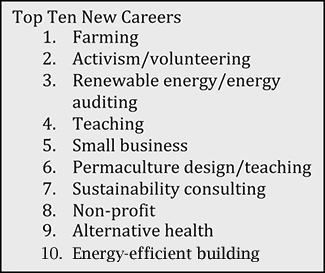
I would argue that these people, the Children of the Club of Rome, are the death panels for hundreds of millions if not billions of people. Yet the Club of Rome model predicts a mass human die off:

<span class=

Thus Bachman's lifestyle leaders are preparing for a Club of Rome apocalypse, which features mass human die off.
I am fond of Gail the Actuary (Gail E. Tverberg), an Oil Drum Editor who is associated with the "we are headed for collapse" point of view. i see Gail's work as having a positive aspect in that she and her guest posters repeatedly point to problems which are otherwise unvoiced. i do disagree with some assumptions and with the chain of argument which inevitably leads to negative conclusions about the future of a high population, materially wealthy civilization. I disagree with the view that the collapse of material civilization is inevitable. In addition I view the projected collapse of material civilization as an unmitigated catastrophe. This is what Chris Clugston suggests:
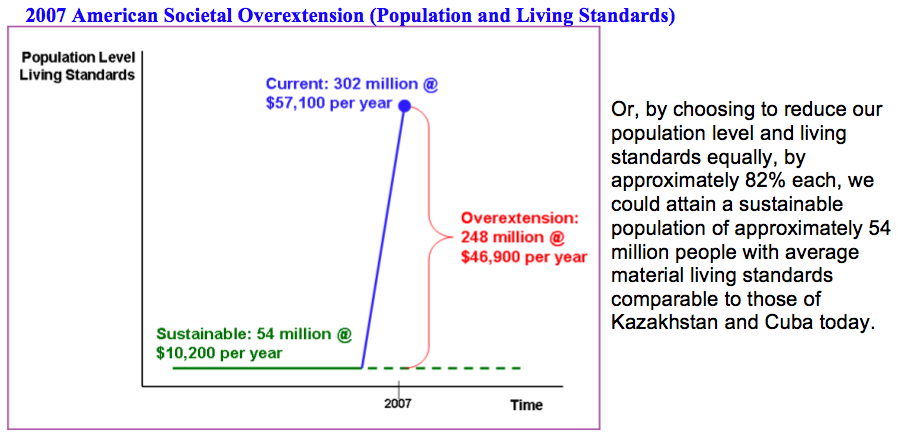
i disagree with this perspective because it assumes a far more limited future resource picture than I do. My viewpoint can be stated simply, we are not running out of energy, material resources, or food. A combination of two technologies, Hydraulic Fracturing (fracking), and in-situ leaching, offers the potential for high material resource recovery with favorable EROEI, from what was previously considered low grade ore. It is inevitable that the use of such recovery technologies will be applied to resource recovery, and the recovery of Uranium and thorium as part of the process will assure a favorable EROEI. Both fracking and in-situ leaching are highly tested technologies and thus appear to offer a path to a continuation of high energy/high material output civilization. Through the use of efficient and safe technologies like the Liquid Fluoride Thorium Reactor, the population of earth can be assured of a high level of material prosperity for as long as there is likely to be people around.

Thus the future resource picture may not be nearly as bleak as Gail the Actuary and her associates would have us believe. Nor is the supposed mega-famine, which Paul Ehrlich, Jay Forrester and the Club of Rome have predicted, nearly as likely to occur, as they suggest. Ehrlich's famine predictions were thwarted by the so called "Green Revolution," which dramatically increased agricultural yields in countries like India.

A recent review of global agricultural resources, published in Science, titled "Food Security: The Challenge of Feeding 9 Billion People." argues,
the world can produce more food and can ensure that it is used more efficiently and equitably. A multifaceted and linked global strategy is needed to ensure sustainable and equitable food security, . . ..
Thus in a high energy uranium/thorium based economy, the food supply is likely to be continue to be assured. The argument for the inevitable collapse of civilization can be falsified with some certainty, the impending image of mass death through the starvation of most people can be written off as a fantasy. Bachman's "lifestyle leaders"can be seen for what they are, a misanthropic death panel for the human race, whose lifestyle will turn against them as the population of earth continues to survive and increasingly prosper.

Saturday, June 6, 2009

A steady-state economy: Now or Later?

The Oil Drum has posted a Lecture by Herman E. Daly, "From a Failed Growth Economy to a Steady-State Economy". The question is, however is has the time for a steady state economy arrived? Daly writes
A steady-state economy is incompatible with continuous growth—either positive or negative growth. The goal of a steady state is to sustain a constant, sufficient stock of real wealth and people for a long time. A downward spiral of negative growth, a depression such as we are entering now, is a failed growth economy, not a steady-state economy. Halting an accelerating downward spiral is necessary, but is not the same thing as resuming continuous positive growth. The growth economy now fails in two ways: (1) positive growth becomes uneconomic in our full-world economy; (2) negative growth, resulting from the bursting of financial bubbles inflated beyond physical limits, though temporarily necessary, soon becomes self-destructive. That leaves a non-growing or steady-state economy as the only long run alternative. The level of physical wealth that the biosphere can sustain in a steady state may well be below the present level. The fact that recent efforts at growth have resulted mainly in bubbles suggests that this is so. Nevertheless, current policies all aim for the full re-establishment of the growth economy. No one denies that our problems would be easier to solve if we were richer. The question is, does growth any longer make us richer, or is it now making us poorer?
Well and good, but are we at a time when a steady state economy is in the offing, or is the earth capable of sustaining much more economic growth?

My answer would be from the viewpoint of energy and resources, no. In fact most of the earth's energy resource potential remains untapped, and thorium, the greatest potential energy resource remains entirely untapped.

There will be a limit to growth, a point at which we reach a maximum level of resource extraction, but that time is certainly not in the near future. There is, however an important resource limitation that occasionally is noted, but its full implications are almost never described, and that is the limitation of phosphate. The phosphate problem is far too important to ignore in a blog that describes itself as green, but today I will only note it in passing, and to note that I have no Idea what I will discover when I begin a case study of the economic impact of phosphorous limitations.

At the moment, however, I will focus on Daly's argument.

Fundamental to Daly's argument is the notion that the magnitude of human desire exceeds the magnitude of te earth's resources. This is a given in the Dennis Meadows/Jay Forester/Club of Rome tradition, and it is simply assumed, never proven.

Yet logically the earth's resources, although not infinite, could exceed the practical limitations of human desire. Take for example iron. No matter how much Iron people want, the potential to extract iron from the earth will always exceed the limitations of human desire for iron. Iron is exceedingly abundant, so it might be conceived of as an exception, but there are other resources that will never reach a steady state limit. Thus even a steady state economy will not achieve steady state utilization with all resources. Thus we can speak of limited and non-limited resources.

Advocates of a steady state economy typically suggest that there are only two types of resources, renewable resources, and non-sustainable resources, which are all in short supply. There are in fact three types of resources, non-sustainable resources, renewable resources and sustainable resources. Sustainable resources are resources that available with sufficient abundance that even a very large human population will never run out of them. World energy supplies in the forms of Uranium and Thorium are sustainable. The failure to recognize the existence of sustainable resources is the flaw on which the no economic growth philosophy rests. We cannot access what are the limits of economic growth until we assess what are our sustainable resources.

Substitution allows non-limited resources to take the place of limited resources, Substitution thus allows wealth to be expanded through the use of non-limited resources. In addition to substitution nuclear alchemy, that is material transmutation inside a reactor, will permit the expansion of certain material resources beyond the limitations set by nature.

I classify energy in the form of uranium and thorium as sustainable but not renewable, because they are recoverable with a favorable ERoEI, at average crustal levels of concentration. Given this potential, many minerals are recoverable at crustal concentration levels as a byproduct of thorium and uranium mining. Thus the case for growth limitations is far weaker than Daly suggests. The entire argument rests on a set of cognitive errors. The first is the untested assumption that peak oil is typical of all resources, and that peak oil is really peak everything. This is an example of the fallacy of composition, the belief that what is true of a part is true of the whole.

In fact some non-sustainable resources will still be available for a long time to come. Sustainable resources can in many cases be substituted for non-sustainable resources, while non-sustainable resources can be supplied by recycling. Small amounts of non-sustainable resources can be obtained through the nuclear transmutation produced by nuclear fission, while even smaller amounts of resources can be obtained through the nuclear transmutations of sustainable materials in transmutation technologies.

There are 40 trillion tons of Uranium in the earth's crust. There are at least 120 trillion tons of thorium in the crust, 1500 tons or uranium and thorium will supply the United States with its entire energy needs for a year, while 750 tons will supply the energy efficient Western Europe. 15,000 tons of uranium and/or thorium will supply the entire population of the earth with energy at near Western European levels. This means that in a billion years we will have used 15 trillion tons of uranium and/or thorium, or about 10% of the amount on the planet. The world will be gone long before the other 90% is used. it is a serious logical error to appeal to your own ignorance as proof that something is not the case.

In a paper titled THE AGE OF SUBSTITUTABILITY. H. E. Goeller and Alvin M. Weinberg, discussed the sustainablity of resources. They quote geologist Dean F. Frasch; said in 1962, "Total exhaustion of any mineral resource will never occur. Minerals, and rocks that are unexploited will always remain in the earth's crust."

Writing in 1975, Goeller and Weinberg maintain:
"Actually, we can conceive of depletion of resources and substitution
in three stages. Stage I is a continuation of our present patterns of use of our non-renewable resources; this almost surely will persist for the next 30 to 50 years. In Stage 11, the society still would depend on reduced C and H found i n nature, i .e. , coal, there wound be 1ittle oil and gas, and people would begin to turn away from widespread use of a few of the non-ferrous metals and toward much greater use of alloy steels (A1 , Mg, and Ti). Stage I1 might last several hundred years. Finally in Stage 111, the truly asymptotic "Age of Substitutability",
all the fossil fuel would be gone; the society would be based almost exclusively on materials that are virtually unlimited. It.is our basic contention that, insofar as limits to mineral resources can be discerned, the condition of life in Stage 111, the Age of Substitutability, will not be drastically different from our preserlt condition of life."
Goeller and Weinberg identify certain sustainable resources, air, salt, sand, limestone, water, as well as huge amounts of iron, aluminum, potassium, and other minerals. These are sustainable raw materials. We have enough raw materials to sustain economic growth or a long time. Daly does not assert that we are running out of resources yet, although he seems to hint that we might be. Daly is weak on the sort of facts that are Goeller and Weinberg's strength. A look at the facts would reassure anyone who wonders that we are no where near out of resources yet. We have enough resources to make the people of China and India and Africa and Latin America all rich without reaching the place where we cannot sustain development. We well reach the point of a steady state economy some day, but that day is not today or tomorrow.

Thus Daly argues for a cap and trade system for resources without determining if that system is needed for all resources. Daly acknowledges that we may not be out of resources, but argues that we should act as if we are. It is quite likely that some resources may someday require a system of allocation, while others would not. Daly does not help us understand what resources we may need to allocate, or when we might need to allocate them. This is not helpful. Resources might require an allocation system some day, but we have no facts to say that is now.

Followers

Blog Archive

Some neat videos

Nuclear Advocacy Webring
Ring Owner: Nuclear is Our Future Site: Nuclear is Our Future
Free Site Ring from Bravenet Free Site Ring from Bravenet Free Site Ring from Bravenet Free Site Ring from Bravenet Free Site Ring from Bravenet
Get Your Free Web Ring
by Bravenet.com
Dr. Joe Bonometti speaking on thorium/LFTR technology at Georgia Tech David LeBlanc on LFTR/MSR technology Robert Hargraves on AIM High