Showing posts with label Concentrated Solar Power. Show all posts

Tuesday, December 8, 2009

Alvin Weinberg, Prophet of CO2 Driven Global Warming

December 2015 Update: Becky has called my attention to the continued relevance of this post.  It is foundational to the project I undertook when I started the Nuclear Green Blog.

2009 Update Note: This post was one of the first I wrote for Nuclear Green in December 2007. Because it deals with the early history of studies of carbon mitigation and Alvin Weinberg's far sighted views on post-carbon energy forms are still relevant to recent discussions on energy, I felt reposting a slightly revised version of my original post was in order.


I have told the story before of my proto-internship in the ORNL-NSF Environmental Studies Program in 1970-71, and hearing there, for the first time about the problem of CO2 emissions and AGW. I no doubt heard it first from Jerry Olson, an ecologist, who was part of an ongoing ORNL research effort on the global carbon cycle. In addition to alerting me, Olson appears to have been the first to alert Alvin Weinberg, who was the Director of ORNL until his politically inspired firing in 1973. When, in 1974, Dixie Lee Ray brought Weinberg to Washington to serve as Director of the Office of Energy Research and Development, his focused shifted from reactors to the relationship of energy to CO2 emissions. I have recently started looking at a collection of Weinberg's papers that is available online. Weinberg's papers reveal him to be a thinker of great depth, and range. What I find most interesting about Weinberg's papers is the role that CO2/global warming played in his discourse after his firing from his position of Director of ORNL in 1973. For the rest of his progessional life, Weinberg warned us, of the dangers that we faced from CO2. In 1974 Weinberg published a major paper on the energy economy is the prestigious journal Science. In "Global Effects of Man's Production of Energy," Weinberg set out his case on the long term consequences of the human commitment to carbon based fules. In 1975 during testamony to congress, Weinberg again laid out his global warming concerns. In 1975 Weinberg returned to Oak Ridge where he led the Institute for Energy Analysis until his retirement in 1984. During that period, the IEA was a major center for the study of energy on climate, and of energy alternativives. In 1977 Alvin Weinberg was named the chairman of a National Study Group on the Global Effects of Carbon Dioxide.

Today Weinberg's views on CO2 and global warming seem prophetic. In a 1976 paper "Economic Implications of A US Nuclear Moratorium. 1985 to 2010," which Weinberg co-authored with Charles E. Whittle, Alan D. Poole, Edward L. Allen, William G. Pollard, Herbert G. MacPherson, Ned L. Treat, and Doan L. Phung, reveal to us exactly how accurate Weinberg's vision into the future was. In the paper Weinberg and his associates assessed the the economic and environmental consequences of moratorium on nuclear construction in the United States. He assumed that no new reactors would be ordered after 1980, but that reactor construction would continue till about 1985. He then looked at the consequences to allow continued operation of reactors on line by 1985. Weinberg tried to think out the implications of the cessation of new reactor construction.

Weinberg and his associates understood that if reactor construction ceased, power companies would construct more coal fired power plants to meet consumer demand for electricity. Weinberg assumed that consumer demand would be driven by two factors population growth, and economic growth. He also assumed that technological changes would increase the efficiency of electrical use, but that these efficiencies would not offset the increase in demand.

Weinberg saw
"four levels of environmental trade offs as a result of shifting the additional fuel requirements from nuclear to coal after 1985."
The first level of effect was what he called global. There were two componants:
(1) Proliferation: Countries wishing to rely primarily on the nuclear option can do so whether or not the United States abandons nuclear power. Thus, a domestic moratorium on nuclear energy would have little effect on proliferation unless the rest of the world abandoned nuclear power.

(2) CO2: Should 20 percent of the world’s fossil fuel be burned, the CO2 concentration might double; this could lead to unacceptable changes in the world’s climate. A U.S. moratorium per se would have little effect on this possibility; however, loss of the nuclear option through much of the world,’which is a conceivable consequence of a U.S. moratorium, might make it more difficult to respond quickly to a perceived danger from higher CO, levels in the atmosphere.
Weinberg and his associates believed that
the effect of a moratorium (on reactor construction) adopted only by the United States would be marginal and secondary: marginal because reactors would be available from other countries, secondary because of the influence of the United States on world nuclear energy policy (including decisions by others to follow suit).

It is no longer possible for a single nation to influence significantly the possibility of proliferation through a unilateral capacity to supply nuclear power systems. On the other hand, the extent to which the U.S. influence on worldwide nuclear policy would be diminished by its withdrawal from nuclear power development could result in less rigid international regulation and inspection.
But their observations on CO2 were extraordinary:
The ultimate constraint on the burning of fossil fuel may be the climatic impact from atmospheric CO, buildup. This, of course, is a global problem; what the United States does during the next 30-50 years is likely to contribute little to total global atmospheric levels. Nevertheless, increasing reliance on fossil fuel by such a large consumer as the United States poses a prospect of severe climatic shifts that cannot, in principle, be dismissed. The extent to which a nuclear moratorium would aggravate the buildup of CO, must therefore be examined.

Carbon dioxide in the atmosphere affects the thermal radiative balance of the planet and through this balance the global climate. On the basis of the best atmospheric models now available, a doubling of the atmospheric CO, would result in a global average surface temperature increase of 1.5-2.4 C, with greater increases in the high latitudes. Although models of the type used in these studies predict present global climate surprisingly well, a number of significant variables are not included. Consequently, the results must be regarded as preliminary until additional information and more reliable climatic feedback mechanisms can be properly included.

During the past hundred years, the annual global production of CO, by burning fossil fuels has grown nearly fiftyfold. It now stands at 18 x 10(9) tons, which is about one-tenth the amount accounted for by the annual net primary fixation of carbon by terrestrial plants. This production appears to have caused an increase in the concentration of CO2 in the atmosphere. Since 1958 observers at the Mauna Loa Observatory in Hawaii have monitored atmospheric CO2 content, and the 1975 measurements show an average CO, concentration of 330 ppm (in the latter part of the nineteenth century it was 290-295 ppm). The measurements show annual increases for each year, averaging about 0.7 ppm during the late 1950s and early 1960s and up to 1 .O ppm or more in recent years.

The cumulative production of C02 since the end of 1957 and the observed increase in CO2 are plotted in Figure 8. The upper set of points indicates the increase in concentration of CO2 in the atmosphere that would have occurred if all CO, produced from fossil fuels and cement since 1957 remained airborne. The lower set of points represents the observed increase in atmospheric CO2 concentration at the Mauna Loa Observatory.
The paper added:
Almost any reasonable scenario for future global energy demand yields continued increases in atmospheric C02, but the resulting concentrations do not appear to reach levels that will cause severe climate alterations before 2000. However, little complacency should be derived from this, since continued energy demands during the first few decades of the next century will push atmospheric C02 concentrations to levels which warrant serious concern, even for the low energy growth case. The inertial effect in energy supply systems makes it clear that decisions made now on the nuclear/nonnuclear issue will have an impact reaching many years into the future.
The authors also observed
that the time when atmospheric CO, concentration will become crucial is early in the twenty-first century.
They expected
"an increase of 62-73 ppm over the 1958 value of 315 ppm by 2000. "
Then they added,
"atmospheric concentration of 375-390 ppm may well be a threshold range at which climate change from C02 effects will be separable from natural climate fluctuations. "
An increase of 150-225 ppm by 2025 (concentration of 465-540 ppm) should certainly result in recognizable climate change if such changes are ever to occur. The consequences of an increase of this magnitude in atmospheric C02 make it prudent to proceed cautiously in the large-scale use of fossil fuels."
In both nuclear proliferation and CO2/global climate change Weinberg and his associates were clearly correct. In 1974 India exploded its first nuclear device bomb without possessing American reactors. Other nations followed in developing nuclear weapons programs without relying on American designed and built power reactors. South Africa which actually assembled 6 nuclear weapons during the 1980's, using a locally designed uranium seperation technology. Pakistan built nuclear weapons without using American reactor technology from the 1980's onward. Pakistan is believed to have stolen technology from the West, and also received some technological help from China. North Korea was able to construct nuclear weapons with Pakistani help. Iraq's nuclear weapons programs were blocked by Israeli military action in the 1980's, and by international pressure and military actions since the 1990's. Iran received Pakistani help in developing an apparently ongoing nuclear weapons program. Libya also received Pakistani help on developing a nuclear weapons program, but is believed to have dismantled that program a few years ago, after an agreement with the United States. Israel acquired nuclear weapon making capacity during the 1960's with some French assistance, but without American reactors.

Weinberg was also correct about the implications of an American reactor construction moratorium for CO2 emissions. The world wide demands for energy has increased rapidly, and as of December 2009, with that demand predominately having been filled by coal burning power plants.

Weinberg and his associates foresaw the possibility of reactor accidents including a core melt down. He also envisioned the deaths of coal miners in accidents.

Some of their predictionsd are amazingly accurate. For example, they foresaw that
The decade 2000-2010 is the period of rapid deployment of the new supply technologies and/or stringent conservation measures. In this period world oil and gas production is expected to peak and begin to decline.
They predicted that in 2000 the price of oil would be $25 a barrel. The price actually ranged between $22 and $28 a barrel. They foresaw that a moratorium on reactor production after 1985 would increase OPEC's power.

The paper suggested
In the very long run, the society may have only solar energy and nuclear power as its major energy options. Solar energy, especially as a stand-alone electric system, presently appears to be much more expensive than nuclear energy.

This study disclosed several areas where additional research is needed: (a) specific regional impacts from alternative energy strategies; (b) the feasibility of mining multibillion tonnages of coal; (c) potential long-range environmental impacts, particularly that of CO, ; and (d) long-range asymptotic energy supply and demand beyond 2010.

and noted some implications of the solar choice, that are still not addressed by the current energy discussion:
insofar as solar may impose an intermittency on our pattern of living, an all-solar energy system would seem to be far from a totally “free” society. What may ultimately be at issue is freedom in the use of time. The nuclear society, with its high energy potential, allows us to use our time without regard to energy availability. The price we pay for this freedom is the necessity to organize and manage the nuclear system so as to avoid recognized potential hazards.
The consequence of failing to listen to Dr. Weinberg's excellent advice in the 1970's is that the world faces a global CO2 - energy crisis in 2010 without the tools to take deal with it. Continued hysteria about the alleged liabilities of nuclear power still block our path to a low carbon future, and so called energy experts have as of yet not come to terms with the solar cost issues that Alvin Weinberg pointed to a generation ago.

Thursday, December 4, 2008

Greener Than A Thousand Suns

The wikipedia notes several definitions of Green Power:
An alternate term for renewable energy.
Energy generated from sources which do not produce pollutants (e.g., solar, wind, and wave energies).
Energy generated from sources that are considered environmentally friendly (e.g., hydro (water), solar (sun), biomass (landfill), or wind)
Energy generated from sources that produce low amounts of pollution.
Energy that is produced and used in ways that produce relatively less environmental impacts.
To these definitions we ought to add to further green dimensions, energy return on energy invested, and green land and water use principles.
Thus the green potential of LFTR technology can be illustrated by comparing its "greenness" to the the "greenness" of solar electrical generation systems.

Surprisingly the greenness of solar power cannot be taken for granite. The Energy Return on Energy Invested (EROEI) of solar cells is at best about 10 over their life time, and when you add the energy consumed in the manufacture of materials used in large scale solar cell arrays and during the construction of those arrays, the EROEI of PV generated energy becomes even lower. Indeed it has been argued that the EROEI of PV technology may be as low as 1 to 1. There is some debate whether PV technology produces more energy than it consumes. It is quite clear that at present PV technology is not economically viable and would not be used for electrical production were in not for a system of generous state subsidies there would be PV would not be in play at all as an electrical producing technology. If we add to the discussion about the question of green land use practices, the greenness of widespread use of PV electrical generation technologies clearly can be questioned.

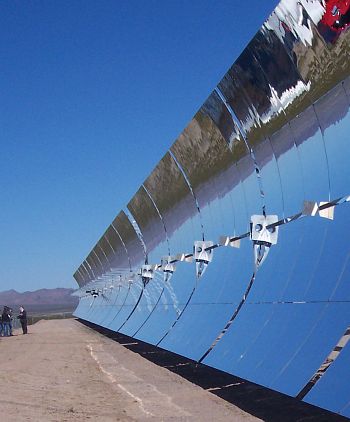
In the case of concentrated solar power (CSP), the potential for a positive return on energy invested is clearer. Although it cannot be said that there is a great deal of evidence, the EROEI of concentrated solar is reported to be about 10. Thus CSP is green by EROEI standards. But what about land use? Austra calculates that by using its technology a 92 by 92 mile square or 8464 square miles or 5.4 million acres would be sufficient to supply the entire United States with electricity at its current rate of consumption. David Rutledge, using real world data from Navada Solar One project land use asserts that it would take 11,600 square miles to supply current US electrical requirements. Bernadette Del Chiaro, Sarah Payne and Tony Dutzik claim about 10,000 square miles.

It should be noted that the general replacement of fossil fuels by electricity in economic sectors like transportation and process heating, could easily double solar land use requirements. Del Chiaro, Sarah Payne and Tony Dutzik claim that the land area disturbed by solar installations would be comparable to that disturbed by coal mining:
more than 9,000 square miles of the United States has been disturbed by coal mining over the nation’s history. And at least 1,644 square miles are disturbed by current mining operations
We may not have an entire picture of the land use impact of solar installations. In addition to the installations themselves, land would be occupied by electrical gathering systems, electrical substations, and high voltage electrical lines. 

There is little doubt then that at least 10,000 square miles of fragile desert habitat and quite possible twice that amount could be impacted by a full blown national solar electric scheme. Thus from a land use point of view, some "Greens" would seem willing to sacrifice green land use valuse in the cause of solar generated electricity, while others are not. Sandy Bahr of the Sierra Club states,
"We support solar power, but it is an industrial activity and putting it next to a wilderness area just is not a good idea".
There you have the Green dilemma.

Water conservation is a green value. Water use in concentrated solar power systems is almost completely ignored, but Joe Gelt points out that water use in concentrated solar is greater than that of coal and similar to nuclear per MWh generated:
a coal fired plant uses 110 to 300 gallons per megawatt hour; a nuclear plant uses between 500 and 1100 gallons/MWh; and a solar parabolic trough plant uses 760 -920 gallons/MWh.
Gelt adds:
Efforts to increase water efficiency in solar energy operations involve modifying the conventional cooling tower. For example, dry desert air could be used instead of water to cool the operation. This, however, would greatly increase building costs because enormous cooling towers would need to be constructed. Also relying on air to cool would not cool the water circulating through the plant to a low enough temperature for peak performance, decreasing the efficiency of the plant.
The Southwest has already has a significant water shortage, and climate projections are for the Southwest to become even dryer during the coming years. The only possible source of enough water for desert based solar thermal power facilities would be to withdrawal water from agricultural use and to transfer it to power production. This would in turn raise food prices in the southwest, and thus would paradoxically constitute a subsidy paid by poor food consumers who would pay higher food prices, to solar electrical producers who would profit from from nation wide electrical sales. Social justice is presumably a Green goals.   

Within the Southwest, concentrated solar power is not environment friendly.  It does not conform to green land and water use principles, and CSP water use requirements would indirectly make the life of the poor in the Southwest worst rather than better.  

Moving concentrated solar electrical production out of the Southwest is not an option, because solar electrical generation is highly dependent on cloudless skies.  There is ample reason then to view there hither to unquestioned "greenness" of concentrated solar generated electricity as open to question.  

In contrast as I have already pointed out there are many aspects of LFTR greenness.  Thorium is a sustainable energy source, with the potential to provide people all of the energy they need for millions of years.   There is already a great deal of Thorium above ground in the form of mine tailings, enough to supply human demands for hundreds of years.  Thorium energy conversion is 100 to 200 time more efficient, that current uranium reactor technology.   LFTR reactor designs use materials more efficiently than conventional reactor designs to.  Recycling of existing coal fired power plants sites for LFTR use has the potential to create energy savings of 50% to 75% compared to start from scratch power plant construction.  LFTR produce little   
to no nuclear waste, thus greatly diminishing energy inputs into waste control.  Material outputs from nuclear daughter products would be an energy savings, that would be unique to LFTR technology.  It is clear then that the LFTR EROEI would from somewhere in the three figures at its lowest on up. From the EROEI stand point, the LFTR would be the ultimate in energy efficiency.

Since most of the chemical output of the LFTR is already recyclable, and some materials processing and separation is expected to be a normal part of reactor operation, the LFTR is expected to produce little unused byproduct.  There are existing markets for some radioactive byproducts and other markets can be developed.  Molten Salt Reactors have been proposed for the disposal of transuranium nuclear waste.  Thus the potential exists to completely eliminate 
not only their own nuclear waste, but also the nuclear waste of conventional reactors  through the use of LFTRs.  Thus the LFTR hasthe potential to be a 100% pollution free technology.

The LFTR has the potential to be very parsimonious in its land use. First I have proposed the recycling of existing coal power plant sites. It should also be noted that much of the landused by nuclear power facilities is actually used as a land buffer for the mitigation of accidental release of radioactive products. Thus up to 95% of the land occupied by a LFTR facility may actually be set aside for conservation purposes. Compared to CSP facilities, LFTRs would have a very modest land use footprint.  Underground placement of the reactor would further restrict visual intrusions, as well as add to reactor safety defenses.  

The LFTR would typically runs at a far higher temperature than conventional reactors. This higher temperature could be used to improve energy efficiency in electrical output. Thus a smaller percentage of the heat produced by LFTR would need to be dissipated by water cooling, In addition most potential LFTR sites are located in areas which do not experience chronic water shortages. Water conservation measure could be applied if needed, and water conservation facilities would already exist at some coal fired plant sites. If needed LFTRs could be air cooled. In the Southwest, LFTRs could be located near the sea coast, an option not available for CSP..

The Liquid Fluoride Thorium Reactor is by definitions green. The LFTR is green by the principles of green engineering. The LFTR conforms to the goal of green chemistry by not producing polluting waste. There is little doubt that the LFTR is greener than CSP in terms of energy efficiency, land use and water conservation, and could potentially be as pollution free as well. The LFTR thus is by conventional definitions of green, greener than all forms of solar power.

Tuesday, June 24, 2008

BrightSource dimming

"Sunflower" in a comment yesterday on Grustmill provided the following prices quotes for CSP:
Ausra (line focus) claims $100/m2, BrightSource (power tower heliostats) $150/m2, Matrix Solar Dish (me) $100/m2.

Let's do a little analysis. A square kilometer at $100 per square meter would cost $100X1000X1000 = 100,000,000 per square kilometer or $247,000,000 per square mile. This represents an improvement over the $260,000,000 for 400 acres figure we got for Nevada Solar 1, or the $1 billion fir 1900 acres figure we got for Solana, but again the word inflation did not appear in the discussion.

The 150/m2 estimate gives us $370500000 per square mile, still a little better than Nevada Solar 1 in price.

Ausra and PG%E have announced a 1 square mile line focus generating facility with a name plate power rating of 177 MWs. The facility is to be located at San Luis Obispo. No price tag has been placed on it yet, so it is impossible to tell if the $100/m2 figure will hold.

BrightSource has a contract with PG%E that calls for the construction of three solar facilities producing a total of 500 MWs. The cost appears to be estimated in the two to three billion dollar range. The size of the facility does not appear in press releases. However, press releases contained a a statement by John Woolard, CEO of BrightSource that the United States production tax credits are "absolutely critical" for his development. "Otherwise these plants will get built all over the world and not in the U.S." It would appear then that the BrightSources facility is not so much of a bargain, since it is too expensive to build without a massive federal subsidy.

According to the Tree Hugger, the first BrightSource facility has a name plate rating of 100 MWs, and will produce 246,000 MWs of electricity a year. That means that the BrightSolar facility will produce peak power with at an .84 capacity factor for 8 or so hours a day. The cost for the first BrightSource Unit would run between four and six hundred million, thus would fall in the range the Nevada Solar 1 range.

While we have not direct report of the size of BrightSource facilities, their mirror test facility in Israel occupies 12,000 Square Meters. The facility produces 1.5 MWs of electricity. This would scale up to about 800,000 Square Meters or 0.8 square kilometers. Subflower gave us the estimate of $150 Per M(2) fir BrighSource,andfor a 100 MW facility that should cost about $120,000,000 which is way lower than my $400,000,000 to $600,000,000 guestimate. And remember that the guestimate was based on BrrightSource's own statement.

A further consideration would be that BrightSources own estimated cost estimates falls within the cost range of current cost estimates for nuclear power plants costs. For the basically the same price as a 1 GW BrightSource generating facility PG&E could buy a 1 GW reactor that would generate power day and night, rain or shine with 3 times the daily electrical output of the BrightSource facility.

Monday, June 16, 2008

"Subsidies"

I usually defer the analysis of solar energy costs to the esteemed Dr. Buzzo, but this weekend I came across a Solar array data set on The Gristmill, to which which  commenters had applied useful and illuminating analyzed on this usually very dark subject. The data was on Navada Solar 1, a 64MW CSP facility completed last year. The Nevada Solar 1 site covers 400 acres, and was completed last year at a cost of over 260 million dollars. Nevada Solar 1 was upon completion the third largest solar generating facility in the world. Gar Lipow discussed Nevada Solar 1, in a May 21 post on Gristmill, in which he reported that Nevada Solar 1 produced 134,000,000 kWh in a year. Such statement are typical of renewable supporters, big numbers that hide inefficiencies and costs. Lets brake the 134,000,000 kWh figure down. Assuming 8 hours a day of useful sunshine, Nevada Solar 1 averages producing 45 million KWh. This gives us a 23% capacity factor. A link which Lipow supplies tells usthat the Nevada Solar 1 facility cost more than 260 million to build.

We now have some data upon which to build an analysis. In a comment on Lipow's post Skeptico noted that the Navada 1 plant cost over $17,000 per kW.

Lipow responded "If you look at costs over 20 years and include interest and O&M that is a cost somewhere between 10 and 12 cents per kWh - not an unreasonable cost for peaking power."

Skeptico shot back, "$260,000,000 / 134 Million KWhr/year /20 years = 10c per kWHr. But that is before any maintenance and before interest. The entire $250 million is paid up front. At only 5% that increases costs by a factor of 2.65, and that's before maintenance."

Sean Casten asked, "How do you get 10 - 12 cents from these numbers? added, that assuming a reasonable 10% rate of return on the $260 million, "[p]aying off that money requires a $30.5 million/year annuity. On 134 million kWh, that equates to 23 cents/kWh, and is before including any maintenance or operating costs, or returns above capital recovery. Drop the rate to 5% (e.g., absurdly low) and you're still looking at 16 cents/kWh."

Sean Casten repeated his question, "How do you get 10 - 12 cents from these numbers?"

Lipow responded with one word, "Subsidies."

Ah ha, we have some light!

In a June 14 comment on Gristmill, Gar Lipow accused Skeptico of using a dishonest argument, because "Skeptico took the kWh per year, treated them as baseload, and calculated capacity based on treating a peaking plant as a baseload plant." Lipow's accusation is strange because solar advocates seldom refer to solar plants as limited to peak load, even though that is largely the case, Lipow had not mentioned the words "peak load" in his May 21 post.

Lipow offered a further response to Sean Casten:

I looked at this particular plant because it happens to be the most recent plant. But it is only 64 MW - tiny and not able to grab the full economies of scale needed for CSP. . . . But CSP of 300 MW or greater is normally considered to pen out to a levelized cost (with interest) of 9-12 cents per kWh."

Lipow offered as proof of this a link to a pamphlet on CSP from Sandia Lab, which claims:

"Current technologies cost $2–$3 per watt. This results in a cost of solar power of 9¢–12¢ per kilowatt-hour. New innovative hybrid systems that combine large concentrating solar power plants with conventional natural gas combined cycle or coal plants can reduce costs to $1.5 per watt and drive the cost of solar power to below 8¢ per kilowatt hour."

Thus we have a total disconnect between the the theoretical world inhabited by Lipow and Sandia scientists, and the empirical world of Nevada Solar 1. Lipow's sole excuse for the disconnect isfound in the words "economies of scale." No case for cost lowering through economies of scale is laid out.

Another issue emerged from the same discussion on June 14 discussion. Nucbuddy noted a growing controversy on water use by desert solar facilities. Nevada Solar One near Boulder City uses 400 acre feet of water for 64 megawatts of power. Nucbuddy also notes that the $260 million cost of Nevada Solar1, does not include the cost of electrical transmission lines.

We now have enough data to do an initial comparison between Concentrated Solar Power and nuclear power. If Nevada Solar 1 were scaled up to produce the equivalent annual electrical production of a AP-1000 nuclear plant. Our solar power plant would occupy about 42 square miles of desert, and would cost $17 Billion. Overnight storage of heat, electrical transmission lines, and interest would carry additional costs. Our 1 GW solar facility would annually consume nearly 27000 acre feet of rare desert water.

In contrast, the two 1.7 GW Mitsubishi's Advanced Pressurized Water Reactor (APWR) Luminant Energy is planing to build at Comanche Peak are currently estimated to cost $5-6 billion each.

Followers

Blog Archive

Some neat videos

Nuclear Advocacy Webring
Ring Owner: Nuclear is Our Future Site: Nuclear is Our Future
Free Site Ring from Bravenet Free Site Ring from Bravenet Free Site Ring from Bravenet Free Site Ring from Bravenet Free Site Ring from Bravenet
Get Your Free Web Ring
by Bravenet.com
Dr. Joe Bonometti speaking on thorium/LFTR technology at Georgia Tech David LeBlanc on LFTR/MSR technology Robert Hargraves on AIM High