
Showing posts with label Pebble Bed Reactor. Show all posts

Thursday, March 31, 2011

Does Nuclear Grade Graphite Burn?

Does Nuclear Grade Graphite burn?

The Union of Concerned Scientists's Ed Lyman never met a reactor he liked, despited his profession that he is not prejudiced against nuclear power in principle. Are Lymans concerns about nuclear safety sound? Or is Lyman trying to lead us off the deep end? Is Lyman trying to convince us that a safe reactor is not possible? Take for example the Pebble Bed Modular Reactor, a reactor that seemingly is safe. Unlike Japan's ill fated GE Mark 1 reactors if you shut down the coolant system of the PBMR, nothing bad happens. The PBMR is melt down proof. Now isn't that a safer reactor? "No way," Lyman tells us:
The PBMR has been promoted as a “meltdown-proof ” reactor that would be free of the safety concerns typical of today’s plants. However, while the PBMR does have some attractive safety features, several serious issues remain unresolved. Until they are, it is not possible to support claims that thePBMR design would be significantly safer overall than light-water reactors.
You see there Lyman is ready to rescue us from our nuclear safety illusions. What is wrong with the PBMR is simple,
A second unresolved safety issue concerns the reactor’s graphite coolant and fuel pebbles. When exposed to air, graphite burns at a temperature of 400°C, and the reaction can become self-sustaining at 550°C—well below the typical operating temperature of the PBMR. Graphite also burns in the presence of water. Thus extraordinary measures would be needed to prevent air and water from entering the core. Yet according to one expert, “air ingress cannot be eliminated by design.”
Rainer Moormann, a German reactor scientist argued that,
graphite burning caused by a huge air ingress may lead to massive fission product releases into the environment.
Genera Atomic says Lyman is wrong because nuclear grade graphite does not burn. It is often incorrectly assumed that the combustion behavior of graphite is similar to that of charcoal and coal.
Numerous tests and calculations have shown that it is virtually impossible to burn high-purity, nuclear-grade graphites. Graphite has been heated to white-hot temperatures (~1650°C) without incurring ignition or self-sustained combustion. After removing the heat source, the graphite cooled to room temperature. Unlike nuclear-grade graphite, charcoal and coal burn at rapid rates because:
* They contain high levels of impurities that catalyze the reaction.
* They are very porous, which provides a large internal surface area, resulting in more homogeneous oxidation.
* They generate volatile gases (e.g. methane), which react exothermically to increase temperatures.
* They form a porous ash, which allows oxygen to pass through, but reduces heat losses by conduction and radiation.
* They have lower thermal conductivity and specific heat than graphite.
In fact, because graphite is so resistant to oxidation, it has been identified as a fire extinguishing material for highly reactive metals.

The oxidation resistance and heat capacity of graphite serves to mitigate, not exacerbate, the radiological consequences of a hypothetical severe accident that allowed air into the reactor vessel. Similar conclusions were reached after detailed assessments of the Chernobyl event; graphite played little or no role in the progression or consequences of the accident. The red glow observed during the Chernobyl accident was the expected color of luminescence for graphite at 700°C and not a large-scale graphite fire, as some have incorrectly assumed.
Is this true? The New Scientist published a discussion of the General Atomic claim in its November 4. 1989 edition. The New Scientist investigation pointed out that the graphite in the Windscape fire was inpure, while the relatively pure graphite at Chernobyl contributed little to the that fire's heat. General Atomics in the past offered a demonstration to skeptics who wanted further convincing of their "Graphite does not burn," claim. A block of graphite would be brought out and heated to a red hot temperature. Then oxygen would be blow ovr the red hot graphite which would not catch fire. Needless to say Ed Lyman did not attend one of those demonstrations. The New Scientist did not entirely support the General Atomics Graphite does not burn claim, but the analysis came down on the side of a graphite does burn reluctantly, and is not very dangerous conclusion, pointing to Peter Kroeger's research for support.

Peter Kroeger of Brookhaven National Laboratory used a compluter simulation to check on General Atomic's claim. He found that if openings developed at two opposite ends of a graphite reactor containment structure, air could flow through the core, and graphite structures would burn some, but not very much, and certainly not enough to release radioactive materials embedded in the graphite. Kroeger remarked,
Air ingress into the primary loop requires prior depressurizatlon with significant subsequent air inflow. Scenarios that have been considered are, for Instance, a primary vessel leak such that during decay heat removal via a
main loop or an auxiliary loop, significant amounts of gas can be exchanged between the primary loop and the RB, while the operating loop forces the re- sulting gas mixture through the core [34]. (It may be hard to conceive signi- ficant air ingress and combustible gas discharge from a single break; butonly with such a large break or with several separate breaks and with simultaneous forced flow conditions can significant amounts of air be forced through the core.) Order of magnitude computations indicate that natural circulation can only result In about .1 to .3 kg/s of gas circulation through the core of a typical modular pebble bed reactor. The initial RB air Inventory of about 80 kg mol (even if none were lost during the Initial blowdown) can only cause the burning of about 400 kg of graphite. Thus, air Ingress consequences under natural circulation conditions appear to be less severe than those under the above forced cooldown scenarios.
Four hundred kilograms? That is less than a thousand pounds, hardly a roaring confligration.
Kroeger found that,
Separate code applications for air Ingress with auxiliary loop cooling [34,43,44] generally indicate that fuel temperatures are only raised slightly due to local burning, at most reaching 1200 C for a core with 1000 C design temperature. Thus, fuel failure from excessive temperature is not to be ex- pected. With auxiliary cooling the oxidation stops after 4 to 96 hrs, depend- ing on the assumed air ingress rate and the number of loops operatlij^. The maximum burn-off (averaged over a pebble) ranges from 100 to 350 mg/cm , which represents about 10 to 40% of the total exterior graphite coating of the fueled pebbles. (It should be noted that the higher values are obtained for extremely large assumed air ingress rates, which may not be realistic.)
A further review of the Lyman's (and Moormann's) claim that graphite fires an PBMR are serious nuclear safety issues, is the composition of the Pebbles of Pebble Bed Reactors. The Pebbles are complex manufactured objects. Each pebble contains an inner coat of silicon carbide a nonflamable material that is designed to contain radioactive fission products within the pebble. Any fire on the graphite surface of the pebble would be stopped by the SiC coat, and thus would not lead to a dangerous release of radioactive materials.

Needless to say, Ed Lyman forgot to mention any of Peter Kroeger's research, the General Atomic's argument, or other arguments that makes his simple "Graphite burns" statement less than a serious enditement of pebble bed reactor safety.

Even less so, does the "graphite burns" statement a serious safety objection to the use of graphite in the core of Molten Salt Reactors. It should be noted that the presence of liquid fluoride salts would be a serious inhibitor of any graphite fire, and in the event of salt drainage from a MSR core, a graphite fire would not be a safety issue, because both fission products and nuclear fuel would drain out of the core along with the coolant salt. Thus even if we reject the General Atomic's contention that Nuclear Graphite does not burn, the graphite burns objection does not appear to raise a serious concern about Molten Salt Reactor safety.

Thursday, October 16, 2008

A Primer on Nuclear Safety: 2.5 Defense in Depth

A Primer on Nuclear Safety:
2.5 Defense in Depth
The Pebble Bed Reactor Option

During the late 1940's research began in Oak Ridge on safe reactor designs.
Farrington Daniels was a pioneering advocate of the practical use of solar energy. Daniels had been, during World War II, assistant director of the University of Chicago Metallurgical Laboratory chemistry devision. The Metallurgical Laboratory was the great incubator of reactor designs. Daniels had done research on the concept of using a furnace filled with small balls or pebbles to fix nitrogen from air. Daniels developed the idea of building a reactor along somewhat similar lines to the pebble furnace, and in 1945 he applied for a patent for it.

There was enough interest in Daniels pile, that in 1946 design work intended to facilitate its development began in Oak Ridge at the Clinton Laboratory, later Oak Ridge National Laboratory. Oak Ridge was the primary inheritor of the Metallurgical Laboratory's tradition of reactor innovation. That pebble Bed research was set aside when the researchers were reassigned to help develop the light water reactor for the Navy. By early 1950's ORNL research had focused on an even more radically innovative reactor concept, the Molten Salt Reactor, thus the Daniels' pile, as it was called in Oak Ridge, was shelved.

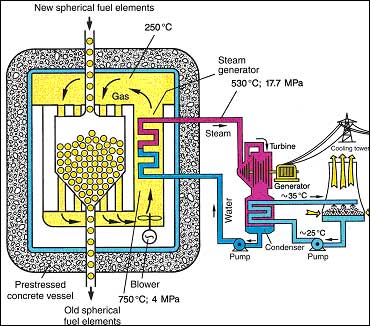
Daniels Idea was embed uranium in small graphite balls or pebbles. The pebbles would be placed inside a chamber, and cooled with helium. The graphite would serve as a moderator, an given the presence of enough uranium inside the balls of moderating graphite, a chain reaction would commence.

After the death of Daniels project in Oak Ridge, the pebble bed idea lay dormant for a few years. then in 1956 a German physicist Rudolf Schulten picked it up and began to develop it. The British were developing gas cooled, graphite moderated reactors the time, and gas cooled reactors offered some attractive advantages over the rapidly emerging American Light Water Reactor. Schulten believed that a pebble bed reactor could be built that would be inexpensive to build and operate, and would be far safer than the American Light Water Reactor. In addition the Pebble Bed Reactor would operate at a far higher temperature, and thus would have greater thermal efficiency than the Light Water Reactor.

The Pebble Bed Reactor looked like a good match to the thorium fuel cycle and there were real concerns in the 1950's and 60's about how long the supply of uranium would last. So the original concept was to make the PBR a thorium breeder. This intention was defeated by the proliferation resistant nature of the PBR's pebbles.

The first German Pebble Bed Reactor, the AVR was conceived to be highly safe. The Pebbles themselves are a major source of PBR defense in depth. Each pebble contains thousands of tiny Uranium dioxide particles. The Uranium dioxide particles are surrounded by multiple layers of material including a carbon inner buffer, followed by an inner layer of pyrolytic carbon, a layer of ceramic silicon carbide, followed by a second outer layer of pyrolytic carbon. Thus each fuel particle contains a five layered defense in depth. In addition the particles were designed to withstand the stress, and high tempreture expected to be encountered in the PBR.

The German Pebble Bed Reactors had one remarkable feature that is repeated in reactor developed from the PBR concept. The pebbles were blown into the reaction chamber by helium gas, and suspended within the reaction chamber by the gas flow. Thus the pebbles had to be designed to withstand the mechanical stress of constantly bumping into each other in the reactor's chamber, as well as the high temperature encountered in the reactor core. The fuel particles were believed to be capable of withstanding the sort possible accident possible with a PBR, hence even without the other PBR fuel safety measures, they offered a high level of inherent safety. The Triso particles were are in turn embedded in graphite pebbles.

The Germens built two pebble bed reactors. The AVR was a successful experimental prototype operated between 11966 and 1988. The THTR-300 was a developmental reactor intended to prepare the way for commercial deployment of PBRs. During its brief operating history between 1983 and 1989 the THTR-300 suffered from the sort of teethings problems common with new technologies. It was by no means a failure, but at the time of the project shutdown there were clearly developmental issues remaining to be addressed. The THTR was originally intended to operate as a thorium fuel cycle reactor, but reprocessing the nuclear fuel proved to be complex and expensive, and the thorium cycle was dropped for a conventional once through Enriched uranium approach. The THTR used no less than 670,000 6cm fuel pebbles. The German Pebble Bed reactor research program was shut down in 1988-89 as a political consequence the Chernobyl accident. At The time of the project shut down, design work was proceeding on the HTR-500, which was intended to be the first commercial PBR.

The PBR was regarded as highly safe. It could be shutdown with cno core cooling without core damage. During AVR testing the reactor was actually brought to shut down with the cooling system turned off. No core damage occurred. This was a remarkable performance. Shutting down a LWR without cooling will lead inevitably to core meltdown due to the heat generated by the radioactive decay of fission products.

The safety features of the PBR include:

- The use of Graphite in the core structure and fuel pebbles.

- The fife layered defense in depth of each fuel particle contained within the fuel pebble

- The SiC coating layer on fuel particles intended to insures the retention of fission products

- Low radiation levels in the environment of the reactor - opperators received only 20% of the radiation experienced by LWR operators

- The use of Helium as a coolant

- Passive removal of decay heat

- Maximum core heating remained below the level that would damage core and fuel structures

- The use of very strong prestressed concrete in the reactor vessel

- The capacity of the outer reactor structure to withstand the impact of an aircraft

The NRC notes:
Because the PBMR is continuously refueled, the excess reactivity can be kept low. Also, the design has a more negative fuel temperature coefficient than LWRs, as the Doppler feedback is greater for the less-thermal neutron spectrum associated with a graphite moderator.* These features reduce the risk of reactivity accidents for most scenarios (but increases the risk for accidents involving core overcooling).

A major component of the PBMR safety basis is a low power density (an order of magnitude below that of an LWR) and large thermal capacity (as a result of the large mass of graphite in the core), together with the high-temperature resistance of the fuel. The maximum power rating of each module (265 MWth) and the high surface-to-volume ratio of the core were chosen so that in the event of a loss of coolant from the primary system, adequate cooling would be provided without the need for forced convection. PBMR designers claim that in the event of a total loss of primary coolant and no operator intervention, the core heatup rate would be slow and the maximum fuel temperature would not exceed 1600 C. Thus the design does not include conventional emergency core cooling systems, which are required for LWRs to provide emergency water sources in the event of a loss-of-coolant accident.
The German PBR project was subsequently regarded as an outstanding success. Not only wree over all project goals meet till the time of shut down but the expectation existed that the technology could be developed into a revolutionary commercial reactor that could be built at a lower cost than conventional light water reactors, yet would operate with at a higher temperature which in turn would lead to greater thermal efficiency. The PBR design has a high level of inherently safe.

Following the shut down the potential of the PBRM was recognized by commercial interests in South Africa, and by the Chinese. Projects to develop PBR technology for electrical generation and process heat have been undertaken in both countries. Both programs expect to build PBRs in factories with serial production beginning by 2020. Between 2020 and 2030 hundreds of PBRs may be built in Chinese and South African factories.

So far I have pointed to the numerous safety advantages of the PBR. However the NRC has questioned the safety adequacy of current PBR designs.
PBMR advocates are so confident in the safety of the reactor (some even call it "meltdown-proof") that they have proposed a drastic weakening of a number of safety requirements that apply to the current generation of U.S. nuclear plants. These proposals include (1) use of a filtered, vented confinement building instead of a robust containment capable of preventing a large release of radioactive materials in the event of severe core damage; (2) a reduction of the size of the emergency planning zone (EPZ) from 16 kilometers to 400 meters; (3) a reduction in the number of staff, including operators and security personnel; and (4) a reduction in the number of systems whose components must meet the most stringent quality assurance standards.

However, there is insufficient technical justification for these measures. The presence of a pressure-resistant, leak-tight containment and the maintenance of comprehensive emergency planning are both prudent "defense-in-depth" measures that could mitigate the impact of a severe accident with core damage. Defense-in-depth is the requirement that nuclear reactors should have multiple, independent barriers in place to prevent injuries to the public and damage to the environment. The presence of multiple barriers is a hedge against uncertainty and an acknowledgement that the understanding of the performance of any one barrier is incomplete.

PBMR promoters claim that a robust containment is unnecessary because the design-basis depressurization accident cannot cause damage to the PBMR fuel severe enough to result in a large radiological release. They argue further that such a containment would actually be detrimental to safety because it would inhibit heat transfer and interfere with the passive mechanism needed to cool the core in the event of a loss-of-coolant accident. However, a containment is needed not only to inhibit the relatively minor releases that would occur during the design-basis accident, but also to mitigate the consequences of a more severe accident. Containments can also help to protect the reactor core from a sabotage attack utilizing truck bombs or hand-held rocket launchers --- an ominous possibility that should not be discounted.
The NRC concerns seem speculative in that it involves the postulation of potential core damage that has not been demonstrated to be possible by simulation. The mention of truck bombs and hand held rocket launchers takes us clearly into the realm of fantasy because the use of such weapons against a PBR can be defeated by relatively low tech security measures already used to harden high risk targets. What sort of major accident did the the NRC have in mind?
Among the largest sources of uncertainty for the PBMR are the potential for and consequences of a graphite fire. The large mass of graphite in the PBMR core must be kept isolated from ingress of air or water. Graphite can oxidize at temperatures above 400 C, and the reaction becomes self-sustaining at 550 C (the maximum operating temperature of the fuel pebbles is 1250 C)[1]. Graphite also reacts when exposed to water vapor. These reactions could lead to generation of carbon monoxide and hydrogen, both highly combustible gases.

If a pipe break were to occur, leading to a depressurization of the primary system, it has been shown that flow stratification through the break can cause air inflow and the potential for graphite ignition[2]. While the PBMR designers claim that the geometry of the primary circuit will inhibit air inflow and hence limit oxidation, this has not yet been conclusively shown.

The consequences of an extensive graphite fire could be severe, undermining the argument that a conventional containment is not needed. Radiological releases from the Chernobyl accident were prolonged as a result of the burning of graphite, which continued long after other fires were extinguished[3]. Even though the temperature of a graphite fire might not be high enough to severely damage the fuel microspheres, the burning graphite itself would be radioactive as a result of neutron activation of impurities and contamination with "tramp" uranium released from defective microspheres. An even worse consequence would be combustion of carbon monoxide, which could damage and disperse the core while at the same time destroying the reactor building, which is not being designed to withstand high pressure. In contrast, the large-volume concrete containments utilized at most pressurized-water reactors can withstand explosive pressures of about 9 atmospheres.
Here we must raise a question since the risk of graphite fire seems greatly exaggerated. General Atomics, which has some experience with the operation of Graphite core and fuel reactors, states,
NUCLEAR-GRADE GRAPHITES ARE NONCOMBUSTIBLE BY CONVENTIONAL STANDARDS"
The General Atomics statement adds:
because graphite is so resistant to oxidation, it has been identified as a fire extinguishing material for highly reactive metals, including zirconium.

The oxidation resistance and heat capacity of graphite serves to mitigate, not exacerbate, the radiological consequences of a hypothetical severe accident that allowed air into the reactor vessel. Similar conclusions were reached after detailed assessments of the Windscale and Chernobyl events; graphite played little or no role in the progression or consequences of the accidents. The "red glow" observed during the Chernobyl accident was the expected color of luminescence for graphite at 700°C and not a large-scale graphite fire, as some have incorrectly assumed.
The NRC has a more realistic concern, howbeeit, one would not lead to a major PBR accident:
First, the fundamental fuel behavior must be sufficiently well understood that a complete set of technical specifications for the fuel can be derived. It appears that this is not yet the case. There are numerous instances in which TRISO microspheres manufactured to identical specifications and irradiated under identical conditions exhibited drastically different fission product release behavior that could not be attributed to observed physical defects like cracking of the SiC layer[6]. This indicates that there are technical factors affecting TRISO performance that have not yet been identified.

Second, when a complete set of technical specifications is finally at hand, the PBMR fuel manufacturing process will have to be reliable enough to ensure that the specifications are met. Because PBMR fuel is credited to a greater degree than LWR fuel for maintaining safety under accident conditions, and is less tolerant than LWR fuel to defects, PBMR fuel will have to be subjected to more stringent quality control. However, even if the requirements were no more stringent for PBMR fuel than for LWR fuel, inspecting the enormous microsphere flow with a high enough sampling rate to ensure an adequately low defect level would be a considerable challenge. The number of TRISO microspheres manufactured annually to support ten PBMR modules (1150 MWe total) would be on the order of ten billion, three orders of magnitude greater than the number of uranium fuel pellets needed to supply an LWR of the same capacity.

Finally, even if the above two criteria are satisfied, there must be assurance that the behavior of the fuel will not be significantly worse than expected if conditions in the core deviate from predictions --- that is, the fuel should "fail gracefully." It is on this count that the current TRISO fuel technology is clearly a loser. While past experiments have shown that the SiC layer of TRISO fuel limits the release of highly hazardous radionuclides like Cs-137 to below 0.01% of inventory up to 1600 C, the retention capability is rapidly lost as the temperature continues to increase. At 1800 C, releases of 10% of the Cs-137 inventory have been observed, which is on the order of the release expected during a LWR core-melt accident[7]. Without a leak-tight containment present, the release into the environment would be comparable to the release from the fuel.

Thus in order to justify the absence of a leak-tight containment, Exelon needs to demonstrate that the PBMR maximum fuel temperature will not exceed 1600 C during the design-basis depressurization accident, and that more severe accidents that could cause higher fuel temperatures are so improbable that they do not need to be considered. However, given the uncertainties discussed in the previous section --- like a discrepancy between calculated and measured maximum temperatures of at least 130 C --- there are serious grounds for skepticism.
There is a strong element of the "not invented here" syndrome in the NRC statement, and the reminder that since the repair of the American nuclear safety establishment was never made good after the havoc that Milton Shaw visited on it.

There are still problems with PBR safety. Rainer Moormann, a German researcher who studied the decontamination of the decommissioned AVR, found an unexpectedly high level or radioisotope contamination in the decommissioned AVR. He attributed the contamination to fuel breakdown at high temperature. While Moormann's findings ought to be taken seriously, radioactive contaminants in a decommissioned experimental reactor built during the 1960's ought not by themselves seen as evidence of a fatal flaw in the reactor design. The AVR used something like 20 separate pebble designs during its over 20 year history. Moormann believes that the problem stemmed from the over heating of fuel pebbles within the reactor. This is most likely a fixable problem, but fixing it requires resources.

Alvin Weinberg who certainly understood the advantage of nuclear safety, viewed the successful design of large scale technological objects like reactors and the product of big science. Nothing can substitute for the large scale deployment of technological resources in seeking technological objectives. Unfortunately the sort of large scale nuclear establishment which the United States possessed in the 1950's and 60's. I would expect the Chinese to deploy the major resources needed to insure Pebble Bed Reactor safety. The Chines need the PBR simply because they need a low cost nuclear technology to replace hundreds of coal burning steam plants. If the politicians do not disrupt it, a safety culture should emerge within the Chinese nuclear community which will provide china and the world with a highly safe PBR. For society, nuclear defense in depth includes a strong nuclear research community that has the curiosity and the resources to investigate nuclear safety concerns ands identify safe materials, designs, and safe production and operation standards without political interference.  

Monday, September 15, 2008

Three Technologies That Can Save Civilization

I am setting aside, for the moment, my history of the Molten Salt Reactor to focus on a question raised by Robert Hargraves on "Energy From Thorium". Dr. Hargraves asked:

If we were to try to convince the US to pursue MSR technology, what would we propose? to whom? Who would carry out the work? How much would it cost? How long would it take? Can we argue for long-term funding, by treaty, as supplied to the CERN supercollider? What university professors and research laboratory scientists would support such a proposal and also have credibility and influence?

I've met with my congressman and senator on the subject of energy in the past, but I don't know what I would ask for on the subject of the thorium MSR.

This question poses a dilemma for the sort of innovative project that can reasonably expected to contribute to our post carbon energy future. If no funding is available, and past attempts to secure funding have been discouraged, then there is no incentive to to continue to develop projects, even on a conceptual level. Thus we get caught in a vicious circle, that no funding leads to a lack of interest, and the lack of interest then becomes the excuse for no funding.

Dr. Hargraves has been a brilliant advocate for Pebble Bed Reactor technology, and the dilemma effects PBR development in the United States no less than it does MSR/LFTR technology.

I would contend that PBR technology, MSR/LFTR technology can play critical roles in future resolutions of our energy crisis. Both reactor types are very safe and highly efficient, and can be manufactured at much lower costs than traditional reactor designs, they have great potential for reducing the cost of nuclear generated electricity. Because of their low cost, both LFTRs and PBRs can serve as peak electrical generators as well as well as base load generators. In addition MSRs have excellent load following characteristics. Indeed load following can extend the core life of graphite cored LFTRs, by lessening the intensity of neutron radiation the core is exposed too. The load following ability of LFTRs also makes them candidates to support wind electrical generating systems, since the ability of LFTRs to quickly respond to rapidly changing electrical currents from wind generators.

Renewables advocates often suggest the use of fossil fuel plants for load following and generation back up, but this option is not sustainable, is expensive, generates CO2, and outs European nations at risk for energy blackmail by natural gas suppliers. Therefore the flexibility of the LFTR makes it an ideal candidate to be paired with wind generation systems, and thus a prime candidate to replace coal and gas burning electrical plants. The rub is that a system of LFTRs would be a low cost alternative to a system of unreliable windmills with LFRT backup. This no doubt rests at the heart of the opposition to nuclear power, by renewables advocates.

At any rate either with or without renewables, the

There are several advantages of LFTRs over PBRs. However PBR's may have some advantageous in the area of proliferation resistance. Thus it is possible to sell PBR's to countries that are a considered a proliferation risk with MSRs. PBRs can be produced cheaply, do not require containment structures, do not require elaborate and expensive containment structures, can replace coal, natural gas, and oil fired generators, are extremely safe, can be operated by simple low cost computers, can provide industrial process heat, heat for space heating, and heat for desalinization in addition to electricity. There low cost makes them attractive options for peak load generators. There are several disadvantages of PBRs vis-à-vis LFTRs. PBRs don't breed or convert their own nuclear fuel. While LFTRs can burn up to 98% of the thorium in their system, PBRs can only burn a tiny fraction of their potential nuclear fuel. As a consequence PBRs produce several orders of magnitude more nuclear waste than LFRTs. The difficulty and expense of reprocessing PBR fuel is a key to their proliferation resistance.

A second disadvantage of PBRM's is that they are not good load followers. In order to follow loads, PBR operators would have to be dumped heat rather than running it through the generating system. This is not efficient use of nuclear power.

Despite these disadvantageous PBR's are destined to play a significant role in the replacement of fossil fuel power plants with nuclear reactors. Like LFTRs, PBRs can be quickly and inexpensively built in very large numbers in factories. Thus, for example, the Chinese, who are developing their own PBR technology, could build thousands of PBRs between 2020 and 2050. Reportedly the Chinese have already offered Canada PBRs to be used in processing Alberta tar sands into crude oil. The rub would be that the oil would then go to China.

South Africa is developing its own PBR which is a little more technologically advanced than the Chinese concept. The South Africans probably can project a very large market for the sale of these reactors. Both the under developed countries of Africa, and Latin America, as well as the more advanced nations of Europe, North America and Asia, would be included in the South African target markets. Thus it can be foreseen that PBRs will play a major role in the replacement of carbon based electrical and energy sources between 2020 and 2050.

LFTRs, because of their superior fuel efficiency, the major reduction of the problem of nuclear wast that LFTR technology brings, their safety, their ability to serve as base load generators, peak load generators, and effect load followers, and there low manufacturing cost, would be the preferred power generation technology for nuclear capable nations. A nuclear capable country is a nation which posses the capacity to produce nuclear weapons, without new technological transfers from external sources. An illustration of nuclear capacity would be South Africa, which developed its own centrifuge Uranium enrichment technology in the 1970's and 80's and managed to produce 6 nuclear weapons. Other nations which are nuclear capable include Argentina, Australia, Canada, the Ukraine, Japan, Taiwan, Egypt, Turkey, Iran, Brazil, Poland, the Czech Republic, Germany, Spain and other European nations. All of these countries could produce nuclear weapons if they chose too.

The low cost of LFRT factory manufacture, plus their many attractive features, and the abundance of recoverable thorium, will mean that in many situations LFTRs will be preferred to PBRs for both power and heat, in many situations. Like PBRs, relatively small (100 MWe to 300 MWe) LFTRs can be built in factories and transported to their long term sites. While LFTR technology is not being developed at the same pace as as PBR technology is proceeding, a large knowledge base was developed in Oak Ridge between 1960 and 1976. In addition other recent technological breakthroughs, for example the development of high temperature gas turbine technology, have technological problems that were unresolved when ORNL stopped working on MSR development in 1976.

Given the current state of LFTR development, a Manhattan Project style development program commenced by 2012, could have LFTRs moving out factory doors by 2020. There are no insurmountable barriers to large scale production.

With their potential for easy, quick and low cost manufacture, PBRs and LFTRs will play a major role in the future of energy, and will be by 2050 the predominant source of electricity world wide.

If reactors are to be the major form by which future energy is produced, more attention needs to be paid to how energy gets stored for transportation. At present Lithium-ion batteries represent the preferred technology for the electrification of transportation in the near future, however, lithium Ion technology brings with it a number of draw backs. First is safety related issues, that are caused by battery heating due to rapid discharge. The second serious problem is Lithium-ion batteries costs which are anticipate to run in the neighborhood of $30,000 for the first Lithium-ion powered EVs. For that price Lithium Ion Batteries offer uninspiring performance. The trip range of the GM Volt is expected to be about 30 miles with our backup from internal combustion engine. That is good for drives to work, and errands, but not for trips out of town.

It is highly desirable then, if carbon based technology is to be replaced in transportation that better electrical storage technology must emerge. Lithium-Sulfur batteries appear to have potential as one such technology. According to a recent Insyncworld report,
in theory, Lithium-Sulfur potentially offers over 50% more Watt-hours/liter than Lithium-Ion batteries, and over four times the Watt-hours/Kg. That allows for smaller, lighter, or longer lasting (pick two) portable devices. Those are theoretical maximums that have not yet been reached, but current Li_S batteries already have a better power/weight ratio than conventional Lithium Ion.
The potential of Li_S technology is illustrared by this recent BBC story.

Li_S technology is newly emerging, but appears to hold great potential including greatly extended battery powered driving ranges, and lower costs. Although personal transportation would seem to be a lower priority on the energy problems list, in fact it is very important, because the physical structure of civilization in countries like the United States is highly dependent on personal mobility. Without personal transportation, the ability of workers to travel from home to work would be significantly compromised in spread out cities. Were workers to be foprced to move closer to their jobs, enormous values would be lost in home, infrastructure and commercial suburban investments. The loss of value in these investments would produce significant investment losses, that could not be easily recovered from.

Thus two reactor technologies, the LFTR and the PBR hold enormous promise as sources of low cost electrical energy and industrial heat. In addition a recently emerging battery technology, the Lithium-Sulfur battery, holds promise to improve the post-carbon transportation picture.

The development of these technologies must be given the highest priorities by our society, during the next few years, if your civilization is not to be seriously wounded. We must not allow Dr. Hargraves dilemma to inhibit that development.

Followers

Blog Archive

Some neat videos

Nuclear Advocacy Webring
Ring Owner: Nuclear is Our Future Site: Nuclear is Our Future
Free Site Ring from Bravenet Free Site Ring from Bravenet Free Site Ring from Bravenet Free Site Ring from Bravenet Free Site Ring from Bravenet
Get Your Free Web Ring
by Bravenet.com
Dr. Joe Bonometti speaking on thorium/LFTR technology at Georgia Tech David LeBlanc on LFTR/MSR technology Robert Hargraves on AIM High