
 Nuclear safety has been an important concern of reactor designers since the first reactors were designed. The earliest reactor designers realized that some reactors designs were safer than others. Safety flaws were known to exist in the reactors built in the Hanford, Washington complex. For that reason the complex was situated in a relatively remote lightly inhabited area.
 The safety problem with the Hanford reactor stemmed from the use of water cooling in a graphite reactor. If the reactor heated up to much, the water inside the reactor could could boil within its pipes. Water inside the graphite moderated core, tends to act as a break on the chain reaction. When water is removed from the water cooled graphite reactor the break is released, and the chain reaction speeds up. That adds more heat to the reactor core, and the added heat boils off more water. This process can build up very rapidly until there is a steam explosion that could potentially destroy the reactor core.
Why would anyone ever build such an unsafe reactor? The answer in the case of the United States, was that the Hanford Reactors were built because the American Government believed that it had a military necessity to do so. In 1942, the Germans were known to be developing nuclear technology, and that technology was assumed to have a military purpose. Few of the people who were involved at the time believed that nuclear safety was the most important issue. The danger to national survival that would emerge if Germany was the first to develop a nuclear weapon was the primary concern. Thus the decision was made to build unsafe reactors at Hanford because the reactors would be an important source of weapons grade fissionable Plutonium. The Hanford reactor design was never copied elsewhere in the United States, and when the United States Government around 1950 made the cold war decision to expand its plutonium output, a different, safer reactor design was chosen.
The political leadership of the Soviet Union dictated that nuclear safety was not an issue, When Yuri Andreyev took an examination to become a Soviet nuclear plant operator, he was asked to describe how a reactor could explode. He answered the question by describing three different scenario. The examiner criticized Andreyev 's answer,
With this attitude the Soviet Union chose to copy the Hanford design for plutonium production reactors. Later these military heated coolant water from these reactors was used to produce steam that drove electrical generators. This experiment was considered successful, and the Soviet leadership chose to develop a new class of power generating civilian reactors that was based on the old, unsafe Hanford design, During the 1950's the Soviets began producing a slightly modified Plutonium production reactor, that could also generate steam for electrical generation. These reactors were designed with little regard to the nuclear safety concerns, but they were cheap and easy to manufacture, so the Soviets adopted the design for a single purpose power reactor, the RBMK.

"Keep it in your mind, man -- Soviet reactors cannot explode,"the examiner told him.
With this attitude the Soviet Union chose to copy the Hanford design for plutonium production reactors. Later these military heated coolant water from these reactors was used to produce steam that drove electrical generators. This experiment was considered successful, and the Soviet leadership chose to develop a new class of power generating civilian reactors that was based on the old, unsafe Hanford design, During the 1950's the Soviets began producing a slightly modified Plutonium production reactor, that could also generate steam for electrical generation. These reactors were designed with little regard to the nuclear safety concerns, but they were cheap and easy to manufacture, so the Soviets adopted the design for a single purpose power reactor, the RBMK.

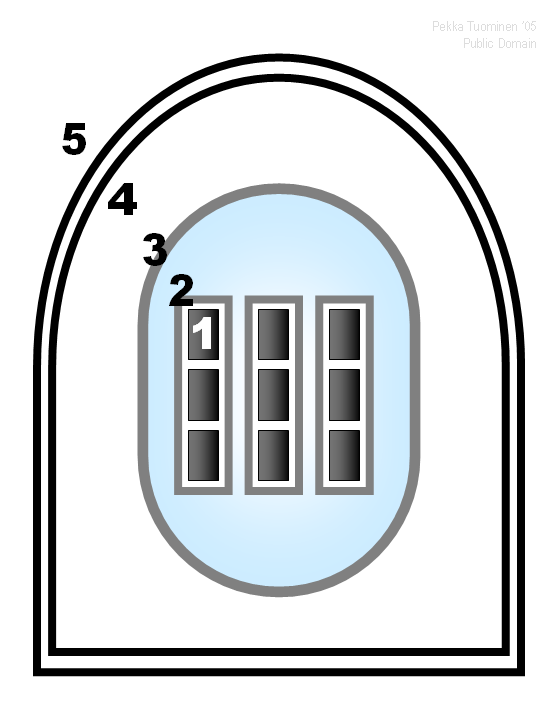
All of the safety problems of the original Hanford design were still present in the RBMK. While thinking about nuclear accident containment had advanced in the West, the Soviets failed to see the point. Western researchers had investigated how radioisotopes could escape into the environment in a nuclear accident, and how that escape could be prevented. Western power reactors reactor designs included a system of multiple barriers to the release of radioactive materials into the environment in case of an accident. The Western nuclear containment system was tested at Three Mile Island when a an error by a reactor operator turned a minor nuclear incident into a core meltdown. The TMI accident was contained without and known illnesses or deaths as a consequence. Some radiation was released in the form of radio active gases, but radio active gasses are also released by burning natural gas in the home. Despite the evidence that the Western containment system prevented radiation related deaths and illness, the Soviets slightly modified RBMK reactor building design to improve containment, but this modification still left RBMK containment far short of Western standards.
In addition to its known safety problems, the RBMK design included a serious hidden safety flaw. Sonja Schmid, in a study of Soviet nuclear safety practices notes,
Soviet design choices display a similar circular pattern: while the “Sovietness” of the graphite-water reactor (the “Chernobyl’ type” reactor) was invoked to legitimize its development, mass production and implementation, the reactor design itself then served as proof of Soviet technological prowess.
In addition to the already noted RBMK safety flaws, there was a defect in the design of its control rods. There was a graphite extension of the control rod, that entered the reactor prior to the neutron absorbing metal that formed the main body of the control rod. The control rod channels were normally filled with water, which as I have already noted acted as a break on the chain reaction. The presence of more graphite actually accelerated the chain reaction, as did the displacement of water in the control channels. As a result, as the control rods entered the reactor, there was a massive spike in core reactivity. Power output rose quickly to an estimated 30 Billion thermal watts, ten times what the RBMK was designed to handle. As this process unfolded, the heat of the reactor core increased dramatically, fuel elements and full channels began to rupture and pressure built up in the coolant water tubes As steam began to escape the rupturing tubes, steam pressure inside the reactor case increased, until the case explosively ruptured. A two thousand ton plate that covered the top of the reactor was blown off by the force of the explosion, opening the upper surface of the reactor to the sky. Three seconds later, an even more violent explosion occurred ripped the core apart, flinging chunks of burning radioactive matter high into the air.
Under ordinary circumstances graphite does not burn, but the graphite in the Chernobyl was heated white hot, and the mass of superheated graphite was exposed to an airflow, that ignited it. Then all of the Soviet nuclear mistakes, all of the Soviet arrogance that vainly assumed that nothing bad could happen to Soviet reactors came home with horrific force.
The Chernobyl reactor disaster was not simply a result of poor reactor design, but it was the result of an ideological system that believed that Soviet reactors could not fail. Mistakes made by the Chernobyl operators played a very large role in the accident. Those mistakes were the result of a test requirement imposed on the reactor staff, by the authoritarian Soviet system. Reactor safety issues were simply ignored in the performance of the test, and the reactor staff drove the reactor to and past its breaking point. It is unlikely that there would have been a Chernobyl, had there not been a Soviet Union.



 Posts
Posts


