Showing posts with label Oak Ridge. Show all posts

Friday, May 21, 2010

Dick Smyser told the Oak Ridge Story, and Environmental concerns were a part of it

I found two unpublished posts related to Thomas Pigford today in a search of my old posts. I thought these were to good to leave under raps

One of the things that happened to me while growing up in Oak Ridge, is that I managed to assimulate the viewpoint of the atomic pioneers. I had no idea at the time of the importance of Eugene Wigner to the shaping of the ORNL/Oak Ridge mentality. In fact Wigner was often in the background and his thinking was communicated to Oak Ridge in ways we little suspected. Dick Smyser had a lot to do with the communications of the ORNL View to the community. Smyser was the editor and later the publisher of the Oak Ridger. Smyser was more than a jurnalist. His Brother-in-Law, Thomas H. Pigford, who was a former ORNL engineer, a Professor of Nuclear Engineering at the University of California, Berkele, and the only nuclear scientist to serve on the Three Mile Island Commission. The Pigford connection gave Smyser an added in with the ORNL staff, On addition Smyser had an "in house" expert he could turn to for insight, when he did not understand something. As a consequence Smyser not only kept Oak Ridgers well informed anout developments at the lab, but he helped to make Oak Ridge a uniquely nuclear literate community, I have little doubt that Weinberg sharred his thoughts with Smyser on more than one occasion, and Smyser had a social relationship with many ORNL scientists, and would have at leasst meet Wigner and been aware of his importance in creating in Oak Ridge a high level of nuclear literacy that extended beyond the scientific community. I am sure that I picked up terms like neutron economy and breeder blanket from the Oak Ridger, although I did not fully understand what they meant until I began to look closely ate the MSR in 2007. The MSR came well before the current energy crisis, but it was understood in Oak Ridge that the thorium fuel cycle MSR had the potential to provide all of the nation's energy in the future. By the 1960's the vision of a high tec future that would benefit not only the United States, but the world's poorest people, had taken hold in Oak Ridge, and the Oak Ridger reported on it.

Pigford was an expert on both the Uranium andthe thorium fuel cycle, and no doubt Dick Smyser learned something about those subjects from his brother-in-law.

So I grew up nuclear literate and exposed to the world view that lay behind the most daring scientific projects of Oak Ridge scientists. In addition Oak Ridge carried with it the Manhatten Project legacy. The story of K-25 particularly informed the Oak Ridge view of the world. K-25 was huge. It had been the world's largest building under one roof when it was completed during World War II. The isotope separation process used at K-25 was not perfected until construction was well underway. That sort of experience engenders a measure of self confidence. Oak Ridgers had considerable confidence in the power of their technology. They knew that a business as unusual sometimes needed to be set aside and that a great deal could be accomplished by people who were hard working and intelligent. The first atomic bomb that was dropped on Japan used uranium that was processed at Oak Ridge. From 8 tons of Uranium K-25 and Y-12 produced 64 kg of U-235. When the Little Boy bomb went critical, a little more than 1% of the U-235 in the bomb fissioned and about 0.6 g of that mass was transformed into energy. That bomb exploded with the energy equivalent of 20,000 tons of TNT. Most energy writers are unaware of the enormous amount of energy that can be extracted from tiny amounts of matter.

Oak Ridge Scientists conceived of the The Light Water Reactor and made major contributions towards its development, but Oak Ridge scientists knew that the LWR is a very inefficient means of turning matter into energy in a nuclear process. The Light Water Reactir core has to be far larger than a Molten Salt Reactor core. Small cores requite less material and labor to build. They are not necessicarily less safe.

The Oak Ridge vision was in no small measure formed by the natural setting of the city. Oak Ridge has a beautiful setting, and few places where the human species has found itself living can rivaled East Tennessee for natural beauty. Between 1942 and the present many people have lived in Oak Ridge for a short time, but those who tendede to stay, were people who enjoyed the natural setting. As a result Oak Ridge was a city of unusual environmental awareness.


ORNL uses the beauty of the Oak Ridge area as a selling point for employee recruitment.

It was inevitable that ORNL was to become a center of environmental research and from the 1970's onward took the scientific lead in pointing to potential environmental problems caused by CO2 emissions. Oak Ridge scientist understood that burning fossil fuels represented a long term threat to humanity and believed that nuclear power could make an important contribution to the successful prevention of that threat.

Sunday, October 11, 2009

Letters to Jesse 4: A Second Manhattan Project?

Dear Jesse, The conventional view is that it would take a long time to develop Generation IV nuclear technology. This is mistaken because the Indians expect to complete a commercial Generation IV Fast Breeder Prototype Reactor in 2011, and then begin to build standard production reactors immediately after. They currently expect to complete at least 4 commercial fast breeders by 2020, and more later.

The long gestation period view assumes that the development of Generation IV technology would be conducted with business as usual approaches. But if we think that the fate of human society would rest on the pace of a Generation IV development project, would a business as usual approach make sense? Alternatives would be a simi-Manhatten project model and a mini-Manhattan project approach. The difference would have to do with time scale, with the Simi-Manhattan project approach trying to bring in everything in a two to three year time range, while the mini approach might take 5 years. The mini approach might cost $20 billion, perhaps twice the cost of the business as usual approach, but at the end of the five years a saleable product, and a factory to build it would be ready.

Let me illustrate what I mean by the Manhattan Project approach. The Mahnattan Project was a massive research, development and production project conducted during World War II. The aim of the project was the development of deliverable nuclear weapons. That goal was meet. Rather than develop one single approach to the project, and perfect it, project scientists undertook to develop parallel approaches to project goals. Scientists identified two fissionable materials that could be used in Nuclear Weapons, U-235 and Pu-239. Rather than settle on one approach, they decided to develop two weapons, each using one of the fissionable matereials. The method of producing Pu-239 was deemed very dangerous, and the production facility was located in a desert in Washington State. Production at the Washington State site was to be accomplished through the use of 3 large, experimental reactors of a type never built before. Construction of the reactors began in August 1943, The first was finished in September 1944, and the final reactor was completed by February 1945. The entire 3 reactor project was completed in 18 months. Despite questions about the safety of their design, the Hanford reactors never had a serious accident. Their designer, Eugene Wigner was trained by a chemical engineer who had done notable chemistry research in the 1930's.

A further research reactor was build in Oak Ridge with an overlapping time schedule to the Hanford Reactors. The X-10 Graphite Reactor, was intended to produce plutonium for the research required to waponize it. The designer of the Graphite Reactor was a young scientist, who had recently acquired a PhD in biophysics from the University of Chicago. Despite the fact that the youthful Alvin Weinberg had more training in biology and mathamatics than in physics, and had no engineering training at all, he was able to design a reactor that was built in 10 months, and performed flawlessly, and proved a valuable research tool.

Thus from December 1942, when Enrico Fermi's Chicago pile went critical, and November 1944, the design of reactors leaped forward by would have required a business as usual approach a generation to accomplish. Further more, the designers of these reactors would have been viewed as completely unqualified to perform this task, because they lacked the proper educational background.

In addition to the development of reactors to facilitate the production of a plutonium based nuclear weapon, the project to develop a uranium based weapon had an equally remarkable history. Three separate uranium enrichment projects were developed in Oak Ridge. The Y-12 project developed and used electro-magnets in devices called calutrons to seperate the uranium isotopes. The calutrons required a huge amount of copper wire, and when copper was in short supply, the Manhattan project borrowed 14,700 tons of another electrical conductive metal, silver, from the United States Treasury to wire the magnets. A second uranium separation process was housed at K-25, which when finished was the largest building under one roof in the world.

The K-25 project would have cost $8 billion today. While it was being built, scientists and engineers did not know if they could make the gaseous diffusion method work. Again, a huge investment produced in months what a business as usual approach would have required years to accomplish.

I would argue that given the dual crises of CO2 emissions/Anthropogenic Global Warming and Peak Oil, and the potential for Generation IV nuclear technology, a rapid nuclear development program is demanded.

If a Manhattan project type endeavor were undertaken, regulation would be expidited but safety not compromised. The NRC would work alongside reactor researchers, establishing reasonable safety standards, and passing them on. During the development period the NRC should determin that reactor developments are meeting all NRC safety goals. The complete design should already have an NRC license, even before the prototype is built.

In the Simi-Manhattan project alternative design approaches would be researched in parallel, while in the mini approach they might be investigated sequentially. Both would involve spending at a robust level. There are shortcuts to development including licensing sucessful technology. This might include licensing Russian BN-600 technology, Indian Fast Breeder Prototype Reactor technology, in addition too drawing on American Experimental Breeder Reactor-II (EBR-II) technology and experience. I am not a big fan of the LMFBR type, but it is probably inevitable that we are going to build some, and if we do, we might as well develop and build them fast.


That document assumed a business as usual approach, and suggested development plans that would take a generation to realize. How much would it cost?

According to ORNL-4812, up to 1972 ORNL had spent $130 million dollars on MSR development. In 2009 terms this was less than than one billion dollars,

In 1980 the ORNL staff estimated that a commercial DMSR could be developed for $700 million (about 2.5 billion in 2009 dollars). Given another 2.5 billion for the development of the LFTR prototype we would have a total investment of between 5 and 6 Billion 2009 dollars investment. At that point there would be a product ready to go on the assembly line. Thus the total investment in the LFTR would be comparable to the Federal investment into the LWR. It would be one fourth the investment made so far in unsuccessful American LMFBR technology.

My analysis suggests that with factory production and by recycling coal fired power plants, modular LFTRs can come online for an investment as small as a dollar a watt. Let us assume that the actual cost is twice that. We still have a price for LFTRs that is lower than the 2009 price for windmills, even with a capacity factor no better than the windmills, the LFTR would be a far better buy because of its superior flexibility.

It would be nice to imagine a private enterprice investing in the LFTR. Is it possible? $5 billion would not be unreasonable for a private business invest in LFTR development. There are American businesses that are capable of writing a$5 billion check for LFTR development today. Consider the €11 billion plus that Airbus invested in the development of the A380 aircraft. At a cost of $327 million, the A380 would be, if anything, more expensive than the modular LFTR. In fact it is doubtful that Airbus will ever recover the Airbus 380 development cost, while the LFTR potentially could be quite profitable.

Compaired to the cost of renewables, the Manhattan project approach would be an incredible bargain. For example, the German newspaper Die Zeit recently reported that the costs of photovoltaic instalations built in Germany up to 2008
will amount to even more than 30 billion Euros.
And how much electricity will German consumers get for their investment? A recent estimate reported that in 2008. German PVs produced 4,300 GWh, about half the power output of one conventional nuclear reactor. 30 billion Euros would pay the development of both Sandia's "Right Size" Reactor, a small, factory built Fast Breeder Reactor, and the the Liquid Fluoride Thorium Reactor, a very safe, factory build reactor.

Eventually, the LFTR will prove to have significant advantages over the Fast Breeder Reactors. First the core of the LFTR is smaller, hense the structure ment to house the LFTR core will be smaller, and lower cost. Secondly the LFTR has safety abvantages over the fast reactor. Even if the fast reactor proves in practice to be as safe as the LFTR, that safety is not entirely inherent, and will come at a cost. Finally, fuel reprocessing with the fast reactor, will be far more expensive than with the LFTR.

Given the very great importance of a rapid, and massive world wide deployment of low cost nuclear technology capable of safely meeting human energy needs. a Manhattan Project type approach to facilitate the development of promising nuclear technology seems more than warranted. Indeed given the potentially disastrous consequences of failing to safely meet human energy needs, the rapid development of promising technology, is an imperative, not an option. - Charles

Monday, March 9, 2009

We Colonize the Past: A Postcolonial Essay

We Colonize the Past: A Postcolonial Essay

The whole construct of postcolonialism is riddled with problems and questions. Children are colonists. Children colonize the adult past and make it their own, or they ignore the precolonial past. Adult society colonizes too. Places change from rural to suburban or urban. As they change landscapes undergo profound changes, and people get rearranged. There can be great transformations.

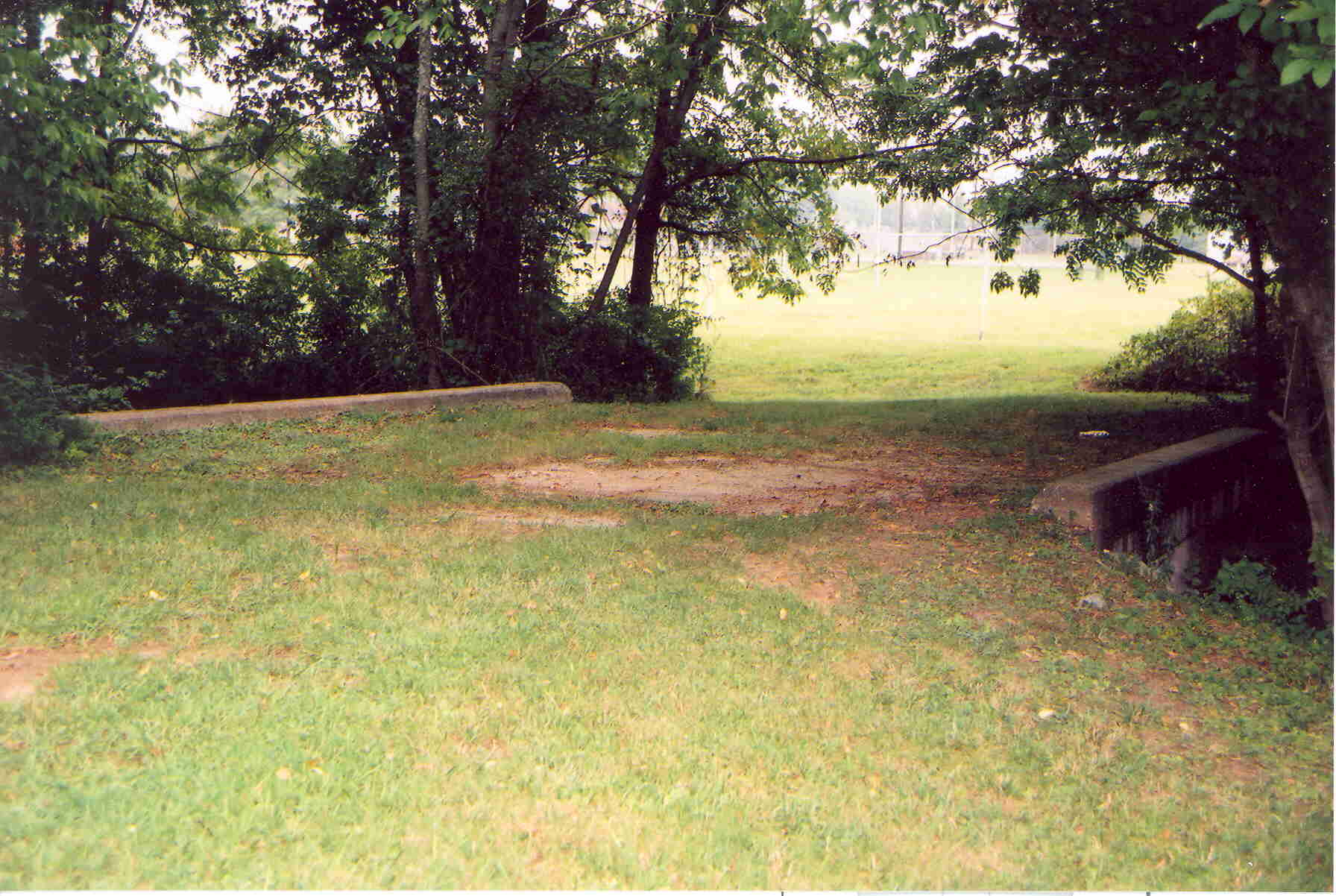
When I was a child I walked into my backyard and saw evidence of the past. There was a row of dogwood trees, and along the trees some strands of wire attached to wooden pools, the remnant of a fence. Next to to the fence was the barely discernible remains of an old dirt road, a country lane or farm road from the past. The lane could be made out by slight indentations in the earth, left by my wheels or tires. Where these indentations were visible they ran parallel to the trees and to the remnant of the fence. That was all. About a quarter mile up hill, on top of the ridge was an old peach grove, and there was also an area flattened by a bulldozer, the site of a World War II Army barracks, that was gone by the time I started exploring in the early 1950's. My childhood friends and I called the site the flat top, after a style of temporary house built in Oak Ridge during World War II. We spoke of the "old army barracks" having once been on the flat top, old being something that had been dismantled 5 years ago. The road and the fence were older than the barracks, which in turn dated from before the time of the Manhattan project.

The image “http://www.smithdray1.net/history/images/emeryroadbridgelr.jpg” cannot be displayed, because it contains errors.

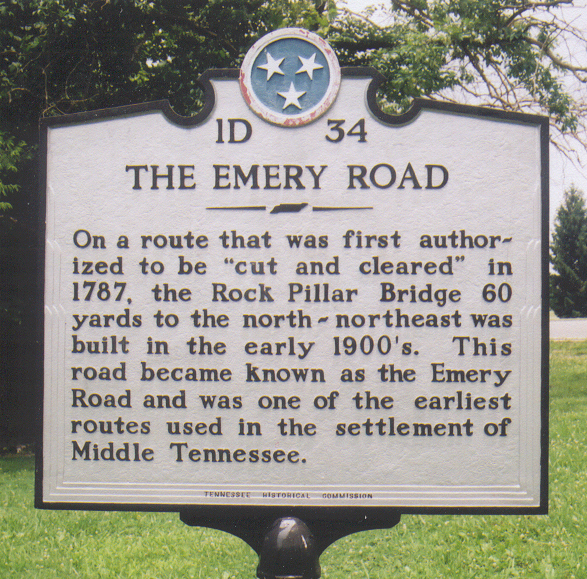
The "pre-colonial" Emery Road Bridge in Oak Ridge is no longer in use.

The image “http://www.smithdray1.net/history/images/Emery%20Road%20Marker%20lr.jpg” cannot be displayed, because it contains errors.

Before I was born the land had been home to several rural communities. Scattered farmsteads, a few stores and churches, at least two schools. After 1948 a few remnants remained. The old gymnasium from Robertsville High School, that would become the gymnasium for Robertsville Junior High School. The old communities were named, Scarborough, Wheat, Robertsville, and Elza. Of the four Robertsville is best preserved in local memory. There is of course Robertsville Junior High School, but also Robertsville Road, and Robertsville Baptist Church. Scarborough is also known as a part of Oak Ridge. During my childhood Scarborough was the black part of town, completely segregated from the white community, close to the city dump, and just across a Ridge from the secret plant called Y-12. Although Y-12 was originally built as a Uranium enrichment facility, during the cold war, it became a center for building atomic weapons. Informally Y-12 was called the Bomb Factory. The memory of Elza was always connected to the memory of the Elza Gate, which is now the location of Elza Park. There is also an Elza Drive and an Elza Paint and Body Shop. It was an actual Elza Gate to the city of Oak Ridge until the city stopped being a restricted area in the early 1950's. The Gate was truly a magnificent structure.


Elza Gate

In 1942, the United States Government decided to produce Atomic Bombs. In order to do so, they needed to build experimental reactors to research the production of Plutonium. They also need to build large factories that were devoted to the highly difficult and technical task of separating U235, the material needed to make bombs, from U238, the sister isotope that does not explode. In order to accomplish this the government needed to requisition a large amount of land in rural East Tennessee. There were several considerations that went into the choice of locations, but the most important was the availability of electrical power through the Tennessee Valley Authority.

mountains.psd

Once the location was chosen, the next step was to get rid of the people who lived there. The four communities involved were homes to a thousand families. These communities were long established. The area had been settled as early as 1790. Robertsville was established in 1804. Wheat was over a century old, and had been the boyhood home of Sam Rayborn, a House Speaker who had represented a congressional district in Texas during the mid-20th century.

The image “http://www.atomicmuseum.com/tour/photos/oakridge.jpg” cannot be displayed, because it contains errors.

A rustic cabin - home to one of the thousand or so families who lived on the land that later became Oak Ridge.

At the time Oak Ridge was built, Tennessee was a profoundly rural state. Farm families constitute 63% of Tennessee's population. In Anderson county during 1942 a way of life suddenly changed.

The image “http://oakridgevisitor.com/history/images/Bear-Creek-Valley.jpg” cannot be displayed, because it contains errors.

This 60-plus-year-old photograph was taken at George Anderson’s
residence looking to the north, where his house stood on the south side of
present-day New Hope Pond Road, which was Bear Creek Road in 1942. Bear Creek Valley was the site of prophet John Hindrix 's vision. That vision was fulfilled when the Y-12 plant was built in Bear Creek Valley,

The image “http://www.mphpa.org/classic/PH/OR_2/ORP-622.jpg” cannot be displayed, because it contains errors.

Y-12 in Bear Creek Valley some time after 1942

The federal government took over 59,000 acres of East Tennessee land, and evicted a thousand farm families. Massive industrial facilities were built. One of the new buildings, designated K-25, was a half mile long and a thousand feet wide. When completed it was the largest building under one roof in the world.

K 25 Gaseous Diffusion Plant

K-25

A new city was built, Oak Ridge. Actually there was a second city, Happy Valley, that was built on the site of what had once been Wheat Community. Happy Valley was torn down almost immediately after World War II, and its remaining population moved to Oak Ridge, or dispersed to surrounding communities. Today Happy Valley is a forgotten memory. The population of Oak Ridge, was 70,000 at its war time peak. Today it has stabilized at around 27,000. The location of Oak Ridge is one of stunning natural beauty. It could almost be called a city set in a park. The relationship between the new city of Oak Ridge and its past might be described as one of colony to colonized.

A colony can be defined as:
  • a body of people who settle far from home but maintain ties with their homeland; inhabitants remain nationals of their home state but are not literally under the home state's system of government
  • a geographical area politically controlled by a distant country
  • a colony is a territory under the immediate political control of a geographically-distant state (or city, in ancient times).
  • Some colonies were historically separate countries, while others were territories without definite statehood at the moment of colonization.The metropolitan state is the state that owns the colony. In Ancient Greece, the city that owned a colony was called the metropolis within its political organization.

  • In its origins, Oak Ridge was a colony of the National Government of the United States. The Government simply took the land of the native people of East Tennessee away, declaring arbitrarily what could count as just compensation for a way of life. What was established was a community of people who were for the most part far from home. The new colonialists differed from the original inhabitants. They were far better educated. Many of the former residents did not have more than an 8th grade education. Many of the new residents of Oak Ridge had PhDs. There were differences in religion too. Oak Ridge included Catholic and Mormon families, and there was an active group of Jehovah's Witnesses. Such religious views were foreign to the old East Tennessee rural communities that proceeded Oak Ridge. Oak Ridgers voted Democratic. The old East Tennesseans were Republican. Oak Ridgers liked to drink alcohol. The traditional communities had been dry.

    Henry Cabot Lodge once observed: "The word “colonial” is preferable to the more obvious word “provincial,” because the former is absolute, while the latter, by usage, has become in a great measure relative. We are very apt to call an opinion, a custom, or a neighbor “provincial,” because we do not like the person or thing in question; and in this way the true value of the word has of late been frittered away. “Colonialism,” moreover, has in this connection historical point and value, while “provincialism” is general and meaningless. Colonialism is also susceptible of accurate definition. A colony is an off-shoot from a parent stock, and its chief characteristic is dependence."

    There is no doubt that the city of Oak Ridge has been dependant on the Federal Government throughout its existence. The relationship of Oak Ridgers to their neighbors in surrounding East Tennessee communities has always been one of Colonists to Provincials. The distance in the relationship is not only in terms of physical distance, it is also in terms of time. In time East Tennesseans and Oak Ridgers grew more like each other. In 2006 84% of Tennessee's population was urban, a remarkable shift in two generations. In many respects these changes left most Tennesseans with a post-colonial problem. An urban, modern present had colonized their past, and they were left with the problem of figuring out who they are.

    By building Oak Ridge the federal government did not in fact intend to plant a colony, but it had.

    fallcolors.psd

    "G" Road is close to my childhood home. It leads out of Oak Ridge into the "pre-colonial" landscape beyond the city. I walked this road many times during my childhood seeking the hidden secrets of the past.


    We all have colonial legacies, and thus postcolonial status is part of the universal human experience.

    Monday, April 21, 2008

    Waldo Cohn, nuclear and genetic pioneer

    Waldo Cohn was both a remarkable scientist and a remarkable person. I have previously posted about his leadership in the school desegregation controversy in Oak Ridge, which lead to the peaceful desegregation of Oak Ridge Schools in 1955. Waldo's was a biochemist, but pioneering physical chemical research on plutonium during World War II made an important contribution of nuclear technology. The ion exchange method Cohn developed had wide applications including the processing of fission products, rare earth separation, and in nucleic acid research.
    In 1963, the American Chemical Society honored Cohn for his "pioneering work in ion exchange chromatography which has made possible much of the progress that has been made in two completely different fields of chemistry since World War II."

    Dr. Cohn pioneered the use of radioisotopes as tracers in medicine and was influential in starting the production of radioisotopes for scientific research and medicine at Oak Ridge. He set up a system for radioisotope distribution.pioneered the use of radioisotopes in medicine.

    He applied his plutonium research methods to the study of the components of the nucleic acids DNA and RNA, and his research made a major contribution to the understanding information transfer from nucleic acids to protein molecules.

    Alvin Weinberg stated about his long time friend Waldo Cohn:

    "The main task (in 1943) was to produce gram quantities of the nuclear explosive, plutonium. The techniques developed there were transferred to the huge plutonium-producing nuclear reactors at Hanford, Wash.

    "To manufacture plutonium, one had to 'cook' uranium in an atmosphere of neutrons in the nuclear reactor at Clinton Lab. In this process uranium atoms were split to create radioactive 'fission products.' Cohn set about to identify the chemical species of fission products. He applied to this process a technique known as 'ion exchange chromotography.'

    "After the war Cohn realized that this technique could be applied to the characterization of the components of the nucleic acids, DNA and RNA. Cohn's technique ultimately led to Crick and Watson's structure of the genetic materials, DNA and RNA. For this achievement Cohn received the Chromotography Award of the American Chemical Society and he was named a fellow of the American Academy of Arts and Sciences.

    "Cohn was also the first to organize and promote the use of radioactive radioisotopes produced in nuclear reactors. The widespread use of radioisotopes is perhaps the most important scientific byproduct of the Manhattan Project."

    Dr. Cohn's obituary in the Oak Ridger noted his many civic, artistic and political contributions to the Oak Ridge community:

    "Cohn was politically involved both nationally and locally. He was one of the organizers of a petition signed by a large number of scientists urging that a nuclear bomb first be detonated in a test blast before being used on human targets. Immediately after World War II he became active in urging international control of nuclear weapons."

    "Locally he was one of the leaders of a group of local Democrats who worked to make basic reforms in the organization and operation of the party in Anderson County."

    "He was a strong proponent of the development of nuclear power and often spoke out against what he thought were exaggerated fears about the dangers of radioactive materials to the public. , , ,"

    "Less than two months after joining the staff at Clinton Laboratories, he placed a small notice in The Oak Ridge Journal, weekly newspaper published by the Manhattan Engineer District, inviting all Oak Ridgers interested in playing in an orchestra to a meeting. Nine other musicians responded, two other strings and seven woodwind players. In a 1983 interview he told Juanita Glenn of The Knoxville News-Sentinel, "I didn't want to join an orchestra, I was just looking for someone to play duets."

    "Cohn had studied the cello since age 11, although at first he hated carrying the large instrument. Before his 16th birthday he had been invited to join the Berkeley Community Orchestra."

    "That initial group of interested early Oak Ridge musicians grew into a string orchestra of 19. At first they rehearsed in the Cohn living room but soon moved to the auditorium of the original Oak Ridge High School, which was located on the knoll off Kentucky Avenue overlooking Blankenship Field and which, before it was demolished, had become Jefferson Junior High School."

    "The early musician group named him their conductor and gave their first concert as the Oak Ridge Symphonette in June 1944. Then, within weeks, they became the 65-member Oak Ridge Symphony, which gave its first concerts on Nov. 3-4, 1944."

    "Besides the Symphony and his service on the early Advisory Town Council, Cohn was a regular reader for Recording for the Blind and Dyslexic, reading primarily scientific texts. In more recent years he also volunteered regularly at the Oak Ridge Convention and Visitors Bureau, where he would answer visitors' questions about the wartime atomic bomb development and the later research at the ORNL Biology Division, from which he had retired in 1975."

    Waldo stepped down as conductor of the Oak Ridge Symphony in 1955 when he received the first of his two Guggenheim Fellowships, this was for a year's study at Cambridge University in England. Dr. Cohn also received a Fulbright Research Scholarship.

    Cohn continued to play the cello in the Oak Ridge Symphony until ill health forced him to stop a couple of years before his death in 1999.

    I had a brief visit with Cohn about 1998, because I wanted to capture his memories of his 1954 recall election from Oak Ridge City Council. He was by then in poor health, but his stories of the recall period were lively and illuminating. Cohn was very charismatic. He was handsome, and had an air of distinction about him.

    Saturday, April 19, 2008

    Alvin M. Weinberg :The Bell and The Bomb

    Introduction: Alvin Weinberg originally delivered this paper at a 1998 symposium held in honor of the 100 year anaversary of Leó Szilárd's birth. The symposium was head by Eötvös University, and focused on ‘strengthening the tradition of non-use of nuclear weapons.'" The Bell is the International Friendship Bell, or "peace bell" was a joint project of the cities of Oak Ridge, Tennessee and Hiroshima, Japan. The Bell was designed in Oak Ridge as a traditional Japanese bell. It was cast using traditional casting methods in Japan, and is approximately 4.8 feet in diameter and 6.7 feet tall. It weighs approximately 1,000 kan, about 3,750 kilograms or 8,250 pounds, and is cast of solid bronze (about 85 percent copper and 15 percent tin). The Bell is located in a Park in Oak Ridge. Alvin Weinberg was chairman of the committee which oversaw the planning and construction of the bell.

    The Bell and The Bomb

    By Alvin M. Weinberg

    The Earth's history has been punctuated by catastrophes. Perhaps the greatest was the impact of a 10-kilometer diameter meteorite on Yucatan, Mexico some 65 million years ago. The energy released, the equivalent of about 100 million megatons of TNT, resulted in the extinction of the dinosaurs as well as 75% of all other living creatures. Another catastrophe which, according to Judeo-Christian tradition, wiped out almost all living creatures was the "Flood." That a catastrophic Flood actually happened is suggested by traditions on every continent that speak of a Flood. A meteorite impact in an ocean with the energy of 1000 megatons could well have created a tidal wave over a 100 feet high that would have devastated coastal areas.

    Both of the above catastrophes had natural causes. By contrast, the Holocaust, a man-made event, resulted in the deaths of some 6 million people, probably many more than were supposedly killed in the Flood. The Flood, assuming it actually occurred, and the Holocaust constitute turning points in human history. The Flood story, though it can never be proven, has persisted for thousands of year by virtue of its incorporation in religious traditions. The Holocaust is but 50 years old, but it too will certainly persist in Jewish religious tradition essentially forever.

    The nuclear bombing of Hiroshima also represents a major turning point in human history. To help prevent the extinction of humans by a nuclear holocaust, Hiroshima, no less than the Flood and the Holocaust, should be incorporated in that most permanent of human institutions, religious tradition. I call this the "sanctification of Hiroshima."

    When I joined the Manhattan Project at Chicago in December 1941, our group was terrified lest Nazi Germany develop the bomb before we did. By the time the first atomic bomb was tested four years later, Germany had been defeated and Japan was tottering. Many scientists at Chicago and Oak Ridge debated how, or whether, to use the bomb against Japan. I signed petitions urging that the bomb be demonstrated first, but this advice was not heeded. The Hiroshima bomb was dropped from the B-29 Enola Gay, at 8:15 a.m., August 6, 1945, and exploded with an energy release equivalent to about 15,000 tons of TNT.

    After the Hiroshima bombing, my original doubts practically vanished. After all, the bomb had helped greatly in ending the war. And I have come to realize that a demonstration in which no one was killed simply would not have had the extraordinary social and political impact that the use of the bomb on humans achieved. Hiroshima will stand for all time as a terrifying symbol that man now has the capacity to destroy himself!

    With 70,000 nuclear bombs in the world's inventory at the height of the Cold War, the conceivable nuclear devastation could exceed that of a vast natural catastrophe. Since nuclear bombs are an unprecedented threat to humanity, the most important event of the 50 years since Hiroshima and Nagasaki has been a non-event-the non-use of nuclear weapons. Most policy-makers and military people have recoiled from ordering a nuclear strike. As Professor Tom Schelling, of the University of Maryland, says, a "tradition of non-use" of nuclear weapons is being established. If we concede that the hydrogen bomb represents an unprecedented threat to humanity, then it is imperative that the "tradition of non-use" be preserved forever.

    My preoccupation with the longevity of the tradition of non-use began in 1993 with the celebration of the 50th anniversary of the founding of Oak Ridge, Tennessee, where the U-235 in the Hiroshima bomb was produced. As a symbol of this anniversary, a four-ton bronze bonshoo Bell was cast in Kyoto by the famous Japanese bell-maker Iwazawa and presented to the city. On the Bell are inscribed four dates that defined Oak Ridge: Pearl Harbor, December 7, 1941; Hiroshima, August 6, 1945; Nagasaki, August 9, 1945; and VJ Day, September 2, 1945. In addition, the words PEACE and INTERNATIONAL FRIENDSHIP as well as bas-reliefs of scenes from Japan and Appalachia are embossed on the Bell.

    Bronze bells can last for centuries. The Oak Ridge International Friendship Bell will probably still be rung well past the year 2945, the 1000th anniversary of the Hiroshima and Nagasaki bombings. Even if all nuclear bombs were to be destroyed the knowledge of how to make them will still be available in 2945. The nuclear genie, once having been released, can never be stuffed back into the bottle. Hydrogen bombs cannot be "uninvented." As the Bell's longevity will serve to remind future generations of the bomb's immortality, it also will remind them that the "tradition of non-use" must last forever.

    Although the bomb has not been used since 1945, there have been several near-misses: Korea, Vietnam, Cuba and possibly Iraq and Israel at the time of the Gulf War. Of these, the 1962 Cuban missile crisis may have been the closest shave. What was not known-until it was divulged in 1989 at meetings between U.S. and Soviet crisis management teams-was that the Soviets had placed tactical nuclear weapons in Cuba. A U.S. invasion might have been countered by tactical nukes and the tradition of non-use would have been broken thirty-odd years ago.

    Despite such close shaves, the tradition of non-use has been maintained. Policymakers have recoiled from the ultimate step: the doctrine of nuclear deterrence has worked for 50 years. Will it work forever?

    One approach to reducing the likelihood of use of nuclear weapons are sanctions backed by extraordinary power and strength. We can consign nuclear weapons to Freeman Dyson's "Dustbin of History" if the use of nuclear bombs becomes a crime against humanity which would be punished by overwhelming force.

    The Gulf War illustrates the possibility. Saddam Hussein was punished for threatening to take control of Middle East oil, but he was also punished for trying to develop nuclear arms. The world knew that Iraq was attempting to make nuclear weapons. The Gulf War aborted the project. Though no world tribunal justified the allied attack on the grounds that a nuclear-armed Iraq posed an unacceptable danger, in retrospect this was perhaps the most important justification for the war. For sanctions to work, we must maintain a world-wide regime that has the moral authority as well as the military power to dissuade any rogue state's use of nuclear weapons.

    Nuclear deterrence-i.e., mutually assured destruction-is the only proven mechanism for preventing the use of nuclear weapons. Although a first U.S. strike could have obliterated the Soviet Union, a retaliatory strike, ragged though it might have been, would have destroyed at least Washington, D.C., and New York City. This awful knowledge has always been in the mind of every president since Eisenhower; and as the Cuban missile crisis demonstrated, it was also in the mind of Nikita Khrushchev. The sheer enormity of such weapons seems to insure that they can never be used.

    Would encumbering use of nuclear weapons with somewhat vague moral sanctions reduce the effectiveness of the nuclear deterrent? Had such sanctions been in place at the time of the Gulf War, and had Iraq possessed nuclear weapons, would its leaders have used them and counted on its opponents to abstain from retaliations because of the sanction? I doubt it. More likely, no matter the strength or character of moral sanctions, nuclear deterrence would always operate at some level.

    But against the possible erosion of the nuclear deterrent because of moral taboos, one must place the morally sanctioned regime that would be empowered to intervene militarily were nuclear war threatened. As I contemplate the distant future, I visualize such a morally sanctioned international regime gradually acquiring the strength to prevent nuclear war-in effect, supplementing deterrence in maintaining the tradition of non-use. But this lies in some very distant future whose political structure and whose attitude toward war we cannot now fathom.

    Let us assume that investing nuclear weapons with moral sanctions and taboos is desirable. How can we, the generation that first used the nuclear weapon, and then abstained from its use for 50 years, devise moral sanctions of sufficient strength to prevent nuclear war?

    We can hope that the Peace Bell, by virtue of its existence for 1000 years, will remind future generations of what happened on August 6 and 9, 1945, and how these cataclysmic events were followed by 50 years of non-use. But remembrance is hardly enough: the Bell, a physical object, has no moral authority.

    The ultimate source of moral authority is religion. The three great monotheistic religions-Judaism, Christianity, and Islam-are basically historical in content. Events such as the Crucifixion, the Hegira and possibly even the Flood were given religious significance and became fixed in humanity's memory. They will never be forgotten as long as there are Jews, Christians or Muslims. Thus, if the full significance of the bomb is to be appreciated over the millennia, ought not the tradition of non-use acquire religious significance? Should not Hiroshima and Nagasaki somehow be incorporated in the world's religious traditions? Just as the Holocaust and protection of the state of Israel has become part of the liturgy in certain Jewish synagogues, should not Hiroshima and Nagasaki become incorporated in various liturgies? If the nuclear turning-points become part of religious tradition, they would remain forever in human memory even after the Bell has disappeared.

    We are witnessing an immortalization of the Hiroshima and Nagasaki events that may well presage their ultimate "sanctification." This process seems to be proceeding in three directions: First, through the erection of monuments that keep alive the memory of Hiroshima and Nagasaki; second, through the many ceremonies of a quasi-religious nature on the anniversaries of Hiroshima and Nagasaki; and third, through pleas for rejection of nuclear war by religious leaders.

    At Hiroshima and at Nagasaki there are Peace Parks located at the ground zeros of the explosions. Central features of the parks are bonshoo bells which can be struck by the many visitors to the parks. Thousands of paper birds, similar to those in Japanese shrines, dot the parks which have become shrines to peace. The Oak Ridge International Friendship Bell and its pavilion should acquire the same transcendent significance as the Japanese Peace Parks.

    At Wendover, Utah, there is a monument to the 509th Composite Air Group which included the two B-29's, Enola Gay and Bok's Car, that delivered the bombs to Hiroshima and Nagasaki. Chiseled in the monument are the words of Harry Truman: "The atomic bomb is too dangerous to be loose in a lawless world ...we pray that God may guide us to use it in His ways and for His purposes."

    Two Japanese bonshoo bells dedicated to world peace hang in Honolulu, donated by its sister city, Hiroshima, and by the city of Nagasaki.

    In Chicago, at the site of the first man-made release of nuclear energy by Enrico Fermi on December 2, 1942, a large bronze Henry Moore sculpture commemorates the release of nuclear energy. It seems to portray a modernistic mushroom cloud.

    As for ceremonies, on the 50th anniversary of Hiroshima tens of thousands of people attended memorial services there and dignitaries from Japan and elsewhere spoke about the need for world peace. Though not explicitly religious-there were no Shinto or Buddhist priests in attendance-a religious atmosphere prevailed.

    The Pugwash Conference, held first in 1955 at Pugwash, Nova Scotia, has provided a valuable anti-nuclear war forum. It has conducted innumerable conferences devoted to furthering peace, particularly to avoiding nuclear war. Pugwash, and its leader Joseph Rotblat received the 1995 Nobel Peace Prize, enhancing its prestige and effectiveness. Although Pugwash itself is non-religious, its stand on most issues seems to be supported by the various church-sponsored studies on peace and nuclear war.

    In the past decade there have been many studies on nuclear war sponsored by various churches. (These studies have been summarized in Ethics, Nuclear Deterrence, and War, edited by Jack Barkenbaus, Director of the Energy, Environment and Resources Center at the University of Tennessee, Knoxville, and published by Paragon House.) The most elaborate statement was that of the Roman Catholic Bishops of the United States, The Challenge of Peace: God's Promise and Our Response. Ten other Bishops' statements from all over the world appeared about the same time. Papers on the same topic were issued by many Protestant denominations, such as the United Methodist Council of Bishops' In Defense of Creation and the Presbyterian General Assembly's Christian Obedience in a Nuclear Age.

    While these studies do not constitute a sanctification of Hiroshima and Nagasaki, many congregations will draw on them in their prayers and sermons. Were Hiroshima and Nagasaki to become part of the standard Protestant or Catholic liturgy, we need not worry about their being "forgotten" after the Bell has eroded. One could even imagine an Eleventh Commandment, "Thou Shalt Not Use Nuclear Weapons" being added to the Decalogue. This would provide the religious basis and, therefore, the moral sanction for the world-wide imposition of powerful and condign temporal sanctions against violating the tradition of non-use.

    To see how a mix of deterrent and moral sanctions might work, let us return again to the case of Iraq. In 1981 when Israel destroyed Iraq's OSIRAK reactor, I could not understand this action since OSIRAK merely converted enriched uranium into a lesser amount of plutonium. If Iraq intended to make a nuclear bomb, why not simply use the French enriched uranium supplied for the OSIRAK reactor? I did not realize what Israel presumably knew: that Iraq planned to manufacture its own enriched uranium and use OSIRAK to produce several plutonium bombs each year. Though Israel was justified in its attack, at the time it was strongly criticized.

    Now, suppose the use of nuclear weapons were forbidden both by generally accepted religious and moral sanctions and by economic and military sanctions. Iraq might not have dared secretly to develop nuclear capability. Since it did-and was known to be doing so-the Israeli attack, as well as the 1991 Gulf War, would have received full worldwide support from the outset. As it was, only President Bush's determination in the face of domestic opposition enabled the allies to launch the war and, after winning, stopped Iraq's development of a nuclear force.

    Are there precedents for planning on a millennial scale. Three instances come to mind: Hitler's 1000-Year Reich; environmental attempts to prevent global warming; and plans for defense against meteorite impacts on earth.

    Albert Speer, Hitler's minister of production, tells in his autobiography that Hitler ordered that buildings and monuments constructed by the Third Reich must last for 1000 years, the minimum time he expected Nazi tyranny to last. To fulfill this requirement, experiments were conducted to measure the corrosion rate of the concrete to be used in construction.

    Carbon dioxide injected into the atmosphere remains there for a century or more. Thus, the problems we are creating now that seem to lead to global warming will be with us long after we are dead.

    The possibility of an earth-meteorite collision-an event that a few years ago would have been regarded as too far-fetched to consider-is now receiving serious attention. Recently, the Air Force and NASA have received $22 million to study the problem. The first step is to catalogue the threatening objects. Then, presumably, a plan for deflecting or destroying them will be developed-perhaps utilizing a nuclear device in space.

    Plutonium 239 waste has a half-life of about 24,000 years and therefore can be dangerous for many millennia if the waste containers and the surrounding geologic burial grounds leak. The Nuclear Regulatory Commission requires that integrity of wastes be maintained for 10,000 years. Leaving aside whether such a requirement makes any sense, it is an almost unique example of an action taken today with a time horizon of 10,000 years. Thus, my concern with preserving the tradition of non-use into the far distant future does have precedent.

    As for political attempts to control nuclear bombs, a comprehensive test ban has been accepted by all nuclear powers except India. This treaty presumably will be followed by ratification of START II (Strategic Arms Reduction Treaty), which in turn would be followed by future bilateral and multilateral reductions in nuclear weapons. The recent suggestions by the former head of the Strategic Air Corps, retired Air Force General George Lee Butler and by 60 general officers from many countries to reduce drastically the number of nuclear weapons and to stand down first-strike weapons merit strong support.

    Will the world ever reach "zero" weapons, as General Butler has suggested? In my view, probably not; the risk of cheating is too great, at least as we now see the world. The number of nuclear weapons that remain even after major disarmament would still be sufficient to retaliate against what we call the "cheating threshold" of weapons-that is, the number of weapons that could plausibly be sequestered clandestinely. This number would be much below the 3500-weapon level of START II.

    As Admiral Stansfield Turner, former director of the CIA, has argued, even one retaliatory H-bomb is too heavy a price for a nuclear aggressor to pay. A worldwide defensive system that can assure the survival of even a few H-bombs may be a central element of a world in which nuclear weapons play no role except to dissuade cheaters of the futility of nuclear aggression. Whatever technical measures evolve, the strengthening of moral sanctions against nuclear war seems to me to be essential. And these moral and religious sanctions would, one hopes, be backed by temporal sanctions of a strength sufficient to guarantee punishment against adventurous entities that threaten nuclear war.

    Can the Bell toll not only for an end to nuclear war but for peace itself? Is Immanuel Kant's Comity of Peaceful Liberal Democracies, first visualized in 1795, still a mirage? The end of the Cold War is both reassuring and disappointing in this regard. How can we speak of peace while ethnic wars remain unresolved? Yet the ascendance of liberal democracy, the perfection of smart weapons and smart surveillance and, eventually, a powerful, morally sanctioned regime that in the future would abort Bosnias and Chechnyas offer hope. Our generation has agreed, thus far, that nuclear war is too dangerous to fight, too abhorrent to contemplate. Let us hope these realities about nuclear war-incorporated in the tradition of non-use-will lead to the peaceful world symbolized by the Oak Ridge International Friendship Bell.

    Followers

    Blog Archive

    Some neat videos

    Nuclear Advocacy Webring
    Ring Owner: Nuclear is Our Future Site: Nuclear is Our Future
    Free Site Ring from Bravenet Free Site Ring from Bravenet Free Site Ring from Bravenet Free Site Ring from Bravenet Free Site Ring from Bravenet
    Get Your Free Web Ring
    by Bravenet.com
    Dr. Joe Bonometti speaking on thorium/LFTR technology at Georgia Tech David LeBlanc on LFTR/MSR technology Robert Hargraves on AIM High