
Tuesday, June 30, 2009

Why I object to subsidies for the IFR: The Argonne Lobby Enters the Nuclear Debate
The United States government has paid a very large sum of money - over twenty billion 2008 dollars on LMFBR development. The entire history of LMFBR is one of political influence overwhelming scientific judgment and good sense. Against MSR/LFTR the argument has been
repeatedly made that the the LMFBR is mature technology that does not pose significant technological challenges. Indeed LMFBR advocates repeatedly tell us how perfect, how flawless LMFBR/IFR technology is. How it is so safe that quite obviously not another cent need be spent on IFR safety research, how there are absolutely no IFR R&D problems that still need to be addressed. Then they start begging for money for another IFR R&D project, the building of a prototype. Since a private business has expressed interest in the development of IFR technology, why can't they invest in the prototype?
Why is it that the United States tax payers are expected to foot the bill for a commercial prototype, rather than the Japanese corporation that has expressed an interest in the developing commercial IFR technology? If the reactor is worth development, let the people who will profit from its development pay for it. What we have right now from Tom Blees, Steve Kirsch, and Barry Brook is a campaign in which they front for Argonne National Laboratory. The whole object of the campaign is to get the public to pay for more research and development on a reactor which Argonne National Laboratory, Tom Blees, Steve Kirsch, and Barry Brook all repeatedly tell us is already perfect, and hence needs no further development.
There are words for what Argonne is doing, and they are neither nice nor kind. If the United States is to spend more research dollars, we need to consider what has already been spent, and why our money did not get us more. We ought to consider whether there are other projects that would return us more on the tax payers dollar than Argonne National Laboratory's obsession with sodium-cooled reactor technology. Tom, Steve and Barry are acting as lobbies for Argonne National Laboratory. They are telling us why the US government should throw money into a money pit that Argonne has constructed. The name of the money pit is the IFR and we will go on throwing money into it as long as we go on playing Argonne's game. LMFBRs are the black holes of the energy game. Only the Indians seem capable of getting them right. ORNL rejected LMFBR technology during the Weinberg days. And Weinberg warned Argonne that they were making a mistake.
There are those who might also accuse me of being a lobbyist as well. It is true. I am Alvin Weinberg's lobbyist. But Alvin is dead. He does not want, not does he need taxpayers' money, but no doubt he would want his story heard.
repeatedly made that the the LMFBR is mature technology that does not pose significant technological challenges. Indeed LMFBR advocates repeatedly tell us how perfect, how flawless LMFBR/IFR technology is. How it is so safe that quite obviously not another cent need be spent on IFR safety research, how there are absolutely no IFR R&D problems that still need to be addressed. Then they start begging for money for another IFR R&D project, the building of a prototype. Since a private business has expressed interest in the development of IFR technology, why can't they invest in the prototype?
Why is it that the United States tax payers are expected to foot the bill for a commercial prototype, rather than the Japanese corporation that has expressed an interest in the developing commercial IFR technology? If the reactor is worth development, let the people who will profit from its development pay for it. What we have right now from Tom Blees, Steve Kirsch, and Barry Brook is a campaign in which they front for Argonne National Laboratory. The whole object of the campaign is to get the public to pay for more research and development on a reactor which Argonne National Laboratory, Tom Blees, Steve Kirsch, and Barry Brook all repeatedly tell us is already perfect, and hence needs no further development.
There are words for what Argonne is doing, and they are neither nice nor kind. If the United States is to spend more research dollars, we need to consider what has already been spent, and why our money did not get us more. We ought to consider whether there are other projects that would return us more on the tax payers dollar than Argonne National Laboratory's obsession with sodium-cooled reactor technology. Tom, Steve and Barry are acting as lobbies for Argonne National Laboratory. They are telling us why the US government should throw money into a money pit that Argonne has constructed. The name of the money pit is the IFR and we will go on throwing money into it as long as we go on playing Argonne's game. LMFBRs are the black holes of the energy game. Only the Indians seem capable of getting them right. ORNL rejected LMFBR technology during the Weinberg days. And Weinberg warned Argonne that they were making a mistake.
There are those who might also accuse me of being a lobbyist as well. It is true. I am Alvin Weinberg's lobbyist. But Alvin is dead. He does not want, not does he need taxpayers' money, but no doubt he would want his story heard.
Sunday, June 28, 2009
Barry Brook 's List of IFR Links
In responce to my complaint that there was an information drought concerning the IfR, Barry Brook wrote:
Charles, methinks thou dost protest too much.
Below are various and sundry to get you started -- some are non-peer reviewed articles for the lay audience or technically savvy, and a bunch are peer reviewed journal and conference papers.
Note that to uncover a whole lot yourself, try these two tools:
Google Scholar: http://scholar.google.com.au/scholar?q="integral+fast+reactor"
OSTI literature database:
http://www.osti.gov/energycitations/advancedsearch.jsp
Dubberly, AE, 2003, S-PRISM fuel-cycle study. Proceedings of ICAPP ’03 Córdoba, Spain, May 4-7, 2003 Paper 3144 http://www.sustainablenuclear.org/PADs/pad0305dubberly.pdf
Carroll and Boardman, 2002 D.G. Carroll and C.E. Boardman, The super-PRISM reactor system, J. Inst. Nucl. Eng. 43 (6) (2002), pp. 165–167 http://runners.ritsumei.ac.jp/cgi-bin/swets/hold-query-e?mode=0&key=&idxno=05497088
The Technology of the Integral Fast Reactor and Its Associated Fuel Cycle. Edited by
W. H. Hannum. Progress in Nuclear Energy, Special Issue, Vol. 31, Nos. 1–2; 1997.
Y. I. Chang, “The Integral Fast Reactor,” Nuclear Technology, Vol. 88, p. 129, November 1989
Y. I. Chang and C. E. Till, “Design and Performance Characteristics of Alternative Fuels and Fuel Cycles,” ANL-80-40 (1980).
http://www.aps.org/units/fps/newsletters/2002/april/a1ap02.html
http://www.sustainablenuclear.org/PADs/pad0509till.html
http://home.comcast.net/~georgestanford1/REMINISCENCES_OF_REACTOR_DEVELOPMENT.pdf
http://www.anl.gov/Media_Center/logos20-1/passive01.htm
http://www.energyfromthorium.com/gnep/GE-Hitachi%20Report.pdf
http://local.ans.org/virginia/meetings/2007/2007RIC.GE.NRC.PRISM.pdf
http://cat.inist.fr/?aModele=afficheN&cpsidt=2532980
http://www.nationalcenter.org/LWRStanford.pdf
http://dx.doi.org/10.1016/j.anucene.2007.09.003
http://www.osti.gov/energycitations/product.biblio.jsp?osti_id=6572843
http://www.osti.gov/energycitations/product.biblio.jsp?osti_id=6840765
http://www.osti.gov/energycitations/product.biblio.jsp?osti_id=6151427
http://www.osti.gov/energycitations/product.biblio.jsp?osti_id=5855627
http://www.osti.gov/energycitations/product.biblio.jsp?osti_id=6263792
http://www.osti.gov/energycitations/product.biblio.jsp?osti_id=5915875 http://www.osti.gov/energycitations/product.biblio.jsp?osti_id=109978
http://www.osti.gov/energycitations/product.biblio.jsp?osti_id=10180695
http://www.osti.gov/energycitations/product.biblio.jsp?osti_id=6330481
http://www.osti.gov/energycitations/product.biblio.jsp?osti_id=6819123
http://www.osti.gov/energycitations/product.biblio.jsp?osti_id=6016862
http://www.osti.gov/energycitations/product.biblio.jsp?osti_id=10161651
http://www.osti.gov/energycitations/product.biblio.jsp?osti_id=6373286
http://www.osti.gov/energycitations/product.biblio.jsp?osti_id=5067224
http://www.osti.gov/energycitations/product.biblio.jsp?osti_id=5155906
http://www.osti.gov/energycitations/product.biblio.jsp?osti_id=10138091
http://www.osti.gov/energycitations/product.biblio.jsp?osti_id=5380888
http://www.osti.gov/energycitations/product.biblio.jsp?osti_id=10105480
http://www.osti.gov/energycitations/product.biblio.jsp?osti_id=5920731
http://www.osti.gov/energycitations/product.biblio.jsp?osti_id=5574651
http://www.osti.gov/energycitations/product.biblio.jsp?osti_id=10117074
http://www.osti.gov/energycitations/product.biblio.jsp?osti_id=5248945
A slew of papers can be obtained from Charles Boardman:
http://www.thecamerongroupinc.com/team/charles/boardman.html
Charles, methinks thou dost protest too much.
Below are various and sundry to get you started -- some are non-peer reviewed articles for the lay audience or technically savvy, and a bunch are peer reviewed journal and conference papers.
Note that to uncover a whole lot yourself, try these two tools:
Google Scholar: http://scholar.google.com.au/scholar?q="integral+fast+reactor"
OSTI literature database:
http://www.osti.gov/energycitations/advancedsearch.jsp
Dubberly, AE, 2003, S-PRISM fuel-cycle study. Proceedings of ICAPP ’03 Córdoba, Spain, May 4-7, 2003 Paper 3144 http://www.sustainablenuclear.org/PADs/pad0305dubberly.pdf
Carroll and Boardman, 2002 D.G. Carroll and C.E. Boardman, The super-PRISM reactor system, J. Inst. Nucl. Eng. 43 (6) (2002), pp. 165–167 http://runners.ritsumei.ac.jp/cgi-bin/swets/hold-query-e?mode=0&key=&idxno=05497088
The Technology of the Integral Fast Reactor and Its Associated Fuel Cycle. Edited by
W. H. Hannum. Progress in Nuclear Energy, Special Issue, Vol. 31, Nos. 1–2; 1997.
Y. I. Chang, “The Integral Fast Reactor,” Nuclear Technology, Vol. 88, p. 129, November 1989
Y. I. Chang and C. E. Till, “Design and Performance Characteristics of Alternative Fuels and Fuel Cycles,” ANL-80-40 (1980).
http://www.aps.org/units/fps/newsletters/2002/april/a1ap02.html
http://www.sustainablenuclear.org/PADs/pad0509till.html
http://home.comcast.net/~georgestanford1/REMINISCENCES_OF_REACTOR_DEVELOPMENT.pdf
http://www.anl.gov/Media_Center/logos20-1/passive01.htm
http://www.energyfromthorium.com/gnep/GE-Hitachi%20Report.pdf
http://local.ans.org/virginia/meetings/2007/2007RIC.GE.NRC.PRISM.pdf
http://cat.inist.fr/?aModele=afficheN&cpsidt=2532980
http://www.nationalcenter.org/LWRStanford.pdf
http://dx.doi.org/10.1016/j.anucene.2007.09.003
http://www.osti.gov/energycitations/product.biblio.jsp?osti_id=6572843
http://www.osti.gov/energycitations/product.biblio.jsp?osti_id=6840765
http://www.osti.gov/energycitations/product.biblio.jsp?osti_id=6151427
http://www.osti.gov/energycitations/product.biblio.jsp?osti_id=5855627
http://www.osti.gov/energycitations/product.biblio.jsp?osti_id=6263792
http://www.osti.gov/energycitations/product.biblio.jsp?osti_id=5915875 http://www.osti.gov/energycitations/product.biblio.jsp?osti_id=109978
http://www.osti.gov/energycitations/product.biblio.jsp?osti_id=10180695
http://www.osti.gov/energycitations/product.biblio.jsp?osti_id=6330481
http://www.osti.gov/energycitations/product.biblio.jsp?osti_id=6819123
http://www.osti.gov/energycitations/product.biblio.jsp?osti_id=6016862
http://www.osti.gov/energycitations/product.biblio.jsp?osti_id=10161651
http://www.osti.gov/energycitations/product.biblio.jsp?osti_id=6373286
http://www.osti.gov/energycitations/product.biblio.jsp?osti_id=5067224
http://www.osti.gov/energycitations/product.biblio.jsp?osti_id=5155906
http://www.osti.gov/energycitations/product.biblio.jsp?osti_id=10138091
http://www.osti.gov/energycitations/product.biblio.jsp?osti_id=5380888
http://www.osti.gov/energycitations/product.biblio.jsp?osti_id=10105480
http://www.osti.gov/energycitations/product.biblio.jsp?osti_id=5920731
http://www.osti.gov/energycitations/product.biblio.jsp?osti_id=5574651
http://www.osti.gov/energycitations/product.biblio.jsp?osti_id=10117074
http://www.osti.gov/energycitations/product.biblio.jsp?osti_id=5248945
A slew of papers can be obtained from Charles Boardman:
http://www.thecamerongroupinc.com/team/charles/boardman.html
S-PRISM Scalability a Repose for Steven Kirsch
Steve Kirsch has posted an important statement on the IFR today on The Huffington Post. While Kirsch's statement is something of a breakthrough for Nuclear Power on Huffington Post, It contains a major flaw that Kirsch was unaware of . The flaw is simple. IFR/S PRISM technology is not sufficiently scalable to make a difference in the fight against AGW. I spotted the problem in a paper on the S PRISM fuel cycle. I discussed the scalability problem in a posted a month ago. I am reposting "Scalability and Breeder Start Up." Because I believe that the backers of nuclear power should openly debate their options, I intend to publish more posts on the IFR/S PRISM option, and my questions about it in future Nuclear Green posts.
Scalability and Breeder Start Up
Scalability is a deal breaker in global warming technology. One of the nice things about the LFTR is that it is scalable. You can build them in factories ship them off to coal-fired generation facilities, dig a whole into the ground, plant them, hook um up to the Grid, and turn them on. And then stand back and let them work. Every now and then you might add some thorium and remove some U-233 that would be used to start a new reactor.
Basically you could build as many as you wanted too in the LFTR factory. You would need a start up charge of fissionable material - U-233, U-235, or Pu-239. The start up charge would initiate the chain reaction in the reactor, and begin the breeding process. Later fuel will be derived from breeding, so no further nuclear fuel from external sources would be required to keep the chain reaction going.
The number of start up charges, the material composition of start up charges, and the size of each charge would pose a potential limit on LFTR scalability. LMFBRs would also require start up charges.
Neutron speed would play an important role with faster neutron reactors requiring more fissionable materials to keep a chain reaction going. For example French researchers studying Molten Salt Reactors operating at various neutron speeds found that a Thermal TMSR requited a charge of 790 kgs of U-233 in order to maintain breeding in a 1 GWe reactor. An Epithermal TMSR required 2400 kgs to fulfill the same conditions. While a Fast TMSR required 5200 kgs of U-233. The French also reported that a standard fast neutron reactor - I assume a LMFBR -would require 12,25o kgs of plutonium.
An S PRISM related study "S-PRISM Fuel Cycle Study: Future Deployment Programs and Issues," suggested that as of the year 2000, four hundred tons of plutonium could be recovered from spent nuclear fuel. This in turn would provide enough plutonium to supply start up charges for twenty-two, 1520 MWe S-PRISM facilities with ab output of 33,440 MWe. That is about 12 tons per 1 GWe of reactor capacity.
Clearly then neutron speed has an adverse effect on reactor scalability.
On the other hand neutron speed also influences the fission rate per neutron absorption, this in turn influences neutron production. Pu-239 fissions 25% more often in a fast reactor than in a thermal reactor. On the other hand it still take more Pu-239 to maintain a chain reaction in a fast reactor than in a thermal reactor. Reactor physics tricks and fuel cycle also seem to influence start up charge size.
A recent discussion on the EfT form produced quite a lot of useful information. "Jagdish" reported that
Indian 500MW PFBR is designed to use only two tons of plutonium.
"Honzik" pointed to French research of epithermal/fast Thorium Molten Saalt Reactors. The French, modeling the use of transuranium materials from spent nuclear fuel, in a 1 GB reactor had calculated a need for 7.3 tons of fissile elements (87.5% of Pu (238Pu 2.7%, 239Pu 45.9% , 240Pu 21.5%, 241Pu 10.7%, and 242Pu 6.7%), 6.3% of Np, 5.3% of Am and 0.9% of Cm). Alternatively the reactior would require a start uo charge of 4.6 tons of U-2330.
Lars reported that
The S-PRISM design would appear far less scalable than Epithermal or thermal MSRs. David LeBlanc's estimates are based on the use of blankets with Epithermal MSRs. If we estimate that 2 kgs of reactor grade plutonium from spent nuclear fuel about 1 kg of U233, 500 kgs of U-233 would be a similar startup charge to a ton of RGP. Thus the same amount of RGP that will start 33 GWe worth of S-Prism FBRs will also start 400 GWe worth of LFTRs. Clearly the LFTR offers scalability advantages over the IFR/S-PRISM.
The minimum for unity breeding from the French group is 1.5 tonnes u233 / GWe.Alex P noted:
the french design has an only radial, not axial, blanket, so for comparison I'd think that the fissile start-up in a LFTR with a fully encompassing blanket can be at least one tonn of u-233 per GWe, or even lowerDavid LeBlanc noted:
The French TMSR design running without graphite moderator needs upwards of 5 tonnes of U233 or 8 or more tonnes of fissile Pu. They could drop this somewhat if they just wanted to barely break even but not very much since they'll start losing too many neutrons that would migrate into the axial reflectors. In designs in which the blanket is nearly fully encompassing you can get by with much lower fissile concentrations. It is only speculation for now but based on early Oak Ridge studies using sphere within sphere designs I think we could probably get things down to 500 Kg of u233 or maybe even lower but 1000 kg is a fine for a conservative estimate. These designs with lower fissile concentration would also be fairly soft spectrums since the salt itself can do a modest job at moderating the neutrons.The problem of plutonium in nuclear breeding should be noted. In thermal breeders plutonium suffers from poor neutron economy, while in fast neutron reactors plutonium neutron economy improves but does not compensate for the added requirement for fissile material. Radial and axial thorium blankets in a breeder appears to lower fissile demand by as much as 300% (but this principle has been applied in S-PRISIM design).
The S-PRISM design would appear far less scalable than Epithermal or thermal MSRs. David LeBlanc's estimates are based on the use of blankets with Epithermal MSRs. If we estimate that 2 kgs of reactor grade plutonium from spent nuclear fuel about 1 kg of U233, 500 kgs of U-233 would be a similar startup charge to a ton of RGP. Thus the same amount of RGP that will start 33 GWe worth of S-Prism FBRs will also start 400 GWe worth of LFTRs. Clearly the LFTR offers scalability advantages over the IFR/S-PRISM.
Friday, June 26, 2009
The Congressional Budget Office: The Cost of Liability for Nuclear Accidents
The cost of the Price-Anderson Nuclear Liability act is highly controversial. Here is the Congressional Budget Office's estimate. It should be noted that the accident is calculated for Generation II reactors. The accident rate for Generation III + reactors would be much lower, with casualty-producing accidents occurring in spans of over once in a billion years. The probability of a casualty-producing accident occurring with a LFTR might be something in the order of once every 10 Billion years, or something close to the currently estimated lifespan of the universe. Added LFTR safety features would lower the casualty-producing accident probability even further. At this point concern about nuclear accidents enters into the realm of absurdity.
It would not be unreasonable to charge the reactor owners a premium to cover the value of
Price Anderson. On the other other hand it would also not be unreasonable, assuming the extreme unlikelyhood of a reactor event that would require government compensation, that the government fore goe such a premium in the grounds that it would be extremely unlikely that Price-Anderson compensation would ever be paid during the lifetime of these reactors, and that future reactors will be so much more safe, that the payment of future compensation is etremely implausible.
Among its various provisions, the Energy Policy Act of 2005 extended the Price-Anderson Nuclear Industries Indemnity Act, which limits the industry’s liability for accidents at nuclear power plants. In practice, Price-Anderson subsidizes utilities by reducing their cost of carrying liability insurance. Instead of purchasing full coverage, operators of nuclear power plants are required to obtain coverage only up to the liability limit, which is currently set at about $10 billion per accident.1 The value of the subsidy is the difference between the premium for full coverage and the premium for $10 billion in coverage. On the basis of data obtained from two studies—one conducted by the Nuclear Regulatory Commission (NRC) and the other by the Department of Energy (DOE)—the Congressional Budget Office (CBO) estimates that the subsidy probably amounts to less than 1 percent of the levelized cost for new nuclear capacity.2
To assess the health hazards that existing nuclear power plants could pose, analysts at the NRC estimated the probability of radioactive releases occurring at several nuclear facilities, including the Surry power station in Virginia, and the consequence of such an event.3 Damage to property and possible injury or loss of life caused by a hypothetical accident at that facility could be pertinent to assessing the liability of proposed nuclear plants because several of them would be located in areas of the Southeast with roughly similar population densities. For the Surry power station, the NRC study provides assessments of both internally initiated accidents (which could be caused by malfunctioning equipment or human error) and externally initiated accidents (which could result from a fire or earthquake). According to the study, an internally initiated accident at such a facility that on average caused more than 10 deaths would occur, at most, once every million years. A fire-related accident causing more than 1,000 deaths on average would occur, at most, once every million years. CBO’s analysis adopted those probabilities and results for the sake of determining liability from fatalities. To that, CBO added estimates of injuries and property damage to provide a more complete estimate of liability.
CBO based its assessment of liability from injuries and property damage on the DOE report, which modeled a radioactive release at the Limerick facility near Philadelphia. That scenario includes, in addition to the number of fatalities, estimates of injury and property damage, from which CBO inferred potential liability resulting from an accident at the Surry plant.
On the basis of the probability of fatal accidents estimated in the NRC report and the estimates of damage from such accidents in the DOE report, it appears that catastrophic accidents are possible but likely to be rare; CBO estimates that an accident causing about $500 billion in damages will occur an average of 3 out of every 100 million years.4 Because such potential damages are spread over a long period, the long-run average of damages per year (the expected cost) would be only about $600,000. That figure does not include the cost of nonfatal accidents, which might already be covered by the $10 billion in damages for which the nuclear power industry is held liable under the Price-Anderson Act. If so, the projected annual subsidy is about $600,000 per reactor as well.
Insurance premiums represent a small portion of the levelized cost for a nuclear power plant. Even if the analysis based on the Surry facility understates the expected cost of fatal nuclear accidents by a factor of 10, paying a fair premium would not lead to large changes in the levelized cost. In CBO’s reference scenario, increasing the insurance premium by $6 million per year increases the levelized costs by 1 percent.
______________________
1. That $10 billion in coverage has two layers: The owner of a nuclear plant is required to purchase primary insurance covering liability up to $300 million. In the event of an accident, liability for damages assessed at between $300 million and $10 billion would then be shared among the owners of all U.S. nuclear plants, who would pay a "retroactive premium."
2. See Nuclear Regulatory Commission, Severe Accident Risks: An Assessment for Five U.S. Nuclear Power Plants, NUREG-1150 (December 1990); and Department of Energy, Technical Guidance for Siting Criteria Development, SAND-81-1549 (December 1982). CBO’s estimate was derived to evaluate the sensitivity of levelized costs (or the minimum price of electricity at which a technology generates enough revenue to be economically viable) to limits on liability but should not be interpreted as a precise estimate of the expected cost of liability.
3. A description and evaluation of the NRC’s probabilistic risk assessment models is provided in Nuclear Power Joint Fact-Finding (Keystone Center, June 2007).
4. Each fatality is assumed to lead to $5,000,000 in liability, and each injury is assumed to cause $2,500,000 in liability.
It would not be unreasonable to charge the reactor owners a premium to cover the value of
Price Anderson. On the other other hand it would also not be unreasonable, assuming the extreme unlikelyhood of a reactor event that would require government compensation, that the government fore goe such a premium in the grounds that it would be extremely unlikely that Price-Anderson compensation would ever be paid during the lifetime of these reactors, and that future reactors will be so much more safe, that the payment of future compensation is etremely implausible.
Wednesday, June 24, 2009
Kirk Sorensen to Announce Silver Bullet in Manchester
Kirk Sorensen has been invited to offer a presentation at the Manchester, England International Festival on July 4 or 5. The Manchester Festival and the Guardian, a newspaper historically associated with Manchester organized a festival event to be held in the Manchester Town hall on July 4 and 5. People with innovative ideas for solving climate change were invited to make submissions to the festival. The top submissions have now been chosen and Kirk's submission was one of them. Kirk's submission will be included in the Manchester Report, which will be an account of the two day Manchester proceedings.
Kirk and I agree that the Liquid Fluoride Thorium Reactor (LFTR) has great potential for fighting global climate change. In contrast with the conventional wisdom. We and others have pronounced the LFTR to be the silver bullet in fighting climate change. Thorium is an exceedingly abundant mineral that can be substituted for uranium in the nuclear process. The technologies for LFTR were designed by Oak Ridge scientists 60 years ago, to efficiently convert Thorium into heat and electrical energy. Despite the success of Oak Ridge technology research in the 1950's and 60's, the United States government decided during the 1970's to commit to coal rather than thorium as a major energy. Despite warnings from Oak Ridge scientists about the dangers of the commitment to coal, political leaders such as Richard Nixon, Gerald Ford, and Jimmy Carter chose to commit to coal rather than thorium with potentially disastrous consequences.
LFTR technology remains a viable future energy option. Oak Ridge scientists solved many of the technological problems related to LFTR development, and were confident that they could solve the rest. They left a detailed research and development program that can guide future scientists in developing the LFTR. A number of years ago Kirk Sorensen began to explore the tens of thousands of pages of research reports left by Oak Ridge National Laboratory researchers. He discovered that ORNL researchers had between 1950 and 1976 had made steady and often dramatic progress toward the development of the LFTR.

Kirk was not alone in this discovery. Researchers in France, Russia, the Czeck Republic, and Japan are currently investigating LFTR potentials. Kirk discovered that the Nobel winning scientist Eugene Wigner had advocated a LFTR-type reactor for electrical production during World War II, and that famous nuclear scientists such as Alvin Weinberg and Edward Teller were LFTR backers.
Reactor pioneers Eugene Wigner and Enrico Fermi both recognized that reactors could either be built with solid cores or fluid cores. Eugene Wigner, who had a PhD in chemical engineering, recognized that while fluid core reactors posed some technological challenges, they also offered solutions to many of the problems of solid core reactors. Wigner believed that thorium offered a superior basis for a nuclear fuel cycle, and that when used in a fluid core reactor, a thorium fuel cycle would solve many of the problems created by solid core reactors. The Molten-Salt Reactor was invented by Oak Ridge engineers in 1947. It was originally intended to be a light weight but powerful reactor that could offer nuclear power to jet aircraft. In 1954 a test molten-salt reactor, the Aircraft Reactor Experiment was successfully tested in Oak Ridge. During the 1960's a more advanced reactor the Molten-Salt Reactor Experiment (MSRE) was built and tested in Oak Ridge. By that time the USAEC had determined that LFTR type technology was very promising as a future energy source. The MSRE was a proof of principle test of the LFTR idea, and was very successful.
With the success of the MSRE, Oak Ridge scientists set out to design both small modular LFTR-type reactors as well as well as very large LFTR's. Work on the project was shut by the Nixon-Ford administration for a variety of reasons that had nothing to do with project merit.
Kirk rediscovered the Oak Ridge LFTR story, and quickly recognized that the LFTR held promise as a superior energy technology that could replace fossil fuels in many energy applications including electrical production, heat for industrial processes, large scale desalinization of sea water, and district space heating. The LFTR has a number of unusual "inherent" safety features. It is the most efficient energy producer ever designed. On ton of thorium in a LFTR will produce as much electric power as three million tones of coal. The LFTR produces very little nuclear waste, and has significant proliferation advantages.
My father was an Oak Ridge scientist who was a pioneering researcher of LFTR technology. Because of my father's work I have always been aware of the LFTR and its potential. In 2007 I determined that the LFTR was potentially the most easily scalable, low cost technology available for rapid replacement of fossil fuel generated energy. I determined that mass production of LFTRs in factories was possible, and that enough LFTRs could be built by 2050 to supply a greatly expanded world energy demand, with as much as 80% of the world's energy coming from LFTR's as soon as 2050. I realize that this is an exceedingly bold claim, but no one has ever offered a serious refutation of the claim.. Thus from 2007 I have supported Kirk's effort to create greater public awareness of LFTR potential. I have done so by posting on my own blog, Nuclear green, and on Kirk's blog Energy from Thorium. I have posted on other bogs as well including The Oil Drum, Daily Kos, Harry's Place, and The Energy Collective.
My posts have covered a variety of topics including the history of the LFTR, practical approaches to lowering LFTR costs, the compatibility of the LFTR with "Green" goals, the sustainability of LFTR technology, and LFTR competitiveness with both traditional nuclear and renewable technologies.
Update: Kirk just announced that he will be giving a talk for google on July 20. Picking up the pace.
Update 2: The Silver Bullet
LFTR with hype
Lets not get carried away, please. Even with the LFTR we are not going to be able to walk on water!
Tuesday, June 23, 2009
Nuclear prices falling
The price of new nuclear facilities is dropping and will probably drop further according to the latest IHS CERA Power Capital Costs Index (PCCI). Power Engineering suggests
The decline in nuclear plant costs slowed over the past six months, falling by 1 percent, due to lower materials costs and additional manufacturing capability for key components. Despite an active pipeline, falling steel prices are likely to push costs down further in the near term.
The PCCI suggests additional declines in costs are likely, particularly as equipment costs further catch up with the fall in materials prices.
Monday, June 22, 2009
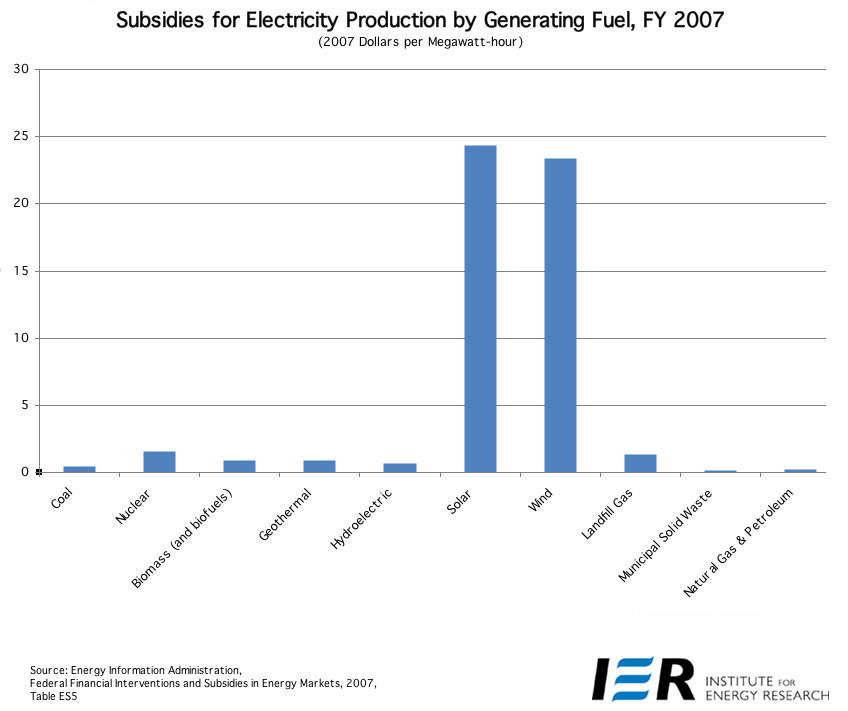
IER: Total 2016 Nuclear Levelized Costs Lower
2016 levelized energy costs compared from the Institution for Energy Research (based on Energy Information Administration data.)
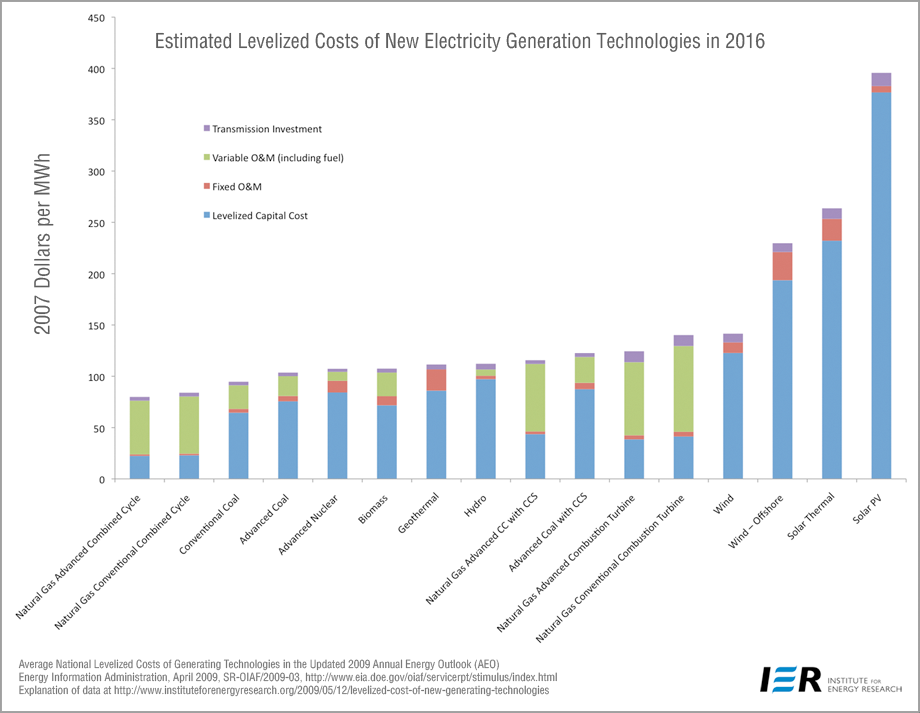 The Canadian Free Press recently published the Institute for Energy Research's summery of the most recent Energy Information Agency's Annual Energy Outlook (AEO) estimate of Levelized Cost of New Generating Technologies, 2016: Revised AEO 2009 Reference Case. The whole table can be viewed here.
It should be noted that the both the levelized costs of nuclear as well as its total levelized cost is significantly lower than the cost of land based wind generated electricity and when the comparison is shifted to off shore wind, Solar PV, and Solar Thermal, the cost gap between nuclear and renewables becomes enormous. This supports the result of my original 2007 post-carbon energy analysis that concluded that Solar and Wind Energy options would be substantially more costly than nuclear. This assessment does not focus on potential cost savings of alternative (Generation IV) nuclear power. What concerns me about levelized cost advantage of nuclear power is that it is not competitive with the levelized cost of Chines nuclear power and is even less cost competitive with the levelized cost advantage of Indian Stage 3 nuclear technology. Stage 3 Indian nuclear power which may cost close to half of the Chinese nuclear power cost. The levelized cost of stage 3 Indian nuclear PHWRs may fall to 15 compared to 84.2 for American Nukes. Factory produced small American nukes might cost 50% less than large nukes, while LFTRs have the potential of falling to a levelized cost as low as 20.
The Canadian Free Press recently published the Institute for Energy Research's summery of the most recent Energy Information Agency's Annual Energy Outlook (AEO) estimate of Levelized Cost of New Generating Technologies, 2016: Revised AEO 2009 Reference Case. The whole table can be viewed here.The IER states
The table below provides the average national levelized costs for the generating technologies represented in the updated AEO2009 reference case.[3] The values shown in the table do not include financial incentives such as state or federal tax credits, which impact the cost and the competitiveness of the technology. These incentives, however, are incorporated in the evaluation of the technologies in NEMS based on current laws and regulations in effect at the time of the modeling exercise, as well as regional differences in the cost and performance of the technology, such as labor rates and availability of wind or sun resources. . . .In short the table reflects the cost of electricity from the various energy sources. In the cases of solar and wind, making the electricity reliable will cost extra.
The levelized cost for each technology is evaluated based on the capacity factor indicated, which generally corresponds to the maximum availability of each technology. . . .
Intermittent renewable resources, e.g. wind and solar, are not operator controlled, but dependent on the weather or the sun shining. Since the availability of wind or solar is dependent of forces outside of the operator’s control, their levelized costs are not directly comparable to those for other technologies although the average annual capacity factor may be similar. Because intermittent technologies do not provide the same contribution to system reliability as technologies that are operator controlled and dispatched, they may require additional system investment as back-up power that are not included in the levelized costs shown below.
| Plant Type | Capacity Factor (%) | Levelized Capital Cost | Fixed O&M | Variable O&M (including fuel) | Transmission Investment | Total System Levelized Cost |
| Advanced Nuclear | 90 | 84.2 | 11.4 | 8.7 | 3.0 | 107.3 |
| Wind | 35.1 | 122.7 | 10.3 | 0.0 | 8.5 | 141.5 |
| Wind-Offshore | 33.4 | 193.6 | 27.5 | 0.0 | 8.6 | 229.6 |
| Solar PV | 21.7 | 376.6 | 6.2 | 0.0 | 12.9 | 395.7 |
| Solar Thermal | 31.2 | 232.1 | 21.3 | 0.0 | 10.3 | 263.7 |
| Geothermal | 90 | 86.0 | 20.7 | 0.0 | 4.8 | 111.5 |
| Biomass | 83 | 71.7 | 8.9 | 23.0 | 3.9 | 107.4 |
| Hydro | 52 | 97.2 | 3.3 | 6.1 | 5.6 | 114.1 |
Saturday, June 20, 2009
India pushes Small Reactor Sales to Asian, African Countries
Earlier this week, Rod Adams interviews ANS President Tom Sanders on the Atomic Show. The interview is well worth the time you spend listening to it. Tom lays out a vision of the future of the nuclear economy based on small, factory produced reactors. Although he does not refer to the LFTR, the LFTR definitely fits into his concept. Tom's vision is international, because he sees a huge market in developing nations for small reactors. Tom's interview is encouraging, because it suggests that my thinking is on the right track.
David Walters recent post on large verses small reactors also triggered a Brian Wang post on the small reactor business model. It is not simply that bloggers are talking about small reactors, but an increasingnumber of potential or actual manufacturers are announcing their intent to build small reactors. None of these reactors will be available until sometime in the next decade.
Small factory built reactors clearly are an idea whose time has come.

But in India that time came a generation ago and never left. Indian small reactors have been completely overlooked in the small reactor discussion, even though only India currently builds and markets advanced small reactors for electrical production. If you want to order a small reactor today, and be assured delivery before 2015, you will need to talk to the Indians. According to Hindu Business Line, NPCIL plans to market its small and mid size reactors to Kazakhstan, South-East Asian countries and African nations.
A proposal for reactor sales to Kazakhstan is already on the anvil, with discussions between NPCIL and the central Asian nation’s nuclear utility Kazatomprom at an advanced stage. According to Government sources, while feelers have also been received from South-East Asian countries, Kazakhstan is likely to be the first breakthrough.An unnamed official of NPCIL told Hindu Business Line,
India has been proactively exploring the possibility of exporting indigenous PHWRs to developing nations that are eyeing nuclear power generation but are constrained by small-sized electricity grids. . . . small size nuclear reactors are apt for countries that have small grids of around 10,000 MW. Use of large reactor units in case of countries having small grids could potentially lead to grid failures if even a single large unit shuts down at any point in time.
Besides, assembling clusters of 220 MWe reactors is projected to be more cost-effective than large-sized reactors from the US or Europe, officials said. Several Asean countries are reported to be eyeing the nuclear option, with Indonesia, Vietnam, the Philippines and Thailand among those having announced plans to tap atomic energy in the future.
“Currently, India is perhaps the only country to have an actively working technology, design and infrastructure for manufacture of small reactors with a unit capacity of 220 MWe. These units have a great potential for exports, particularly to nations with small grids that are planning nuclear forays with relatively lower investment levels.”NPCIL has an expanding Internet presence. A downloadable brochure advertises the two reactors. Reportedly capital costs of small Indian Reactors may run as low as $0.90 per watt, but such cost estimates are based on prevailing Indian wage rates.
Periodic Tables with Sorensens
When I don't hear from Kirk, I assume he is with his kids. Here two of Kirk's daughters, videoed by Rod Adams, recite the periodic table at the ANS Meeting in Atlanta

Scientific American in the Era of Confusion
Once again Scientific American has disgraced itself by hyping a shoddy, unprofessional hit peice against nuclear power, this time by a Ralph Nader's lacky. The SA internet post begins:
The Forward and Acknowledgements of the MIT study notes:
Nuclear power plants may not emit greenhouse gases, but they sure could suck in the tax dollars.I will quickly demonstrate that there are many red flags on the Mark Cooper study. Beyond that there is no evidence that Mark Cooper is an economist, his exact relationship to Vermont Law School is murky, and it is questionable if any part of the study was produced in Vermont. The study was not published by the Vermont Law School, and aside from from the cover claim that Mark Cooper is a Senior Fellow for Economic Analysis at the Institute for Energy and the Environment of the Vermont Law School, nothing links the study to the School. Nothing except the fact that the study can be downloaded from the Institute's web site. Most similar studies will acknowledge the relationship between the study and the institute from which itwas said to have originated. For example, the MIT Study "The Future of Nuclear Power" carries the following inscription
An analysis by economist Mark Cooper at the Vermont Law School claims that adding 100 new reactors to the U.S. power grid would cost taxpayers and customers between $1.9 and $4.1 trillion over the reactors’ lifetimes compared with renewable power sources and conservation measures.
Copyright © 2003 Massachusetts Institute ofTechnology. All rights reserved.Curiously the Cooper study carries no Copyright.
ISBN 0-615-12420-8
The Forward and Acknowledgements of the MIT study notes:
This study also reflects our conviction that the MIT community is well equipped to carry out interdisciplinary studies intended to shed light on complex socio-technical issues that will have a major impact on our economy and society. Nuclear power is but one example; we hope to encourage and participate in future studies with a similar purpose.The Mark Cooper study had no Forward and carried no acknowledgement of financial support.
We acknowledge generous financial support from the Alfred P. Sloan Foundation and from MIT’s Office of the Provost and Laboratory for Energy and the Environment.
The Press release announcing the MIT study clearly stated
On the cover page of the Cooper study, Cooper is described as a
HHHHHMMMMMM!
SA readers were not reticent to tell that once august journal that it had uncorked a stinker with its Cooper study story.
Duncan M noted
Update: Two more Reader comments from Scientific American.
1. dbakerpe
MIT RELEASES INTERDISCIPLINARY STUDY ON "THE FUTURE OF NUCLEAR ENERGY"The press release for the Cooper study failed to include mention of Vermont Law Scholl asside from noting Cooper's alleged title.
On the cover page of the Cooper study, Cooper is described as a
Senior Fellow for Economic AnalysisBut on a Vermont Law School page that mentions the Cooper study, Cooper is described as a
Senior Research Fellow for Consumer EnergyDespite this claim Cooper is not listed among the faculty of the Institute for Energy and the Environment of the Vermont Law School. Indeed I can not find any evidence that Cooper has ever been on the Vermont Law School campus.
HHHHHMMMMMM!
SA readers were not reticent to tell that once august journal that it had uncorked a stinker with its Cooper study story.
Duncan M noted
enewables at 6 cents per kilowatt hour. That's pretty funny, since they require direct production subsidies of 15 cents per kilowatt hour for wind to 35 cents per kilowatt hour for solar, with no reasonable hope those costs will fall significantlyRogeregon responded
Meanwhile, nuclear is cost-competitive with hydro in Europe.
This magazine doesn't deserve to keep the word Scientific in its name if it's publishing political jeremiads like this.
LOL! Duncan M, I've noticed, more and more, how Scientific American has been taken over by a bunch of ultra-left wingers who seem to be mostly pushing political agendas, rather than actual science!uvdiv was blunt
This article is criminally dishonest. It brings up a "12c-20c/kWh" cost range for nuclear, and then also cites an MIT study as calling nuclear power "uncompetitive". Which is interesting because I've READ that MIT study, and it concludes the levelized cost for new nuclear power is 8.4 c/kWh - well outside the other range the author quotes. Does the author point out this discrepancy? No; he ignores the inconvenient parts of his own sources, selectively cherry-picking the quotes and datapoints that support his position.Patrice2 commented
The report is available for free here:
http://web.mit.edu/nuclearpower/
And further when the MIT report calls nuclear power "uncompetitive", it is referring ONLY in comparison with coal and natural gas power, and ONLY when completely ignoring the costs of carbon emissions. In fact, by the studies' numbers, just a very small carbon price would make nuclear as cheap as coal. (2009 update, Table 1)
The cited MIT report also directly conflicts with the "$1.9-4.1 trillion" figure for 100 new reactors. It estimates a capital cost figure of $4/W for new reactors (based on real-world figures from recent reactors in Japan and South Korea, which fell in the range of $2-3/W*, and extrapolating from that with commodity price increases). At the this cost, 100x new 1 GWe reactors would carry a pricetag of $400 billion, which is majorly conflicts with his other (presumably fradulent) numbers. Since when did commercial power reactors reach $41/W???
*These are discussed in a supplementary paper to that report, which is here under "Update on the Cost of Nuclear Power":
http://web.mit.edu/ceepr/www/publications/workingpapers.html
Again, it is despicable that a self-proclaimed "journalist" would so blatantly misrepresent his sources, twist them to support his political ideals.
To append one thing to my comment - I want to preempt any argument that lifetime operation or decommissioning costs explain away the huge discrepancy with that $1.9-$4.1 trillion figure. Construction costs are by far the largest component of nuclear power costs, and other lifetime costs are comparatively trivial. Again citing the same MIT study (the supplement paper): Table 6C compares these. A full 72% of total costs are the initial construction costs (which would be $400 billion for one hundred 1 GWe reactors under this MIT study). A tiny 11% are operation and maintenance costs, 10% are fuel costs, and 7% decommissioning.
Again that paper is available here for free:
http://web.mit.edu/ceepr/www/publications/workingpapers.html
Contrary to the study’s finding that “nuclear power cannot stand on its own two feet in the marketplace” nuclear energy is expected to be among the most economic sources of electricity. To cite one example, an independent comparative study published in January 2008 by the Brattle Group for the state of Connecticut estimated that nuclear energy (at $4,038/kW) may have the highest capital cost, but still produces the least expensive electricity, except for combined cycle natural gas with no carbon controls.Finally JimHolf made a point familiar to Nuclear Green readers
New nuclear reactors have been affirmed as the least cost option for new generation by the Public Service Commission (PSC) in South Carolina, Florida, and Georgia. The analyses supporting the PSC reviews found nuclear to be cost competitive with other forms of baseload generation in addition to helping to address climate change.
Various recently-released academic studies have also found the cost of nuclear energy to be competitive.
It’s useful to think of it like this:
• The cost of building advanced reactors is about the same as advanced coal plants with carbon storage, but nuclear energy has the lowest fuel cost over decades of electricity production.
• By comparison, natural gas plants are relatively cheap to build, but the supply and price volatility is a major drawback. The fuel cost for natural gas plants makes up 90 percent of the power cost. The cost of power from coal and gas-fueled power plants would rise in a carbon-constrained world, further increasing their electricity costs.
A new licensing process, coupled with construction and project management experience from nuclear energy projects globally, will provide useful experience with new reactor designs in the United States.
Put simply, credible estimates of the total cost of new nuclear energy facilities show that electricity from nuclear energy will be competitive with other forms of baseload generation.
It must be noted that while nuclear opponents often claim that renewables are cheaper than nuclear, they are NEVER willing to put that assertion to any kind of market test. Just the opposite. They say they're cheaper, but then insist on policies that prevent any fair market competition between renewables and other means of reducing emissions, including nuclear. Under current/recent policies, renewables are massively more subsidised than nuclear, and there are also outright mandates for their use (regardless of cost or practicality), just in case even those subsidies are not enough. If the relative cost of renewables was anything like this article's study, none of these policies would be even remotely necessary.I see no point for a further review of Mark Cooper glorified trash talking of Nuclear Power. The Scientific American readers once again have proven that, even if journalists no longer have sound judgement, some of their readers do. While Scientific American's coverage of nuclear issues reflects the current dream era of confusion, it is clear from the Scientific American comments, that some people are very much awake already. Oh for those of you who are curious, Dr. Mark N. Cooper is a Washington lobbyist for the Consumer Federation of America, a Ralph Nader front organization. Cooper's official title is Director of Research. Cooper spends his days talking to politicians not consumers.
Update: Two more Reader comments from Scientific American.
1. dbakerpe
The assertion that nuclear will have high long term costs is based on cost overruns on the first generation plants. It false on its face, because those same first generation plants are now the lowest cost power sources on the grid except hydro. Large power projects are built with borrowed money, so the power is always expensive to begin with to pay back the loans. A new nuclear plant will likely last 60-100 years. After the loans are paid back the power will be cheap. If we are going to have a real economy that produces real products, they are the only environmentally acceptable solution.2. sethdayal
The MIT 4000 a kw is just a (WAG) wild guess based on suspect figures.
1) It is based on a few Asian reactors with some rather dubious conversions to US Dollars.
2) In the middle of the worst depression in a century it assumes without proof that nuclear plant cost inflation is 15%.
3) It assumes 11% cost of money at a time when public power ie governments can borrow at 3%.
4) Ignored are Westinghouse's sale of four ap-1000 reactors for 5.5 billion to China a little over 1300 a kw and Hyperions sale of six of its 25 mw units for $25 million each again $1000 a kw with 45 mw of free heat leftover to warm the town.
5) Ignored also is Westinghouse's contention that with mass production techniques it can produce these reactors for around $1000 a kilowatt. With a World War Two hell bent for leather lets save the planet from global warning type effort ramping up quickly to hundreds of plants opening worldwide every year, costs for mass produced reactors would drop drastically.
5) It assumes every country is like the US where a large portion of costs are a result of an army of attorneys, bureaucrats and insurance companies lined up for and against any proposed private power company nuclear plants.
Renewables cheaper. What a joke.
Friday, June 19, 2009
The Energy Collective in the Era of Confusion
One of the principle problems of the Energy Collective, is the failure of most collective writers to understand the issues they write about it terms of cost. Not only are Energy Collective writers confused about cost, they spread their confusion to the public. Some of the most popular writers on the Energy Collective are what I charitably call aggressive, anti-nuclear nut cases. The anti-nuclear nut cases relentlessly harp on the supposedly enormous cost of nuclear power plants, often using high end cost estimates to make nuclear power look bad. These writers inevitably advocate the use of renewable generating capacity as an alternative, with the implied assertion that electricity generated from renewables will cost far less than nuclear generated power.
Needless to say the aggressive anti-nuclear nut cases never compare the cost of nuclear power with the cost of reliable renewable electricity. But even renewable advocates who do not take an aggressive anti-nuclear position, pitch puffballs at renewables costs. Renewables manufacturers, and installation builders frequently try to hide the very high costs of part time, unreliable renewables facilities. Unfortunately renewables friendly writers are party to the conspiracy to hind renewables cost, This pattern shows up over and over in the writing of Energy Collective renewables friendly writers.
In order to demonstrate the problem I made a case study of a recent Energy Collective post by Tyler Hamilton, a senior energy reporter and columnist for the Toronto Star. I would not classify Tyler an anti-nuclear nut case and I have posted a link to "Clean Brake" on Nuclear Green. But Tyler is a far to uncritical renewables advocate in my book. My case study is based on a post of June 18 titled, Duke Energy solar storage pilot worthy of replication. Tyler is nothing, if not a shameless cheerleader for renewable energy, opens his story:
It’s with great delight that I read about the handful of U.S. utilities that are seriously testing out various conservation, smart grid, storage and renewable technologies in an effort to extend greener offerings to customers. The latest is Duke Energy’s McAlpine Creek project, part of which involves the deployment of a 50 kilowatt solar PV array, consisting of 213 solar panels, at a substation that feeds the grid or, alternatively, can charge up a 500-kilowatt zinc-bromide battery system.But no where in Tyler's story is there a hint about how much such a system would cost. This is a very practical question that energy writers should be answering. I decided to to do the leg work that Tyler failed to provide his readers. So how much does the installation cost? According to solarbuzz, PV installations cost from $8 to $10 per W. That would give us an installation cost of $400,000 to $500,000. The facility will have an optimal output on uncloudy days of 333,000 kWh. Hamilton claims that battery backup costs as little as two cents per kW, but I was unable to find any confirmation that zinc-bromide batteries were available at that price. I managed to track down the cost of ZBB zinc-bromide batteries which run to $400 per kWh. Thus the 500 kW battery most likely costs another $200,000. We clearly have a facility which is capable of producing electricity on demand, and will produce something close to 14 kWs per hour in a 24 hour day. The facility costs $600,000 to $700,000. Thus we have a cost of from $43 to $50 per watt of reliable output, or 5 to 6 times the cost of a hugely expensive nuclear plant.
Were Tyler to compare the cost of reliable electricity from the Duke PV facility with the cost of nuclear power, he would simply be forced to admit that reliable PV power was not competitive with nuclear power. No doubt Tyler would experience something less than "great delight" as he made this admission.
During the last two years, I have done repeated case studies that address the cost of reliable renewable electricity. I have looked at several schemes to make solar and wind generated electricity reliable, and assessed the cost of each scheme. The results were always the same. The estimated cost of reliable renewable electrical generating facilities have always proven to be more expensive than the estimated costs of new nuclear generating facilities, For far to many Energy Collective writers, this all too obvious conclusion is so distasteful, that they are simply participating in what amounts to a massive coverup of the real price of reliable renewable generating facilities. The failure of Energy Collective writers to address the issue of adverse renewables cost is an ethics issue, and it has serious consequences.
I have dubbed this current period in thinking about energy, the era of confusion.
We live in an era of confusion. We know that our energy future will be different, but we are like people who are somewhere between dreaming and being fully awake. Our dreams intrude into our thoughts, confusing us. In order to wake up we must stop confusing dreams with reality.Unfortunately this confusion between dream and reality infects writers whose real responsibility is to help deliver the public from its confusion. To continue to yield to ones own confusion while ignoring evident reality is only human, but to lead in an era of confusion one must do a great deal more than yield to one's own confusion. For energy writers there is an ethical imperative to not yield, even if by not yielding we are forced to admit things which we find distasteful.
Thursday, June 18, 2009
Large and Small Reactors: David Walters
David Walters posted an essay about reactor size yesterday on Left Atomic, My view has been that large reactors carry cost penalties, and that clustering small, factory built modular reactors will produce nuclear power at a far lower cost than building large reactors. A small reactor would be a reactor that is transportable by truck or rail. At the very least the core of a small reactor must be rail transportable as a single unit. The upward size of a small reactor would be is often defined as being around 350 MWe output, but David LeBlanc has designed a 400 MWe LFTR core that is easily truck transportable. My view is that optimal size is very much a matter to be identified by engineers. Middle size reactors would be too big to be easily transported in a few modules, but small substantially smaller than the standard Generation II, III and III + reactor. Generation III + reactors generally run from 1100 MWe on up, but the Chinese are still building a generation II reactor that is less than 1000 MWe in generating capacity. The transition between middle and large reactor size runs somewhere between 750 and 800 MWe. A medium reactor should produce half of the power of a large reactor, and not be transportable. The Indians are building a 500 MWe LMFBR that is quite obviously too big to be a small reactor, but only about half the generating capacity of a large reactor.
Indian accounts describe the PFBR reactor vessels:
The usual economic advantage mentioned for large reactors is economies of scale, although the empirical evidence for the economies of scale does not seem especially convincing. However, the skill set required for large reactor construction project managers is extremely demanding. Given the same project to project learning curve, constructing a 1600 MWe will yield the same advance on the learning curve as constructing a 200 MW reactor. Thus if it is possible to build 8 small 200 MWe reactors in the same amount of time as one 1600 MWe reactor, The project manager of the small reactors will be 8 times further advanced on the learning curve as the large reactor project manager. Indeed it will take the large reactor project manager another 21 years to catch up to the point where the small reactor project manager arrived after 3 years.
I have elsewhere argued that large scale construction projects are inherently less efficient in their use of labor in factories. The skill set of factory workers is typically smaller for factory workers than for nuclear construction workers. Wages for factory workers will be lower. Factory workers have assigned work areas allowing for convenient storage of work tools. Factories are more amenable for labor saving devices, and those devices can be employed to typically greater effect in factory settings, Work patterns in factories are likely to be better organized and production lines laid out in a rational fashion to begin with.
David W. recognizes the usefulness of small reactors and indeed he argues in effect for the use of mini reactors (reactors of less than 100 MWe output):
David correctly points to the price per Watt as the critical issue, and this will not be determined before we know a great deal more about the economics of factory produces reactors in general and LFTRs in particular. I have tried to provide some ideas about factory produced LFTR costs, but my hat does not say expert, and indeed if I were an expert, I would probably say, "We don't know enough yet."
Clearly what we have is potential that should be investigated. I have offered a vision of the future which suggests that low cost, abundant and sustainable is a possibility if we want it. i believe that this would be a better future be far for the bulk of humanity than the future offered by the advocates of so called renewable energy, and the cult of limited future resources, It is not in my power, however, to choose this future. Rather it is my role, as well as David's, Kirk Sorensen's, Robert Hargraves, and numerous others to provide the information that this choice is possible, and to suggest that the investment required to make the suggestion that sufficient research and development money be provided so to assure that the choice be available if it is considered desirable.
Indian accounts describe the PFBR reactor vessels:
The main vessel made of stainless steel measures 13 metres in diameter, 13 metres in height, weighs 200 tonnes and will go inside the safety vessel to hold the coolant liquid sodium, reactor fuel, grid plates and others.We are clearly dealing with a reactor that is far to large, heavy and complet to be truck or train transportable in a few modular units. The Indian PFBR is clearly a medium size reactor, but the 300 MWe Indian AHWR is a small reactor, that is probably suitable for factory manufacture. Current Indian PHWR designs run about 700 MWs, and it is not clear if the Indians intend to build the 300 MWe AHWR in serial production, or use it as a prototype for a larger commercial power generator.
The third and smaller of the three vessels is the inner vessel - 11 metres tall - and supports equipments like pumps, heat exchangers and others.
The usual economic advantage mentioned for large reactors is economies of scale, although the empirical evidence for the economies of scale does not seem especially convincing. However, the skill set required for large reactor construction project managers is extremely demanding. Given the same project to project learning curve, constructing a 1600 MWe will yield the same advance on the learning curve as constructing a 200 MW reactor. Thus if it is possible to build 8 small 200 MWe reactors in the same amount of time as one 1600 MWe reactor, The project manager of the small reactors will be 8 times further advanced on the learning curve as the large reactor project manager. Indeed it will take the large reactor project manager another 21 years to catch up to the point where the small reactor project manager arrived after 3 years.
I have elsewhere argued that large scale construction projects are inherently less efficient in their use of labor in factories. The skill set of factory workers is typically smaller for factory workers than for nuclear construction workers. Wages for factory workers will be lower. Factory workers have assigned work areas allowing for convenient storage of work tools. Factories are more amenable for labor saving devices, and those devices can be employed to typically greater effect in factory settings, Work patterns in factories are likely to be better organized and production lines laid out in a rational fashion to begin with.
David W. recognizes the usefulness of small reactors and indeed he argues in effect for the use of mini reactors (reactors of less than 100 MWe output):
Arguably here David has conceded that the bulk of reactor output will be from small reactors. The argument between us then boils down to the relative economies of clusters of small reactors verses a single big reactor as base power sources. David wants to phase
The LFTR is unique from all of the above because it is amazingly scalable...there is no real downward or upward limit to the size or use a LFTR can be employed in. Say, from a small LFTR 'battery' of 20 MWs to a large, base load plant offering 1800 MWs gross base-load power to the grid.
It is my contention that there will be a 'market' for all these sizes. We should first review what these markets are.
On the smaller end, the LFTR, as a high temperature reactor, can provide process heat. A small chemical plant, requiring thousands of tons of steam an hour, can use a LFTR to provide this heat and, to electrically power the plant. A slightly larger version may be able to provide power and vast qualities of heat to an oil refinery or a tar-sands operation thus providing carbon-free process heat to what otherwise would be a huge carbon-spewing operation.
These smaller LFTRs, from 20 to 200 MWs could provide, also, site specific load balancing for a grid that has a lot of load in place but generation many hundreds of miles away. Using a 200 MW LFTR to 'anchor' the grid would be very helpful to any utility. Additionally these smaller LFTRs could be plopped down in various transmission substations to provide quick, peaking power or variable load changing that responds to frequency changes throughout the day.
out gas and coal plants with big 1000+ MW units.I have employed a variety of arguments for the economy of the small reactor cluster in the past. We are simply mapping potential parameters. It will be up to those assigned to turn those parameters into tangible realities to decide what size to build, and assign to specific tasks. What we offer the future is some possibilities and the potential for flexibility. David correctly notes:
One thing that is important for this discussion to note, however, is that LFTRs, from the get go, are cheaper to produce, having a much higher power density than any currently running or under-construction Generation II or III Light Water Reactors. From the reactor core itself to the turbine, size is about 1/2 to 2/3 smaller, thus allowing for a cheaper, and therefore far more efficient, product based on size/cost per MW output. We are looking at, generally a similar ratio in cost reduction.My argument for the factory production of of small LFTR cluster however, is based on a rapid deployment expectation. We simply have to convert our entire energy system from a carbon base to a post carbon base. Factory production works best for rapid deployment, and small reactors work better for factory production than large reactors.
David correctly points to the price per Watt as the critical issue, and this will not be determined before we know a great deal more about the economics of factory produces reactors in general and LFTRs in particular. I have tried to provide some ideas about factory produced LFTR costs, but my hat does not say expert, and indeed if I were an expert, I would probably say, "We don't know enough yet."
Clearly what we have is potential that should be investigated. I have offered a vision of the future which suggests that low cost, abundant and sustainable is a possibility if we want it. i believe that this would be a better future be far for the bulk of humanity than the future offered by the advocates of so called renewable energy, and the cult of limited future resources, It is not in my power, however, to choose this future. Rather it is my role, as well as David's, Kirk Sorensen's, Robert Hargraves, and numerous others to provide the information that this choice is possible, and to suggest that the investment required to make the suggestion that sufficient research and development money be provided so to assure that the choice be available if it is considered desirable.
Wednesday, June 17, 2009
Shell and Greenpeace
I wondered why a Climate Change Advisor for Royal Dutch Shell would be so kind to Greenpeace, And then I realized why: natural gas. Yes Greenpeace wants to shut down reactors and replace them with natural gas fired power plants, and Greenpeace has invested in Royal Dutch Shell. Yes! it sure looks like Greenpeace and Shell oil are in bed with each other.
Five Indian Scientists at a Cookout
I took up residence at my parents house during the Summer of 1962. I had spent the previous year living in a college dormitory at Carson-Newman although I frequently visited home. But that summer I was commuting to classes at the University of Tennessee in Knoxville. I enjoyed the summer and frequently played bridge with my parents and my brothers, David and Mike. Although I had not realized it at the time, my father's work situation had greatly improved. He was now a senior scientist who had produced valuable work that was appreciated not only at ORNL but with his glove box project in all probability by the AEC as well. Warren Grimes's vendetta against my father was off the table, and my father had an assured position for the rest of his career. He had chosen to work with George Parker who was investigating the fate of radioactive isotopes in a reactor accident. George was another East Tennessean, who like my father was more comfortable in the Laboratory than in the conference room. My father admired Parker's research skills, and modestly spoke of his own role as being primarily in writing up Parker's experimental results. After reading some of their reports however, it would appear that my father was making his own research contributions.
Between 1960 and 1964 George Parker, my father and the group of chemists who worked in Parker's group were doing world c;ass research in the field of nuclear safety. They held an annual conference on nuclear safety in Gatlinburg that attracted international participation, and scientist were coming from all over the world to work in Parker's Laboratory along side them. Those scientists would eventually return to their home countries where the would conduct nuclear safety research. During those years my frequently invited visiting scientists and their families to have dinner or at my parent's home.
Duribg 1962 a group of five Indian scientists traveled to Oak Ridge to work with the Parker group. This was a large number of scientists to send in one group to another country for what amounted to advanced training. At home, my father frequently spoke of the Brahman leader of the Indian scientists, Dr. Kalachandra. Soon the five Indians were invited to dinner.
My family often ate in my parents back yard on Saturday evenings. On such occasions we would cook on a charcoal grill. The fair was most often hamburgers and hot dogs. Soon the Indians were invited to a Barton family backyard cookout. four of the five member group were Hindues. A fifth was a Seik. Not only was Dr. Kalachandra the scientific leader of the group, but he was also the scientific leader of the group, ,but as a Brahman he was the spiritual leader of the groups Hindus. As such Dr. Kalachandra disapproved of the fact that other grouindulged in eating meat while dining with my family. How are you going to keep um on the farm after they've seen Oak Ridge?
i am reasonably sure that the name of Homi J. Bhabha was never mentioned in my patents' back yard on that summer day in 1962. yet Homi J. Bhabha was probably behind their stay in Oak Ridge. Sending a five person team to acquire advanced skills in reactor safety research in 1962 was a sign of vast ambition for a country with so little resources. In 1962 India had one reactor and would not have its first tiny commercial reactor for another 7 years. in August 1954 who was then the leader of thr small Indian nuclear research program sent indian Prime Minister Pandit Nehru in a half page summary of a 13 item program to turn india into a nuclear power. Included in Bhabba's list called for:
Setting up of an Atomic Energy research facility,
Uranium prospecting, mining and processing,
Building heavy water and beryllium production plants,
The construction of a uranium enrichment facility
The development of civilian power generating reactors
The construction of breeder reactors and a plutonium extraction plant.
Bhabba also called for a major initive to train and development of the human resources needed for such a program
And the use of radioisotopes in biology, medicine and industry.
Bhabba went on to direct India's atomic energy program until his death. His basic vision, set out in a three stage plan, has now entered the third stage. The completion of Indias fast Breeder reactor in 2013 will mark the emergance of India as the first nation to manufacture a n economically competative Generation IV generation reactor.
The five Indians eventually finished their work with George Parker's group and went back to India where they began to work with other indian scientists to carry out Bhabba's vision. Today that vision is rapidly becoming a reality. Indian nuclear science is among the best in the world.
Setting up of an Atomic Energy research facility,
Uranium prospecting, mining and processing,
Building heavy water and beryllium production plants,
The construction of a uranium enrichment facility
The development of civilian power generating reactors
The construction of breeder reactors and a plutonium extraction plant.
Bhabba also called for a major initive to train and development of the human resources needed for such a program
And the use of radioisotopes in biology, medicine and industry.
Bhabba went on to direct India's atomic energy program until his death. His basic vision, set out in a three stage plan, has now entered the third stage. The completion of Indias fast Breeder reactor in 2013 will mark the emergance of India as the first nation to manufacture a n economically competative Generation IV generation reactor.
The five Indians eventually finished their work with George Parker's group and went back to India where they began to work with other indian scientists to carry out Bhabba's vision. Today that vision is rapidly becoming a reality. Indian nuclear science is among the best in the world.
Monday, June 15, 2009
Sustainable Energy Recovery with Resources.
I hope to come back and do a follow up on my phosphate post. What I hope to show, that the assumptions of my first post were wrong. That phosphate is a sustainable resource, and that futhermore phosphate can probably be sustained with a positive energy recovery. Many low grade phosphate ore deposits can be expected to have other minerals present also in low grades. This will mean that future phosphate mines will produce a variety of minerals. One of the minerals that will be recoverable will be thorium. Thorium recovery will pay the energy bill for mining the low grade or many times over. Thus if thorium recovery is included in low grade ore phosphate mining, a sustainable amount of phosphate can be recovered prior to the end of human life on the earth. There will always be enough energy recovered from phosphate mining to pay for the energy invested in the mine many times over.
As far back as 1943, Manhatten project scientists including Phil Morrison, Harrison Brown and Alvin Weinberg began to understand the energy implications of nuclear energy. Weinberg later wrote:
Weinberg was not alone. By the 1950's M. King Hubbert was talking about recovery of uranium and thorium from the rocks.
Hubbert reminds us,
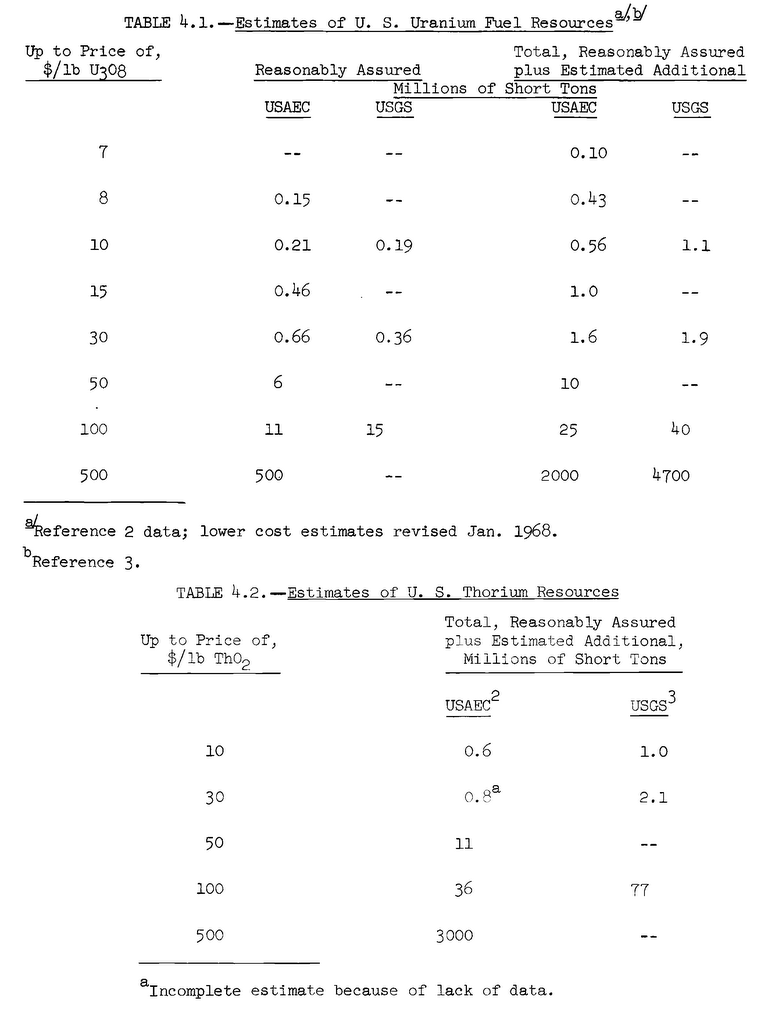 Clearly then if there are enormous amounts of recoverable uranium and thorium in so called low grade ores around the world. The USAEC's estimated $500 in 1969 would be $2900. 45 tons of Southern Appalachian coal cost about $2900 during the winter of 2009. One pound of thorium or in a LFTR or uranium in an IFR would produce the energy equivalent of 1400 tons of coal. Thus the AEC's estimate of a 3 billion ton thorium and a 2 billion ton uranium reserve was based on a recovery cost for thorium that was only 3% of the current cost of coal. If the recovery price for thorium at concentrations of no more than 50 PPM would be 3% of the recovery price for coal. An enormous amount of uranium would also be recoverable at highly attractive prices as an adjunct to the recovery of very low grade mineral ore. For example, gamma ray readings form 131 Fort Worth gas wells indicated a uranium concentration of from 10 to 30 ppm in the enormous Barnett Shale formation. Researchers have suggested that the Barnett Shale formation also contains a rich supply of phosphate. Thus the co-recovery of phosphate and uranium from Barnett Shale seems possible, with more than acceptable EROEI (energy return on energy invested) levels. i have not been able to determine the thorium content of Barnett shale.
As far back as 1943, Manhatten project scientists including Phil Morrison, Harrison Brown and Alvin Weinberg began to understand the energy implications of nuclear energy. Weinberg later wrote:
Phil Morrison could hardly contain his excitement as he showed me his calculations. If uranium were burned ion a breeder, the energy released through fission would exceed the amount of energy required to extract the residual 4 ppm of uranium from granitic rock.Morrison's discovery was to have a profound impact on Weinberg for the rest of his long and illustrious career. Harrison Brown, another Manhattan project scientist, also contributed to Weinberg's vision. Brown, along with James Bonner and John Weir wrote "The Next Hundred Years", a book about future resources.
Weinberg was not alone. By the 1950's M. King Hubbert was talking about recovery of uranium and thorium from the rocks.
Hubbert reminds us,
When a U-235 atom is struck by a neutron, it breaks into fragments known as fission products which consist of other atoms near the middle of the table of atomic numbers, and also releases neutrons which strike other U-235 atoms, thereby maintaining a chain reaction. Each fission releases, on the average, 200-million electron volts of heat which, like the heat of combustion of coal or oil, can be used to drive a steam power plant.Then Hubbert points to the magnitude of the Uranium resource:
The objections to the sole use of U-235 are its scarcity and the large amounts of energy required to separate it from U-238. Hence, very great importance attaches to the possibility of converting the fertile materials, U-238 and Th-232, into fissionable materials by means of the breeder reaction. The breeder reaction for U-238 is shown schematically in Figure 26. In this case, the neutrons from the fissioning of U-235 are used to cause a radioactive transformation of U-238 to Pu-239 which is then fissionable. By a similar reaction Th-232 can be converted to U-233 which is also fissionable. It has been experimentally demonstrated that both of these reactions are possible and are capable of producing from the fertile materials more fuel material than is consumed. Thus, in principle, by means of properly developed breeder reactors, it is possible to consume whole uranium and thorium. In the subsequent discussion it will be assumed that complete breeding will have become the standard practice within the comparatively near future.
Now for the energy that is released by the fissioning of a given amount of uranium (or thorium). As indicated in Table 2, the fissioning of 1 gram of U-235 releases 2.28 x 10⁴ kw-hr of heat, which is equivalent to the heat of combustion of 3 tons of coal or of 13 barrels of oil. One pound of U-235 is equivalent to 1400 tons of coal or 6000 barrels of oil. Within narrow limits the same values are valid for U-238 and for thorium.
the so-called "low-grade" ores are the phosphate rocks and the black shales which have uranium contents in the range of 10 to 300 and 10 to 100 grams per metric ton, respectively. Even so, such rocks are equivalent to 90 to 900 tons of coal or 390 to 3900 barrels of oil per metric ton for the phosphates, and to 30 to 300 tons of coal or 130 to 1300 barrels of oil per metric ton of rock, for the black shales. Even granite, as has been pointed out by Harrison Brown (1954) and by Brown and Silver (1955), contains about 13 grams of thorium and 4 grams of uranium per ton, which is equivalent to about 50 tons of coal or 220 barrels of petroleum per metric ton of granite.Although Hubbert had very little to say about the magnatude of Thorium resources, They can only be described as magnificent. WASH-1097 reported the United States Uranium and Thorium resources. Note that while Hunnadt said little of thorium, WASH-1097 reported that for five hundred 1969 dollars a pound, the United States Thorium reserve amounted to three billion tons:
What quantity of uranium in rocks of these various types may there be? An indication of the order of magnitude may be obtained by a glance at the map in Figure 28. The Colorado plateau, which is the principal producer of the high-grade ores, has an estimated ultimate reserve of the order of 50>000 to 100,000 metric tons of uranium. The large supplies, however, are to be found in the so-called "low-grade" ores of the phosphate rocks and he black shales. The Phosphoria formation alone, it is estimated from a recent paper by McKelvey and Carswell (1955), contains about ?400 million tons of uranium. Another 0.5 million tons, at least, can be obtained from the phosphate rocks of Florida and the neighboring states.
The Chattanooga shale in Tennessee contains a stratum, the Gassaway member, about 5 meters thick whose average content of uranium is about 70 grams per metric ton (Kerr, 1955). With a density of 2.5 metric tons per cubic meter, this would amount to about 175 grams of uranium per cubic meter, or to 875 grams per square meter for the total thickness of the member. Then for an area of a square mile the uranium content of this member would be 2.3 X 10⁹ grams or 2300 metric tons. This does not sound impressive, and in fact, as compared with contents of the more familiar metallic ores, it is a trifling amount; nevertheless, the energy content of this member per square mile is equivalent to 30 billion barrels of oil, or to five East Texas oil fields. Uranium-rich black shales of Devonian-Mississippian age, which correlate with the Chattanooga, are widespread in the Mid-Continent area as well as in Tennessee and the neighboring states. In addition, the Sharon Springs member of the Pierre shale of Cretaceous age occurring in an extensive area of North and South Dakota east of the Black Hills is also rich in uranium. No attempt has been made to determine the amount of minable uranium which these shales must contain, but since their areal extent amounts to several hundred thousands of square miles, their uranium content would appear to be as much as several hundred million metric tons.
Clearly then if there are enormous amounts of recoverable uranium and thorium in so called low grade ores around the world. The USAEC's estimated $500 in 1969 would be $2900. 45 tons of Southern Appalachian coal cost about $2900 during the winter of 2009. One pound of thorium or in a LFTR or uranium in an IFR would produce the energy equivalent of 1400 tons of coal. Thus the AEC's estimate of a 3 billion ton thorium and a 2 billion ton uranium reserve was based on a recovery cost for thorium that was only 3% of the current cost of coal. If the recovery price for thorium at concentrations of no more than 50 PPM would be 3% of the recovery price for coal. An enormous amount of uranium would also be recoverable at highly attractive prices as an adjunct to the recovery of very low grade mineral ore. For example, gamma ray readings form 131 Fort Worth gas wells indicated a uranium concentration of from 10 to 30 ppm in the enormous Barnett Shale formation. Researchers have suggested that the Barnett Shale formation also contains a rich supply of phosphate. Thus the co-recovery of phosphate and uranium from Barnett Shale seems possible, with more than acceptable EROEI (energy return on energy invested) levels. i have not been able to determine the thorium content of Barnett shale. Scientists have postulated since 1943 that an enormous amount of energy from supposibly low grade Thorium and Uranium ores, at acceptable EROEI levels. The recovery of large amounts of nuclear raw materials including uranium and thorium appears possible with favorable EROEI. It would also appear that latge amounts of supposably rare minerals such as phosphate are also present along with thorium and uranium in riock formations such as the Barnett shale formation of North Texas. The potential to co-recover these minerals should receive furthr investigation.
Subscribe to:
Posts (Atom)
Subscribe To Nuclear Green


 Posts
All Comments
Posts
All Comments
Some neat videos
| Nuclear Advocacy Webring Ring Owner: Nuclear is Our Future Site: Nuclear is Our Future |
||||
 |
 |
 |
 |
 |
| Get Your Free Web Ring by Bravenet.com |
||||