There are eight primary sources of nuclear costs:
The cost of the land upon which the nuclear power plant (NPP) is built.
Costs related to designing the NPP
Cost related to the materials from which the NPP is built.
Labor costs related to manufacture and construction.
The cost of obtaining regulatory approval
Investment related costs (interest, etc.)
Transportation and Access related costs
The cost of the electrical transmission system that connects the NPP to the grid
Any attempt to lower nuclear costs must find a way to lower the cost of one or more of these.
Land related costs can be lowered if the investor already owns the land. In the case of NPPs, land costs can be lowered if the NPP is built on a preexisting NPP site. Other, for example transportation related investments may not be required, and access to water is very likely to be available. NPPs can also be located on the site of obsolete coal fired power plants slated to be shut down for technological or environmental reasons. The same advantages of the NPP location would apply to the coal powered site, and additional facilities – for example the turbine hall, parking lots, administrative buildings, workshops, transformer farms, etc. - can potentially be recycled. The layout and size o an existing coal fired power plant may not be appropriate for adaptation for a large nuclear plant, but a cluster of small reactor approach would allow for far greater flexibility in facility layout, and would be far more easy to accommodate.
Small reactors, especially advanced technology small reactors, offer advancements is siting flexibility. For example, clusters of small reactors can be located in former salt mines.
Serial production lowers design costs. Design costs are largely fixed. Design costs can be divided among all of the units produced. If one reactor of a particular design is produced, then the recovery of the cost of that design would be through sale of that unit. If hundreds of units are produced, the recovery of the design cost can be divided between all of the units.
Finally, design simplification can lower nuclear coss. The Generation IV Molten Salt Reactor design offers revolutionary design simplification. In the Molten Salt Reactor the fuel is dissolved in the coolant. Thus much of the core structure is eliminated. Because the Molten Salt Reactor features a negative coefficient of reactivity, the reactor is highly stable without operator control input. Control rods can be partially or completely eliminated. These simple features lower manufacturing costs. And lesson manufacturing time.
The material input into a NPP per watt of output typically decreases as total reactor output rises. Traditionally this has lead to the economies of scales argument, which maintains that the larger the reactor output, the lower the per watt cost. There are, however, problems with this assessment. While it is true that larger size usually means lower material costs per unit of electrical output, there are exceptions to this rule, especially with respect to advanced nuclear technology.
For example:
The greater thermal efficiency of a reactor of similar core size might lower output cost per unit of heat, compared to that of a similar sized, but efficient design.
Reactor safety issues may effect materials input. Light Water Reactor cores and heat exchanges operate under very high pressure. They require significant amounts of material to prevent steam explosions. LWR outer containment structures are typically massive, and thus require large
A more compact reactor core may lower material requirements. Thus if two reactors have the same output, the one with the smaller core is likely to require fewer materials.
Underground reactor siting could potentially lower reactor structural costs, by offering protection against terrorist attacks from aircraft and at surface levels with lower materials inputs.
Small generation componants can lower material requirements. Thus supercitical carbon dioxide turbines are much smaller than steam turbines used in convential reactors. Small turbines require fewer materials, and can be housed in smaller turbine halls, which in turn require less material and labor input to build.
Thus a small advanced technology reactor with a compact core and high thermal efficiency, that operates at a one atmosphere pressure level, and can be sited underground might require fewer materials inputs per unit of electrical output than a much larger conventional reactor.
In addition manufacturing costs can be lowered by simplifying reactor design. Passive safety features can in some instances lower nuclear costs. For example thermosyphoning of reactor coolant, may save the cost of manufacturing and installing coolant punps. Gravity feed emergancy coolant systems save on manufacturing costs in several ways, They do not require backup generators or pumps, thus many of the expenses of older emergancy coolant sysyems can be saved.
Labor costs can be lowered by shifting work from the field to a factory. The more labor which can be performed in a factory, the lower the over all costs. Modular production is consistent with factory manufacture. Factory manufacture lowers labor costs in several ways. First serial production leads to the division of labor, which in turn typically increases labor productivity. The division of labor decreases the skill set required from individual workers. Decreased labor skill sets decrease labor wage expectations. Factory work settings, as opposed to field work settings also decrease wage expectations.
Thus serial production of small reactors in factories would tend to lower labor costs of nuclear manufacture.
The current nuclear regulatory environment favor serial manufacture. Once an example of a particular nuclear design is approved by the NRC is approved, the approval of all subsequent reactors using the design is automatic. Environmental aspects of subsequent application, however, receive the same attention, since they varie from facility to facility.
In addition to NRC license requirements, other licenses may be required. For example, the use of cooling water from rivers and lakes is not automatic, and usually requires regulatory approval. One of the advantages of recycling coal fired power plant sites, is that water access permits may already exist, and potentially can be transferred.
But what if obtaining a water use permit is not possible? With small reactor designs air rather water cooling is practical, with relatively modest efficiency penalties. With efficient advanced reactors, the efficiency benefits may far outweigh the efficiency losses related to air cooling.
Interest accrues as nuclear power plant construction, and accrued interest may amount to a significant percentage of NPP capital costs, especially if the construction project st reaches to half a decade or more. Small factory built reactors are expected to have shortened construction times, compared to large conventional reactors. Simplified advanced reactor designs are also expected to shorten NPP construction time. These shortening construction time can decrease the interest component of capital costs significantly.
Interest charges may reflect the market's assessment of project risks. The greater a projects assumed risk, the higher the interest premium the market will assess. By decreasing a project's size, and lowering projected manufacturing/construction time, nuclear project builders can offer the market lower perceived risks. Lower perceived risks, will lead to interest discounts compared to higher risk large nuclear projects.
Small, factory manufactured reactors offer advantages in transportation costs. Conventional reactors include a number of very large and heavy components, that present transportation challenges. Components such as pressure vessels and steam generators may require special and highly unusual transportation arrangements if they are transported overland. Special huge road transportation vehicles, some capable of moving no more than three miles an hour may disrupt highway uses in large areas over several weeks as they transported conventional reactor steam generators and pressure vessels to reactor sites. In contrast, small reactor cores may be moved by trucks or by rail as ordinary freight.
In areas where water shortages represent acute problems, small reactor access to reliable water supplies is unnecessary. Air cooling will enable small reactors to operate with out a reliable water supply.
Small reactor clusters located at recycled coal fire power plant locations potentially have greatly simplified grid connections. Not only can they be located near to the cities they are intended to serve, but grid hookup is facilitated by existing transformer farms, and grid connections. Because they can be located close to served cities new transmission lines will not cover long distances, thus lowering grid expansion costs. Large reactors may require new transmission lines that are hundreds of miles long, in order to move surplus electricity to market.
In addition to the above savings, and potential savings mentioned above there are other potential savings that may be available with small reactors. For example, with advanced nuclear technology, for example molten salt reactors, combined Rankine (steam) and Brayton (gas) cycles are possible. A bottoming desalinization cycle could be offered to to the system, thus offering formidable efficiency from small reactor packages. A high temperature reactor can provide top cycle heat for industrial processes, as well as producing middle cycle electricity generation, and bottom cycle heat for electrical generation. By adding a second generating cycle, small reactors can lower their electrical generation costs. Desalinization would add a further revenue stream from the reactors operation through the sale of portable water.
Thus it can be concluded that shifts to small nuclear power plants will potentially offer significant savings over current conventional nuclear costs. Shifts from conventional nuclear technology, to some advanced nuclear technologies, also offer significant potential savings. Some advanced technology savings are available to both large and small nuclear power plants, but the flexibility of small NPPs may mean that at least in certain situations small advanced nuclear power plants may offer very significant potential savings in comparison to large conventional NPPs.
Thus small factory produced advance reactors may offer a revolutionary approach to lowering nuclear costs. Economies of scale, often viewed as the only decisive factor in nuclear costs does not control many nuclear cost sources, and is unlikely to be a decisive approach to controlling nuclear costs. Numerous cost containment stratagies, some involving the factory construction of small reactors, but most compatible with small reactors can be drawn on to lower nuclear costs.

Showing posts with label small reactors. Show all posts
Showing posts with label small reactors. Show all posts
Thursday, October 14, 2010

Tuesday, June 15, 2010
South Korea to enter small reactor business
South Korea is panning to enter the small reactor market. The South Korean Ministry of Education, Science and Technology announced on Monday that a consortium of South Korean corporations is developing a small (100 MWe) reactor design, intended primarily for under industrialized nations. The system integrated modular advanced reactors ( SMART) is intended primarily for the international market. The reactor is expected to sell for about $400 million, and thus would have a cost that is roughly competitive with with the Babcock & Wilcox mPower reactor. It is designed to provide heat for desalination, as well as electricity.
Korea which wisely has a national industrial policy. unlike the United States, whose lack of industrial policy has had disastrous consequences in the last generation, plans to be one of the three largest reactor exporters by 2030. in order to accomplish this goal, the Koreans would need a product line, which included both small and standard size reactors.
The Ministry of Education, Science and Technology plans to inject about $80 million into the $150 million dollar project. The state controlled Korea Atomic Energy Research Institute, has organized the project that involves some 13 separate south Korean businesses. The project is far sighted because in the current business climate many world and South Korean businesses are reluctant to invest in new large scale industrial projects. South Korean reports indicates that the SMART will probably include Generation III+ cost saving and safety features.
The SMART marks the third small reactor proposed for entry into the global nuclear market. B&W is developing a similar size LWR, the mPower, while the Indians are marketing their well tested 200 MWe PHWR. In addition, the Chinese are developing a PBMR in the 100 MW to 200 MW range, and new mini reactor projects are popping up in the United States and globally.
Korea which wisely has a national industrial policy. unlike the United States, whose lack of industrial policy has had disastrous consequences in the last generation, plans to be one of the three largest reactor exporters by 2030. in order to accomplish this goal, the Koreans would need a product line, which included both small and standard size reactors.
The Ministry of Education, Science and Technology plans to inject about $80 million into the $150 million dollar project. The state controlled Korea Atomic Energy Research Institute, has organized the project that involves some 13 separate south Korean businesses. The project is far sighted because in the current business climate many world and South Korean businesses are reluctant to invest in new large scale industrial projects. South Korean reports indicates that the SMART will probably include Generation III+ cost saving and safety features.
The SMART marks the third small reactor proposed for entry into the global nuclear market. B&W is developing a similar size LWR, the mPower, while the Indians are marketing their well tested 200 MWe PHWR. In addition, the Chinese are developing a PBMR in the 100 MW to 200 MW range, and new mini reactor projects are popping up in the United States and globally.
Monday, December 21, 2009
Is Nuclear Power Too Risky to Afford?
Currently anti-nuclear ideologues are touting the line that nuclear power is too expensive. But too expensive in what ways? Nuclear critics have pointed to a report by Citigroup Global Markets on Nuclear Risk Factors. It states:
There are five substantial areas of risk faced by developers of new nuclear power stations. Three of those risk areas are so big and significant that if they go wrong, the developer (even the biggest utilities) could be financially damaged beyond repair. These risks can be classed as Corporate Killers. . .Panning, that is the time and money that go into nuclear plans, into acquiring the nuclear site represents the first risk, because the plan might fall through, but
While annoying for the developers if this turns out to be wasted time and money, in no way would a failed planning application threaten the financial integrity of a utility company.Similarly, a risk which the report calls "Decommissioning / Waste" is controllable if the right steps are taken. But Citigroup finds that this risk is also manageable through use of
a tax will be paid on each MWh produced (probably as little as £1/MWh). This would effectively limit the risk faced by the developers.This leaves us with three serious risks. First is construction
Below we give the latest data on the current and future costs of building a new nuclear power station. The latest evidence suggests a cost range of €2,500/kW to €3,500/Kw. For a 1,600MW unit, that means a construction cost of up to €5.6bn. We see very little prospect of these costs falling and every likelihood of them rising further. The cost of the TVO plant in Finland has increased from €3.0bn to €5.3bn since construction started. It has also proven to be very difficult to predict how long a new plant will take to build. The TVO plant is also running three years late. Cost overruns and time slippages of even a fraction seen by TVO would be more than enough to destroy the equity value (and more) of a developer’s investment unless these costs can be passed through somehow. Given the scale of these costs, a construction programme that goes badly wrong could seriously damage the finances of even the largest utility companies.The second risk factor which Citigroup sees as a problem is power price
Nuclear power stations have very high fixed costs and relatively low variable costs. Their cash flows and profitability are therefore particularly sensitive to the price that they sell their power. As we show later, even at the low end of the build cost estimates, we calculate that a new nuclear station will require €65/MWh (£58.5/MWh) in real terms year in/year out to hit its breakeven hurdle rate. . . . the UK has only seen prices at that level on a sustained basis for 20 months of the last 115 months. It was a sudden drop in power prices that drove British Energy to the brink of bankruptcy in 2003. No nuclear power station has ever been built to our knowledge where the developer takes the power price risk.The final risk factor which Citigroup calculates is unexpected operational costs.
Because of their high fixed cost base, nuclear stations are also very vulnerable to shortfalls in output due to operational unreliability. A six-month breakdown can cost £100m’s in direct costs and lost output, particularly if the output has been pre-sold. This risk is too great for a single project to bear, in our view, and at the very least needs to be spread across a portfolio of assets.There are, however, both shorter and longer range solutions to these Citigroup risks. The first and the third risks can be overcome by a government run insurance pool. Reactor constructors pay into the pool, which issues loan guarantees. Initially the guarantees would have to be backed by the government, but as the pool builds up, it would be able to pay off losses either on construction or prolonged operational shutdowns. The rational for this is simple. Just as wind and solar, which are fare more dubious AGW mitigation approaches, have investor risks lowered by substantial government subsidies, the risks entailed by nuclear investments can and should overcome controlled by government action as well. Loan guarantees are a low cost means by which the Government can mitigate the risk of nuclear investors.
A loan insurance pool is a short run means of controlling the loan related risks of nuclear constructors. Longer run means would involve a number of changes in the way reactors are built, and by the introduction of a radical new nuclear technology, that involves a complete redesign of the reactor. As for the price risk, this is a puzzling point, because all alternatives to nuclear power, either carry unacceptable carbon related problems that present even bigger risks to potential investors, political risks or actually will cost more, and lead to even higher electrical costs than would be the case with nuclear power. It seems unlikely than any of the acceptable electrical generation options from the carbon emissions perspective will cost less than nuclear generated electricity.
From a slightly longer range perspective, the small reactor approach will offer substantial relief quite aside from the loan guarantee insurance pool. In a recent Toronto Star column Tyler Hamilton pointed to small reactors as a potential solution to the loan risk problems of nuclear financing. Tyler quotes American Nuclear Society President, Tom Sanders, who argued that small reactors would do for reactors
what Henry Ford did for carsHamilton commented:
The result is that economies of scale are replaced by economies of volume that come from assembly line manufacturing.Factory built reactors could be shipped in large componants by truck, rail or barge, and assembled on reactor construction sites, with what Hamilton calls a,
Lego block approach.Other cost saving ideas include building
them in a factory setting using robotic assembly, . . . The reactors would be low maintenance, have passive safety features, and would be buried underground.Hamilton did not mention recycling old coal fired power plant sites, an approach that could save tens or even hundreds of millions of dollars in side development costs. I have been told that Babcock & Wilcox, the only surviving American Owned reactor manufacture plans to to use all of these money saving approaches. B&W plans to cluster small reactors, rather than to build big reactors. Reactor owners could add more reactors to the cluster as electrical demand increases.
Small reactors would cost proportionately less than large reactors, and thus their financing is not a "bet the farm" proposition. A cluster of small reactors can be purchased one at a time, as it the purchase of each becomes easily affordable. There is a hidden economic advantage to the small reactor - coal yard approach. Grid expansion costs, often associated with the construction of large reactors can be avoided. The construction of new high tension power lines, need to reach electrical customers from some new large reactor projects, and large scale renewables projects, can cost up to $3 billion dollars. Coal fired power plants already have grid hookups available. All you have to do is swap out generation sources.
The small reactor cluster also is an effective counter to the the operational risk problem. If one reactor goes down for a prolong period of time, there would still be a stream of income from the other reactors in the cluster.
The electrical cost problem, identified by Citigroup is a different issue. Both the Energy Information Agency projections and the SCANA projections show that the long term projected costs for nuclear power, although high, is lower than their cost projections for renewables.
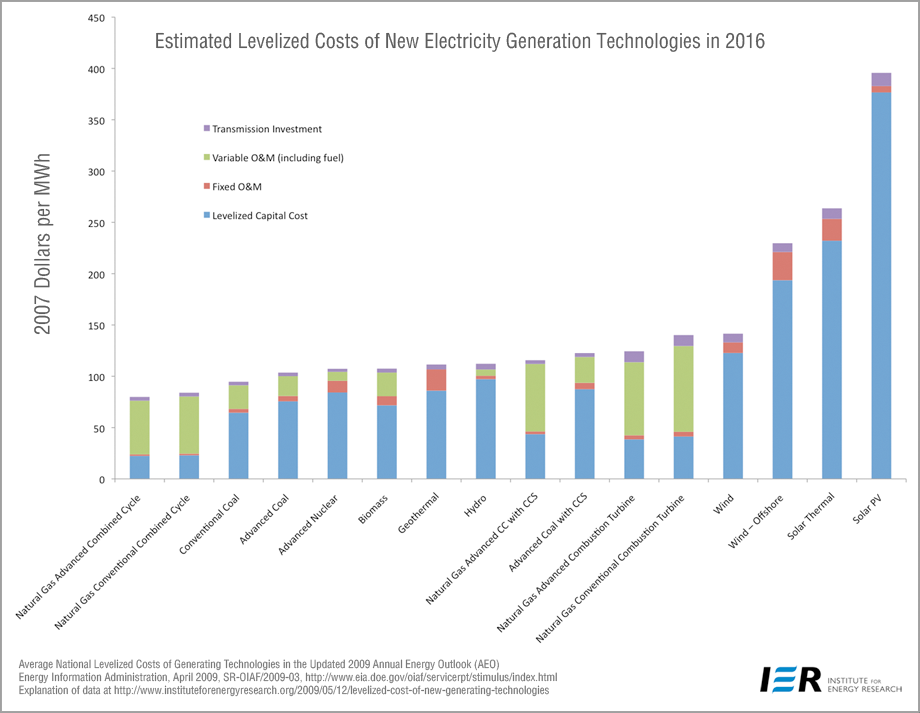
 PV advocates bitterly object to this to the high estimates of PV cost, and insist that the cost of PV panels is going to rapidly sink to virtually nothing for vast amounts of power. Solar advocates have been telling us similar stories since the 1970's, and PV is still outrageously expensive. The PV industry is highly dependent on subsidies for their living, but the need the sky high costs are falling stories to justify more subsidies.
PV advocates bitterly object to this to the high estimates of PV cost, and insist that the cost of PV panels is going to rapidly sink to virtually nothing for vast amounts of power. Solar advocates have been telling us similar stories since the 1970's, and PV is still outrageously expensive. The PV industry is highly dependent on subsidies for their living, but the need the sky high costs are falling stories to justify more subsidies. In a some what longer term more advanced nuclear technology, holds the potential to bring nuclear costs down and lower the cost of electricity. The lure of lower electrical costs, should be enough to lure the advanced industrial states of North America, Eastern Asia, and Europe into investing in advanced nuclear R&W. I have repeatedly argued that a form of advanced nuclear technology that uses fuel dissolved in liquid salts holds the key to lowering nuclear costs. Policy makers should be highly motivated to uncover and sponsor research into such promising options, but as David Walters recently observed in a comment on Nuclear Green,
What is common about countries really engaged in nuclear energy deployment is the goals they really set for themselves: S. Korea, China and India. I expect Vietnam as well. These projects become points of national pride.The failure to develop promising nuclear technologies, which potentially hold the key to lowering energy costs, in the face of of an unprecedented global energy crisis is a matter of national shame. It is utterly shameful than the American Energy Secretary, a Nobel Prize winning physicist, is so poorly informed about this option. Unfortunately the United States and Western Europe face the current energy crisis without a since of national pride. We will pay a high cost for this failure to take pride in ourselves, for this failure to believe in ourselves, and the high cost of electricity will be the least of the costs we pay.
Saturday, October 3, 2009
Indian Reactor Costs, Further Investigations

I recently received a link to an Indian Government PROJECT IMPLEMENTATION
STATUS REPORT covering central Sector projects for the first three months of 2009. This report is part of an ongoing effort by the Indian government to monitor cost and time performances of construction projects. The Report notes seven Indian reactor projects:
1. The Kaiga Power project Units 3 and 4
Both 220 MWe PHWRs
2. The Kudankulam Power Project units 1 and 2
Both are Russian 1000 MWe VVER-1000 light water reactors
At present Russia and India have an agreement to build four more reactors at the Kudankulam site.
3 The Rajasthan Power Project Units 5 and 6
Both 220 MWe PHWRs
4. The Prototype Fast Breeder Reactor
1 Unit @ 500 MWe
Four other production units are planned for construction during the next decade.
Costs:
The reported cost of the two Units of the Kaiga project is Rs.3282 crores, or about $656 Million. (the crores is a unit of 100,000). Thus their capital cost of the Kaiga reactors is $1.49 per watt. The Rajasthan units have an estimated cost of Rs.3072 crores. with a capital cost of $1.40 per watt. Lets review some other recent Indian PHWR costs:
TAPP-3&4 has an approved cost of Rs. 6525 crores, but it is anticipated that the Project would be completed in about Rs.6000 crores. . .,Or about $1.11 cents per watt. The lower cost can be attributed to economies of scale for the 540 MWe PHWR units. I previously inferred from statements about TAPP costs that the construction cost for 220 MW PHWRs ran about $1.18 per watt. That not appears to be 20 to 30 cents low per watt. it should be noted that the 700 MWe PHWR uses a slightly upgraded variant of the 540 MW PHWR core. If the upgrade is accomplished without any significant cost increases, then the cost of the 700 MWe PHWRs could run as low as $0.85 per watt. I would like to caution that this estimate is not yet supported by data supplied from Indian sources, thus must be considered both tentative and speculative, but this suggests that very careful attention should be paid to future Indian reactor costs.
it would appear then that the cost of mid size indigenous Indian Reactors is quite competitive with that of the Russian reactors now being built in India. The first two VVER-1000 carry an approved cost of Rs.13171 crore, or about $2.6 billion. This gives us an overnight cost of $1.31 per Watt. the Indians may well be motivated to build the higher cost Russian reactors because they bring with them access to Uranium fuel. The indigenous Uranium supply is the Achilles heel of the Indian nuclear industry.
Indian costs compared to Western costs
Indian reactors are built with appropriated funds rather than borrowed funds. The Indian government doers expect a return on its investment, as it should if it intends t0o continue building reactors. Power from Indian reactors currently costs Indian consumers between Rs. 2 and 2.5 per kWh, about 4 to 5 cents per kWh. Thus the price of power produced by Indian reactors is competitive with the process of electricity produced from coal fired power plants.
Thus the Indian nuclear industry, has the potential to be a world beater in the cost of of post carbon electricity. It should be noted that there are potentials to lower the cost of Indian reactors could be extended even further. Large scale reactor construction can utilize factory production of reactor kits, a system being evolved in China. important reactor parts such as pressure tubes and fuel bundles, can be mass produced. And large scale production of parts such as pumps and steam generators can lower costs. Thus the Indian nuclear industry has the potential to build reactors substantially below $1.00 per watt, and possibly substantially below 85 cents per watt. Thus a very real probability exists that by 2050nIndian electricity could cost half of what Chinese electricity costs, and as little as 20% of the cost of electricity in Europe and the United States. Even lower reactor and electrical costs would be possible if India chose to adopt LFTR type reactors, as a move to achieve maximum efficiency from the thorium fuel cycle.
If this analysis is correct, we might find contrary to our present expectations, that India, and not China will energy as the world's most significant economic power by the end of the 21st century.
Invitation: I invite more information on Indian nuclear technology and costs, in order to extend my analysis.
Wednesday, August 26, 2009
Energy hedgehogs, Energy foxes

πόλλ' οἶδ' ἀλώπηξ, ἐχῖνος δ'ἓν μέγα ("The fox knows many things, but the hedgehog knows one big thing"). - Archilochus (c. 680 BC – c. 645 BC)

The philosopher Isaiah Berlin divided thinkers into two categories, Foxes who know many little tricks, and hedgehogs who know one big trick. This division is somewhat artificial, but still useful. My quarrel with the Energy Collective is really a quarrel with the foxes of the energy collective, who may know a lot of tricks but none of them are very good. The supporters of nuclear power like Rod Adams and Dan Yurman are the hedgehogs of the collective. They believe that their one trick, nuclear power works better than all of the tricks of The Collective's foxes.
The Collective's foxes deny the very possibility of the Collective's hedgehog's trick. "There is no such thing as a silver bullet," they say knowingly. They tell the rest of us that nuclear power is too expensive, without ever noting that other low carbon energy sources, for example solar and wind, are even more expensive, and are far less reliable. The Hedgehogs notice that much of what the Foxes talk about does not make sense or is unproven. The Foxes seem to hold the Hedgehogs trick in contempt.
If only it wasn't nuclear.Collective fox Tyler Hamilton says, when nuclear hedgehogs demonstrate how neatly their trick works with small reactors. Hamilton adds
The fact is the units would still produce nuclear-fuel waste – a football-sized amount for each reactorMind you, each reactor produces a huge amount of waste, A football size amount! And Tyler lets us know he is on the side of righteousness:
a large part of the population believes it immoral to create and leave behind highly toxic waste for future generations.perhaps we should call him Saint. Tyler demands to know:
Can a company like Hyperion be trusted .. . ?in the end Tyler acknowledges the message of small nuclear
Efficient. Flexible. Safer. Transportable. Scalable. Swappable. In the world of nuclear energy, small could end up becoming the new big.But then he drops the bomb,
If only it wasn't nuclear.It would help if Tyler would have interviewed NASA engineer and nuclear blogger Kirk Sorensen about how radioactive post-reactor LFTR fission products are after a few years, and what their uses are. But typical of Collective foxes, Tyler in not really interested in whether the problem of nuclear waste is real, or if it whether the alleged problems of nuclear power can be solved. Like most Collective foxes, Tyler clearly loathes nuclear power and and wants to have nothing to do with it. Tyler is in the eyes of the nuclear hedgehogs not a fox at all, rather he is an ignorant ass, who is satisfied to remain ignorant about the possibility of making nuclear power our big trick. Should we suffer fools like Tyler gladly when his ignorance puts the future of humanity at risk?
Unfortunately many of the so called energy experts who writings are featured on The Energy Collective are every bit as ignorant as Tyler, and every bit as willfully so. We are not going to win the fight against global warming if we listen to the voices of idiots.
 The world of the Energy Collective Foxes: Recent German wind electrical output.
There are 19,460 wind turbines in Germany with a total capacity of 22,247 MW installed. Note that wind generation output dropped to zero on August 22, and still had not recovered at the end of August 25.
Update 8/27/09: The Capacity Factor has posted another critique of Tyler Hamilton, futher calling into question his professionalism.
The world of the Energy Collective Foxes: Recent German wind electrical output.There are 19,460 wind turbines in Germany with a total capacity of 22,247 MW installed. Note that wind generation output dropped to zero on August 22, and still had not recovered at the end of August 25.
Update 8/27/09: The Capacity Factor has posted another critique of Tyler Hamilton, futher calling into question his professionalism.
Thursday, June 18, 2009
Large and Small Reactors: David Walters
David Walters posted an essay about reactor size yesterday on Left Atomic, My view has been that large reactors carry cost penalties, and that clustering small, factory built modular reactors will produce nuclear power at a far lower cost than building large reactors. A small reactor would be a reactor that is transportable by truck or rail. At the very least the core of a small reactor must be rail transportable as a single unit. The upward size of a small reactor would be is often defined as being around 350 MWe output, but David LeBlanc has designed a 400 MWe LFTR core that is easily truck transportable. My view is that optimal size is very much a matter to be identified by engineers. Middle size reactors would be too big to be easily transported in a few modules, but small substantially smaller than the standard Generation II, III and III + reactor. Generation III + reactors generally run from 1100 MWe on up, but the Chinese are still building a generation II reactor that is less than 1000 MWe in generating capacity. The transition between middle and large reactor size runs somewhere between 750 and 800 MWe. A medium reactor should produce half of the power of a large reactor, and not be transportable. The Indians are building a 500 MWe LMFBR that is quite obviously too big to be a small reactor, but only about half the generating capacity of a large reactor.
Indian accounts describe the PFBR reactor vessels:
The usual economic advantage mentioned for large reactors is economies of scale, although the empirical evidence for the economies of scale does not seem especially convincing. However, the skill set required for large reactor construction project managers is extremely demanding. Given the same project to project learning curve, constructing a 1600 MWe will yield the same advance on the learning curve as constructing a 200 MW reactor. Thus if it is possible to build 8 small 200 MWe reactors in the same amount of time as one 1600 MWe reactor, The project manager of the small reactors will be 8 times further advanced on the learning curve as the large reactor project manager. Indeed it will take the large reactor project manager another 21 years to catch up to the point where the small reactor project manager arrived after 3 years.
I have elsewhere argued that large scale construction projects are inherently less efficient in their use of labor in factories. The skill set of factory workers is typically smaller for factory workers than for nuclear construction workers. Wages for factory workers will be lower. Factory workers have assigned work areas allowing for convenient storage of work tools. Factories are more amenable for labor saving devices, and those devices can be employed to typically greater effect in factory settings, Work patterns in factories are likely to be better organized and production lines laid out in a rational fashion to begin with.
David W. recognizes the usefulness of small reactors and indeed he argues in effect for the use of mini reactors (reactors of less than 100 MWe output):
David correctly points to the price per Watt as the critical issue, and this will not be determined before we know a great deal more about the economics of factory produces reactors in general and LFTRs in particular. I have tried to provide some ideas about factory produced LFTR costs, but my hat does not say expert, and indeed if I were an expert, I would probably say, "We don't know enough yet."
Clearly what we have is potential that should be investigated. I have offered a vision of the future which suggests that low cost, abundant and sustainable is a possibility if we want it. i believe that this would be a better future be far for the bulk of humanity than the future offered by the advocates of so called renewable energy, and the cult of limited future resources, It is not in my power, however, to choose this future. Rather it is my role, as well as David's, Kirk Sorensen's, Robert Hargraves, and numerous others to provide the information that this choice is possible, and to suggest that the investment required to make the suggestion that sufficient research and development money be provided so to assure that the choice be available if it is considered desirable.
Indian accounts describe the PFBR reactor vessels:
The main vessel made of stainless steel measures 13 metres in diameter, 13 metres in height, weighs 200 tonnes and will go inside the safety vessel to hold the coolant liquid sodium, reactor fuel, grid plates and others.We are clearly dealing with a reactor that is far to large, heavy and complet to be truck or train transportable in a few modular units. The Indian PFBR is clearly a medium size reactor, but the 300 MWe Indian AHWR is a small reactor, that is probably suitable for factory manufacture. Current Indian PHWR designs run about 700 MWs, and it is not clear if the Indians intend to build the 300 MWe AHWR in serial production, or use it as a prototype for a larger commercial power generator.
The third and smaller of the three vessels is the inner vessel - 11 metres tall - and supports equipments like pumps, heat exchangers and others.
The usual economic advantage mentioned for large reactors is economies of scale, although the empirical evidence for the economies of scale does not seem especially convincing. However, the skill set required for large reactor construction project managers is extremely demanding. Given the same project to project learning curve, constructing a 1600 MWe will yield the same advance on the learning curve as constructing a 200 MW reactor. Thus if it is possible to build 8 small 200 MWe reactors in the same amount of time as one 1600 MWe reactor, The project manager of the small reactors will be 8 times further advanced on the learning curve as the large reactor project manager. Indeed it will take the large reactor project manager another 21 years to catch up to the point where the small reactor project manager arrived after 3 years.
I have elsewhere argued that large scale construction projects are inherently less efficient in their use of labor in factories. The skill set of factory workers is typically smaller for factory workers than for nuclear construction workers. Wages for factory workers will be lower. Factory workers have assigned work areas allowing for convenient storage of work tools. Factories are more amenable for labor saving devices, and those devices can be employed to typically greater effect in factory settings, Work patterns in factories are likely to be better organized and production lines laid out in a rational fashion to begin with.
David W. recognizes the usefulness of small reactors and indeed he argues in effect for the use of mini reactors (reactors of less than 100 MWe output):
Arguably here David has conceded that the bulk of reactor output will be from small reactors. The argument between us then boils down to the relative economies of clusters of small reactors verses a single big reactor as base power sources. David wants to phase
The LFTR is unique from all of the above because it is amazingly scalable...there is no real downward or upward limit to the size or use a LFTR can be employed in. Say, from a small LFTR 'battery' of 20 MWs to a large, base load plant offering 1800 MWs gross base-load power to the grid.
It is my contention that there will be a 'market' for all these sizes. We should first review what these markets are.
On the smaller end, the LFTR, as a high temperature reactor, can provide process heat. A small chemical plant, requiring thousands of tons of steam an hour, can use a LFTR to provide this heat and, to electrically power the plant. A slightly larger version may be able to provide power and vast qualities of heat to an oil refinery or a tar-sands operation thus providing carbon-free process heat to what otherwise would be a huge carbon-spewing operation.
These smaller LFTRs, from 20 to 200 MWs could provide, also, site specific load balancing for a grid that has a lot of load in place but generation many hundreds of miles away. Using a 200 MW LFTR to 'anchor' the grid would be very helpful to any utility. Additionally these smaller LFTRs could be plopped down in various transmission substations to provide quick, peaking power or variable load changing that responds to frequency changes throughout the day.
out gas and coal plants with big 1000+ MW units.I have employed a variety of arguments for the economy of the small reactor cluster in the past. We are simply mapping potential parameters. It will be up to those assigned to turn those parameters into tangible realities to decide what size to build, and assign to specific tasks. What we offer the future is some possibilities and the potential for flexibility. David correctly notes:
One thing that is important for this discussion to note, however, is that LFTRs, from the get go, are cheaper to produce, having a much higher power density than any currently running or under-construction Generation II or III Light Water Reactors. From the reactor core itself to the turbine, size is about 1/2 to 2/3 smaller, thus allowing for a cheaper, and therefore far more efficient, product based on size/cost per MW output. We are looking at, generally a similar ratio in cost reduction.My argument for the factory production of of small LFTR cluster however, is based on a rapid deployment expectation. We simply have to convert our entire energy system from a carbon base to a post carbon base. Factory production works best for rapid deployment, and small reactors work better for factory production than large reactors.
David correctly points to the price per Watt as the critical issue, and this will not be determined before we know a great deal more about the economics of factory produces reactors in general and LFTRs in particular. I have tried to provide some ideas about factory produced LFTR costs, but my hat does not say expert, and indeed if I were an expert, I would probably say, "We don't know enough yet."
Clearly what we have is potential that should be investigated. I have offered a vision of the future which suggests that low cost, abundant and sustainable is a possibility if we want it. i believe that this would be a better future be far for the bulk of humanity than the future offered by the advocates of so called renewable energy, and the cult of limited future resources, It is not in my power, however, to choose this future. Rather it is my role, as well as David's, Kirk Sorensen's, Robert Hargraves, and numerous others to provide the information that this choice is possible, and to suggest that the investment required to make the suggestion that sufficient research and development money be provided so to assure that the choice be available if it is considered desirable.
Saturday, June 13, 2009
Small Reactors to the rescue
Every now and then I like to repost part or all of an old post that appears to have been spot on. I am usually motivated by vanity. I like showing off to my readers that I was right. Of course a lot of times I probably will have to say that someone else was right before me. Lots of times that someone was Rod Adams, but I would have to include Jim Holm as someone who has made an important contribution. A few months ago I wrote:
One idea that I quickly latched on to was the idea of the small reactor as the key to the rapid deployment of the enormous amount of nuclear power we need to deploy between now and 2050. I first thought of small reactors in 207, when I asked myself a simple question: How can we deploy enough rectors by 2050 to replace at least 80% of the fossil fuels we currently use. My answer was to do what you always do when you want to make a large number of modular objects. You build them in factories. But a Westinghouse AP-1100 is a little big to transport from a factory to its final destination. Westinghouse decided that if it got a large number of AP-1100 orders, it could factory build kits, and assemble the kits on site. This is going to take maybe 16 million hours of on site labor, so the AP-1100 is not a a factory built reactor.
What you need to increase the speed reactor deployment, is a factory constructed reactor that is small enough to transport by truck, railroad or barge, from he reactor factory, to its final set up site. Kitk Sorensen and a couple of his fellow UTK nuclear engineering graduate students had designed a transportable 100 MWe reactor, and so 100 kWe was the placeholder size. In fact, David LeBlanc designed a 400 MWe reactor, the core of which would be ridiculously easy to build in a factory, and be transported to its final set up site by truck. So I regard the final choice of reactor size as a matter to be decided by the people who are going to build the thing.
I picked out the Molten Salt Reactor as the best technology for the project, because of its simplicity, small size per unit of power output, and because the MSR offered solutions to virtually every problem of nuclear power. It is very safe, produces as little as 0.1% of the waste produced by conventional reactors, is up to 300 times more efficient than conventional reactors, and will never run out of fuel. A variant of the MSR, the Liquid Fluoride Thorium Reactor is a thorium fuel cycle reactor. Thorium is a very abundant mineral, so abundant that we will never run out of it no matter how much energy we extract from thorium. I was familiar with the MSR because my father had spent nearly 20 years of his Oak Ridge National Laboratory career involved in various research projects related to the concept. One is always fortunate or unfortunate in ones choice of parents, and I was very fortunate to get a leg up on understanding this very important nuclear technology because of my father.
At any rate by the time I launched my blog I already had developed the model which I call the Aim High Plan after Dr. Rober Hargraves' Aim High presentation which offers the important points of my model. I believe that the Aim High Plan not only should be adopted, but inevitably will be adopted. Indeed there is little choice if we are to have a high energy future for all of the people on earth.
During the 1960's and 70's ORNL reactor engineers designed several small MSRs that could be clustered to equal the power output of a large reactor. In the 1990's Argonne National Laboratory projected building small modular IFRs that could be clustered to provide a power equivalent of a large reactor. So we really are not talking about a newly invented idea. thus it comes as no great surprise that Babcock and Wilcox a long time American reactor manufacture announced plans to build a factory manufactured, transportable reactor. It is a LWR, not a LFTR, but it will offer many features of the AIM high plan. Thus it represents an important transitional step toward realization of the full Aim High Plan.
This now brings me to the old post in which I discussed the issue of economies of scale in nuclear construction, and why small is often better:
Some how great ideas come across as crazy when you first hear them. I thought that Jim Holm's idea of recycling coal fired power plants by converting them into nuclear power plants was crazy the first time I encountered it. I now think it is a terrific idea. I wrote about the idea in May and it recently bubbled up on the "Energy from Thorium" discussion form. I usually don't openly discuss ideas that come up on the discussion form, because I think what is said in the discussion form is a private conversation. But in the case of converting coal fired power plants into LFTR plants, this is an idea that has been floated by Holm, and which I seconded in May.In addition to Jim I owe a good deal to Dr. Robert Hargraves. Several months ago, in an unposted note I wrote:
Dr. Robert Hargraves is a very bright fellow. He thought of some of my best ideas before I did. I did not steal Dr. Hargraves ideas, but I may have borrowed a few. I think that I actually developed my ideas for a factory build, small LFTR before I read Dr. Hargraves Blog. There are actually a few variations between Dr. Hargraves visions and mine, but that is beside the point. Both of us think along similar lines about the advantages of small reactors and how to build them quickly, in expensively and in large numbers. Our thinking is directed to slightly different technologies. Dr. Harvraves offers us some interesting insights into technological advances since the 1970's that can contribute of PBR and for that matter LFTR technology. Anyone who is interested in Reactor safety, ought to read Dr. Hargraves discussion of PBR passive safetyIn addition, Kirk Sorensen, David Walters, David LeBlanc, Axil, DV82XL, Lars Jorgensen, the Sovietologist, Alex P, Dr. Buzz0, Jaro, and numerous others have deeply influenced my thinking. Lets face it, if there is a nuclear Renaissance these guys are in its intellectual forefront. it is a whole lot easier to have have good ideas if there are a lot of bright people around to steal your ideas from.
One idea that I quickly latched on to was the idea of the small reactor as the key to the rapid deployment of the enormous amount of nuclear power we need to deploy between now and 2050. I first thought of small reactors in 207, when I asked myself a simple question: How can we deploy enough rectors by 2050 to replace at least 80% of the fossil fuels we currently use. My answer was to do what you always do when you want to make a large number of modular objects. You build them in factories. But a Westinghouse AP-1100 is a little big to transport from a factory to its final destination. Westinghouse decided that if it got a large number of AP-1100 orders, it could factory build kits, and assemble the kits on site. This is going to take maybe 16 million hours of on site labor, so the AP-1100 is not a a factory built reactor.
What you need to increase the speed reactor deployment, is a factory constructed reactor that is small enough to transport by truck, railroad or barge, from he reactor factory, to its final set up site. Kitk Sorensen and a couple of his fellow UTK nuclear engineering graduate students had designed a transportable 100 MWe reactor, and so 100 kWe was the placeholder size. In fact, David LeBlanc designed a 400 MWe reactor, the core of which would be ridiculously easy to build in a factory, and be transported to its final set up site by truck. So I regard the final choice of reactor size as a matter to be decided by the people who are going to build the thing.
I picked out the Molten Salt Reactor as the best technology for the project, because of its simplicity, small size per unit of power output, and because the MSR offered solutions to virtually every problem of nuclear power. It is very safe, produces as little as 0.1% of the waste produced by conventional reactors, is up to 300 times more efficient than conventional reactors, and will never run out of fuel. A variant of the MSR, the Liquid Fluoride Thorium Reactor is a thorium fuel cycle reactor. Thorium is a very abundant mineral, so abundant that we will never run out of it no matter how much energy we extract from thorium. I was familiar with the MSR because my father had spent nearly 20 years of his Oak Ridge National Laboratory career involved in various research projects related to the concept. One is always fortunate or unfortunate in ones choice of parents, and I was very fortunate to get a leg up on understanding this very important nuclear technology because of my father.
At any rate by the time I launched my blog I already had developed the model which I call the Aim High Plan after Dr. Rober Hargraves' Aim High presentation which offers the important points of my model. I believe that the Aim High Plan not only should be adopted, but inevitably will be adopted. Indeed there is little choice if we are to have a high energy future for all of the people on earth.
During the 1960's and 70's ORNL reactor engineers designed several small MSRs that could be clustered to equal the power output of a large reactor. In the 1990's Argonne National Laboratory projected building small modular IFRs that could be clustered to provide a power equivalent of a large reactor. So we really are not talking about a newly invented idea. thus it comes as no great surprise that Babcock and Wilcox a long time American reactor manufacture announced plans to build a factory manufactured, transportable reactor. It is a LWR, not a LFTR, but it will offer many features of the AIM high plan. Thus it represents an important transitional step toward realization of the full Aim High Plan.
This now brings me to the old post in which I discussed the issue of economies of scale in nuclear construction, and why small is often better:
David Walters passed on to me a 2004 study, by the University of Chicago," The Economic Future of Nuclear Power." This study looked at both nuclear construction and capital costs, and challenged some frequent assumptions and common beliefs. We should be aware that Rod Adams had already done this. Let us begin with the notion of economies of scale. As Rod Adams explained 12 years ago: "Pick up almost any book about nuclear energy and you will find that the prevailing wisdom is that nuclear plants must be very large in order to be competitive. This notion is widely accepted, but, if its roots are understood, it can be effectively challenged."
In the small world of Nuclear Bloggers, Rod Adams is known as a mighty smart man. Adams argues that the notions about economies of scale in the nuclear power industry was a legacy of the experience reactor manufacturers had had with fossil fuel powered generating facilities. "Experience had taught" Westinghouse, General Electric and their competitors, "that larger power stations could produce cheaper electricity and that electricity from central power stations could be effectively distributed to a large number of customers whose varying needs allowed the capital investment in the power station to be most effectively shared between all customers."
Adams continued:
"Their experience was even codified by textbook authors with a rule of thumb that said that the cost of a piece of production machinery would vary by the throughput raised to the 0.6 power. (According to this thumb rule, a pump that could pump 10 times as much fluid as another pump of similar design and function should cost only four times as much as the smaller pump.)"
But in 1996 Adams challenged the idea that economies of scale worked with nuclear power. He asserted, "it is safe to say that there has been no predictable relationship between the size of a nuclear power plant and its cost."
It appeared that large nuclear plant size tended to increase construction time, which in turn increased capitol expenses. Hence, some studies found diseconomies of scale. that outweighed the increased economies related to parts costs.
The University of Chicago's 2004 literature review came to the same conclusion that Adams had. The Chicago study concludes, "It seems reasonable to conclude that few if any scale economies existed in nuclear plant construction in the 1970s and 1980s to confound the identification of learning effects."
Adams advocated small rather than large nuclear power plants. "If a market demand exists for 300 MW of electricity, distributed over a wide geographic area, traditional nuclear plant designers would say that the market is not yet ready for nuclear power, thus they would decide to learn nothing while waiting for the market to expand."
Adams was clearly a head of his time.
Small size, leads for the demand of a larger number of units in order to meet electrical demand. Thus if the standard reactor size produces 100 MWs of electrical power, 10 such units would be required to produce the same amount of electricity as 1000 MW unit. The demand for ten units would lead almost inevitably to serial production. Adams notes, "Though the "economy of scale" did not work for the first nuclear age, there is some evidence that a different economic rule did apply. That rule is what is often referred to as the experience curve. According to several detailed studies, it appears that when similar plants were built by the same organization, the follow-on plants cost less to build. According to a RAND Corporation study, "a doubling in the number of reactors [built by an architect-engineer] results in a 5 percent reduction in both construction time and capital cost."
This in turn lead Adams to point to another factor, that the learning curve, facilitated by serial production, lowers cost through time. It should be noted that the University of Chicago study did not take this line of thinking as far as Adams did, but then Adams thinking about reactor design was far in advance of the thinking found in the august halls of the University of Chicago.
Adams added, "When picking the proper size of a particular product, the experience curve should lead one to understand that high volume products will eventually cost less per unit output than low volume products and that large products inherently will have a lower volume than significantly smaller products."
Adams did not say in 1996, "Mass produce 'em in a factory, but I will wager if I asked him if that was what he was thinking, Adams would have answered, "yes."
Tuesday, May 12, 2009
Amory Lovins rides again and speaks with a forked tongue
Amory Lovins, a college physics drop out and constant fount of misinformation and disinformation about energy is at it again. Lovins recently displayed his ignorance of nuclear technology once again. I am going to "fisk" some of his claims.
Lovins Writes:
Lovins describes U-233 as "plutonium-like" in fact U-233 has more similarities to U-235 than Pu-239. Lovins makes highly contradictory claims about the thorium fuel cycle, stating for example that "Thorium’s proliferation . . . problems differ only in detail from uranium’s" but then going on to acknowledge "but highly radioactive U-232 makes fabricating or reprocessing U-233 fuel hard and costly," without realizing that this problem also made proliferation hard and costly. Lovins also claims that thorium fuel cycle problems including "waste, safety, and cost problems differ only in detail from uranium." As I have noted the a 1 GW LFTR produces somewhere between 1% and 0.1% of the waste produced by a Light Water Reactor. There have of course been multiple discussions of LFTR safety on Nuclear Green and on Energy from Thorium, Quite obviously Mr. Lovins has not checked into them, preferring to make sweeping statements on thorium reactor safety, without the slightest support of facts. Finally I have gone into some detail documenting reasons to believe that LFTR costs will be substantially lower than those of LWRs, and further suggesting cost saving approaches that can be used to lower LFTR cost further. Once again Amory Lovins, a three time college physics drop out, does not have the slightest idea what he is talking about when he discusses nuclear technology.
In addition to his misinformed statements on thorium, Lovins offers more snake oil about why small reactors will not work, According to Lovins
I have suggested on Nuclear Green that a high resources high funding LFTR development program could have the LFTR ready for serial production in as little as five years, although 8 years is probably a more realistic target. Lovins claims
energy efficiency. In fact improvements in energy efficiency have been constant since the 1970's. Despite significant energy efficiency gains during the last generation , per capita energy use continues to rise. This fact does not surprise economists, who pointed out long ago that Amory Lovins has ignored an often confirmed principle of economics called Jevons' paradox, which states that as energy use grows more efficient, demand for energy rises.
Lovins treats energy efficiency as if it were a positive energy source, yet even if energy efficiency were to rise dramatically, energy from some source or sources would still be needed. Lovins holds out micro power, but his definition of micropower shifts, involves large scale burning of fossil fuels, and is far more expensive than he claims. Most people would understand small scale generation technology attached to households, factories and businesses, as micropower. In fact. Lovins would include 1000 MW wind farms built hundreds of miles from the nearest city and requiring high power grid connections costing billions of dollars in the micropower definition. Such projects are of course huge, so what micro power appears to mean is not nuclear. Such shifts in the meaning of language, are unfortunately part of Lovins' method of doing business. It is also called bait and switch.
Lovins huge micropower windfarms unfortunately prove far less than satisfactory at producing reliable electricity. if you want electricity as reliable as "collapsing" nuclear you are just going to have to pay nuclear prices. In fact, some factory produced small nuclear power plants have the potential of producing power at a lower cost than the cost of power from conventional reactors, from renewable "micropower" sources, and from old fashion coal and natural gas. But Mr. Lovins is not going to tell you that. Amory Lovins business is selling snake oil, and the business method of snake oil salesmen is always the same. Speak with a forked tongue.
Lovins Writes:
Some enthusiasts prefer fueling reactors with thorium—an element 3× as abundant as uranium but even more uneconomic to use.In fact Lovins offers no evidence that thorium technology is uneconomical, but he does say
India has for decades failed to commercialize breeder reactors to exploit its thorium deposits.Of course India up until now has operated a decades long research and development program. However this has recently changed as India Defense reports
With the Rs.35-billion PFBR project progressing at good pace at Kalpakkam, 80 km from here, the Indian government has sanctioned building of four more 500 MW fast reactors.35 billion Rupees equals $700 million. Thus far from being uneconomical, India thorium fast breeder prototype will cost, not just less than the of conventional American reactors, but less than coal fired power plants and less than the cost of windmills with the same rated capacity. Furthermore, India Defense adds,
Scientists and engineers at the Indira Gandhi Center for Atomic Research (IGCAR) are hoping to save around Rs.5 billion (Rs.500 crore or $104 million) by modifying the design of four fast breeder reactors on the anvil for nuclear power plants.The indian goal according to nuclear engineer S.C. Chetal
is to sell power at Rs.2 per unit as compared to Rs.3.20 per unit from PFBR; hence the effort to reduce the capital cost.Thus electricity from the Indian prototype will sell for a little more than six cents a kWh, while electricity from the follow up unites will cost about four cents per kWh. Electricity retailing at from four to six cents per kWh would be considered highly competitive in the United States. Thus thorium breeding reactors are neither uneconomical, nor has the Indian program to develop a commercial thorium breeder been a failure.
Lovins describes U-233 as "plutonium-like" in fact U-233 has more similarities to U-235 than Pu-239. Lovins makes highly contradictory claims about the thorium fuel cycle, stating for example that "Thorium’s proliferation . . . problems differ only in detail from uranium’s" but then going on to acknowledge "but highly radioactive U-232 makes fabricating or reprocessing U-233 fuel hard and costly," without realizing that this problem also made proliferation hard and costly. Lovins also claims that thorium fuel cycle problems including "waste, safety, and cost problems differ only in detail from uranium." As I have noted the a 1 GW LFTR produces somewhere between 1% and 0.1% of the waste produced by a Light Water Reactor. There have of course been multiple discussions of LFTR safety on Nuclear Green and on Energy from Thorium, Quite obviously Mr. Lovins has not checked into them, preferring to make sweeping statements on thorium reactor safety, without the slightest support of facts. Finally I have gone into some detail documenting reasons to believe that LFTR costs will be substantially lower than those of LWRs, and further suggesting cost saving approaches that can be used to lower LFTR cost further. Once again Amory Lovins, a three time college physics drop out, does not have the slightest idea what he is talking about when he discusses nuclear technology.
In addition to his misinformed statements on thorium, Lovins offers more snake oil about why small reactors will not work, According to Lovins
Nuclear reactors derive their claimed advantages from highly concentrated sources of heat, and hence also of radiation. But the shielding and thermal protection needed to contain that concentrated energy and exploit it (via turbine cycles) are inherently unable to scale down as well as technologies whose different principles avoid these issues.This statement is utterly preposterous. The reactors aboard nuclear submarines are much smaller than conventional power reactors. Indeed they are smaller than some of the "small reactors Lovins mentions. Yet surprisingly crews onboard nuclear submarines, living and working within a few feet of small reactors are neither exposed to excessive radiation, nor do they live with intolerable levels of heat. I am sure that if Amory Lovins wished too, Rod Adams would be able to arrange for him to visit a nuclear powered submarine, where Lovins can verify for himself that reactor shielding and heat containment can in fact be scaled down.
I have suggested on Nuclear Green that a high resources high funding LFTR development program could have the LFTR ready for serial production in as little as five years, although 8 years is probably a more realistic target. Lovins claims
By the time the new reactors could be proven, accepted by regulators and the public, financed, built, and convincingly tested, they couldn’t undercut the then prices of negawatts and micropower that are beating them by 2–20x today— and would have gained decades of further head start on their own economies of mass production.First it should be noted that the term negawatts, refers to energy efficiency. Lovins has made rather astonishing claims about potential for diminishing energy demand through greater
energy efficiency. In fact improvements in energy efficiency have been constant since the 1970's. Despite significant energy efficiency gains during the last generation , per capita energy use continues to rise. This fact does not surprise economists, who pointed out long ago that Amory Lovins has ignored an often confirmed principle of economics called Jevons' paradox, which states that as energy use grows more efficient, demand for energy rises.
Lovins treats energy efficiency as if it were a positive energy source, yet even if energy efficiency were to rise dramatically, energy from some source or sources would still be needed. Lovins holds out micro power, but his definition of micropower shifts, involves large scale burning of fossil fuels, and is far more expensive than he claims. Most people would understand small scale generation technology attached to households, factories and businesses, as micropower. In fact. Lovins would include 1000 MW wind farms built hundreds of miles from the nearest city and requiring high power grid connections costing billions of dollars in the micropower definition. Such projects are of course huge, so what micro power appears to mean is not nuclear. Such shifts in the meaning of language, are unfortunately part of Lovins' method of doing business. It is also called bait and switch.
Lovins huge micropower windfarms unfortunately prove far less than satisfactory at producing reliable electricity. if you want electricity as reliable as "collapsing" nuclear you are just going to have to pay nuclear prices. In fact, some factory produced small nuclear power plants have the potential of producing power at a lower cost than the cost of power from conventional reactors, from renewable "micropower" sources, and from old fashion coal and natural gas. But Mr. Lovins is not going to tell you that. Amory Lovins business is selling snake oil, and the business method of snake oil salesmen is always the same. Speak with a forked tongue.
Thursday, January 1, 2009
The NRC Bombs
 By Charles Barton
Rod Adams covered the Nuclear Regulatory Commission's December 15 press release on small reactors yesterday, but the story requires more comment. First the press release used childish, highly unprofessional language. For example stating,
"(t)hat is the first step in a process that will take years and years (emphasis added)."The press release does not in any respect suggest that the Nuclear Regulatory Commission (NRC) is willing to cooperate with potential reactor manufacturers in developing safety standards for new technology, and indeed the entire press release seems to express a fairly open hostility to the emergence of innovative American Owned reactor manufacturing businesses. Thus potential reactor manufacturers would be face the possibility of spending hundreds of millions of dollars developing a product only to have the NRC deny it licensing for reasons that would be impossible for the manufacturer to know.
It should be pointed out that the current NRC appears intent on blocking the development of reactors with superior safety potential as well as the potential to produce nuclear power without the creation of nuclear waste. The NRC short sightly dismisses the potential of small reactors to produce power that will serve millions of Americans. The NRC leadership is so incompetent that it does not understand that a large number of innovative reactors rapidly built in factories at low cost can produce more power over time than a small number of hugely expensive large reactors that take years and years to build. The NRC seems intent on crippling the potential for the emergence of new manufacturing models in the nuclear power business, and clearly has stated that it intends to impede the emergence of technological innovations from American own reactor start ups businesses. The NRC is throwing its weight on the side of Japanese and French owned reactor manufacturers against the possibility of American owned reactor businesses.
The December press release reveals the NRC to be incompetent, unprofessional, narrow minded, opposed to technological innovation, and intending to impede the development of innovative American owned reactor manufacturing businesses, while serving the interest of foreign owned reactor manufacturers. Congressional reform of the NRC is clearly called for. This incompetent agency needs a house cleaning beginning with a wholesale firing of its anti-innovation, foot dragging, anti- American reactor business leadership.

Subscribe to:
Posts (Atom)
Subscribe To Nuclear Green


 Posts
All Comments
Posts
All Comments
Some neat videos
| Nuclear Advocacy Webring Ring Owner: Nuclear is Our Future Site: Nuclear is Our Future |
||||
 |
 |
 |
 |
 |
| Get Your Free Web Ring by Bravenet.com |
||||