
less expensive iron alloys including the common stainless steels 304 and 316 [which] have also shown promise at somewhat lower operating temperatures.The use of multiple cost saving strategies also holds promise for lower LFTR costs. These would include the factory construction of small LFTRs, which would be transported by truck, rail or barge to the power plant location, the recycling of old coal fired electrical generation facilities as LFTR locations. The use of underground housing, rather than massive containment structures. The manufacture of large numbers of reactors on a factory assembly line will increase the speed of progression on the manufacturing learning curve, leading to even lower prices.
During the last 40 years the cost of light water reactors has risen dramatically. Rigorous NRC certification standards have dramatically increased the cost of parts design. Nuclear critics point to $50,000 being spent to design as $5 nuclear part. Mass production means that each part can be used on hundreds and even thousands of reactors, lowering nuclear costs. Recent developments in LWR design point to reactor simplification as an important step for lowering nuclear costs. There is little doubt that adopting LFTR would dramatically simplify nuclear designs.
In the absence of a serious design effort by a contemporary nuclear design team, it is difficult to estimate exactly how much LFTRs would cost. ORNL MSBR design studies, although old, do hold clues to nuclear costs. ORNL-TM-1851 (SUMMARY OF THE OBJECTIVES, THE DESIGN, AND A PROGRAM OF DEVELOPMENT OF MOLTEN-SALT BREEDER REACTORS) is a good starting point for looking at LFTR cost estimates. TM-1851 estimated that a LFTR type MSBR could be developed in 8 years at a cost of 125,000,000 1967 dollars.
This estimate was made before ORNL researchers had their three experience of with the Molten Salt Reactor Experiment (MSRE). The MSRE pointed to some real but hardly insurmountable technological problems to be overcome before a LFTR type MSBR could be commercially viable. Thus later ORNL design studies, and R & D plans were more realistic about development costs and time frames.
The early ORNL MSBR designs were fairly complex. TN-1851 developed its cost estimates from analogies to the costs of the light water reactors of the time. But in fact later developments in both technologies diverged.
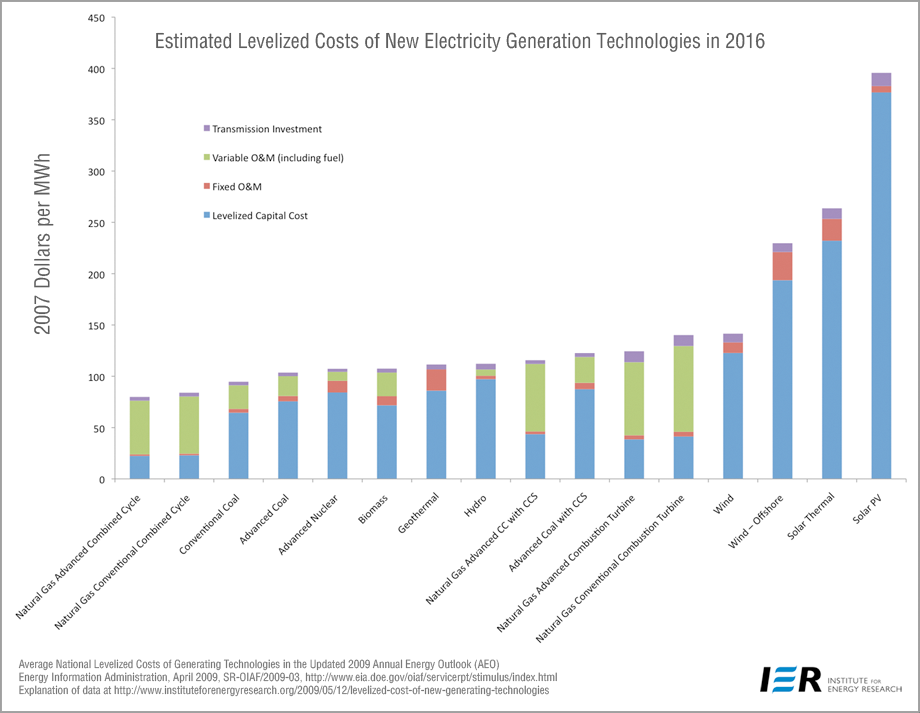
Recent thinking about LFTR design has moved on the 1960's and 1970's designs, and more recent actually point to lower, and potentially much lower LFTR costs, than could be obtained by simply replicating old ORNL designs. Thus it is quite possible that old ORNL estimates for MSBR costs, when adjusted for inflation could be actually higher than future LFTR costs. TM-1851 estimated that power could be generated by MSBRs for as little as 2.6 mills per kWh, of about 1.7 cents per kWh, inflation adjusted 2009 costs. This would be most encouraging, if we could rely on this figure.
This estimate was made before ORNL researchers had their three experience of with the Molten Salt Reactor Experiment (MSRE). The MSRE pointed to some real but hardly insurmountable technological problems to be overcome before a LFTR type MSBR could be commercially viable. Thus later ORNL design studies, and R & D plans were more realistic about development costs and time frames.
The early ORNL MSBR designs were fairly complex. TN-1851 developed its cost estimates from analogies to the costs of the light water reactors of the time. But in fact later developments in both technologies diverged.
Recent thinking about LFTR design has moved on the 1960's and 1970's designs, and more recent actually point to lower, and potentially much lower LFTR costs, than could be obtained by simply replicating old ORNL designs. Thus it is quite possible that old ORNL estimates for MSBR costs, when adjusted for inflation could be actually higher than future LFTR costs. TM-1851 estimated that power could be generated by MSBRs for as little as 2.6 mills per kWh, of about 1.7 cents per kWh, inflation adjusted 2009 costs. This would be most encouraging, if we could rely on this figure.
In another post, I pointed to yet other ORNL studies which also point to similar conclusions about LFTE costs. Finally I point in the same post to the development and manufacturing costs for the Airbus 380 aircraft. Airbus invested €11 billion plus that in the development of the A380. At a cost of $327 million the A380 would be if anything more complex and more expensive than the modular LFTR. Thus we have a reasonable hope that LFTR costs would come in at under $2 per watt of generation capacity, and $1 per watt or even less is not beyond the realm of possibility. We need more research to get a better understanding of LFTR cost estimate, but my preliminary studies suggest that the LFTR could represent a dramatic breakthrough in lowering the cost of post carbon energy.



 Posts
Posts


