Over the last 4 years, a new paradigm for nuclear power has emerged. One which involves the use of Molten Salt nuclear technology and the thorium fuel cycle. The paradigm also includes the factory production of small, relatively low cost, and rapidly built reactors. Proponents believe that this paradigm could would produce a rapidly deployable form of post carbon energy, that could potentially meet high levels of energy demand for millions of years to come. A reactor concept, called the Thorium Molten Salt Reactor in Europe, and the Liquid Fluoride Thorium reactor is associated with this idea, and several potential competing paper designs will potentially embody the concept. No TMSR/LFTR design has yet to emerge as as a project, but considering the fact that 4 years ago, the number of people in the world who knew about the concept, probably numbered in the few hundreds, a great deal of progress has been made towards making Thorium dreams a reality.
A second reactor concept has emerged to potentially compete with the LFTR idea. This is the Integral Fast Reactor, an advanced reactor concept that emerged from Argonne National Laboratory and Idaho National Laboratory between 1970 and 1990. The sociology, and business model of IFR support is different. IFR support relies heavily on the activism of old research veterans, and a small band of insiders, while LFTR support has emerged from a diverse group of scientists, engineers, and thinkers, few of whom were directly involved in Molten Salt Reactor research, prior to their LFTR activism.
There are some significant differences between the way MSR/LFTR supporters and IFR supportors argue their case. Kirk Sorensen, early on, posted a large number of Oak Ridge National Laboratory research reports, and technical papers on line in an archive, as support for his contentions. Although a similar, and indeed even larger set of technical documents could potentially be drawn on to support their contentions, they have chosen the testimony of the old research vetrans, rather than their reports as the primary documentation of their claims.
Indeed, anyone who is curious about what some of those IFR research reports have to say, might discover to their wondermont, that reviews of those reports are more likely to appear on energy from thorium, than on pro IFR web sites like Brave New Climate.
I must say that reading the IFR research literature has given me a somewhat better oppenion of the project, and although I have noted contradictions and discrepancies between the claims of the old Argonne National Laboratory vetrans and the research reports, those contradictions are explainable, especially if the research reports are understood in their political setting. In most instances, I have concluded that the contradictions probably will be settled in favor of the vetrans claims,. But there are still a number of troubling issues which cannot be settled by attempts to resolve the reports, and the claims of the vetrans. Perhaps the most troubling IFR issue yet to be resolved, is that of cost. Marketability is a second, related and troubling issue.
While it is clear that the IFR concept offers utilities many attractive features, it is far less clear that those features would attract utility purchasers to the IFR unless the maufacture could offer reactors at attractive prices. Manufactures will not be able to do that until they have assessed how much it would cost to manufacture and set up IFRs in the field. Such cost estimates are unlikely to be realistic, unless an IFR project has access to a manufacturer with experience building large, high technology projects, and construction engineers who have experience building large construction projects. Among current small reactor projects, only Babcock & Wilcox appears to have reached the organizational stage, that would permit it to begin to understand what it might charge customers for a finished product.
I have already discussed the status of the B&W mPower reactor project, in relationship to the ARC-100, a small IFR project. I have noted that the ARC-100 lacks the mPower project's maturity. The problem here raises a significant issue about the overall viability of the IFR.
General Electric has had a long term interest in the IFR concept, and a set of GE concept reactors, the S PRISMs have been developed as projected commercial implimentations of the IFR concept. All of these concepts require further investments in research and development, presumably with major US government involvement. In contrast, the ARC-100 is based on technology that is past the research and development stage. The ARC-100 technology has already been tested in a prototype, and thus can be considered mature.
If GE and its Japanese partner Tosheba were really interested in moving forward with an IFR the ARC-100 ought to be of interest to them. First because it would serve as a groundbreaker for IFR technology. Secondly, it would provide useful manufacturing and deployment experience. Thirdly, because if the ARC-100 is successful, its success would encourage public acceptance of larger and more ambitious S PRiSM projects.
From the viewpoint of the ARC-100 project, GR-Toshiba would bring many advantages to the table, including both manufacturing and construction engineering capabilities necessary for the ARC-100 project's success. Thus if GE-Toshiba is serious about the development of IRF technology, it would appear to have a stake in the ARC-100 project. Yet no evidence has yet to emerge that GE-Tosheba has the slightest interest in participating in the ARC-100.
This raises a question about how interested GE-Toshiba really is in the IFR as a potential future commercial product. I will be blunt, if GE-Toshiba is not interested in the ARC-100 project, unless another qualified candidate that could bring the necessary skills to the table, the project is likely to fail. But if GE-Toshiba is interested in developing a commercial IFR product, then it has an interest in the ARC-100's success. Therefore a lack of GE-Toshiba interest in the ARC-100 is very bad news for the prospects of the IFR.
The most likely problem would be IFR costs. If the ARC-100 is not cost competitive with small reactors such as the B&W mPower, then investments in it will carry a high risk. And if the ARC-100 is not cost competitive, investments in the IFR are unlikely to lead to big payoffs.
MSR/LFTR backers still firmly convinced that they offer a route to significantly lower nuclear and indeed post-carbon energy costs. While we don't know enough to offer a definitive view, it is likely thatr LFTR costs wiill be substantually lower than IFR costs. This judgement is based on a number of likely factors including lower materials input, simpler reactor design, lower labor costs, the possibility that a larger percentage of the finished product can be factory as opposed to field manufactured.
If I am right about this, potential serious MSR manufacturing efforts will begin to emerge within the next five years, while projects like the ARC-100 will not get past the drawing board stage, and other IFR projects will advance even less. Of course I might be wrong.

Showing posts with label Babcock and wilcox. Show all posts
Showing posts with label Babcock and wilcox. Show all posts
Sunday, August 8, 2010

Monday, December 21, 2009
Is Nuclear Power Too Risky to Afford?
Currently anti-nuclear ideologues are touting the line that nuclear power is too expensive. But too expensive in what ways? Nuclear critics have pointed to a report by Citigroup Global Markets on Nuclear Risk Factors. It states:
There are five substantial areas of risk faced by developers of new nuclear power stations. Three of those risk areas are so big and significant that if they go wrong, the developer (even the biggest utilities) could be financially damaged beyond repair. These risks can be classed as Corporate Killers. . .Panning, that is the time and money that go into nuclear plans, into acquiring the nuclear site represents the first risk, because the plan might fall through, but
While annoying for the developers if this turns out to be wasted time and money, in no way would a failed planning application threaten the financial integrity of a utility company.Similarly, a risk which the report calls "Decommissioning / Waste" is controllable if the right steps are taken. But Citigroup finds that this risk is also manageable through use of
a tax will be paid on each MWh produced (probably as little as £1/MWh). This would effectively limit the risk faced by the developers.This leaves us with three serious risks. First is construction
Below we give the latest data on the current and future costs of building a new nuclear power station. The latest evidence suggests a cost range of €2,500/kW to €3,500/Kw. For a 1,600MW unit, that means a construction cost of up to €5.6bn. We see very little prospect of these costs falling and every likelihood of them rising further. The cost of the TVO plant in Finland has increased from €3.0bn to €5.3bn since construction started. It has also proven to be very difficult to predict how long a new plant will take to build. The TVO plant is also running three years late. Cost overruns and time slippages of even a fraction seen by TVO would be more than enough to destroy the equity value (and more) of a developer’s investment unless these costs can be passed through somehow. Given the scale of these costs, a construction programme that goes badly wrong could seriously damage the finances of even the largest utility companies.The second risk factor which Citigroup sees as a problem is power price
Nuclear power stations have very high fixed costs and relatively low variable costs. Their cash flows and profitability are therefore particularly sensitive to the price that they sell their power. As we show later, even at the low end of the build cost estimates, we calculate that a new nuclear station will require €65/MWh (£58.5/MWh) in real terms year in/year out to hit its breakeven hurdle rate. . . . the UK has only seen prices at that level on a sustained basis for 20 months of the last 115 months. It was a sudden drop in power prices that drove British Energy to the brink of bankruptcy in 2003. No nuclear power station has ever been built to our knowledge where the developer takes the power price risk.The final risk factor which Citigroup calculates is unexpected operational costs.
Because of their high fixed cost base, nuclear stations are also very vulnerable to shortfalls in output due to operational unreliability. A six-month breakdown can cost £100m’s in direct costs and lost output, particularly if the output has been pre-sold. This risk is too great for a single project to bear, in our view, and at the very least needs to be spread across a portfolio of assets.There are, however, both shorter and longer range solutions to these Citigroup risks. The first and the third risks can be overcome by a government run insurance pool. Reactor constructors pay into the pool, which issues loan guarantees. Initially the guarantees would have to be backed by the government, but as the pool builds up, it would be able to pay off losses either on construction or prolonged operational shutdowns. The rational for this is simple. Just as wind and solar, which are fare more dubious AGW mitigation approaches, have investor risks lowered by substantial government subsidies, the risks entailed by nuclear investments can and should overcome controlled by government action as well. Loan guarantees are a low cost means by which the Government can mitigate the risk of nuclear investors.
A loan insurance pool is a short run means of controlling the loan related risks of nuclear constructors. Longer run means would involve a number of changes in the way reactors are built, and by the introduction of a radical new nuclear technology, that involves a complete redesign of the reactor. As for the price risk, this is a puzzling point, because all alternatives to nuclear power, either carry unacceptable carbon related problems that present even bigger risks to potential investors, political risks or actually will cost more, and lead to even higher electrical costs than would be the case with nuclear power. It seems unlikely than any of the acceptable electrical generation options from the carbon emissions perspective will cost less than nuclear generated electricity.
From a slightly longer range perspective, the small reactor approach will offer substantial relief quite aside from the loan guarantee insurance pool. In a recent Toronto Star column Tyler Hamilton pointed to small reactors as a potential solution to the loan risk problems of nuclear financing. Tyler quotes American Nuclear Society President, Tom Sanders, who argued that small reactors would do for reactors
what Henry Ford did for carsHamilton commented:
The result is that economies of scale are replaced by economies of volume that come from assembly line manufacturing.Factory built reactors could be shipped in large componants by truck, rail or barge, and assembled on reactor construction sites, with what Hamilton calls a,
Lego block approach.Other cost saving ideas include building
them in a factory setting using robotic assembly, . . . The reactors would be low maintenance, have passive safety features, and would be buried underground.Hamilton did not mention recycling old coal fired power plant sites, an approach that could save tens or even hundreds of millions of dollars in side development costs. I have been told that Babcock & Wilcox, the only surviving American Owned reactor manufacture plans to to use all of these money saving approaches. B&W plans to cluster small reactors, rather than to build big reactors. Reactor owners could add more reactors to the cluster as electrical demand increases.
Small reactors would cost proportionately less than large reactors, and thus their financing is not a "bet the farm" proposition. A cluster of small reactors can be purchased one at a time, as it the purchase of each becomes easily affordable. There is a hidden economic advantage to the small reactor - coal yard approach. Grid expansion costs, often associated with the construction of large reactors can be avoided. The construction of new high tension power lines, need to reach electrical customers from some new large reactor projects, and large scale renewables projects, can cost up to $3 billion dollars. Coal fired power plants already have grid hookups available. All you have to do is swap out generation sources.
The small reactor cluster also is an effective counter to the the operational risk problem. If one reactor goes down for a prolong period of time, there would still be a stream of income from the other reactors in the cluster.
The electrical cost problem, identified by Citigroup is a different issue. Both the Energy Information Agency projections and the SCANA projections show that the long term projected costs for nuclear power, although high, is lower than their cost projections for renewables.
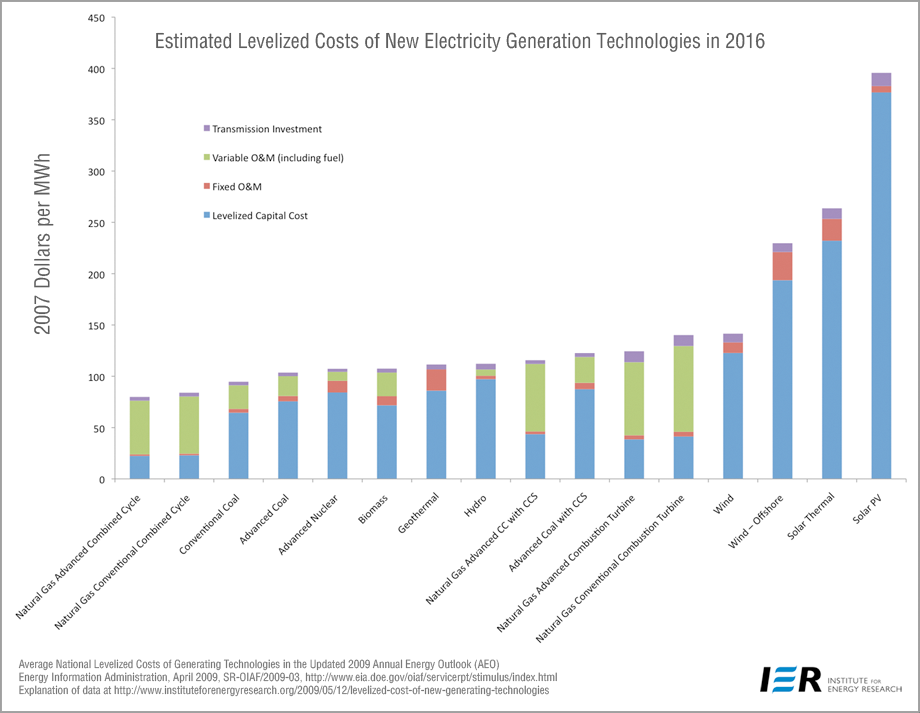
 PV advocates bitterly object to this to the high estimates of PV cost, and insist that the cost of PV panels is going to rapidly sink to virtually nothing for vast amounts of power. Solar advocates have been telling us similar stories since the 1970's, and PV is still outrageously expensive. The PV industry is highly dependent on subsidies for their living, but the need the sky high costs are falling stories to justify more subsidies.
PV advocates bitterly object to this to the high estimates of PV cost, and insist that the cost of PV panels is going to rapidly sink to virtually nothing for vast amounts of power. Solar advocates have been telling us similar stories since the 1970's, and PV is still outrageously expensive. The PV industry is highly dependent on subsidies for their living, but the need the sky high costs are falling stories to justify more subsidies. In a some what longer term more advanced nuclear technology, holds the potential to bring nuclear costs down and lower the cost of electricity. The lure of lower electrical costs, should be enough to lure the advanced industrial states of North America, Eastern Asia, and Europe into investing in advanced nuclear R&W. I have repeatedly argued that a form of advanced nuclear technology that uses fuel dissolved in liquid salts holds the key to lowering nuclear costs. Policy makers should be highly motivated to uncover and sponsor research into such promising options, but as David Walters recently observed in a comment on Nuclear Green,
What is common about countries really engaged in nuclear energy deployment is the goals they really set for themselves: S. Korea, China and India. I expect Vietnam as well. These projects become points of national pride.The failure to develop promising nuclear technologies, which potentially hold the key to lowering energy costs, in the face of of an unprecedented global energy crisis is a matter of national shame. It is utterly shameful than the American Energy Secretary, a Nobel Prize winning physicist, is so poorly informed about this option. Unfortunately the United States and Western Europe face the current energy crisis without a since of national pride. We will pay a high cost for this failure to take pride in ourselves, for this failure to believe in ourselves, and the high cost of electricity will be the least of the costs we pay.
Saturday, November 21, 2009
The B&W mPower and TVA
Some time ago I wrote a series of posts titled the Keys to Lowering Nuclear Costs. Although my primary focus was on lowering LFTR costs, use of many of the cost lowering approaches I suggested was not by any means limited to LFTR type reactors. Most of the ideas did not originate with me, and most of them are obvious to anyone who thinks seriously about methods of lowering nuclear costs. I would thus expect that lowering nuclear costs will become increasingly important during the next few years, and that parts of the Keys formula will be repeated over and over again in new nuclear projects. Rod Adams posted a discussion of the B&W mPower reactor yesterday.
In my estimation the mPower has a far better chance of becoming a reality than he Hyperion reactor does. Rod's post points to Babcock & Wilcox's existing production system, now engaged in the production of reactors for the Navy. Much of skepticism about the future of nuclear power has to do with supposed production bottlenecks. Those bottlenecks would not be a problem for B&W, and at any rate if orders start flooding in, B&W will have ample time to expand their production capacity. Rob also links to an article in Nuclear Engineering International that focus on the B&W reactor. We see clearly how much of B&W's thinking parallels the Keys. We have a small factory built modular reactor, intended to be sited underground. Small reactors can be built in a shortened construction time, B&W estimates as little as two years. The "m" in mPower probably stands for modular, and modules can be clustered in sets of from two to eight reactors. Building the cluster one reactor at a time means that part of a project can be producing power and thus income while other parts are under construction, and still others are in the planning stage. These features substantially lower the accrual of interest, and thus lower capital costs. That is straight out of The Keys.
The mPower can be either air or water cooled, and thus becomes the first site anywhere reactor. B&W says that the reactor will cost $500 million. For the water cooled mPower that comes to $3.70 per watt. It is not clear if this is an overnight figure, or the actual cost of ownership. The B&W mPower would save its owners around $30 million a year in coal costs. The mPower at $3.70 per watt will be price competitive with wind. It will offer a capacity factor of .90 to wind best of .30 to .40 depending on location. Wind costs $2.50 per will produce less than half of the power, and the mPower can produce power on demand.
The mPower would be an excellent investment at the $500 million price. The market would perceive an mPower based project to be low risk, because of the relatively short manufacturing time, and its affordable price. The market has a long memory of the Washington Public Power Supply System's (woops) $2.25 billion default its five reactor nuclear project. The market is likely to be far less intimidated by a project of the modest size of the mPower. At that point the mPower story will begin selling itself. B&W can point to not only the reliability and safety of the nuclear power industry, and to the reliability and safety of the thousands of reactor years of safe operation for small naval reactors it has built by B&W. The combination of small risk and a competitive rate of return is likely to ease investor fears. B&W has the deep pockets needed to make the mPower happen, and they have TVA backing. The first mPower TVA is committed to evaluating a possible site, located in Roane County near Oak Ridge, as a potential site for the lead mPower reactor. In addition, B&W states,
TVA confronts a statutory debt limit of $30 Billion with an existing debt of $25 billion. Thus TVA cannot afford more than one large reactor project, at the most. TVA is currently finishing the Watts Bar II unit, and that will add $2.5 billion to its debt. That would leave room for only one more large project, completion of the long delayed Bellefonte I project, probably for around another 2.5 billion 2009 dollars. That will leave TVA with very little wiggle room, but the Alexander-Webb 100 reactor imitative might provide TVA with an out. At the moment TVA's best large new reactor option, the Westinghouse AP-1000, is under a very silly regulatory cloud at the NRC, and may have to undergo a major containment housing redesign. No such redesign would be requited with the underground mPower reactor. If TVA gets reactor money out of Congress, without a small debt limitation revision, I would expect Bellefonte II and more mPower reactors, perhaps with some arrangement that keeps the debt off TVA's books, to be added to TVA's plans before long. The hand writing on the wall says, "carbon taxes on fossil fuel fired electrical generation are coming soon." TVA faces an utter lack of viable wind resources. and with as many as 209 cloudy days a year, solar reliability is a big joke in the Tennessee Valley. If TVA is going to go green, it will have to go Nuclear Green.
A Memorandum of Understanding has been signed by B&W, TVA and a consortium of regional municipal and cooperative utilities to explore the construction of a fleet of B&W mPower reactors to meet the consortium’s need to diversify its power generation assets.This sounds like something other than direct TVA ownership for the fleet of mPower reactors might be in the works.
TVA confronts a statutory debt limit of $30 Billion with an existing debt of $25 billion. Thus TVA cannot afford more than one large reactor project, at the most. TVA is currently finishing the Watts Bar II unit, and that will add $2.5 billion to its debt. That would leave room for only one more large project, completion of the long delayed Bellefonte I project, probably for around another 2.5 billion 2009 dollars. That will leave TVA with very little wiggle room, but the Alexander-Webb 100 reactor imitative might provide TVA with an out. At the moment TVA's best large new reactor option, the Westinghouse AP-1000, is under a very silly regulatory cloud at the NRC, and may have to undergo a major containment housing redesign. No such redesign would be requited with the underground mPower reactor. If TVA gets reactor money out of Congress, without a small debt limitation revision, I would expect Bellefonte II and more mPower reactors, perhaps with some arrangement that keeps the debt off TVA's books, to be added to TVA's plans before long. The hand writing on the wall says, "carbon taxes on fossil fuel fired electrical generation are coming soon." TVA faces an utter lack of viable wind resources. and with as many as 209 cloudy days a year, solar reliability is a big joke in the Tennessee Valley. If TVA is going to go green, it will have to go Nuclear Green.
Subscribe to:
Posts (Atom)
Subscribe To Nuclear Green


 Posts
All Comments
Posts
All Comments
Some neat videos
| Nuclear Advocacy Webring Ring Owner: Nuclear is Our Future Site: Nuclear is Our Future |
||||
 |
 |
 |
 |
 |
| Get Your Free Web Ring by Bravenet.com |
||||