
Showing posts with label India. Show all posts

Thursday, August 25, 2011

Deproliferation, India and the Thorium Fuel Cycle

In the first part of this essay, I reviewed the almost inevitable rise of China and India to great power status. I pointed out that by 2050, current expectations are that by 2050, China and India will be ranked along with the United States as great powers of the first order. I noted that both China and India are committed to the development of Thorium fuel cycle nuclear technology, and the possibility that those commitments could chalenge the current course of American nonproliferation policy.

It is possible to produce fissionable U-233 from thorium from the same sort of reactors used to produce weapons grade plutonium, yet during the cold war, no one thought to do so. Frank von Hippel is a self-styled non-proliferation expert who has greatly influenced American, and even global non-proliferation policy. Other self-styled non=proliferation experts tend to advocates arms control policies suggested by von Hippel. Together with Jungmin Kanga and von Hippel, actually attempted to explore this seemingly rational step was not taken during and after the cold war in a paper titled U-232 and the Proliferation- Resistance of U-233 in Spent Fuel.

They write,
Uranium-233 is, like plutonium-239, a long-lived fissile isotope produced in reactors by single-neutron capture in a naturally-occurring abundant fertile isotope (see Figure 1). The fast critical mass of U-233 is almost identical to that for Pu-239 and the spontaneous fission rate is much lower, reducing to negligible levels the problem of a spontaneous fission neutron prematurely initiating the chain reaction -- even in a "gun-type" design such as used for the U-235 Hiroshima bomb (see Table 1). Why then has plutonium been used as the standard fissile material in the "pits" of modern nuclear weapons while U- 233 has not? This question is not just of historical interest, since there is increasing interest in U-233-thorium fuel cycles.
Kanga and von Hippel note
One of the most important reasons why plutonium was chosen over U-233 as a weapons material is that first-generation plutonium-production reactors were fueled by natural uranium, which contains almost as large a fraction of neutron-absorbing fertile material (U-238) as is possible consistent with a reactor achieving criticality. In a natural-uranium fueled reactor, such as the Canadian heavy-water-moderated (HWR) reactor type, Pu-239 is produced by neutron absorption in U-238 at a rate of about one gram of plutonium per thermal megawatt-day (MWd) of fission energy release at low U-235 "burn ups," (see Figure 2).1 Approximately one MWd is released by the fission of one gram of fissile material. After taking into account the neutron requirements for maintaining a steady chain reaction, there is about one excess neutron available per fission and virtually all of these neutrons are absorbed by U-238. Production of U-233 requires the addition of the fertile material Th-232. If the fuel is natural uranium, only a relatively small percentage of thorium can be added before it becomes impossible to sustain a chain reaction. We"estimate that about 7 percent thorium oxide can be added to HWR fuel achievable burnup is reduced from 7000 to 1000 MWd/t (thermal megawatt- days per ton-heavy metal). Because the thermal-neutron absorption cross-section of Th-232 is almost 3 times larger than that of U-238, this concentration of thorium would yield about 0.2 grams of U-233 per MWd at burnups lower than 1000 MWd/t (see Figure 3). Thus most of the fissile material produced in the core would still be plutonium.
Kanga and von Hippel also state,
For a country with uranium-enrichment capabilities, the balance between plutonium and U-233 production could be shifted almost all the way toward U-233 by fueling production reactors with highly-enriched uranium. Indeed the U.S. produced much of its weapons plutonium in the Savannah River heavy-water-moderated production reactors, using highly-enriched uranium fuel and depleted uranium targets in mixed-lattice arrangements.
But Kanga and von Hippel also noted a second problem for weaponizing U-233,

But at this point it should be noted that countries with uranium enrichment capacities to the level of highly-enriched uranium already possess the capacity to produce nuclear weapons. And the process of producing U-233 using HEU-235 to in production reactors, destroys more weapons grade fissionable material than it produces. The use of U-235 at Savannah River to produce Pu-239 was motivated by the fact that Pu-239 had useful military qualities that U-235 lacked. The military qualities of U-233 are inferior too the military qualities of U-235. Thus the choice to produce Pu-239 but not U-233 at Savannah River was rational. Kanga and von Hippel acknowledge the problem,
A second problem with U-233 as a fissile material for either weapons or reactor fuel is that it contains an admixture of U-232, whose decay chain produces penetrating gamma rays. The decay chain of U-232 is shown in Figure 4. The most important gamma emitter, accounting for about 85 percent of the total dose from U-232 after 2 years, is Tl-208, which emits a 2.6-MeV gamma ray when it decays (see Appendix C). For plutonium containing a significant admixture of 14.4-year half-life Pu-241, the most important source of gamma-ray irradiation from is its 433-year half-life decay product, Am-241, which emits low-energy (< 0.1 MeV) gamma rays. These gamma rays do not represent a significant occupational hazard for weapon-grade plutonium (0.36% Pu-241) but their dose becomes more significant for "reactor-grade" plutonium, which contains on the order of 10 percent Pu-241. Thus both U- 233 contaminated with U-232 and reactor-grade plutonium are made less desirable as weapons materials by virtue of the fact that their gamma emissions bring with them the potential for significant radiation doses or shielding requirements for workers involved in nuclear weapons production and for military personnel handling nuclear weapons.
How much less desirable? Kanga and von Hippel report that at a 1% U-232 contamination level a worker would begin to accumulate a cancer risk after working with U-233 for less than three minuits. But 1% U-232 is unusual to say the least. The problem is simple, U-233 poses problems for workers and military personel by exposure to radiation from a U-232 daughter product, while the same radiation poses problems for weapons electronics in storage.

Kanga and von Hippel report that India is researching laser isotope separation of U-233 from U-232. But does this represent a proliferation challenge? First if Indian researchers can separate U-233 from U-232 using lasers, they can also separate U-235 from U-238, and U-235 from U-238 separation is one of the two classic route to nuclear weapons. U-235 based weapons are reliable enough that they do not require tests to identify their military effect. This is not the case for U-233 based weapons. The only known test of a U-233 based weapon failed to accomplish test objectives, although it did explode with a respectable if not as large as expected bang, Thus it would appear that given routs to U-233 and U-235 based weapons, given equivalent costs and technical obstacles, but without tests, military planners will prefer the U-235 based weapons.

Now it can be argued that India should not develop laser uranium enrichment technology because such technology poses proliferation risks, but Burma, a rogue state, is also developing Laser enrichment technology, although it is very unlikely that the Burmese will master it. Burma is also attempting to master centrifuge technology, and given the track records of Pakistan and Iran, that appears to more likely.

The Indian three stage nuclear Research and Development program is well known, and despite setbacks, it has made steady progress over the last 50 years. During much of that time, the global anti-proliferation community sought to punish India for its pursuit of nuclear weapons. India, which shares common borders with two nuclear armed hostile states that are allied against it, believed that a small nuclear arms program was prudent, given the likelihood that at least one of its enemies might use nuclear weapons against it. India maintained its nuclear weapons program despite a 34 year embargo on uranium and other nuclear related trade items. The embargo somewhat handicapped the development of the Indian nuclear industry, and limited the production of nuclear power in India.

It should be pointed out that in 1974, at the beginnings of the international nuclear trade sanctions against India, that nation lacked many of the characteristics of a great power. Never the less it refused to back down on its nuclear weapons program. Today, India is rapidly becoming a great power. It is conceivable that by 2050 India will have the largest economy of any nation. At worst India will have by most estimates the second or third largest economy. India, like China is developing aircraft carriers, a standard military technology for projecting power.

If in 1974, a relatively weak India refused to subordinate itself to the nuclear policies dictated by the United States, by 2050 a very powerful Indian State will certainly not place itself under American Nuclear hegemony. The 123 agreement between India and the United States offered India recognition of its great power status.

The Indian three stage Indian Nuclear development plan directly contradicts the non-proliferation policy advocated by Frank von Hippel who opposes nuclear waste reprocessing and the use of fast reactors. Von Hipple states,
Reprocessing is enormously dangerous. The amount of radioactivity in the liquid waste stored at France's plant is more than 100 times that released by the Chernobyl accident. That is why France's government set up antiaircraft missile batteries around its reprocessing plant after the 9/11 attacks.

Even more dangerous, however, is the fact that reprocessing provides access to plutonium, a nuclear weapon material. That is why the U.S. turned against it after 1974, the year India used the first plutonium separated with U.S.-provided reprocessing for a nuclear explosion. President Gerald Ford and Henry Kissinger, his secretary of State, managed to intervene before France and Germany sold reprocessing plants to South Korea, Pakistan and Brazil, all of which had secret weapons programs at the time.
The heart of the Indian long range three stage nuclear program involves recycling spent fuel from conventional power reactors. Plutonium in that spent fuel becomes the the Fissile start charge for for fast breeder reactors, which produce plutonium and U-233 from thorium. That fuel is recycled and the the Plutonium is returned to the fast breeder while the thorium is used to power thorium fuel cycle thermal breeder reactors.

Von Hippel apparently has not produced a comprehensive case study of nuclear disarmament issues from the Indian perspective, but he thinks he knows what the Indians should be doing. In 2006 he co-authored a paper which offered prescriptions for demands which the United States should seek to include in any nuclear trade agreement with India. In particular von Hippel demanded that any nuclear trade agreement with India should require that before trade can begin
that India has stopped the production of fissile material (plutonium and highly enriched uranium) for weapons or else joined a multilateral fissile production cutoff agreement;
Von Hippel also called for
A determination and annual certification that U.S. civil nuclear trade does not in any way assist or encourage India's nuclear weapons program.
The Conditions which von Hippel sought to impose on India might be described as humiliating for a great power, even a great power which was content to hold a small number of nuclear weapons. India faces a possible military alliance between China and Pakistan which together hold far more nuclear weapons than India does. Thus India's nuclear arsenal may not offer India sufficient for conceivable national defense needs.

In addition von Hippel has taken a stance that nuclear fuel reprocessing is conducive to weapons use of fissile materials. Von Hippel also objects to fast reactors because a fast reactor fleet will inevitably be dependent on fuel reprocessing, and theoretically fast reactors could produce fissionable materials that could be used in nuclear weapons. Later in this essay, I will examine problems with von Hippel's belief that reprocessing and fast reactors increase the likelihood of nuclear proliferation. In Fast Breeder Reactor Programs: History and Status, a study coauthored by von Hippel, he remarks
India’s Prototype Fast Breeder Reactor (PFBR), expected to be completed in 2010, will have the capacity to make 90 kg of weapon-grade plutonium per year, if only the radial blanket is reprocessed separately and 140 kg per year if both radial and axial blankets are reprocessed.15 The Nagasaki bomb contained 6 kg of weapon-grade plutonium and modern weapons designs contain less. At 5 kg per warhead, the PFBR would produce enough weapon-grade plutonium for 20–30 nuclear weapons a year, a huge increase in production capacity in the context of the South Asian nuclear arms race. were left mixed with the plutonium, however — a project that the U.S. Department of Energy abandoned when it learned that the technology was not in hand — the gamma radiation field surrounding the mix would still be less than one-hundredth the level the IAEA considers self-protecting against theft and thousands of times less than the radiation field surrounding plutonium when it is in spent fuel (figure 1.4).
It is doubtful that von Hippel favors Indian reprocessing of Thorium cycle nuclear fuel. Thus to the extent that American nonproliferation policy is influenced by von Hippel and his followers, American nonproliferation policy, it is likely to conflict with Indian nuclear policy. The Indian nuclear policy had from its inception of using nuclear power to turn India into a rich and powerful nation. Not just militarily and politically powerful, but economically powerful as well. It is unlikely that the Indian political leadership will abandone their goal of achieving great power political and economic status for India, and the prevailing view that nuclear power will play a key roal in accomplishing that goal. To understand Indian national goals is to begin to understand the realpolitik of Indian objections to American nonproliferation as interpreted by Frank von Hippel.

Much 20th century thinking about nuclear nonproliferation, sprang from ethical goals. Nuclear war, is a moral wrong, and the use of nuclear weapons is evil. These assumptions cannot be dispited. But nuclear weapons and their use exist in a morally imperfect world, where people believe that they are sometimes are forced to commit acts that are morally wrong, and even to do things which in absolute moral terms are evil. It is not necessicary to justify such behavior in order to acknowledge that it exists, and to regard the necessity of responding to the real acts of people, as imposing on us constraints on the moral aspects of our life and thought. It is desirable to bring together the real world of human thought and action, with the more lofty goals offered by moral thought. Such is the case if we wish to control the production and use of nuclear weapons.

Thus future American policy towards India nuclear developments ought to focuse on a conversion of the ethical with the realpolitik goals. American policy has no choice but to accept that India has chosen a path that will lead to a thorium based economy. as well as the Indian need for a limited stock of nuclear weapons, at least in the short run.. Once Indian goals accepted, India will willingly participate in the creation on an international order directed towards arms control.

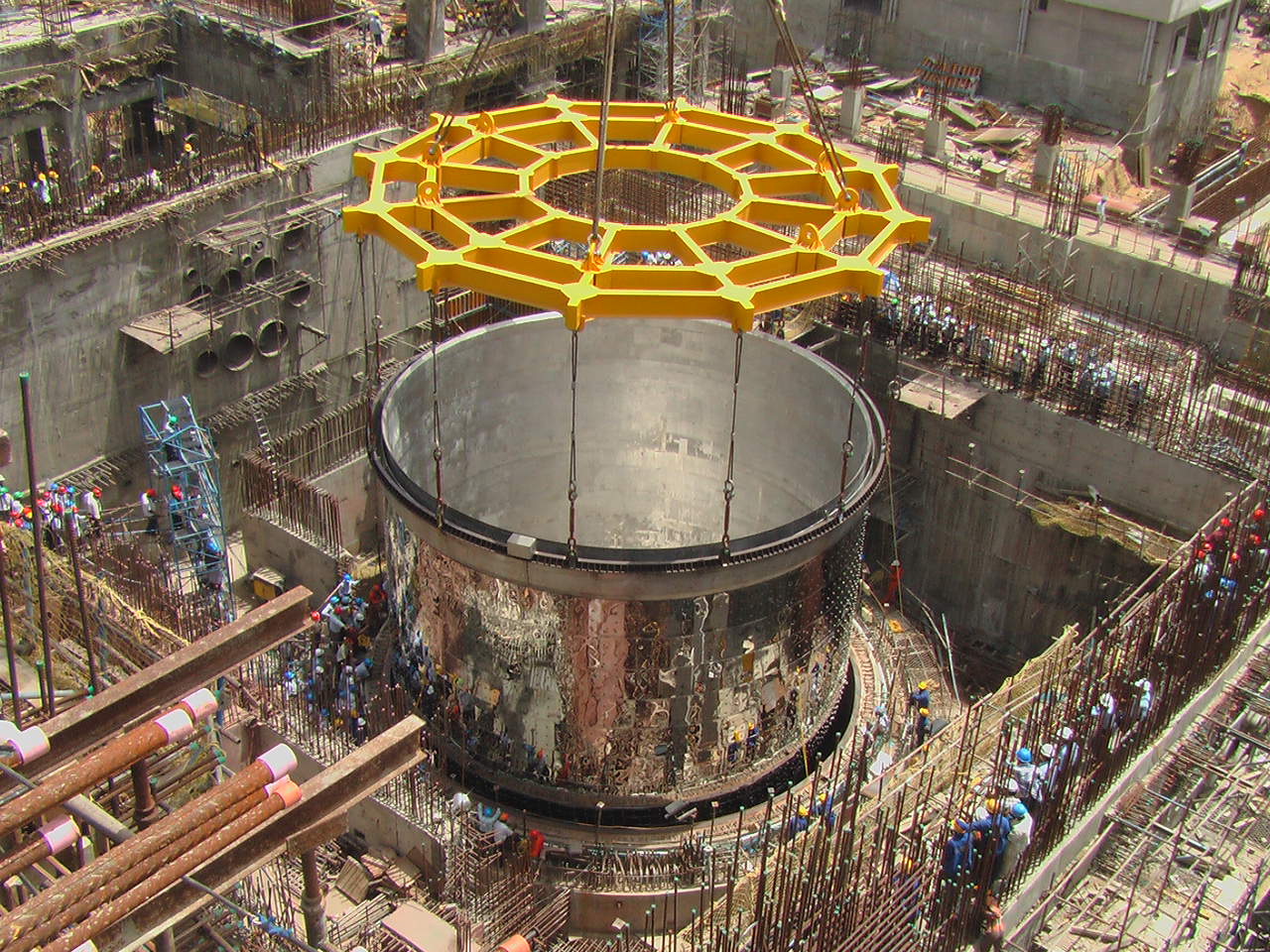
Tuesday, August 23, 2011

Indian and Chinese Developmemt, Nonproliferation and Thorium

This is the first of a series of posts which I plan to offer that will argue that current nuclear nonproliferation schemes are at best transitory, and are likely to undergo significant changes before the middle of the 21th century.

Numerous studies projecting future global economic growth have suggested that by and in most cases well before 2050, the Chinese economy will be the largest single national economy. Some studies, however, suggest that Indian economic growth will exceed China over the next 40 years, and by 2050 the Indian economy will be the largest in the world. Views that the Indian economy will rank second or third in the global economy are generally seen as more common.

A recent Citigroup Global Markets study finds
China should overtake the US to become the largest economy in the world by 2020, then be overtaken by India by 2050.
The Chinese political-social system as well as current demographic trends are expected begin to act as a drag on its economic growth, while Indian democracy and the greater openness of Indian society is expected to lead to higher levels of competitiveness.

By 2050 Citi researchers expect both the Chinese and the Indian economies to be twice the size of the American economy. These developments have significant implications for global affairs. Globally Citi anticipates that the 10 largest economies in 2050 will be India, China, The United States, Indonesia, Brazil, Nigeria, Russia, Mexico, Japan and Egypt. Key resources, including Water and electricity play a major tole in economic development, and in the long run will potentially be sources of economic problems. The Citi researchers suggest,
Many rapidly growing economies, including China and India continue to charge prices for key resources, including water, electricity and other sources of power that are far below long-run social marginal cost and even far below long-run marginal private cost (excluding environmental externalities) (see OECD (2009) and Easter and Liu (2005), World Bank (2010)). In the case of prices charged to households, there is a second-best argument that, if cash grants to address poverty are not administratively feasible, the subsidization of certain key goods and services consumed by the poor is (constrained) efficient. This argument also supports the use of subsidies on the staple foods consumed by the poor as a poverty relief measure. There is no equity or efficiency-based case, however, to subsidise (charge a price below long-run marginal social cost) the use of water, power and other resources by the industrial and agricultural sectors – by far the largest consumers of power and water.23 The over-use of both power and water this has encouraged is creating a major potential environmental problem in both India and China. Unless this issue is addressed as a matter of urgency, scarcity of clean, fresh water alone could become a binding constraint on growth in both India and China – and many other countries with large arid regions. Long-run social marginal cost prices of all key resources (or equivalent physical rationing schemes which would, however, be much less efficient in practice) is the only way to prevent further destruction of environmental capital.
Thus sources of low cost sustainable energy will play an important role in economic development, especially approaching 2050 or after. Both India and China are planning very ambitious programs of nuclear power development. Both countries are planning rapid deployment of significant numbers of traditional Light Water and Heavy Water power reactors. while projecting for further development both Fast Liquid Metal Reactors and Thorium cycle breeder reactors.

Indian nuclear plans include the construction of a large number of fast reactors that will be used to both produce electricity and breed thorium. In addition India plans currently include a large number of Thorium Fuel cycle heavy water reactors that operate at or close to one to one conversion ratios. The Chinese Academy of Science has initiated a program of Thorium cycle Molten Salt Reactor (LFTR) research and development.

Nuclear Green has argued on the basis of studies conducted at Oak Ridge National Laboratory, that LFTR type reactors will offer safe, sustainable and efficient nuclear power at a potentially low cost. (See for example, ORNL-TM-1851 (SUMMARY OF THE OBJECTIVES, THE DESIGN, AND A PROGRAM OF DEVELOPMENT OF MOLTEN-SALT BREEDER REACTORS) ). In contrast to the relatively simple and low cost chemical processes that would allow low cost Fluoride salt based nuclear fuel reprocessing being investigated by the Chinese, the Indian thorium cycle scheme would involve far more expensive chemical fuel reprocessing systems, and most likely more expensive reactors. All in all, the Indian thorium based energy scheme appears to be more complex and more expensive.

Several motives will undoubtedly drive India and China to develop nuclear power systems that are capable of producing sustainable energy, while at the same time facilitate rapid and mast deployment while providing low cost energy. These motives include concerns about the climate implications of burning fossil fuels, increasing scarcity of and rising prices for fossil fuels, the health and agricultural consequences of burning fossil fuels, and the ready availability of large, easily recovered thorium deposites.

Conclusions

By the middle of the 21st century the combined economic power of India and China will be so great that they can impose an international order that is consistent with their interests on the global political-economic system. Where future Indian and Chinese interest converge, the United States can expect to make little headway against them. Both India and China appear committed to developing a thorium nuclear fuel cycle, and it would appear to be rational that they both do so. It is possible that the combined interest of India and China might diverge from those of the United States, and it would appear unlikely that under such circumstances, the interest of the United States would prevail. These conclusions have significant implications for future American nonproliferation policy.

In the next post, I will review the implications of current American nonproliferation policies for the deployment of thorium based nuclear technologies.

Friday, December 18, 2009

India moves ahead with an ambitious nuclear program to combat global warming

More evidence is emerging that the Nuclear Power Corp. of India (NPCIL) is planning to finance future nuclear construction through debt financing. Both local and international sources will be tapped. NPCIL plans to raise at least $6.5 billion from local sources, and another 3 billion euros from international lenders. Local funding will also include equity from NPCIL and at least three Indian partners. Three Billion is being raised locally to finance 4 locally designed 700 MW PHWRs. Another $3.5 billion is being sought to pay for 2 larger Russian PWRs to be built at Kudankulam. In addition equity financing for Indian Nuclear development is expected to come from Large Indian businesses, including the Oil Corporation of India, The National Aluminium Company, and NTCPL.

Indian nuclear developments could have an impact on global carbon emissions. Indian PricewaterhouseCoopers Pvt., Executive Director, A.V. Kameswara Rao, told Bloomberg,
The spending is justified considering nuclear power will help reduce India’s spending on oil and coal imports, . .
Indian plans include the construction of as many as 14 Russian Reactors, partially financed by "soft loans" from Russia, and partially by funds from local sources. The Russian reactor projects are but a small part of the Indian nuclear plans which will eventually require vast financial resources for their completion.

Indian Nuclear plans are exceedingly ambitious and the Indians have started a huge infrastructure program. Bharat Heavy Electricals (BHEL), is owned by the Indian Government, and already supplies 80% of the heavy equipment for India's national nuclear power program. BHEL plans to spend $7.5 billion in two years building plants to supply components for both local and foreign designed reactors to be built in India, In addition, BHEL plans a further joint venture with NPCIL intended to supply even more components to for reactor construction, and is involved in a further joint venture with NPCIL and an as of yet unnamed European partner to build generator turbines for new Indian Reactors. A further BHEL joint venture with Heavy Engineering Corp (HEC) will produce castings and forgings for nuclear power plants, BHEL is also engaged in talks with British Sheffield Forgemasters International Ltd and Japan's Kobe Steel exploring the possibility of even more joint ventures for nuclear forgings. Still other joint ventures and agreement involving BHEL will be announced. All in all it appears that BHEL and NPCLI plan to invest $50 Billion during the next five years, to expand the Indian nuclear manufacturing base. This would be astonishing, but investment of this size are probably being matched by China.

The current indian plan calls for the construction of up to 40 GW of foreign reactors, in the next 22 years. Although India has developed excellent nuclear technology, will use the foreign designed reactors to jump start the expansion of the Indian post-carbon power industry. In addition, the purchase of foreign designed reactors will provide India with a stream of reactor uranium. The uranium plays a major role in future Indian nuclear plans. The so called nuclear waste from the India's foreign designed Light Water Reactors will play a critical role in India's nuclear future according to current Indian plans. NPCIL plans to use plutonium from the light water "spent fuel stream" to fuel its new generation of Fast Breeder Reactors, which will in turn transmute thorium into the U-233 that will power the next generation of Indian Light Water Reactors.

Now contrast these and many other documented Indian developments with the following statement from nuclear critic Steve Thoma, and his associates Mycle Schneider, Antony Froggatt, and Doug Koplow,
In 2006 the chairman of the Nuclear Power Corporation of India (NPCI) told reporters that 62 reactors with a combined capacity of 40 GW would be operating by 2025.342 There is no evidence of how the country would enable an annual increase of 1,850 MW every year between 2008 and 2025. . . .

Considering its poor past industrial record, it remains to be seen whether the Indian nuclear sector will be up to its own expectations in the future. Foreign assistance could make a difference to some extent. . .
In other words, "those poor darkie Indians don't have a clue about what they are doing with nuclear technology. They need all of the help they can get." This statement was commissioned by the then Green dominated German Federal Ministry of Environment, Nature Conservation and Reactor Safety. Who says that the spirit of Nazi racism is dead in Germany?

It is clear then that the India Government plans to become a global leader in the peaceful uses of nuclear power, and sees nuclear technology as its preeminent tool in that struggle. While India advances its capacity to produce a post carbon energy sector, it is also laying the groundwork for a revolutionary change in the lives of hundreds of millions of its people. and for India to become one of the great powers of the 21st century.

Friday, November 27, 2009

Canada and Indian Reactors

It has recently been proposed that the Canadian reactor manufacture company Atomic Energy Canada, Limited should be sold to Indian interests, presumably the Nuclear Power Corporation of India (NPCIL), an Indian government owned business that builds and operates Indian power reactors. NPCIL is a very successful reactor designer of small to middle size reactors. And AECL has something that NPCIL needs, and that is reactor manufacturing capabilities. India is buying foreign reactors in part to jump start the Indian reactor supply chain, but in the long run indian plans still envision Indian designed and built reactors producing most of the countries future energy.

Currently India has a number of successful, low cost reactors, whose design has evolved from the an early AECL CANDU reactor design. A couple of the Canadian reactors were built in India, and served as prototypes for subsequent Indian reactors. The Indians appear to have solved a number of technological problems with the CANDU design, and are now interested in exporting their small and possibly their middle size reactors. AECL is stymied because they don't have any up to date reactor products, and their old reactors are known to have significant material flaws that necessitate expensive rebuilds every 25 years. The Indians appear to have overcome this problem. Thus Indian technology and reactor design might benefit SECL, but what benefits would the Indians receive from the deal?

We should note that it would cost significantly more for AECL to manufacture reactors in Canada, than for NPCIL to manufacture reactors in India. But on the other hand AECL has a number of international customers in Asia, Latin America, and Europe and an established presence in North America. AECL gives NPCIL an opening to its old customers and an international reputation. Sale of NPCIL designed reactors to customers in the United States as well as Canada might be a possibility. NPCIL could aid AECL to lower reactor costs by exporting parts as well as the design of low cost reactors. The smallest Indian reactor at rated at 220 MWe, has very large potential for world wide sales, and might well sell well in the united States, where small reactors are beginning to attract attention. A second Indian reactor. the larger 700 MWe design is similar in size to the CANDU 600 reactor. The Canadians have looked at an enhanced CANDU 600, but It might cost less to adapt the Indian 700 MW reactor to North American requirements. Among the advantages of the Canadian-Indian reactor design is the absence of such manufacturing bottlenecks as requirement for a large and difficult to manufacture reactor pressure vessel.

Thus the AECL could adapt the Indian reactors to Canadian and American requirements, and manufacture and sell them in North America, together with sales to other traditional AECL customers. NPCIL could contribute its technology and capital which AECL desperately needs. NPCIL could also sell reactors directly to customers in Asia and Africa.

The Indians are developing a reactor, the Advanced Heavy Water Reactor (AHWR). This reactor has Generation III + safety features. In India the AHWR will operate on a thorium fuel cycle, but a AHWR design that uses uranium is in the works for export. The AHWR(U) might fit into the AECL catalogue, and a 1000 MW big brother might cap the AECL offerings for some time to come. Thus NPCIL does have something to offer AECL, and AECL might help NPRIL find international customers, as well as boosting reactor production. There would be, of course, issues of corporate culture to overcome. Thus a deal is at least possible.

Tuesday, November 24, 2009

Indian Nuclear Plans

The World Nuclear Association has published a long new account of the advances in the Indian nuclear program. Things are now moving very fast and three dozen reactors reactors are either planned or under serious consideration. Indian plans include light water reactors from Russia, France, and the United States, in addition to a locally designed Light Water Reactor.

Why the plunge into foreign Light Water Reactors, after India has painstakingly developed its heavy water reactor technology? The reason becomes obvious when we learn that the Indians are now expanding their fast breeder reactor plans. The WNA tells us
Longer term, the AEC envisages its fast reactor program being 30 to 40 times bigger than the PHWR program . . . this will be linked with up to 40,000 MWe of light water reactor capacity, the used fuel feeding ten times that fast breeder capacity, thus "deriving much larger benefit out of the external acquisition in terms of light water reactors and their associated fuel". This 40 GWe of imported LWR multiplied to 400 GWe via FBR would complement 200-250 GWe based on the indigenous program of PHWR-FBR-AHWR. Thus AEC is "talking about 500 to 600 GWe nuclear over the next 50 years or so" in India, plus export opportunities.
Oh wow, talk about ambitious! As i keep saying the Indians intend eat every ones lunch by running their industries on low cost thorium power. Even though foreign reactors are more expensive than Indian designed reactors, they fit into Indian plans, because they produce lots "spent fuel". In other countries "spent fuel" is considered a problem, and is called nuclear waste. In India spent light water reactor fuel is fuel for fast breeder reactors. And fast breeders will produce both electricity and the start up fuel for Advanced Heavy Water Reactors. The AHWRs will be breeders too, so as long as India has thorium, it will have nuclear fuel.

Unlike China, India does not have a legacy of coal, and further unlike China, India is not cursed with a large domestic coal supply. The Indians have known for 60 years that the key to their energy future would lie with nuclear power, and have doggedly pursued a nuclear development program. Along the way the Indians were able to develop really low cost but good quality reactors. Locally designed and built Indian reactors cost 40% less than Chinese reactors. And needless to say both cost a whole lot less than American and European reactors. The Indian reactor price advantage could begin to tell in 20 years when India and China start their post carbon energy program in ernest.

Current Chinese plans for post-carbon energy call for an everything but the kitchen sink approach. And even the lowest carbon Chinese energy plan calls for over 40% of Chinese electricity to be generated by fossil fuels in 2050. The Chinese expect to be building 4th Generation reactors by 2050, but it is far from clear what role they will play in Chinese nuclear plans.

The Indians clearly have charted a route to a high energy, low cost nuclear future. The Chinese as of yet have not. Of course Indian plans, though good, could be even better. The Indians are committed to do a lot of fuel reprocessing, a decision the Chinese appear to be also following. Both nations are involved with expensive approaches, and current fuel reprocessing technologies tend to loose too much plutonium, Indian reactor and fuel processing costs could be lower, provided the Indians adopted Molten Salt Reactor technology. A LFTR would include fuel reprocessing technology with each reactor unit, and would not produce plutonium. LFTRs need not produce plutonium at all. The Indians are probably years away from doing that, but a rapid program ofLFTR development in the United States could lead to lower post carbon electrical costs and would keep our industrial economy competitive with India.

Friday, November 20, 2009

2025 Economic Developments in China and India, and the Future of American Solar and Wind

Brian Wang has a very interesting post based on economic projections by Rio Tinto, the international mining outfit. Rio Tinto clearly wants to know about future metal demands in the global economy. Of course this is important for Rio Tinto to know since it takes both time and a lot of capital to develop a new mine, and an accurate future projections is a way to control investment risks. Rio Tinto's projections are most interesting because they foresee the most significant driving force in the world economy as the development of China. The development of India will be a second major world economic driver. The Rio Tinto projection focuses on the next 15 years, and foresees rapid advances for both Chinese and Indian economies, with dramatic increases in personal income and standards of living. From Rio Tinto's perspective, the most important aspect of this picture is the demand for metals, and Rio Tinto for sees dramatic increases in Chinese and Indian demand for copper, and by implication for iron (steel) and aluminum.

While it would be fascinating to speculate on the consequences of these developments on the peoples of China and the United States who will by 2025 find themselves in the middle of an energy crisis, brought on by a decline in the world supply of petroleum, and the certainty of Anthropogenic Global Warming. I am assuming that by 2025 reality will have caught up with the most confirmed AGW skeptic. What I am interested in is how the economic development of China and India will impact the American efforts to deal with this dual energy crisis.

The Rio Tinto model suggests that Asian demand for the raw materials for developed societies, such as copper, steel, aluminum and cement would increase, and by implication there will be a steady increase in the price of these commodities. It will be plausible then the price in American dollars for copper, steel, aluminum and cement will be much higher than it is now, and that the ability of the United States to compete for these commodities on the international market will be seriously compromised by the large American international debt, especially the debt to China.

The competitive disadvantage of the United States will adversely effect many of its options in dealing with the dual energy crisis, because the raw materials for building new energy producing resources will be subject to increasingly onerous dollar inflation of materials costs. These developments will preclude energy approaches that will require high levels materials inputs, and will favor energy sources that will use lower cost materials, or smaller material inputs. These factors would tend to favor nuclear energy over renewables for both obvious and hidden reasons. The obvious reason is that nuclear requires far less copper, steel, aluminum and cement by the kW of generating capacity than Wind and Solar generating facilities do. We can infer from Barry Brook's discussion in the previous link, that the material requirements for a large renewables development in the United States would make such a development unsustainable.

Renewable advocates seldom talk about costs, that is advocates with the exception of Ed Ring. Prior to the 2008 vote on California Proposition 7, which mandated that by 2025 50% of California power be produced by renewables. Ring observed:
There is nothing wrong with encouraging clean, renewable, domestically produced energy. But California’s proposition 7 “would, if approved, require California utilities to procure half of their power from renewable resources by 2025" . . .

since Californians by 2025 are going to be consuming about 1,000 gigawatt-hours per day, if proposition 7 is enacted, 500 gWh per day will have to come from wind and solar power.
Solar power, installed – not including transmission or storage infrastructure – costs about $7.0 million per megawatt of output; this equates to $7.0 billion per gigawatt. If this sounds expensive, it is, but to get a truly accurate price you have to also take into account yield. Even in sunny California, solar energy (in terms of full-sun-equivalent hours), can only be harvested on average for 4.5 hours per day, which means to get 500 gWh of solar generated electricity each day in California, you would need to install 111 gigawatts of solar arrays (500/4.5), which would cost $777 billion dollars.
Wind power, installed – is a better deal currently than solar – insofar as you can probably get costs down to around $2.5 million per megawatt of output, or $2.5 billion per gigawatt. But the yield figures are also not promising. In California there is widespread disagreement on the yield for wind power – credible estimates range from 10% (2.4 hours per day) to 25% (6.0 hours per day). Given the magnitude of what is being proposed, it would be prudent to project wind yields in California somewhere in the middle of this range, say 17.5%, or 4.2 hours per day. This means to get 500 gWh of wind generated electricity in California you would need to install 119 gigawatts of solar arrays (55/4.2), which would cost $297 billion dollars.
Ring added,
It is tempting, and not entirely implausible, to expect prices for solar power to drop significantly over the next several years. But given the cost of balance of plant and installation labor, it is unlikely solar electricity is going to get measurably cheaper than wind power no matter how inexpensive the actual collector materials become. Moreover, the costs for new transmission lines and grid upgrades, the costs for massive energy storage units (since the sun and wind are only producing power during small portions of the day), and the costs for land aquisition, permitting and fighting environmentalist lawsuits will be substantial. For these reasons, estimating the total cost for California to deliver 50% renewable electricity at $300 billion is probably the very best case, if not fantastically optimistic. This is $20 billion per year for the next 15 years. Readers are encouraged to critique these projections.

Ring, did not include the costr of materials inflations in his estimate of costs.

A second serious materials problem for the development of renewables is materials requirements for electrical transmissions systems necessitated by the remote locations and the necessity of generation backup associated with a renewable dominated grid. Electrical Engineer E.G. Preston, who "by profession" does
transmission studies for wind and solar clients.
Preston, who has a PhD in Electrical Engineering, has an very impressive resume, clearly qualifies as an expert on renewables transmission, that is someone who would be accepted as an expert witness in court cases involving renewable related electrical transmission. In addition Preston does not have an ax to grind. Thus what he has to say about renewables transmission systems deserves serious attention. commenting on the recent Jacobson-Delucchi Scientific American article, A path to sustainable energy by 2030", Preston states:
Because the wind and solar and water and geothermal projects are not in the locations of the existing power plants, new lines will be needed. Looking at the graph on page 63, and carefully measuring scales on the graph, I estimate that there is 40,000 MW of wind and 40,000 MW of centralized solar on that graph. . . That leaves us needing 80,000 MW of new wind solar and geothermal generation just to serve California. I think an estimate of 500 miles from wind and solar resources to major load centers is reasonable. A 500 kV transmission line is rated at about 2000 MW max power. But you don't want to operate it at that power level because the losses are too high and there is no reserve capacity in the line to handle the first contingency problem. Therefore I will estimate we will load the new 500 kV lines to about 1500 MW on average. So we have 80,000 MW of renewable sources widely scattered around the Western System (WECC) with each carrying 1500 MW so that we need roughly 50 new 500 kV lines of 500 miles each, for a total length of 25,000 miles.
Preston adds
The article assumes there is little solar power energy storage and it also assumes the wind be blowing at night. We know for sure that the solar power is not available at night so we are nearly totally dependent on wind for night time energy. You are going to ask about the geothermal energy. One geothermal project I recently worked on for determining the transmission access for looked like a good project until the geothermal energy extraction failed to work. Recently other geothermal projects have created human induced earthquakes. Geothermal energy seem less likely today than just a few years ago. So we are nearly totally dependent on wind energy for the nighttime CA energy as envisioned in the 100% renewables by 2030. If we plan for those few occurrences when there is no wind in the WECC system, we must interconnect WECC with the rest of the US so CA can draw power from other wind generators that do have wind (hopefully) outside the WECC area, such as the Texas coast and east of the rocky mountains where massive wind farms can be constructed. However we will need at least 40,000 MW of lines that I estimate will average 2000 miles in length. If we used 500 kV lines, we would need about 25 of these lines bridging from WECC to the US eastern grid and ERCOT and the total length would be about 50,000 miles.
Of course, the increased cost of materials will effect the cost of transmission lines as well.

Prestons estimate is far more parsimonious in its guess about the number of solar and wind installations require to meet California's electrical need, and given a system of the magnitude Ring foresaw to meet California's 2025 electrical needs, a far larger local transmission system would have been required. Given the nuclear power cost advantage of both China and India over the next 20 years, the energy future of the United States and indeed the economic future looks quite dismal without a major technological breakthrough.

Tuesday, April 15, 2008

Thorium Fuel Cycle Development in India

Homi Jehangir Bhabha, an Indian physicist, who had, during a pre-World War II stay in Europe, made important discoveries about cosmic rays. Upon his returned to India at the start of the war, he began to campaign for Indian research institutions deveoted to physics and nuclear energy. He quickly established himself as a scientist politician who had the ear of Pandit Nerhu, the first Indian Prime Minister. Shortly after Indian independence in 1948, Bhabha was assigned the task of establishing the Indian Atomic Energy Commission, and developing a nuclear research program.

During the first UN Conference on the Peaceful Uses of Atomic Energy (1955), Bhabha, who was the Conference President, presented a paper on Indian Atomic development. He argued that India lacked energy resources, and in order for the Indian people to have a Western standard of living, Indian electricity must be generated by nuclear means. He noted, "the necessity of obtaining enriched or pure nuclear fuel (plutonium- or uranium-233) for use in future atomic power stations of a more advanced design required the setting up during the next decade of a few atomic power stations designed to produce these materials as well as electric power.”

Bhabha once remarked that "No energy is costlier than no energy". He was what Texans use to call a wheeler-dealer. He used his position at the The First Conference to obtain British, Canadian and American assistance for the Indian nuclear program. Soon Indian Scientists were showing up at Chalk River, Harwell, and Oak Ridge for on the job training.

In addition to training, during the 1950’s, with American support and Canadian help, India began to construct its first reactor, the heavy water Cirus. What the Americans and Canadians did not notice was that the Cirus was capable of producing weapons grade plutonium.

In early 1957, Bhabha summarized his plan for the Indian nuclear energy future,

“It is likely that in the future more advanced and efficient types of atomic power stations will use concentrated atomic fuel, such as uranium-235, uranium-233, or plutonium, rather than the naturally occurring uranium. If we are not to depend on the import of such fuel from abroad, and not to build a gaseous diffusion plant involving an enormous expenditure and technical effort, it is necessary for us to start producing this fuel now by converting natural uranium into plutonium, and thorium into uranium-233 in atomic reactors. If we are therefore, not to lose further ground in the modern world, it is necessary for us to set up some atomic power stations within the coming five years, which will produce plutonium for our future power reactors, in addition to producing electricity now."

Bhabha believed that nuclear generated electricity would play an important future role in the Indian economy, and that India possessed only limited Uranium resources. However, India possessed large thorium reserves. Thus Bhabha believed that the Indian nuclear research must be directed toward the development of the thorium fuel cycle. During the 1950’s Bhabha set out a three stage development program for Indian Nuclear technology.

In the first stage, Heavy water reactors using unenriched uranium derived from India’s limited uranium reserve, would be constructed and begin operating. The use of heavy water reactors meant that India did not need to to develop expensive and power demanding uranium enrichment facilities.

During the second stage, India was to construct Fast Breeder Reactors, which burned plutonium reprocessed from the spent fuel of the heavy water reactors as well as their depleted uranium. India needed to develop breeder technology quickly, because it had limited uranium resources. Breeders allowed India’s uranium supply to be used much more efficiently.

During the third stage thorium was to be bred, and U-233 would fuel Indian power reactors.

This plan enabled India to boot strap its limited nuclear resources, into a viable nuclear energy program. Of course, along the way, something which Pandit Nehru swore on a stack of Bhagavad Gitas would never happen, did.  India used some of Bhabha plutonium to build nuclear weapons. But remarkably fifty years later, India is still following Bhabha’s three stage plan for nuclear power development. The plan is now at the beginning of the third stage.

India has 13 heavy water reactors with 4 more under construction. These Indian reactors are smaller than western commercial power reactors. India also has fuel reprocessing facilities, and a developmental breeder reactor. A full scale fast breeder (500,000 MW), which will breed both U-238 and Th-232 in a hybrid fuel cycle, is under construction, and is expected to be completed in 2010. A second large thorium fast breeder, the ATGB is already in the planning stage. The KAMINI test reactor is used to test the use of U-233 produced by the Kalpakkam experimental breeder. A Generation 3+ Thorium fuel cycle Advanced Heavy Water Reactor is also in the planning stage. India plans, by 2020, to have reactors capable of generating 20 GWs of power, most of it using thorium fuel cycle nuclear fuel. Bu 2050, India plans to produce 30% of its electricity from thorium fuel cycle nuclear generating facilities.  The Indians believe that their thorium reserve will last them for at least 350 years.

The Indian nuclear program is remarkable in several respects.  First, is the depth of Homi Bhabha's understanding of Indian nuclear resources and the sort of nuclear program that would achieve the maximum benefit from his country. The second, was the reliance on the relatively simple CANDU technology, during the first development stage and its continued development through all three stages. Reactors were kept small, 220 MW's, limiting capitol commitment for each reactor. In addition reactor design was given a chance to develop, successive improvements were made as new reactors were designed. Operational experience gave feedback to reactor designers. During the second stage, the full plutonium - thorium - U233 fuel cycle was tested in two small reactors. 

Finally, believing that they had mastered all of the individual components of their thorium fuel cycle program, the Indians have set about to build prototypes of commercial reactors that are intended to go into serial production. They have been faithful to Bhabha's vision. They have found a way to highly efficient technology, a technology that is far more efficient in its use of nuclear fuel, than the French/American nuclear system by ingeniously mastering and organizing relatively old nuclear technologies, and leveraging them into a fuel efficient system. By doing so they will achieve EROIE's many times that achieved by Western fuel/reactor systems.  They plan to supply electricity to a huge population for at least 350 years from only 500,000 t0ns of nuclear fuel.  Indian scientists and engineers are on the brink of a significant human accomplishment, the realization of Bhabha vision of bringing nuclear generated electricity to India's vast population.

Followers

Blog Archive

Some neat videos

Nuclear Advocacy Webring
Ring Owner: Nuclear is Our Future Site: Nuclear is Our Future
Free Site Ring from Bravenet Free Site Ring from Bravenet Free Site Ring from Bravenet Free Site Ring from Bravenet Free Site Ring from Bravenet
Get Your Free Web Ring
by Bravenet.com
Dr. Joe Bonometti speaking on thorium/LFTR technology at Georgia Tech David LeBlanc on LFTR/MSR technology Robert Hargraves on AIM High