Showing posts with label China. Show all posts

Tuesday, August 30, 2011

MSR/LFTR development and Chinese Economic Growth.

Note: This is the third part of an three part essay on the the the future non proliferation policies of India and China with respect to the thorium related technologies. The second part of this essay discussed the role of Thorium in India's nuclear development program, and Indian past, present and possible future attitudes towards nonproliferation.

Despite the current extremely robust growth of the Chinese economy during the last decade, some economists, looking ahead see clouds on the horizon. Michael Pettis is a professor at Peking University's Guanghua School of Management, and author of the well received book, The Volatility Machine: Emerging Economics and the Threat of Financial Collapse. Pettis is a pessimist about the stability of the international finance order, and sees international boom and bust monitary cycles effecting the economies of developing countries even more than the econmies of developed countries. In a recent article in China Financial Markets, Professor Pettis argues that
we are at the end of one of the six or so major globalization cycles that have occurred in the past two centuries. If I am right, this means that there still is a pretty significant set of major adjustments globally that have to take place before we will have reversed the most important of the many global debt and payments imbalances that have been created during the last two decades. These will be driven overall by a contraction in global liquidity, a sharply rising risk premium, substantial deleveraging, and a sharp contraction in international trade and capital imbalances.
Professor Pettis predicts:
* BRICS and other developing countries have not decoupled in any meaningful sense, and once the current liquidity-driven investment boom subsides the developing world will be hit hard by the global crisis.
* Over the next two years Chinese household consumption will continue declining as a share of GDP.
* Chinese debt levels will continue to rise quickly over the rest of this year and next.
* Chinese growth will begin to slow sharply by 2013-14 and will hit an average of 3% well before the end of the decade.
* Any decline in GDP growth will disproportionately affect investment and so the demand for non-food commodities.
* If the PBoC resists interest rate cuts as inflation declines, China may even begin slowing in 2012.
* Much slower growth in China will not lead to social unrest if China meaningfully rebalances.
* Within three years Beijing will be seriously examining large-scale privatization as part of its adjustment policy.
* European politics will continue to deteriorate rapidly and the major political parties will either become increasingly radicalized or marginalized.
* Spain and several countries, perhaps even Italy (but probably not France) will be forced to leave the euro and restructure their debt with significant debt forgiveness.
* Germany will stubbornly (and foolishly) refuse to bear its share of the burden of the European adjustment, and the subsequent retaliation by the deficit countries will cause German growth to drop to zero or negative for many years.
* Trade protection sentiment in the US will rise inexorably and unemployment stays high for a few more years.
The rest of Professor Pettis's article fleshes out his predictions about the course likely followed by the Chinese economy for the rest of the decade, and the implications of that course for Chines society, and political system. (Hat tip to Brian Wang for his recent post on Professor Pettis's economic forecast.)

It is my view that even if this socio-economic and political crisis strikes China, Global awareness of the grave implications of continued reliance of carbon based energy sources will rise rise rapidly. Thus at the same time China may faces an economic crisis. Even if more conventional estimates of the developmental course of turn out to be correct, China will be faced with the problem of shifting its energy system to post-carbon energy technologies.

Thus what ever the course of the Chinese economy, the need to replace energy from fossil fuel sources, with energy from post carbon sources will start to become acute within the next ten years. Thus what ever its economic situation, China will require rapidly scalable energy technologies that can replace coal and other fossil fuels. At the moment, China appears committed to developing LFTR technology. On February 2, in the wake of the Chinese LFTR announcement I stated on Nuclear Green, I stated:
The potential promise of thorium and the LFTR technology can rapidly be brought into the effort to prevent further global climate change. China, perhaps more than any other country has realized the importance of energy in increasing the wealth of its citizens, and making life for its people better. At the same time, the Chinese have paid an enormous price for their reliance on fossil fuel technology. As many as 500,000 people die every year from fossil fuel related causes. Global Warming represents another large threat to the well-being of the Chinese people, and although China has made a large commitment to renewable energy sources, the Chinese leadership is aware that renewables cannot produce anything like the amount of energy that the Chinese people need to bring their standard of living to that enjoyed by people living in advanced Industrialized and post-industrial societies. At the same time, the Chinese leadership is far more technologically oriented than the leadership of the United States or Europe.

Thus, the leadership of China is far more open to promising new technology. In addition China has a large thorium supply that comes from its rare earth mines, and so far has not found any use for thorium. The LFTR allows China to kill two birds with a single thorium stone. First it offers a potential source of vast amounts of environmentally clean and safe energy at a low cost, and secondly it allows China to take advantage of an unused resource, which can easily replace coal. LFTR technology has the potential of providing China with abundant energy at a very low cost, and might solidify Chinese economic, cultural and political dominance of the world for a long time to come.
What will appeal to Chinese leadership about MSR/LFTR technology during the next decade is its potential for rapid production in large numbers and at a low cost. Uranium fueled MSRs offer a technology that is almost ready for mas production today.

The MSR core is very simple, requires few materials, and can be built with a tiny fraction of the labor required by conventional reactor cores, Other optional parts of the MSR may be more complex, but this is in no small measure because radioactive fission products can be continuously cleaned from the MSR core. The added cost of fuel salt cleaning can be balanced by a diminished cost of other safety features. Both fuel cleaning and reprocessing can be included in the MSR package. Thus the MSR can eliminate the necessity for building a separate large and complex fuel reprocessing facility. Molten Salt Reactor researchers world wide have repeatedly touted their safety. Low cost underground placement would further enhance their safety.

One the other hand the low cost of MSRs, their scalability and the sustainability of of LFTR technology would make LFTR technology an extremely valuable source of post-carbon energy, and quite possibly the dominate energy technology on earth asa soon as 2050. The paths to LFTR development were charted at Oak Ridge National Laboratory during the 1970's and are well understood. In terms of the potential cost savings that could be achieved through the adoption of LFTR technology the cost of its development would be extremely small, and indeed a number of large American companies could afford to finance LFTR development without government assistance, if they chose to do so.

Nor would MSR/LFTR development take long, if a business as usual approach were abandoned in favor if a more intensive approach. My estimate that if MSR/LFTR development were commenced in China this year, MSRs could be ready to start rolling off production lines by 2020. With factory based mass production, the replacement of carbon based electrical generation could be accomplished in a short time. In addition, to use in electrical generation, LFTRs and be used as an industrial process heat source. They can be used to produce hydrogen, and carbon based liquid fuels from atmospheric CO2 and water. They can also be used to power ships.

The principle obstacle to MSR/LFTR development is ignorance and human incredulity. Until recently Molten Salt Reactor technology was not even be mentioned is the training of reactor physicists and nuclear engineers. Past statements about Molten Salt Reactor technology form the Department of Energy are filled with misinformation While Secretary of Energy Chu recently made statements about the LFTR that suggest he had been given the same misinformation. Even when informed about the potential some people are incredulous, or insist that it would take to long to develop to be a practical solution, or that it is too technologically challenging. The Chinese have a significant advantage, because its technologically sophisticated national leadership is aware of the potential that the LFTR offers.

The LFTR approach to world energy issues amounts to a paradigm shift. What will be required for the success of a LFTR based approach is the spread of knowledge about the LFTR and of a vision of LFTR potential. Knowledge and vision cannot simply be spread by policy, and indeed in the United States policy has been an impediment to its spread, until the policy makers themselves are educated, and catch a little of the vision. Once that knowledge and the vision are discovered by enough people, as appears to be the case in China, a tsunami of change will follow that will rapidly sweep us forward into the post carbon age.

Thus by continuing its commitment to develop LFTR technology, Chinese leadership, either Communist or democratic, will almost certainly assure continued Chinese economic development, whatever short run national economic problems emerge in China.

No accurate estimate of China's Thorium reserve is available, but thorium is a common mineral in rare earth mining tilings, and China's rare earth mining industry is by far the largest in the world. My guess is that China holds enough thorium above ground now, to power the entire Chinese economy for hundreds if not thousands of years. The energy potential of this internal, low cost energy source is attractive to China, which like India is dependent on foreign uranium sources for a uranium powered economy, would prefer to have total control of its energy resources.

Historically China has been economically self contained, and although Chinese economic development has focused on international trade, Professor Pettis offers the view that future Chinese economic development will focuse on the growth of internal markets. In addition the Chinese government is under great though largely hidden pressures to clean up environmental problems. Shifting from coal to Thorium would solve serveral environmental problems at the same time. A shife from trade to internal economic grown and increasingf environmental concerns thus point to a rational for thorium energy use as a matter of national policy.

The historic foreign policy of China has usually been to exercise hegemony over its neighbors but to not incorporate them into its empire. In addition, the Chines state has usually defended its territory rather than sought expansion. The present Communist government has acted to insure that traditional Chinese imperial territory remain part of China. The 1949 invasion of Tibet, and the continued Chinese insistence that Taiwan is part of China are evidence of that poi icy, The Chinese Government is also concerned about border defenses, and the 1962 war between China and India was motivated by Chinese desires to obtain defensible southern borders.

Finally China has cooperated with American Nonproliferation policies only when it is in Chinese interests to do so. China has in the past been willing to transfer of nuclear weapons technology and even weapons grade nuclear materials, when the development of nuclear weapons by other states furthered what Chinese leaders viewed as China's national interest. China has viewed India as a potential enemy, and thus its allied itself with another enemy of India Pakistan. China reportedly provided both nuclear weapons design and U-235.

Thus China appears wholly unwilling to adopt nonproliferation goals, that run contrary to its national interests, or the national interests of Allies that it might wish to see possessing nuclear weapons. Furthermore China is unlikely to prefer nonproliferation over national economic or energy policies. To the extent that American policy toward the thorium cycle as a proliferation issue runs contrary to Chinese trade or energy goals, China will be unwilling to give preference to American goals over its own.

Thus if American thorium related nonproliferation policies are contrary to Chinese interest, China can be expected to oppose and even undermine them. China may well regard its own internally developed LFTR as a legitimate trade item, even without proliferation controls preferred by the United States. The United States will have no choice except to adapt its nonproliferation policy to the sort of nonproliferation order that China is willing to accept. China, like India will most likely be willing to support a nonproliferation agreement that embraces thorium, but that order may be quite contrary to current US nonproliferation policy.

Thus both India and China have in the past been notably independent from American nonproliferation policies and goals, and can be expected to maintain that independence. There growing economic power will make that opposition increasingly difficult for the United States to impose its nonproliferation goals on the international community. Both India and China have interests in developing a Thorium cycle nuclear power technology, and it is very likely that any future nonproliferation order will conform to Chinese and Indian policy goals with respect to thorium fuel cycle technology.

Tuesday, August 23, 2011

Indian and Chinese Developmemt, Nonproliferation and Thorium

This is the first of a series of posts which I plan to offer that will argue that current nuclear nonproliferation schemes are at best transitory, and are likely to undergo significant changes before the middle of the 21th century.

Numerous studies projecting future global economic growth have suggested that by and in most cases well before 2050, the Chinese economy will be the largest single national economy. Some studies, however, suggest that Indian economic growth will exceed China over the next 40 years, and by 2050 the Indian economy will be the largest in the world. Views that the Indian economy will rank second or third in the global economy are generally seen as more common.

A recent Citigroup Global Markets study finds
China should overtake the US to become the largest economy in the world by 2020, then be overtaken by India by 2050.
The Chinese political-social system as well as current demographic trends are expected begin to act as a drag on its economic growth, while Indian democracy and the greater openness of Indian society is expected to lead to higher levels of competitiveness.

By 2050 Citi researchers expect both the Chinese and the Indian economies to be twice the size of the American economy. These developments have significant implications for global affairs. Globally Citi anticipates that the 10 largest economies in 2050 will be India, China, The United States, Indonesia, Brazil, Nigeria, Russia, Mexico, Japan and Egypt. Key resources, including Water and electricity play a major tole in economic development, and in the long run will potentially be sources of economic problems. The Citi researchers suggest,
Many rapidly growing economies, including China and India continue to charge prices for key resources, including water, electricity and other sources of power that are far below long-run social marginal cost and even far below long-run marginal private cost (excluding environmental externalities) (see OECD (2009) and Easter and Liu (2005), World Bank (2010)). In the case of prices charged to households, there is a second-best argument that, if cash grants to address poverty are not administratively feasible, the subsidization of certain key goods and services consumed by the poor is (constrained) efficient. This argument also supports the use of subsidies on the staple foods consumed by the poor as a poverty relief measure. There is no equity or efficiency-based case, however, to subsidise (charge a price below long-run marginal social cost) the use of water, power and other resources by the industrial and agricultural sectors – by far the largest consumers of power and water.23 The over-use of both power and water this has encouraged is creating a major potential environmental problem in both India and China. Unless this issue is addressed as a matter of urgency, scarcity of clean, fresh water alone could become a binding constraint on growth in both India and China – and many other countries with large arid regions. Long-run social marginal cost prices of all key resources (or equivalent physical rationing schemes which would, however, be much less efficient in practice) is the only way to prevent further destruction of environmental capital.
Thus sources of low cost sustainable energy will play an important role in economic development, especially approaching 2050 or after. Both India and China are planning very ambitious programs of nuclear power development. Both countries are planning rapid deployment of significant numbers of traditional Light Water and Heavy Water power reactors. while projecting for further development both Fast Liquid Metal Reactors and Thorium cycle breeder reactors.

Indian nuclear plans include the construction of a large number of fast reactors that will be used to both produce electricity and breed thorium. In addition India plans currently include a large number of Thorium Fuel cycle heavy water reactors that operate at or close to one to one conversion ratios. The Chinese Academy of Science has initiated a program of Thorium cycle Molten Salt Reactor (LFTR) research and development.

Nuclear Green has argued on the basis of studies conducted at Oak Ridge National Laboratory, that LFTR type reactors will offer safe, sustainable and efficient nuclear power at a potentially low cost. (See for example, ORNL-TM-1851 (SUMMARY OF THE OBJECTIVES, THE DESIGN, AND A PROGRAM OF DEVELOPMENT OF MOLTEN-SALT BREEDER REACTORS) ). In contrast to the relatively simple and low cost chemical processes that would allow low cost Fluoride salt based nuclear fuel reprocessing being investigated by the Chinese, the Indian thorium cycle scheme would involve far more expensive chemical fuel reprocessing systems, and most likely more expensive reactors. All in all, the Indian thorium based energy scheme appears to be more complex and more expensive.

Several motives will undoubtedly drive India and China to develop nuclear power systems that are capable of producing sustainable energy, while at the same time facilitate rapid and mast deployment while providing low cost energy. These motives include concerns about the climate implications of burning fossil fuels, increasing scarcity of and rising prices for fossil fuels, the health and agricultural consequences of burning fossil fuels, and the ready availability of large, easily recovered thorium deposites.

Conclusions

By the middle of the 21st century the combined economic power of India and China will be so great that they can impose an international order that is consistent with their interests on the global political-economic system. Where future Indian and Chinese interest converge, the United States can expect to make little headway against them. Both India and China appear committed to developing a thorium nuclear fuel cycle, and it would appear to be rational that they both do so. It is possible that the combined interest of India and China might diverge from those of the United States, and it would appear unlikely that under such circumstances, the interest of the United States would prevail. These conclusions have significant implications for future American nonproliferation policy.

In the next post, I will review the implications of current American nonproliferation policies for the deployment of thorium based nuclear technologies.

Wednesday, February 2, 2011

Why the Chinese Commitment to the LFTR Matters

I changed the name of Nuclear Green to the Nuclear Green Revolution a couple of years ago. The Name Nuclear Green signified that Molten Salt/Liquid Fluoride Thorium technology had the potential to provide energy in a way that would protect the environment. The LFTR is the environmental reactor. (In fact however, nuclear power is very benign, the LFTR is just more environmentally benign than other forms of nuclear technology.)

The reason I added the word "Revolution" to the name of my blog, was that I believed that the LFTR had revolutionary potential, that it could change the lives of everyone on earth for the better. There is a huge amount of thorium in the earth, and the LFTR is up to 300 times more fuel efficient than conventional nuclear power plants. The LFTR could provide low-cost energy at the level now enjoyed in the United States to everyone on the planet, and provide it for millions of years.

During the last four years, this has all been thought about, argued about, and speculated in the Energy from Thorium Discussion pages. As of this morning, the EfT discussion has drawn over 33,600 comments on nearly 2200 topics, and no doubt those number will continue to grow. Energy from Thorium and Nuclear Green have participated in a campaign to increase public awareness. Both Energy from Thorium's Kirk Sorensen and I come from missionary religious traditions, and we have been spreading the word about thorium and the LFTR. Kirk has been especially vigorous in the use of social media. In addition to his blog, and its adjoining document archive and discussion forum, Kirk has used Facebook, YouTube videos, and Twitter to put his message across. Kirk has been to the United Kingdom twice, and has traveled several times to the Google campus to give presentations.

The consequences of our effort has been a steady increase in public awareness. Other Members of the Energy from Thorium community have reached out as well. Articles have appeared in The (UK) Guardian, The Economist, The (UK) Telegraph, and the Geek oriented, WIRED Magazine. Journal targeting scientists, engineers and technophiles including C&E News, Machine Design, American Scientist, and Mechanical Engineering have all carried thorium/LFTR related stories.

I have concentrated on spreading the word through the blog sphere. In addition to my own blogs, my posts have appeared on The Oil Drum, Daily Kos, The Energy Collective, Energy from Thorium and even the Liberal Zionist blog, Harry's Place. In addition I have posted energy related comments in dozens of other Internet sites.

If there is to be a Nuclear Green Revolution it will have worked from the bottom up, striving to create grassroots support. An energy from Thorium community has grown up, and people like David Le Blanc, Robert Steinhaus, and Robert Hargraves, and many other people have become active communicators about thorium LFTR advantages. Few of us doubt that Anthropogenic Global Warming is a major issue and perhaps the defining issue of this century. Global Climate Change is upon us:
While some hold out hope for a renewables-based approach to mitigation of climate change, critics of renewables point to daunting issues such as high costs and unreliability as lingering problems. Conventional nuclear power, while less expensive and far more reliable than renewable energy sources, is still more expensive than desirable. In addition the world supply of fissionable U-235 is far more limited than the world supply of thorium. A more advanced nuclear approach can transform Thorium into fissionable U-233, lower nuclear energy costs, while facilitating rapid global deployment of safe and clean nuclear power generating units.
The potential promise of thorium and the LFTR technology can rapidly be brought into the effort to prevent further global climate change. China, perhaps more than any other country has realized the importance of energy in increasing the wealth of its citizens, and making life for its people better. At the same time, the Chinese have paid an enormous price for their reliance on fossil fuel technology. As many as 500,000 people die every year from fossil fuel related causes. Global Warming represents another large threat to the well-being of the Chinese people, and although China has made a large commitment to renewable energy sources, the Chinese leadership is aware that renewables cannot produce anything like the amount of energy that the Chinese people need to bring their standard of living to that enjoyed by people living in advanced Industrialized and post-industrial societies. At the same time, the Chinese leadership is far more technologically oriented than the leadership of the United States or Europe.

Thus, the leadership of China is far more open to promising new technology. In addition China has a large thorium supply that comes from its rare earth mines, and so far has not found any use for thorium. The LFTR allows China to kill two birds with a single thorium stone. First it offers a potential source of vast amounts of environmentally clean and safe energy at a low cost, and secondly it allows China to take advantage of an unused resource, which can easily replace coal. LFTR technology has the potential of providing China with abundant energy at a very low cost, and might solidify Chinese economic, cultural and political dominance of the world for a long time to come. This is what the Chinese leadership sees.

Monday, January 31, 2011

Have the Chinese Been Reading Energy from Thorium or Nuclear Green?

Last week the Chinese Academy of Science announced that it planned to finance the development of a Chinese Thorium Breeding Molten Salt Reactor (TMSR) or as it is called in the United States, the Liquid Fluoride Thorium Reactor (LFTR). The announcement came in a news report from Weihui.news365.com.cn. The announcement was relayed to Westerners who were interested in Thorium breeding molten salt reactors in a discussion thread comment posted by Chinese Scientist Hua Bai, last Friday. Kirk Sorensen, Brian Wang, and I all posted about Bai's announcement on Sunday, January 30.

In addition to these posts, the thread which Hua Bai started contains the revelation that the engineer who heads the Chinese Molten Salt Reactor Project is none other than Jiang Mianheng, a son of Retired Chinese President, Jiang Zemin. In addition to being President of People's China, Jiang was the chairmanship of the powerful Central Military Commission, suggesting the likelihood that Jiang Mianheng has military ties. He is the cofounder of Semiconductor Manufacturing International Corporation, and a former lead researcher in the Chinese Space Program, as well as Vice President of the Chinese Academy of Sciences. The presence of such a well connected Chinese science leader suggests that the Chinese TMSR project is regarded as important by the Chinese leadership. Thus the Chinese leadership, unlike the American Political andscientific leadership has grasped the potential of molten salt nuclear technology.

Yesterday, "horos11" commented on my blog, Nuclear Green,
I read this, and I didn't know whether to laugh or cry.

After all, this site and others have been sounding the clarion call to action on this, and I should be glad that someone finally heeded it and its getting traction in a place that really matters, but I have a sinking feeling that:

a. its going to take far less than their planned 20 years

b. they are going to succeed beyond their wildest expectations.

Which means that the next, giant sucking sound we may hear is the sound of the 5 trillion dollar energy market heading east, further depressing our economy, weakening the dollar (and the euro) and ultimately making the US economy dependent on rescue from the chinese in the future (when they are done rescuing themselves).

Yet, in the large scheme of things, this is a definite good, and may be our savior from anthropomorphic climate change.

so again, laugh? or cry. I guess its up to how you view things - I guess I'm tentatively laughing at the moment, but mostly from the overwhelming irony of all this.
Jason Ribeiro added,
I can't help but have a feeling of sour grapes about this. While I congratulate China for doing the obvious, America has its head buried so far in the sand it can't see straight. With all the internet clamor about LFTR that's been going on the internet in the past 3-4 years, it was the non-English speaking Chinese that finally got the message that this was a great idea worth investing in. Our leadership ought to be ashamed of themselves.
The Chinese News story on the Thorium Molten Salt Reactor reflects the clear Chinese thinking about the potential role of LFTRs in the future Chinese energy economy. I will paraphrase,
"the future of advanced nuclear fission energy - nuclear energy, thorium-based molten salt reactor system" project was officially launched. . . The scientific goal is to developed a new generation of nuclear energy systems [and to achieve commercial] use [in] 20 years or so. We intend to complete the technological research needed for this system and to assert intellectual property rights to this technology. Fossil fuel energy is being depleted, and solar and wind energy are not stable enough, while hydropower development has reached the limit of its potential.. . .

Nuclear power seems to offer us a very attractive future energy choice, high energy density, low carbon emissions, and the potential for sustainable development. . . . China has chosen {to make an energy] breakthrough in the direction of molten salt reactors. . . . this liquid fuel reactors has a simple structure and can run at atmospheric pressure, [it can use any fissionable material as fuel} and has other advantages. "This new stove" can be made very small, will operate with stabile nuclear fuel, and will run for several decades before replacement. After the thorium is completely used in the nuclear process the TMSR will produce nuclear waste will be only be one-thousandth of that produced by existing nuclear technologies.

As the world is still in the development of a new generation of nuclear reactors, the thorium-based independent research and development of molten salt reactors, will be possible to obtain all intellectual property rights. This will enable China to firmly grasp the lifeline of energy in their own hands.

Let the word "nuclear" no longer mean war.

In the past, people always talk about "core" colors. The Hiroshima atomic bomb, the Chernobyl nuclear power plant explosion, these are like a lingering nightmare that is marked in human history. But a new generation of nuclear power will take the color green, the mark of peace taking human beings into a new era.
Oh Wow! It sounds as if someone in China has been reading Nuclear Green or Energy from Thorium. And there is more!
In addition, the "new stove" operating at atmospheric pressure operation, rather than the traditional reactor operating at high pressure, will be simple and safe. "When the furnace temperature exceeds a predetermined value, in the bottom of the MSR core, a frozen plug of salt will automatically melt, releasing the liquid salt in the reactor core into an emergency storage tanks, and terminating the nuclear reaction," scientist Xu Hongjie told reporters, as the cooling agent is fluoride salts (the same salts that also carrying the nuclear fuel), after the liquid salt cools it turns solid, which prevents the nuclear fuel from leaking out of its containment, and thus will not pollute ground water causing an ecological disasters. The added safety opens up new possibilities for reactors, they can be built underground, completely isolating radioactive materials from the reactor, also the underground location will protect the reactor from an enemy's weapon attack. Reactors can be built in large cities, in the wilderness, or in remote villages.
Well Kirk Sorensen and I wanted our ideas to become national priorities. We just did not know in what country it would happen first. Unfortunately the leadership of the United States, continues to be determined to lead this nation into the wilderness of powerlessness, while the leadership of communist China is alert to the possibilities of a new energy age. Possibilities that can be realized by molten salt nuclear technology. Lets hope that someone in the White House or Congress wakes up. The Chinese understand the implications of their venture into Molten Salt nuclear technology. The American leadership does not.

Sunday, January 30, 2011

China starts LFTR Development Project

China has become the first nation to begin a LFTR development project.
Five days ago, China just started the TMSR project in the Chinese Academy of Sciences (CAS) annual report conference, which indicates that China has joined the international MSR club officially. Chinese TMSR project is one of the first four launched projects in 2011, as can be called the "Strategic and Leading Project of Science and Technology". Its ultimate target is to investigate and develop a whole new nuclear system ( thorium based molten salt nuclear system) in about 20 years. The website link of related reports are as follow.
http://www.cas.cn/xw/zyxw/ttxw/201101/t ... 7050.shtml
http://whb.news365.com.cn/yw/201101/t20 ... 944856.htm

The LFTR (TMSR) was first developed by Oak Ridge National Laboratory researchers between 1950 and 1975, and has been discussed in detail on Energy from Thorium and Nuclear Green. During the last decade by The Reactor Physics Group of the University of Grenoble has renewed TMSR research. This step is highly rational for the Chinese to take. China appears to have a large thorium reserve, much of it now in the form of rare earth mining tailings. LFTRs as so efficient that they could supply China with all the energy it needs for a period of time that could streach out for millions of years. LFTRs can be factory built and rapidly deployed in Very large numbers. A large scale LFTR program would enable China to replaced fossil fuel energy sources with nuclear power by 2050, if LFTR development had a 20 year gestation period.

Kirk Sorenson at Energy From Thorium has a deperate story on the Chinese TMSR plan.

Tuesday, November 24, 2009

Indian Nuclear Plans

The World Nuclear Association has published a long new account of the advances in the Indian nuclear program. Things are now moving very fast and three dozen reactors reactors are either planned or under serious consideration. Indian plans include light water reactors from Russia, France, and the United States, in addition to a locally designed Light Water Reactor.

Why the plunge into foreign Light Water Reactors, after India has painstakingly developed its heavy water reactor technology? The reason becomes obvious when we learn that the Indians are now expanding their fast breeder reactor plans. The WNA tells us
Longer term, the AEC envisages its fast reactor program being 30 to 40 times bigger than the PHWR program . . . this will be linked with up to 40,000 MWe of light water reactor capacity, the used fuel feeding ten times that fast breeder capacity, thus "deriving much larger benefit out of the external acquisition in terms of light water reactors and their associated fuel". This 40 GWe of imported LWR multiplied to 400 GWe via FBR would complement 200-250 GWe based on the indigenous program of PHWR-FBR-AHWR. Thus AEC is "talking about 500 to 600 GWe nuclear over the next 50 years or so" in India, plus export opportunities.
Oh wow, talk about ambitious! As i keep saying the Indians intend eat every ones lunch by running their industries on low cost thorium power. Even though foreign reactors are more expensive than Indian designed reactors, they fit into Indian plans, because they produce lots "spent fuel". In other countries "spent fuel" is considered a problem, and is called nuclear waste. In India spent light water reactor fuel is fuel for fast breeder reactors. And fast breeders will produce both electricity and the start up fuel for Advanced Heavy Water Reactors. The AHWRs will be breeders too, so as long as India has thorium, it will have nuclear fuel.

Unlike China, India does not have a legacy of coal, and further unlike China, India is not cursed with a large domestic coal supply. The Indians have known for 60 years that the key to their energy future would lie with nuclear power, and have doggedly pursued a nuclear development program. Along the way the Indians were able to develop really low cost but good quality reactors. Locally designed and built Indian reactors cost 40% less than Chinese reactors. And needless to say both cost a whole lot less than American and European reactors. The Indian reactor price advantage could begin to tell in 20 years when India and China start their post carbon energy program in ernest.

Current Chinese plans for post-carbon energy call for an everything but the kitchen sink approach. And even the lowest carbon Chinese energy plan calls for over 40% of Chinese electricity to be generated by fossil fuels in 2050. The Chinese expect to be building 4th Generation reactors by 2050, but it is far from clear what role they will play in Chinese nuclear plans.

The Indians clearly have charted a route to a high energy, low cost nuclear future. The Chinese as of yet have not. Of course Indian plans, though good, could be even better. The Indians are committed to do a lot of fuel reprocessing, a decision the Chinese appear to be also following. Both nations are involved with expensive approaches, and current fuel reprocessing technologies tend to loose too much plutonium, Indian reactor and fuel processing costs could be lower, provided the Indians adopted Molten Salt Reactor technology. A LFTR would include fuel reprocessing technology with each reactor unit, and would not produce plutonium. LFTRs need not produce plutonium at all. The Indians are probably years away from doing that, but a rapid program ofLFTR development in the United States could lead to lower post carbon electrical costs and would keep our industrial economy competitive with India.

Friday, November 20, 2009

2025 Economic Developments in China and India, and the Future of American Solar and Wind

Brian Wang has a very interesting post based on economic projections by Rio Tinto, the international mining outfit. Rio Tinto clearly wants to know about future metal demands in the global economy. Of course this is important for Rio Tinto to know since it takes both time and a lot of capital to develop a new mine, and an accurate future projections is a way to control investment risks. Rio Tinto's projections are most interesting because they foresee the most significant driving force in the world economy as the development of China. The development of India will be a second major world economic driver. The Rio Tinto projection focuses on the next 15 years, and foresees rapid advances for both Chinese and Indian economies, with dramatic increases in personal income and standards of living. From Rio Tinto's perspective, the most important aspect of this picture is the demand for metals, and Rio Tinto for sees dramatic increases in Chinese and Indian demand for copper, and by implication for iron (steel) and aluminum.

While it would be fascinating to speculate on the consequences of these developments on the peoples of China and the United States who will by 2025 find themselves in the middle of an energy crisis, brought on by a decline in the world supply of petroleum, and the certainty of Anthropogenic Global Warming. I am assuming that by 2025 reality will have caught up with the most confirmed AGW skeptic. What I am interested in is how the economic development of China and India will impact the American efforts to deal with this dual energy crisis.

The Rio Tinto model suggests that Asian demand for the raw materials for developed societies, such as copper, steel, aluminum and cement would increase, and by implication there will be a steady increase in the price of these commodities. It will be plausible then the price in American dollars for copper, steel, aluminum and cement will be much higher than it is now, and that the ability of the United States to compete for these commodities on the international market will be seriously compromised by the large American international debt, especially the debt to China.

The competitive disadvantage of the United States will adversely effect many of its options in dealing with the dual energy crisis, because the raw materials for building new energy producing resources will be subject to increasingly onerous dollar inflation of materials costs. These developments will preclude energy approaches that will require high levels materials inputs, and will favor energy sources that will use lower cost materials, or smaller material inputs. These factors would tend to favor nuclear energy over renewables for both obvious and hidden reasons. The obvious reason is that nuclear requires far less copper, steel, aluminum and cement by the kW of generating capacity than Wind and Solar generating facilities do. We can infer from Barry Brook's discussion in the previous link, that the material requirements for a large renewables development in the United States would make such a development unsustainable.

Renewable advocates seldom talk about costs, that is advocates with the exception of Ed Ring. Prior to the 2008 vote on California Proposition 7, which mandated that by 2025 50% of California power be produced by renewables. Ring observed:
There is nothing wrong with encouraging clean, renewable, domestically produced energy. But California’s proposition 7 “would, if approved, require California utilities to procure half of their power from renewable resources by 2025" . . .

since Californians by 2025 are going to be consuming about 1,000 gigawatt-hours per day, if proposition 7 is enacted, 500 gWh per day will have to come from wind and solar power.
Solar power, installed – not including transmission or storage infrastructure – costs about $7.0 million per megawatt of output; this equates to $7.0 billion per gigawatt. If this sounds expensive, it is, but to get a truly accurate price you have to also take into account yield. Even in sunny California, solar energy (in terms of full-sun-equivalent hours), can only be harvested on average for 4.5 hours per day, which means to get 500 gWh of solar generated electricity each day in California, you would need to install 111 gigawatts of solar arrays (500/4.5), which would cost $777 billion dollars.
Wind power, installed – is a better deal currently than solar – insofar as you can probably get costs down to around $2.5 million per megawatt of output, or $2.5 billion per gigawatt. But the yield figures are also not promising. In California there is widespread disagreement on the yield for wind power – credible estimates range from 10% (2.4 hours per day) to 25% (6.0 hours per day). Given the magnitude of what is being proposed, it would be prudent to project wind yields in California somewhere in the middle of this range, say 17.5%, or 4.2 hours per day. This means to get 500 gWh of wind generated electricity in California you would need to install 119 gigawatts of solar arrays (55/4.2), which would cost $297 billion dollars.
Ring added,
It is tempting, and not entirely implausible, to expect prices for solar power to drop significantly over the next several years. But given the cost of balance of plant and installation labor, it is unlikely solar electricity is going to get measurably cheaper than wind power no matter how inexpensive the actual collector materials become. Moreover, the costs for new transmission lines and grid upgrades, the costs for massive energy storage units (since the sun and wind are only producing power during small portions of the day), and the costs for land aquisition, permitting and fighting environmentalist lawsuits will be substantial. For these reasons, estimating the total cost for California to deliver 50% renewable electricity at $300 billion is probably the very best case, if not fantastically optimistic. This is $20 billion per year for the next 15 years. Readers are encouraged to critique these projections.

Ring, did not include the costr of materials inflations in his estimate of costs.

A second serious materials problem for the development of renewables is materials requirements for electrical transmissions systems necessitated by the remote locations and the necessity of generation backup associated with a renewable dominated grid. Electrical Engineer E.G. Preston, who "by profession" does
transmission studies for wind and solar clients.
Preston, who has a PhD in Electrical Engineering, has an very impressive resume, clearly qualifies as an expert on renewables transmission, that is someone who would be accepted as an expert witness in court cases involving renewable related electrical transmission. In addition Preston does not have an ax to grind. Thus what he has to say about renewables transmission systems deserves serious attention. commenting on the recent Jacobson-Delucchi Scientific American article, A path to sustainable energy by 2030", Preston states:
Because the wind and solar and water and geothermal projects are not in the locations of the existing power plants, new lines will be needed. Looking at the graph on page 63, and carefully measuring scales on the graph, I estimate that there is 40,000 MW of wind and 40,000 MW of centralized solar on that graph. . . That leaves us needing 80,000 MW of new wind solar and geothermal generation just to serve California. I think an estimate of 500 miles from wind and solar resources to major load centers is reasonable. A 500 kV transmission line is rated at about 2000 MW max power. But you don't want to operate it at that power level because the losses are too high and there is no reserve capacity in the line to handle the first contingency problem. Therefore I will estimate we will load the new 500 kV lines to about 1500 MW on average. So we have 80,000 MW of renewable sources widely scattered around the Western System (WECC) with each carrying 1500 MW so that we need roughly 50 new 500 kV lines of 500 miles each, for a total length of 25,000 miles.
Preston adds
The article assumes there is little solar power energy storage and it also assumes the wind be blowing at night. We know for sure that the solar power is not available at night so we are nearly totally dependent on wind for night time energy. You are going to ask about the geothermal energy. One geothermal project I recently worked on for determining the transmission access for looked like a good project until the geothermal energy extraction failed to work. Recently other geothermal projects have created human induced earthquakes. Geothermal energy seem less likely today than just a few years ago. So we are nearly totally dependent on wind energy for the nighttime CA energy as envisioned in the 100% renewables by 2030. If we plan for those few occurrences when there is no wind in the WECC system, we must interconnect WECC with the rest of the US so CA can draw power from other wind generators that do have wind (hopefully) outside the WECC area, such as the Texas coast and east of the rocky mountains where massive wind farms can be constructed. However we will need at least 40,000 MW of lines that I estimate will average 2000 miles in length. If we used 500 kV lines, we would need about 25 of these lines bridging from WECC to the US eastern grid and ERCOT and the total length would be about 50,000 miles.
Of course, the increased cost of materials will effect the cost of transmission lines as well.

Prestons estimate is far more parsimonious in its guess about the number of solar and wind installations require to meet California's electrical need, and given a system of the magnitude Ring foresaw to meet California's 2025 electrical needs, a far larger local transmission system would have been required. Given the nuclear power cost advantage of both China and India over the next 20 years, the energy future of the United States and indeed the economic future looks quite dismal without a major technological breakthrough.

Thursday, October 16, 2008

A Primer on Nuclear Safety: 2.5 Defense in Depth

A Primer on Nuclear Safety:
2.5 Defense in Depth
The Pebble Bed Reactor Option

During the late 1940's research began in Oak Ridge on safe reactor designs.
Farrington Daniels was a pioneering advocate of the practical use of solar energy. Daniels had been, during World War II, assistant director of the University of Chicago Metallurgical Laboratory chemistry devision. The Metallurgical Laboratory was the great incubator of reactor designs. Daniels had done research on the concept of using a furnace filled with small balls or pebbles to fix nitrogen from air. Daniels developed the idea of building a reactor along somewhat similar lines to the pebble furnace, and in 1945 he applied for a patent for it.

There was enough interest in Daniels pile, that in 1946 design work intended to facilitate its development began in Oak Ridge at the Clinton Laboratory, later Oak Ridge National Laboratory. Oak Ridge was the primary inheritor of the Metallurgical Laboratory's tradition of reactor innovation. That pebble Bed research was set aside when the researchers were reassigned to help develop the light water reactor for the Navy. By early 1950's ORNL research had focused on an even more radically innovative reactor concept, the Molten Salt Reactor, thus the Daniels' pile, as it was called in Oak Ridge, was shelved.

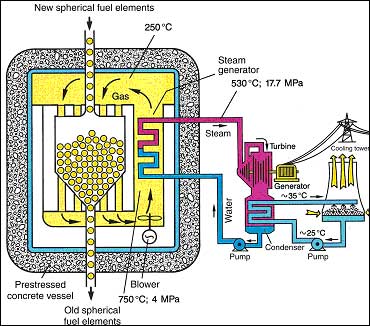
Daniels Idea was embed uranium in small graphite balls or pebbles. The pebbles would be placed inside a chamber, and cooled with helium. The graphite would serve as a moderator, an given the presence of enough uranium inside the balls of moderating graphite, a chain reaction would commence.

After the death of Daniels project in Oak Ridge, the pebble bed idea lay dormant for a few years. then in 1956 a German physicist Rudolf Schulten picked it up and began to develop it. The British were developing gas cooled, graphite moderated reactors the time, and gas cooled reactors offered some attractive advantages over the rapidly emerging American Light Water Reactor. Schulten believed that a pebble bed reactor could be built that would be inexpensive to build and operate, and would be far safer than the American Light Water Reactor. In addition the Pebble Bed Reactor would operate at a far higher temperature, and thus would have greater thermal efficiency than the Light Water Reactor.

The Pebble Bed Reactor looked like a good match to the thorium fuel cycle and there were real concerns in the 1950's and 60's about how long the supply of uranium would last. So the original concept was to make the PBR a thorium breeder. This intention was defeated by the proliferation resistant nature of the PBR's pebbles.

The first German Pebble Bed Reactor, the AVR was conceived to be highly safe. The Pebbles themselves are a major source of PBR defense in depth. Each pebble contains thousands of tiny Uranium dioxide particles. The Uranium dioxide particles are surrounded by multiple layers of material including a carbon inner buffer, followed by an inner layer of pyrolytic carbon, a layer of ceramic silicon carbide, followed by a second outer layer of pyrolytic carbon. Thus each fuel particle contains a five layered defense in depth. In addition the particles were designed to withstand the stress, and high tempreture expected to be encountered in the PBR.

The German Pebble Bed Reactors had one remarkable feature that is repeated in reactor developed from the PBR concept. The pebbles were blown into the reaction chamber by helium gas, and suspended within the reaction chamber by the gas flow. Thus the pebbles had to be designed to withstand the mechanical stress of constantly bumping into each other in the reactor's chamber, as well as the high temperature encountered in the reactor core. The fuel particles were believed to be capable of withstanding the sort possible accident possible with a PBR, hence even without the other PBR fuel safety measures, they offered a high level of inherent safety. The Triso particles were are in turn embedded in graphite pebbles.

The Germens built two pebble bed reactors. The AVR was a successful experimental prototype operated between 11966 and 1988. The THTR-300 was a developmental reactor intended to prepare the way for commercial deployment of PBRs. During its brief operating history between 1983 and 1989 the THTR-300 suffered from the sort of teethings problems common with new technologies. It was by no means a failure, but at the time of the project shutdown there were clearly developmental issues remaining to be addressed. The THTR was originally intended to operate as a thorium fuel cycle reactor, but reprocessing the nuclear fuel proved to be complex and expensive, and the thorium cycle was dropped for a conventional once through Enriched uranium approach. The THTR used no less than 670,000 6cm fuel pebbles. The German Pebble Bed reactor research program was shut down in 1988-89 as a political consequence the Chernobyl accident. At The time of the project shut down, design work was proceeding on the HTR-500, which was intended to be the first commercial PBR.

The PBR was regarded as highly safe. It could be shutdown with cno core cooling without core damage. During AVR testing the reactor was actually brought to shut down with the cooling system turned off. No core damage occurred. This was a remarkable performance. Shutting down a LWR without cooling will lead inevitably to core meltdown due to the heat generated by the radioactive decay of fission products.

The safety features of the PBR include:

- The use of Graphite in the core structure and fuel pebbles.

- The fife layered defense in depth of each fuel particle contained within the fuel pebble

- The SiC coating layer on fuel particles intended to insures the retention of fission products

- Low radiation levels in the environment of the reactor - opperators received only 20% of the radiation experienced by LWR operators

- The use of Helium as a coolant

- Passive removal of decay heat

- Maximum core heating remained below the level that would damage core and fuel structures

- The use of very strong prestressed concrete in the reactor vessel

- The capacity of the outer reactor structure to withstand the impact of an aircraft

The NRC notes:
Because the PBMR is continuously refueled, the excess reactivity can be kept low. Also, the design has a more negative fuel temperature coefficient than LWRs, as the Doppler feedback is greater for the less-thermal neutron spectrum associated with a graphite moderator.* These features reduce the risk of reactivity accidents for most scenarios (but increases the risk for accidents involving core overcooling).

A major component of the PBMR safety basis is a low power density (an order of magnitude below that of an LWR) and large thermal capacity (as a result of the large mass of graphite in the core), together with the high-temperature resistance of the fuel. The maximum power rating of each module (265 MWth) and the high surface-to-volume ratio of the core were chosen so that in the event of a loss of coolant from the primary system, adequate cooling would be provided without the need for forced convection. PBMR designers claim that in the event of a total loss of primary coolant and no operator intervention, the core heatup rate would be slow and the maximum fuel temperature would not exceed 1600 C. Thus the design does not include conventional emergency core cooling systems, which are required for LWRs to provide emergency water sources in the event of a loss-of-coolant accident.
The German PBR project was subsequently regarded as an outstanding success. Not only wree over all project goals meet till the time of shut down but the expectation existed that the technology could be developed into a revolutionary commercial reactor that could be built at a lower cost than conventional light water reactors, yet would operate with at a higher temperature which in turn would lead to greater thermal efficiency. The PBR design has a high level of inherently safe.

Following the shut down the potential of the PBRM was recognized by commercial interests in South Africa, and by the Chinese. Projects to develop PBR technology for electrical generation and process heat have been undertaken in both countries. Both programs expect to build PBRs in factories with serial production beginning by 2020. Between 2020 and 2030 hundreds of PBRs may be built in Chinese and South African factories.

So far I have pointed to the numerous safety advantages of the PBR. However the NRC has questioned the safety adequacy of current PBR designs.
PBMR advocates are so confident in the safety of the reactor (some even call it "meltdown-proof") that they have proposed a drastic weakening of a number of safety requirements that apply to the current generation of U.S. nuclear plants. These proposals include (1) use of a filtered, vented confinement building instead of a robust containment capable of preventing a large release of radioactive materials in the event of severe core damage; (2) a reduction of the size of the emergency planning zone (EPZ) from 16 kilometers to 400 meters; (3) a reduction in the number of staff, including operators and security personnel; and (4) a reduction in the number of systems whose components must meet the most stringent quality assurance standards.

However, there is insufficient technical justification for these measures. The presence of a pressure-resistant, leak-tight containment and the maintenance of comprehensive emergency planning are both prudent "defense-in-depth" measures that could mitigate the impact of a severe accident with core damage. Defense-in-depth is the requirement that nuclear reactors should have multiple, independent barriers in place to prevent injuries to the public and damage to the environment. The presence of multiple barriers is a hedge against uncertainty and an acknowledgement that the understanding of the performance of any one barrier is incomplete.

PBMR promoters claim that a robust containment is unnecessary because the design-basis depressurization accident cannot cause damage to the PBMR fuel severe enough to result in a large radiological release. They argue further that such a containment would actually be detrimental to safety because it would inhibit heat transfer and interfere with the passive mechanism needed to cool the core in the event of a loss-of-coolant accident. However, a containment is needed not only to inhibit the relatively minor releases that would occur during the design-basis accident, but also to mitigate the consequences of a more severe accident. Containments can also help to protect the reactor core from a sabotage attack utilizing truck bombs or hand-held rocket launchers --- an ominous possibility that should not be discounted.
The NRC concerns seem speculative in that it involves the postulation of potential core damage that has not been demonstrated to be possible by simulation. The mention of truck bombs and hand held rocket launchers takes us clearly into the realm of fantasy because the use of such weapons against a PBR can be defeated by relatively low tech security measures already used to harden high risk targets. What sort of major accident did the the NRC have in mind?
Among the largest sources of uncertainty for the PBMR are the potential for and consequences of a graphite fire. The large mass of graphite in the PBMR core must be kept isolated from ingress of air or water. Graphite can oxidize at temperatures above 400 C, and the reaction becomes self-sustaining at 550 C (the maximum operating temperature of the fuel pebbles is 1250 C)[1]. Graphite also reacts when exposed to water vapor. These reactions could lead to generation of carbon monoxide and hydrogen, both highly combustible gases.

If a pipe break were to occur, leading to a depressurization of the primary system, it has been shown that flow stratification through the break can cause air inflow and the potential for graphite ignition[2]. While the PBMR designers claim that the geometry of the primary circuit will inhibit air inflow and hence limit oxidation, this has not yet been conclusively shown.

The consequences of an extensive graphite fire could be severe, undermining the argument that a conventional containment is not needed. Radiological releases from the Chernobyl accident were prolonged as a result of the burning of graphite, which continued long after other fires were extinguished[3]. Even though the temperature of a graphite fire might not be high enough to severely damage the fuel microspheres, the burning graphite itself would be radioactive as a result of neutron activation of impurities and contamination with "tramp" uranium released from defective microspheres. An even worse consequence would be combustion of carbon monoxide, which could damage and disperse the core while at the same time destroying the reactor building, which is not being designed to withstand high pressure. In contrast, the large-volume concrete containments utilized at most pressurized-water reactors can withstand explosive pressures of about 9 atmospheres.
Here we must raise a question since the risk of graphite fire seems greatly exaggerated. General Atomics, which has some experience with the operation of Graphite core and fuel reactors, states,
NUCLEAR-GRADE GRAPHITES ARE NONCOMBUSTIBLE BY CONVENTIONAL STANDARDS"
The General Atomics statement adds:
because graphite is so resistant to oxidation, it has been identified as a fire extinguishing material for highly reactive metals, including zirconium.

The oxidation resistance and heat capacity of graphite serves to mitigate, not exacerbate, the radiological consequences of a hypothetical severe accident that allowed air into the reactor vessel. Similar conclusions were reached after detailed assessments of the Windscale and Chernobyl events; graphite played little or no role in the progression or consequences of the accidents. The "red glow" observed during the Chernobyl accident was the expected color of luminescence for graphite at 700°C and not a large-scale graphite fire, as some have incorrectly assumed.
The NRC has a more realistic concern, howbeeit, one would not lead to a major PBR accident:
First, the fundamental fuel behavior must be sufficiently well understood that a complete set of technical specifications for the fuel can be derived. It appears that this is not yet the case. There are numerous instances in which TRISO microspheres manufactured to identical specifications and irradiated under identical conditions exhibited drastically different fission product release behavior that could not be attributed to observed physical defects like cracking of the SiC layer[6]. This indicates that there are technical factors affecting TRISO performance that have not yet been identified.

Second, when a complete set of technical specifications is finally at hand, the PBMR fuel manufacturing process will have to be reliable enough to ensure that the specifications are met. Because PBMR fuel is credited to a greater degree than LWR fuel for maintaining safety under accident conditions, and is less tolerant than LWR fuel to defects, PBMR fuel will have to be subjected to more stringent quality control. However, even if the requirements were no more stringent for PBMR fuel than for LWR fuel, inspecting the enormous microsphere flow with a high enough sampling rate to ensure an adequately low defect level would be a considerable challenge. The number of TRISO microspheres manufactured annually to support ten PBMR modules (1150 MWe total) would be on the order of ten billion, three orders of magnitude greater than the number of uranium fuel pellets needed to supply an LWR of the same capacity.

Finally, even if the above two criteria are satisfied, there must be assurance that the behavior of the fuel will not be significantly worse than expected if conditions in the core deviate from predictions --- that is, the fuel should "fail gracefully." It is on this count that the current TRISO fuel technology is clearly a loser. While past experiments have shown that the SiC layer of TRISO fuel limits the release of highly hazardous radionuclides like Cs-137 to below 0.01% of inventory up to 1600 C, the retention capability is rapidly lost as the temperature continues to increase. At 1800 C, releases of 10% of the Cs-137 inventory have been observed, which is on the order of the release expected during a LWR core-melt accident[7]. Without a leak-tight containment present, the release into the environment would be comparable to the release from the fuel.

Thus in order to justify the absence of a leak-tight containment, Exelon needs to demonstrate that the PBMR maximum fuel temperature will not exceed 1600 C during the design-basis depressurization accident, and that more severe accidents that could cause higher fuel temperatures are so improbable that they do not need to be considered. However, given the uncertainties discussed in the previous section --- like a discrepancy between calculated and measured maximum temperatures of at least 130 C --- there are serious grounds for skepticism.
There is a strong element of the "not invented here" syndrome in the NRC statement, and the reminder that since the repair of the American nuclear safety establishment was never made good after the havoc that Milton Shaw visited on it.

There are still problems with PBR safety. Rainer Moormann, a German researcher who studied the decontamination of the decommissioned AVR, found an unexpectedly high level or radioisotope contamination in the decommissioned AVR. He attributed the contamination to fuel breakdown at high temperature. While Moormann's findings ought to be taken seriously, radioactive contaminants in a decommissioned experimental reactor built during the 1960's ought not by themselves seen as evidence of a fatal flaw in the reactor design. The AVR used something like 20 separate pebble designs during its over 20 year history. Moormann believes that the problem stemmed from the over heating of fuel pebbles within the reactor. This is most likely a fixable problem, but fixing it requires resources.

Alvin Weinberg who certainly understood the advantage of nuclear safety, viewed the successful design of large scale technological objects like reactors and the product of big science. Nothing can substitute for the large scale deployment of technological resources in seeking technological objectives. Unfortunately the sort of large scale nuclear establishment which the United States possessed in the 1950's and 60's. I would expect the Chinese to deploy the major resources needed to insure Pebble Bed Reactor safety. The Chines need the PBR simply because they need a low cost nuclear technology to replace hundreds of coal burning steam plants. If the politicians do not disrupt it, a safety culture should emerge within the Chinese nuclear community which will provide china and the world with a highly safe PBR. For society, nuclear defense in depth includes a strong nuclear research community that has the curiosity and the resources to investigate nuclear safety concerns ands identify safe materials, designs, and safe production and operation standards without political interference.  

Tuesday, February 26, 2008

The Second Nuclear Age Begins

The initiation of the construction of the first ever Westinghouse AP-1000 reactor in Sanmen City, Zhejiang Province, China today, the curtain was run up on the second nuclear age. Three more AP-1000 are on order in China. TVA has applied for a NRC license to build and operate two AP-1000's and several other prospective operators plan to apply for licenses for over a dozen more AP-1000s this year. In addition to the 4 AP-1000's on order, China has indicated that it intends to make the AP-1000 the center of its plan to develop nuclear powered electrical sources.

Photo taken on Feb. 26, 2008 shows the construction of China's first third-generation nuclear plant and also the world's first AP1000 nuclear plant, the AP1000 Sanmen nuclear plant, in Sanmen, east China's Zhejiang Province. The Sammen Nuclear Power Project kicked off its excavation construction on Tuesday. (Xinhua Photo)

Photo taken on Feb. 26, 2008 shows the excavation kick-off ceremony of the AP1000 Sammen Nuclear Power Project, in Sanmen, east China's Zhejiang Province. The AP1000 Sanmen nuclear plant, China's first third-generation nuclear plant, would also become the world's first AP1000 nuclear plant.(Xinhua Photo)

Construction of the AP-1000 is expected to be take as little as 36 months. Because the NRC licensing of TVA's initial reactors is expected to take 42 months, the construction of America's first AP-1000 is expected to commence in 2012. The first TVA AP-1000, located at TVA’s Bellefonte, Alabama nuclear site s is expected to be completed about 2015, followed by a second reactor being completed in 2o17. In addition TVA expects to complete the construction of another reactor at the Watts Bar, Tennessee nuclear plant in 2012.

The AP-1000 is rated from 1100 to 1250 MWs. AP-1000 generated electricity is expected to costs below 3.5 cents per KWh, and AP-1000s ae expected to opeate for 60 year. TVA is the lead licenses applicant for the AP-1000. The numerous other applications for the construction of AP-1000s in the United States will be based on the approval of the TVA application,

TVA is the only national utilirty to have continued building reactors during the last 2o years. The first Watts Bar reactor, begun in 1972 was completed in 1996. Following the completion of the Watts Bar reactor, TVA undertook to rebuild the Browns Ferry Unit 1 reactor, damaged by a fire in 1975. That reactor was rebuilt beginning in 2002, and emerged as a virtually new unit, in 2007. Both reactors are currently contributing power to the TVA system. In addition, TVA began a program to complete a second Watts Bar reactor in late 2007. Construction of the reactor had begun in the 1970's and had been suspended early in 1985. Construction on the second Watts Bar reactor is expected to be completed in 2012. Because TVA has recent experience with reactor construcion, it was considered a good candidate to lead off the construction of Westinghouse's recently designed AP-1000.

In 2012 when construction of TVA's first AP-1000 begins, Westinghouse anticipates that it will have broungt its first AP-1000 project in China to a sucessful completion, while TVA will have completed the construction of 2 reactors in the five previous years. By 2017 TVA anticipates the completion of its 4th reactor in a decade. By that time no doubt, TVA will have more nuclear projects on the drawing board.

Thursday, December 6, 2007

Westinghouse gets new AP-1000 order from China


From: International Herald Tribune
Westinghouse reactor to power China plant
By Winnie Zhu
Bloomberg News
Wednesday, December 5, 2007

SHANGHAI: China Guodian, one of the five biggest electricity generators in the nation, plans to build a nuclear power station in Fujian, southeastern China, using technology from the Westinghouse Electric unit of Toshiba.

The plant in Zhangzhou city will have "several" reactors with one million-kilowatt capacity each and use the Westinghouse AP1000 technology, according to a statement Tuesday on the State-owned Assets Supervision and Administration Commission's Web site. No financial details were given.

Westinghouse and Areva of France are competing to build as many as 26 reactors by 2020 as China turns to atomic energy to cut pollution and reliance on oil. The nation needs to build two reactors a year to meet a target of generating 4 percent of its power supply from nuclear plants by 2020.

"Westinghouse has its advantages in terms of technology and reactors operation," Yao Wei, an analyst at Guotai Jun'an Securities in Shanghai, said Wednesday. "It has a good relationship with Chinese partners."

Liu Kemou, a director at China Guodian's media department, confirmed the statement, but declined to comment further. Wen Xuting, the company's spokesman, could not be reached.

Toshiba shares closed at ¥883, or $7.99, after rising 2.08 percent in Tokyo. GD Power Development, the Shanghai-listed unit of China Guodian, climbed 4.73 percent, the biggest daily gain since Nov. 6, to close at 15.93 yuan, or $2.15.

Kaori Hiraki, a spokeswoman for Toshiba, could not be reached for comment.

Westinghouse secured a $5.3 billion order from China National Nuclear in July to provide four AP1000 nuclear power reactors in Haiyang, Shandong Province and Sanmen, Zhejiang Province, both in eastern China.

Westinghouse will start building the reactors in eastern China in 2009. The first reactor will begin operation in late 2013 and the remaining three will start up between 2014 and 2015, it said on July 24.

The company expects at least 35 orders within the next decade as the United States and China expand atomic energy, Dan Lipman, the company's senior vice president, said Sept. 19.

Areva in November won an €8 billion, or $12 billion, agreement to build two nuclear reactors for China Guangdong Nuclear Power in Taishan in southern Guangdong Province, the company's chief executive officer, Anne Lauvergeon, said in Beijing on Nov. 26.

Guangdong Nuclear, the second-largest nuclear power producer in the country, will also gain access to 35 percent of production from Areva uranium unit UraMin, Lauvergeon said. The French company will supply nuclear fuel for the two reactors with 1,700 megawatts capacity each until 2026, she said then.

China plans to increase its spending on nuclear power plants by 12.5 percent to 450 billion yuan, or $61 billion, during the 15 years ending in 2020, the National Development and Reform Commission, the top economic planner in the nation, said Nov. 2.

Followers

Blog Archive

Some neat videos

Nuclear Advocacy Webring
Ring Owner: Nuclear is Our Future Site: Nuclear is Our Future
Free Site Ring from Bravenet Free Site Ring from Bravenet Free Site Ring from Bravenet Free Site Ring from Bravenet Free Site Ring from Bravenet
Get Your Free Web Ring
by Bravenet.com
Dr. Joe Bonometti speaking on thorium/LFTR technology at Georgia Tech David LeBlanc on LFTR/MSR technology Robert Hargraves on AIM High