
Showing posts with label Ted Trainer. Show all posts

Sunday, August 14, 2011

The IPCC and Greenpeace: The Implausible Case for 80% Renewables

Renewables advocates including the anti-nuclear fanatics of Greenpeace live in a land of unreality. Brave New Climate has recently published yet another Ted Trainer critique of renewables, this one of Intergovernmental Panel on Climate Change, Working Group 111, Mitigation of Climate Change, Special Report on Renewable Energy Sources and Climate Mitigation. June, 2011. Greeenpeace actually was a major source of the IPCC Renewables report and Trainer wastes no time in demonstrating that the report is an example of the sort of problematic energy planning we have grown to expect from Greenpeace. Trainer states,
The report does not show that renewable sources can meet future energy demand, or a large fraction of it. It is not that its attempt to show this is unsatisfactory; the point is that it does not offer a case; it does not attempt to show what proportion of demand could be met by renewables. It presents much evidence relevant to the issue, but this is not put together into a case which sets out reasoning leading to the conclusion that the necessary quantities could be provided, how they could be provided, and that the difficulties could be overcome. The report merely presents the results of some studies which state conclusions about renewable energy’s potential, without attempting to assess their worth. It is argued below that the main such study, on which the WG3 report relies heavily, is deeply flawed, is of little or no value and does not establish its claims.
Trainer adds,
There is no critical examination of the 164 studies. There is no list of the studies enabling their examination. (There is a list which seems to be of 16 research groups carrying them out.) It is not explained how they were selected; it is said that they were not randomly selected. Were only optimistic studies selected? There is no reference to any of (the few) studies that I am aware of as having been published doubting the capacity of renewable energy to meet demand. (These include Hayden, 2004, Trainer, 2007, 2010a, Moriarty and Honnery, 2010.) A satisfactory review would have presented the details from an IPCC working group reporting on their thorough critical examination of all, or a representative selection of, the reports to determine whether their quantitative conclusions were sound or plausible and whether the difficulties had been dealt with. There is no analysis of this kind. In other words the IPCC has not carried out an evaluation of literature in the field; it has only summarised the conclusions of (a select number of) studies, with no apparent effort to check on their validity.
Trainer argues that the report suffers from numerous glaring flaws, and ignores significant problems for renewable energy schemes,
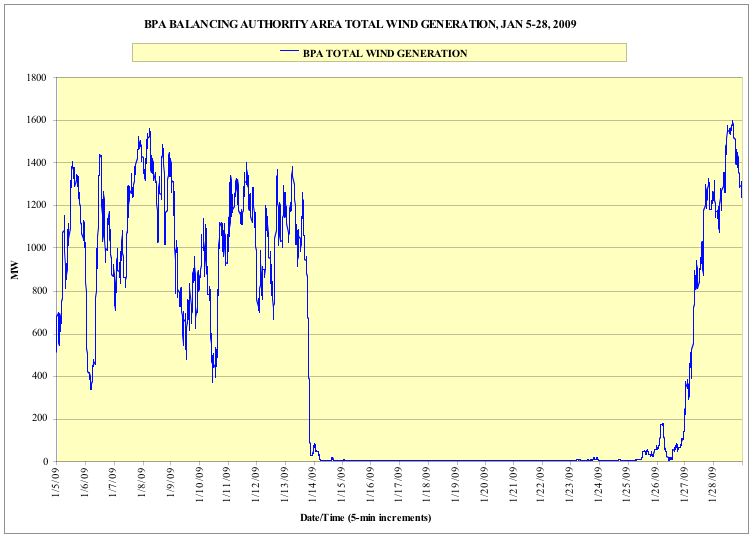
there is a much bigger problem, on which the report does not comment. The greatest challenges set by variability of wind and sun concerns the gaps of several days in a row when there might be no sun or wind energy available across large regions, including continents.
Trainer then documents the extent of the problem, by listing and briefly describing research studies which the IPCC renewables report ignored.
Clearly these lengthy periods of calm are not rare or of minor significance. For several days in a winter month in good wind regions there would have to be almost total reliance on some other source. The considerable capital cost implications of having a back up system capable of substituting for just about all wind capacity . . .

”reliably” in this context means 95% probable and the crucial point concerns what can happen in the remaining 5% of the time, which is 17 days of the year. As the above cases show it is very likely that what can happen is the occurrence of long periods with negligible wind. Thus the probability of a loss of load event might be very low, but if and when it happens the entire wind contribution would have to be made up by some other source, and as Lenzen notes the capital cost of this provision should be accounted to the wind system.
Trainer points out the problem of redundancy with renewables,
Optimistic claims re the potential of renewable energy (e.g., Stern, 2006, The World Wide Fund for Nature, 2010, Zero Carbon Britain, 2007, Greenpeace International and European Renewable Energy Council, 2010), typically fail to recognise the need for large scale redundancy in generating capacity, caused by the fact that often one or more component systems will not be contributing much if anything. For instance, when the availability of solar energy is low, enough wind capacity (or some other source) would have to have been built to make up that deficiency. When there is little wind there would have to be on hand sufficient solar generating capacity to meet the deficit. Thus total system capital cost might be several times what at first seemed to be required.
Trainer points to the problems posed by the non dispatchable nature of Wind and Solar. Both require large scale storage in order to be viable.
Again there is discussion of this issue, reviewing (superficially, some) options, but it does not help much in assessing the possibility of a global renewable energy supply system. Such a system would have to rely heavily on very large scale storage of electricity, which is not possible at present and is not foreseen. The report does not contradict this view. The formidable difficulties are recognised briefly (Chapter 8, p. 41), in a sentence which actually says it is questionable whether solutions will be found. Again the seriousness of the issue is not brought out; if very large scale storage of electricity is not possible (or affordable) then it is difficult to imagine how utopian renewable energy scenarios could be achieved. . . .

Solar thermal systems are planned to have 17 hr storage. If a solar thermal power station was to b e cap able of maintaining supply through four cloudy days it would need 96 hour storage. The IEA says the cost of present solar thermal storage capacity, usually c. 6-7 hours, makes up about 9% of plant cost, so a 96 hr storage capacity would add more than the cost of another 1/5 solar thermal power stations.

However the key question here is whether solar thermal heat storage capacity could enable an entire electricity supply system to continue delivering through a four day period of no wind or sun. If wind, PV and solar thermal were each delivering one-third of supply then the storage task for solar thermal would have to correspond to 3×96 hours, multiplied again by the additional capacity to deal with peak demand. In addition solar thermal power blocks would have to be three times normal size, adding to capital costs.
This should be quite enough to demonstrate that Ted Trainer's reasoning about renewable energy runs on the same track mine does. The BNC discussion of Dr. Trainer's essay is also worth reading. John Morgan pointed to a discussion of Greenpeace propagandist Sven Teske role in selecting the studies that survey as background for the critical chapter 10 of the IPCC report. Among the studies which Teske picked out for special attention was his own Energy [R]evolution. The IPCC has more than its share of enemies, including the fanatic climate science denier, Steve McIntyre who quickly picked up on the IPCC-Greenpeace connection. McIntyre has decent research skills and quickly uncovered connections between the IPCC, Greenpeace and the Renewable Energy Industry.

Left-wing, pro-nuclear environmentalist, Mark Lynas clearly saw the implications of McIntyre's attack. The press release issued by the IPCC along with the Renewbles report stated,
Close to 80 percent of the world‘s energy supply could be met by renewables by mid-century if backed by the right enabling public policies a new report shows.
Thus, the most extreme Greenpeace claims about the future effectiveness of renewables are advanced by by global headlines in stories about the IPCC report. The message that the public an policy makers are most likely to receive is that the IPCC, an august scientific organization, believes that government policies should be designed to produce 80% renewable energy by 2050, and that goal is both realistic and feasible, and is recommended by the IPCC. The implications of this impression for the OPCC are terrible. Left uncorrected they can destroy the IPCC's credibility.

Mark Lynas commented,
I don’t know about Steve McIntyre, but speaking for myself I would have been delighted had the IPCC’s Working Group 3 been able to offer a credible assessment of the potential for scaling up renewable energy – as opposed to, or in combination with, other mitigation options like nuclear, fossil fuels with CCS and so on. That Greenpeace’s “revolutionary vision” ended up headlining the whole thing is a tragedy, because – in a PR disaster any half-brained PR flack should have spotted a mile off – they have undermined the very cause they sought to promote.
Lynas is hardly an enemy of renewables and indeed goes on to state.
Personally I think that 80% of the world’s energy probably could be met by renewables by mid-century – but the IPCC’s renewables report singularly fails to demonstrate that.
Lynas is, of course, far to kind to renewables, as Dr. Trainer demonstrates.

In fact Dr. Trainer has asked important and valid questions about a high penetrations renewables dominated electrical systems. Those questions need to be answered before the credibility of a renewables dominated electrical system can be regarded as established. The IPCC to its discredit, allowed wholly implausible claims about future renewables effectiveness to be advanced in its name.

Thursday, September 10, 2009

Barry Brook and Company Destroy the Case for Renewables


When I first got interested in energy related issues I encountered what amounted to the "Green" party line. That was that Renewables would soon be so cheap, and our energy use would be so efficient that electricity would be virtually given away. I began however, to find reliable sources of information. Sometimes that reliable source was a press release for a "renewables" project, a wind farm or solar array. Reliable information could include the cost of the project, although this almost never included transmission lines. The press release often included the rated output of the project. If it was a solar project, the press release might refer to the area the project covered. The press release got really interesting when it talked about the projects cost. I should say estimated cost, because I suspect that some of those projects I read about ended up costing more than the reported cost in the press release.

I began to analyze this information. I was interested in the answer to the question, how much would it cost to replace CO2 emitting fossil fuel in electrical generation with a post-carbon energy source. That is where I ran into the reliability problem. You cannot replace coal powered electrical plants with wind generated electricity if the coal mainly produces electricity in the day time, and the wind blows at night. It was explained to me by some renewable advocates that the day time coal could be replaced by solar generated electricity, while night time power would be supplied by wind. This sounded good, but that meant that you had to pay for at least two generation facilities in order to be assured round the clock energy production. That got to be a little expensive, but then I discovered that even with solar and wind generation facilities you might not always have electricity when you wanted or need it. So you needed electricity from other sources.

Surprisingly renewables advocates told me that those other sources would burn fossil fuels. But that did not satisfy me, because the point of my exercise was to discover how much it would cost to replace fossil fuels., not how much burning fossil fuels would cost as a crutch for the limitations of renewables.

Some renewabes advocates told me that energy from renewables could be put into storage, and drawn out when there was demand for electricity. How much would that cost, I wondered. So I checked on the cost of various storage plans, pumped storage, Large batteries and compressed air. it turned out that there were inefficiencies and sources of energy lost coupled with all of these, ad none of them came cheep. When I started calculating the cost, an interesting pattern emerged. In every case, renewables plus storage was more expensive than the highest estimated nuclear cost. Even when I made assumptions that were favorable to renewables, for example assuming that the cost of nuclear power would be subject to inflation, while the cost of renewables would not be, the cost always turned out to be higher for renewabes. When I assumed a level playing field, the cost of reliable renewables would strikingly higher than nuclear, so much so that no one in his or her right mind would support renewables.

Someone suggested to me that I look at Mark Z, Jacobson's base wind scheme. I read Jacobson's papers and realized that his promised base load output, was about 20% of the name tage output of his wind facilities. Thus in order to produce a promised base load capacity of 1 GW 80% of the time, wind producers would have to put up 5 GWs of wind generation capacity. But 5 GWs of wind capacity was more expensive than a 1 GW nuclear power plant. Once more a favored renewables scheme proved more expensive than nuclear. The problem was much worse than this, however. None of the renewables schemes was as reliable as nuclear was. Jacobson's base load wind delivered 79% of the time, while the average nuke delivered 92% of the time. What is more, at least part of the nukes down time would be for maintenance, and could be scheduled in advance. The Nuke clearly offered superior flexibility over renewables, the nuk would almost always deliver electricity on demand.

I recently discovered that Australian Climate Scientist Barry Brook was posting information on his blog Brave New Climate that resembled my studies and which came to similar conclusions. These studies, many of which were preformed in part or completely by people who had far more expertise than i have came to the same conclusions that I came too.

i regard Barry as a major figure in the carbon mitigation debate. Perhaps there is a little vanity in this assessment, In many respects Barry's thinking is similar to mine, however, we party company in one significant respect. Our views on preferred nuclear technology differ, and the clash has at times been rancorous. I will deal with the issues on another occasion. At present I want to focus on Barry's month long attack on renewables. On August 8, Barry posted on brave New Climate a discussion of a paper by Peter Lang. Barry describes Peter:
(Peter is a retired geologist and engineer with 40 years experience on a wide range of energy projects throughout the world, including managing energy R&D and providing policy advice for government and opposition. His experience includes: coal, oil, gas, hydro, geothermal, nuclear power plants, nuclear waste disposal, and a wide range of energy end use management projects)
The post was titled "Does wind power reduce carbon emissions?" The Lang paper offered the following statement:
A single 1000 MW nuclear plant (normally we would have four to eight reactors together in a single power station) would avoid 6.9 million tonnes of CO2 equivalent per year. Five hundred 2 MW wind turbines (total 1000 MW) would avoid 0.15 to 1.3 million tonnes per year – just 2 to 20% as much as the same amount of nuclear capacity. When we take into account that we could have up to 80% of our electricity supplied by nuclear (as France has), but only a few percent can be supplied by wind, we can see that nuclear can make a major contribution to cutting greenhouse emissions, but wind a negligible contribution and at much higher cost.
The discussion which followed contained over 150 comments. This post was followed by an august 13 post titled, Wind and carbon emissions – Peter Lang responds. Lang's second essay offered the following statement: I would argue that average capacity factor is not valid for determining the amount of back-
up generation capacity required. The total generation system must be able to provide peak power when there is no output from the wind turbines. When wind power is zero, or near zero, at the time of peak demand, we need sufficient conventional generator capacity to provide the peak demand. This is because electricity demand must be matched by supply at all times. In other words, wind power cannot displace much, if any, conventional generator capacity.
If wind doesn't reduce CO2 as much as nuclear does and cannot be counted on in periods of peak electrical demand, what good is it? One hundred eighty four comments followed.

This was followed by an August 16 Lang based post, Solar power realities – supply-demand, storage and costs. This time a Lang paper goes after solar power.

This paper provides a simple analysis of the capital cost of solar power and energy storage sufficient to meet the demand of Australia’s National Electricity Market. It also considers some of the environmental effects. It puts the figures in perspective. By looking at the limit position, the paper highlights the very high costs imposed by mandating and subsidising solar power. The minimum power output, not the peak or average, is the main factor governing solar power’s economic viability. The capital cost would be 25 times more than nuclear power. The least-cost solar option would require 400 times more land area and emit 20 times more CO2 than nuclear power.

Conclusions: solar power is uneconomic. Government mandates and subsidies hide the true cost of renewable energy but these additional costs must be carried by others.

Four hundred thirty six comments followed this post. The Lang paper on solar power was followed by an August 31 post,Solar thermal questions, this time based on a paper by University of NSW academic, Ted Trainer. The Trainer essay is an all out, no holds barred, take no prisoners assault on solar, and what sort of intellectual respectability is left to solar advocates after their thrashing at Trainer's hands is open to question. Trainer writes:

The heat storage capacity of solar thermal systems overcomes some of the intermittency problems that trouble wind and PV systems, such as the occurrence of night time. The standard provision will be 12 hour storage enabling continuous 24 hour electricity delivery. However examination of climate data reveals that even at the best sites sequences of 4 or more days without sunshine are not unusual. The best US sites often have 2 runs of 4 consecutive days of cloud in a winter month. (Davenport, 2008)

If 1000 MW(e) output was to be provided for four cloudy day from stored heat, some 290,000MWh of heat would have to be stored. Storage cost has been estimated at $(A)10/kWh(th) meaning that the required storage plant would cost more than $8 billion, or around twice the cost of a coal-fired plant plus fuel. However this refers to trough technology and it is likely that for the ammonia process costs would be higher.

Again we would be faced with the prospect of very high capital costs for a large amount of plant that would not be used most of the time, and would still be insufficient occasionally. There would also be the question of whether there would be enough solar radiation in winter to meet daily demand and also recharge a large storage sufficiently to cope with the next run off 4 cloudy days.

The Trainer essay and Barry's discussion drew 98 more comments. Finally on the 10th Barry followed up Lang's first solar essay, with Solar realities and transmission costs – addendum.
Basically Lang compares the cost of providing reliable power for Australia with Nuclear and solar power. Trainer had observed,
examination of climate data reveals that even at the best sites sequences of 4 or more days without sunshine are not unusual. The best US sites often have 2 runs of 4 consecutive days of cloud in a winter month. (Davenport, 2008).
Lang noted,
A loop through the midday images for each day of June, July and August 2009, shows that much of south east South Australia, Victoria, NSW and southern Queensland were cloud covered on June 1, 2, 21 and 25 to 28. July 3 to 6, 10, 11, 14. 16, 22 to 31 also had widespread cloud cover (26th was the worst), as did August 4, 9, 10, 21, 22.. This was not a a rigorous study.
Thus Lang was thus responding to this data by asking how much would it cost to provide electricity during cloudy winter days in Australia..

It is assumed that South East Australia would need a power reserve capable of providing electricity during the cloudy winter days. That reserve can be either provided by nuclear power plants or by solar systems with three days energy storage, that is capable of being transformed into electricity. Lang's conclusions can be summarized with the following table:
Discussion of the latest Lang post continues, but it is clear that Lang, Trainer and Brook have destroyed the case for renewables beyond redemption.

Followers

Blog Archive

Some neat videos

Nuclear Advocacy Webring
Ring Owner: Nuclear is Our Future Site: Nuclear is Our Future
Free Site Ring from Bravenet Free Site Ring from Bravenet Free Site Ring from Bravenet Free Site Ring from Bravenet Free Site Ring from Bravenet
Get Your Free Web Ring
by Bravenet.com
Dr. Joe Bonometti speaking on thorium/LFTR technology at Georgia Tech David LeBlanc on LFTR/MSR technology Robert Hargraves on AIM High