Wednesday, December 30, 2009

The EIA Foresees Failure in Fight Against Climate Change

Mathematician Mary Hutzler, is an important voice in energy forecasting. Before she left the Energy Information Agency in 2004, Mary had served as both the acting administrator and deputy administrator of the agency. She was also the director of the EIA’s Office of Integrated Analysis and Forecasting. After 25 years with the agency, Mary in 2004 moved to the Bureau of Transportation Statistics (BTSas where she served as the Associate Director of Statistical Programs). While at the BTS Mary served for 6 months as its Acting Director. During Mary's career at the EIA, she planned, directed, and managed all mid- and long-term analysis and forecasting at EIA, as well as the production of EIA’s annual forecasting publications. Hutzler oversaw development of the National Energy Modeling System, for which she received a Presidential Rank Award in 1999. Thus Mary Hutzler was for many years one of the top, if not the top energy analyst for the United States government.

Mary is thus uniquely qualified to analyze, and report EIA data. She gas just posted her analysis of the latest EIA 2035 energy forecast. Mary's conclusions are extremely sobering. We are loosing the war against AGW. Mary reports that the EIA's 2010 assessment indicates American carbon dioxide emissions will grow over the next 25 years. Hutzler states,
The agency expects liquid fuels and other petroleum demand to be up almost 10 percent by 2035, natural gas demand up by almost 7 percent, and coal demand up by 12 percent, all from 2008 levels.
She notes
Even with large gains in renewable capacity, fossil fuels will still dominate our energy landscape by 2035 to fuel the country’s economic growth expected to increase at 2.4 percent per year. Energy consumption is expected to increase by 14 percent by 2035 with large percentage increases in renewable fuels, but far larger absolute quantity increases in fossil fuels, making them the dominate source of energy for the foreseeable future. Carbon dioxide emissions will therefore continue to grow and EIA expects that growth to average 0.3 percent per year. However, due to structural changes in our economy and to efficiency improvements, carbon intensity (carbon dioxide emissions per unit of gross domestic product) will continue to decline. EIA expects that decline to be 2.1 percent per year. Carbon dioxide emissions per capita also decline by 0.6 percent per year.
But does the EIA ignore the growth of renewables?
EIA is forecasting an . . . 81 percent for all forms of renewable energy (hydropower, biomass, wind, solar, and geothermal). Hydropower is expected to be 22 percent higher due to improved water conditions and some minor capacity additions, biomass 88 percent higher, and wind, solar, and geothermal combined 187 percent higher. . . .

The largest increase in renewable generating capacity is expected from wind power (46 gigawatts), followed by biomass (29 gigawatts), and solar power (13 gigawatts). Except for wind power, most of the renewable penetration is not in the central station generating sector, but at industrial sites (for biomass) and on residential and commercial rooftops (for solar). Because, of the lower capacity factors for wind and solar power, the increase in renewable generation comes mainly from biomass, which supplies almost half of the increase in renewable generation. Wind power supplies 32 percent of that increase, followed by hydropower (10 percent) and solar (4 percent).
For those of us who view biomass conversion to energy as a step back for soil conservationl, this forecast is extremely discouraging.

The EIA also foresees very little progress for Nuclear power.
EIA is forecasting an increase of 11 percent for nuclear energy,
The reason for EIA pessimism is clear, the German renewable model has not only failed, but failed dismally. A recent report from the Rheinisch-Westfälisches Institut für Wirtschaftsforschung titled "Economic impacts from the promotion of renewable energie" sets out the German renewables failure with brutal honesty.
* on-shore wind, widely regarded as a mature technology, requires feed-in tariffs that exceed the per-kWh cost of conventional electricity by up to 300% to remain competitive.
* (despite) having the second-largest installed wind capacity in the world, . . . the estimated share of wind power in Germany’s electricity production was 6.3%
* We estimate that the wind power subsidies may total 20.5 Bn € (US $28.1 Bn).
Solar PV performance was even worse. Solar PV had
* a feed-in tariff of 43 Euro-Cents (59 Cents US $) per kWh in 2009,
The total German solar subsidy including a feed in tariff between 2000 and 2009 cost an estimated
53.3 Bn € (US $73.2 Bn)
The feed in tariff alone cost German consumers
* 43 Euro-Cents (59 Cents US $) per kWh in 2009,
For this huge price the German renewable policy has lead to
* 6.3% of German electricity being generated by wind
*0.6% of German electricity being generated by solar PV.
In contrast German nuclear power plants, which the German Greens and Socialists were intent on shutting down, produce 28% of all German electricity. Thus without any recent investments, no subsidies, and despite political opposition German nuclear power produces 80% of German carbon free electricity. Urick Fahl of the University of Stuttgart estimates that it cost 7€ to eliminate a ton of CO2 with a European Pressurized Water Reactor. (For any who wonder the cost of eliminating a ton of CO2 with a LFTR could run as low as $1 per ton.) In contrast it costs between 611 and 716 € (US $1,050) per tonto eliminate CO2 with photovoltaics. The cost of carbon abatement with wind runs between 91 € and 54 € per ton, that is between 8 and 12 times the cost of carbon abatement with nuclear. Clearly further investments in renewables, coupled with a failure to set reasonable goals is the route to national suicide.

Daily Kos blogger "nnider" recently chose to leave Daily Kos because his use of the word stupid to describe critics of nuclear power was censored. But what can we say of people who favor mans of fighting AGW that are 100 to 1000 times less effective than nuclear power?

It is clear then that a lack of commitment to nuclear power, and especially a lack of commitment to the development of advanced forms of nuclear technology, will lead the world straight into disaster, and that the people who will be responsible for the disaster will be the greens who fight against nuclear power tooth and nail.

Tuesday, December 29, 2009

Short Trip, EV Transportation

In a recent post, Brian Wang discussed the use of light electrical vehicles in China, and recent light EV technology developments. The unwritten mission statement of Nuclear Green foresees the electrification of society as a consequence of the adoption of a large scale nuclear technology in a post carbon age. The use of electrically powered surface transportation would be a major component of this technology.

In the near future electrical powered light vehicles such as bicycles would be more practical for short trips, than electrical powered autos. In a world of increasing gasoline prices, electrical bikes represent a lower cost transportation option for every day errands. Many of my personal errands involve round trips of less than 5 miles, and it is absurd to use a 3000 pound, automobile to make such a trip. Yet time savings, comfort and convenience point to the use of a car. Alvin Weinberg, in his debate with Amory Lovins, pointed out that freedom to control personal time is an important motive for energy use. Energy is used in order to save time. Personal comfort is another consideration. Trips that would be uncomfortable to make if walking, are much more comfortable to make in an auto. No one would walk a substantial distance in the heat of a Dallas summer afternoon, if he or she had an air condition car as an alternative. Walking in rain can be uncomfortable, while walking in a thunderstorm can be down right dangerous. Cold weather can also pose comfort issues. Beyond the comfort issue, walking may impose an inconvenience. For example, a trip to the grocery store may be difficult to manage on foot, if one purchases several bags of groceries.

Light electrical vehicles, such as electric bikes and scooters, represent a step up both in terms of time savings, comfort and convenience. Light electrical vehicles are by no means entirely satisfactory even for all small trips. An electric bike or scooter is still going to be comfortable in the rain, and will carry only a limited weight in addition to a rider. Also people with balance problems would probably avoid electric bikes and scooters. There are three wheeler electrical bikes imported from China, but when I looked at them, they appeared heavy and awkward. I am not sure that an older person would want to ride one on a regular basis. The advantages of electrical bicycles is that they are cheap and trip costs with them would be very low. Electrical scooters though faster than electrical bikes, are more expensive and pose like electrical bikes some comfort, safety and convenience issues.

Short trip EVs should be cheap. The GEM, while cheaper than conventional autos, is ten times more expensive than an electrical bike. Well it is cute, and you can get one with a mini truck bed, and you can carry all the groceries you would wish to with that, but in its current iteration the GEM, with a top speed of 25 MPH, may not be street legal on many of the urban streets I would wish to drive it on. The GEM has an adequate thirty mile range between recharges, and it uses conventional, low cost acid lead batteries.In addition to its low speed, the GEM would present safety issues. Imagine a collision between a GEM and a Hummer. The GEM would be sent flying like a bowling ball. Despite its small size the underpowered GEM would not be nimble in traffic, and its diminutive size and light weight, do not suggest structural safety. Before you run out to buy a GEM, you need to make sure that it can be legally put to the use you intended for it.

The GEM could be designed to be safer, and to have more power. A 30 horsepower electric motor, would offer adequate speed. Magnets made with rare earth alloys would improve motor performance, but future low cost rare earth supplies must be assured. Before it could be adopted for street use, a vehicle like the GEM would have to be made safer. Race car technology could be adopted to rider protection, but of course race cars are expensive, and their safety technology would require modification to lower costs.

Thus the real question for the future street legal GEM would have to do with its price. If a car like this can be made legal and safe, would it still be cheap enough to attract buyers who are looking for low cost errand transportation?

Monday, December 28, 2009

Updating ORNL MSR Design and Cost Studies

In order to understand the importance of the LFTR, we must return to the original research reports and other working documents prepared at Oak Ridge National Laboratory between 1950 when ORNL research on the Molten Salt Reactor concept began at ORNL and 1980 when ORNL scientists who had MSR expertize, wrote their last proposal. ORNL researchers in the 1960's and 1970's argued that MSR development would not cost a lot and commercial MSR was cost competitive with then current LWE designs. Since the 1970's some of the development problems for the MSR have been independently solved. Much of the most challenging MSR technology is also used in other high temperature reactors, and in fusion reactors. So ongoing research and development on these technologies has contributed to the development of the technology proposed for the MSR. At the same time proposed design of the Thorium Breeding Molten Salt Reactor (the LFTR), has increasingly diverged from current Light Water Reactor (LWR) designs. Canadian physicist David LeBlanc has proposed a radically simplified of the already simple MSR/LFTR core design. LeBlanc's redesigned core could be assembled in less than a day, in a LFTR factory. LeBlanc also suggests the use of
less expensive iron alloys including the common stainless steels 304 and 316 [which] have also shown promise at somewhat lower operating temperatures.
The use of multiple cost saving strategies also holds promise for lower LFTR costs. These would include the factory construction of small LFTRs, which would be transported by truck, rail or barge to the power plant location, the recycling of old coal fired electrical generation facilities as LFTR locations. The use of underground housing, rather than massive containment structures. The manufacture of large numbers of reactors on a factory assembly line will increase the speed of progression on the manufacturing learning curve, leading to even lower prices.

During the last 40 years the cost of light water reactors has risen dramatically. Rigorous NRC certification standards have dramatically increased the cost of parts design. Nuclear critics point to $50,000 being spent to design as $5 nuclear part. Mass production means that each part can be used on hundreds and even thousands of reactors, lowering nuclear costs. Recent developments in LWR design point to reactor simplification as an important step for lowering nuclear costs. There is little doubt that adopting LFTR would dramatically simplify nuclear designs.

In the absence of a serious design effort by a contemporary nuclear design team, it is difficult to estimate exactly how much LFTRs would cost. ORNL MSBR design studies, although old, do hold clues to nuclear costs. ORNL-TM-1851 (SUMMARY OF THE OBJECTIVES, THE DESIGN, AND A PROGRAM OF DEVELOPMENT OF MOLTEN-SALT BREEDER REACTORS) is a good starting point for looking at LFTR cost estimates. TM-1851 estimated that a LFTR type MSBR could be developed in 8 years at a cost of 125,000,000 1967 dollars.

This estimate was made before ORNL researchers had their three experience of with the Molten Salt Reactor Experiment (MSRE). The MSRE pointed to some real but hardly insurmountable technological problems to be overcome before a LFTR type MSBR could be commercially viable. Thus later ORNL design studies, and R & D plans were more realistic about development costs and time frames.

The early ORNL MSBR designs were fairly complex. TN-1851 developed its cost estimates from analogies to the costs of the light water reactors of the time. But in fact later developments in both technologies diverged.

Recent thinking about LFTR design has moved on the 1960's and 1970's designs, and more recent actually point to lower, and potentially much lower LFTR costs, than could be obtained by simply replicating old ORNL designs. Thus it is quite possible that old ORNL estimates for MSBR costs, when adjusted for inflation could be actually higher than future LFTR costs. TM-1851 estimated that power could be generated by MSBRs for as little as 2.6 mills per kWh, of about 1.7 cents per kWh, inflation adjusted 2009 costs. This would be most encouraging, if we could rely on this figure.

In another post, I pointed to yet other ORNL studies which also point to similar conclusions about LFTE costs. Finally I point in the same post to the development and manufacturing costs for the Airbus 380 aircraft. Airbus invested €11 billion plus that in the development of the A380. At a cost of $327 million the A380 would be if anything more complex and more expensive than the modular LFTR. Thus we have a reasonable hope that LFTR costs would come in at under $2 per watt of generation capacity, and $1 per watt or even less is not beyond the realm of possibility. We need more research to get a better understanding of LFTR cost estimate, but my preliminary studies suggest that the LFTR could represent a dramatic breakthrough in lowering the cost of post carbon energy.

Sunday, December 27, 2009

The Renewable Plan A and the Nuclear Plan B

My anonymous pro-renewables commentator advocated nuclear power as the Plan B for renewables advocates. His argument is in effect that renewable advocates, are betting the farm on low cost renewable generated electricity, unless they have a back up plan. While he and I do not agree about the extent of the risk involved in the renewable gamble, we agree that there is a risk, and the belief that renewables can be both low priced and reliable, and that they can be deployed fast enough to control global carbon emissions by 2050. There are plenty of reasons for skepticism about this belief. So much so that we must ask our energy advocating friends, if they are really interested in a rational approach to energy, or if they wish to resolve energy issues through faith. My view is that faith might get you to heaven, but on Earth it will not provide you with warmth and light on a cold but windless winter night in East Tennessee.

Renewables advocates, like David Roberts of Grist, when challenged with the uncertainties of renewables, have respond with the following dodges:
1. We will get electricity from non-renewable backups on the Grid.
This means of course that we are still going to be burning quite a lot of fossil fuels to keep electricity flowing through what is suppose to be a post carbon grid.

2. We will build pump storage facilities to back up wind generation. Pump storage facilities are expensive, locations are difficult to find in high wind areas, and pump storage may fail with catastrophic consequences.

3. We can use compressed air energy storage with both wind and solar generators. CAES is very inefficient, and current CAES systems require the burning of natural gas. Thus CAES is both expensive and not exactly carbon neutral.

4. We can back up with batteries. But battery backup is expensive,and it would take a huge amount of battery - or for that matter CAES or pump storage back up to tide us over during a worst case renewables scenario. A worst case reneweables scenario for wind be a series of several windless days over much of the United States. The worst case scenario for solar might involve huge multiday dust storms in the Southwest, or the sort of winter storms such as those currently (December 26, 2009) sweeping the American mid-section.

5. We can build lots of windmills over a large area, enough to to compensate for localized wind patterns. But a huge number of redundant windmills will be very expensive and we would end up with a huge and hugely expensive grid expansion to move electricity from the innumerable wind farms required to make wind reliable to the electricity hungry consumers.

6. We could build redundant solar capacity over a wide area. But a huge number of redundant solar facilities will also be very expensive and we would end up with a huge and hugely expensive grid expansion to move electricity from the innumerable solar required to make solar reliable to the electricity hungry consumers. Plus the sun still does not shine at night.

7. Solar thermal advocates will counter that solar energy can be used to heat liquid salt, and that the heat can then be drawn on at night to provide generate electricity. But to provide enough heat to provide round the clock electricity on long winter nights, solar thermal gathering fields need to be tripled or quadrupled. This redundancy will make round round the clock solar thermal power extremely expensive.

8. Renewable advocates point to geothermal power. But natural geothermal resources are limited to a relatively few areas, and the "hot rocks" approach poses an earth quake risk. Furthermore, the "hot rocks" do not qualify under many definitions of sustainable energy, as a sustainable resource.

There is ample reason then to question the possibility of deriving low cost, reliable electricity from renewable sources on the massive scale required by 21st century society. Many renewable advocates argue that energy efficiency, by itself, will so lower energy and electrical demand, that efficiency can will lower electrical consumption demands. But efficiency does not replace carbon based generation capacity, with electricity generated by post-carbon sources. Nor does efficiency compensated for the unreliability of renewable generated electricity. In addition nothing would prevent reaping the advantages of efficiency along side a non-renewable nuclear approach to electricity generation.

Many renewable advocates claim that a smart grid will compensate for the instability of a renewables based grid. But a smart grid cannot solve the problems based on long term wide scale generation outages that are possible with renewable sourced electricity. Smart grids, by themselves are not electrical generators. In addition smart grid management systems are vulnerable to sabotage by hackers. Sabotaging an enemies smart grid, may replace the guided rocket delivered nuclear bomb, as the new ultimate weapon.

Thus renewable generation plans carry with them a high degree of uncertainty. But nuclear power offers the possibility of generating large amounts of low cost, electricity, and given a modest investment would be sustainable for billions of years. Many but by no means all renewable advocates will object to to the Nuclear Plan B on a number of ground.
1. Nuclear energy is too dangerous. Reactors can blow up like bombs and kill millions of people. Reactors cannot blow up like bombs, old reactors have been modified to improve their safety, and current reactor designs are much safer than the modified older designs. Even safer reactors are possible, if we are not satisfied with the safety of current reactor designs.

2. Nuclear reactors create a huge amount of deadly, highly radioactive waste, that will pose radiations hazards to anyone who gets within a hundred miles of it for the next billion years. Nuclear reactors can be designed that will use what is now considered nuclear waste as fuel. The more efficient use of nuclear fuel will solve most of the nuclear waste problem. What is now considered nuclear waste is in fact a potential source of many valuable raw materials, used by modern society. Thus far from being waste, nuclear power holds the potential to become an important source of many increasing scarce materials needed to sustain society.

3. Nuclear power will inevitably lead to a nuclear arms race, and inevitably lead to nuclear exchanges between nuclear powered countries. Terrorist groups will gain control of power reactors and will inevitably use them to build nuclear weapons. But most reactors will be going to nations which already posses the human and technological resources to build nuclear weapons, and the current design of power reactors makes electrical generation incompatible with the production of weapons grade plutonium. The redactor grade plutonium, produced by power reactors, is very radioactive and will not produce large explosion. Although all nuclear armed nations have easy access to large amounts of reactor grade plutonium, they have chosen to not build nuclear weapons with it.

Reactor grade plutonium typically explodes with far less force than weapons grade plutonium, and terrorist groups can accomplish the same effect with conventional explosive with can be obtained with far less effort, at far lower prices, and which would be far easier to manage. Small nations wishing to obtain nuclear weapons can obtain the plans for a low cost, easy to construct weapons grade plutonium production reactor from North Korea, which already attempted to sell one to Syria.

A low or inadequate energy future might well lead to conditions that might well spark a war. In a still nuclear armed world, energy resource wars might well lead to nuclear exchanges. Thus, ironically, one of the risks of a failed renewables future would be the greater likelihood of a nuclear exchange of between energy starved countries fighting over energy resources.


4, Nuclear critics claim that reactors are too expensive, and take too long to deploy. But the projected costs of reliable renewable electrical systems are far higher than the cost of a nuclear dominated system. Nuclear advocates point to numerous steps that can be taken to lower nuclear costs. Building small reactors in factories, and shipping them to be assembled like legos, at reactor sites is one. Recycling old coal fired power plants as reactor sites is a second. Housing reactors underground would remove the necessity of building massive and expensive concrete and steal containment buildings. Small reactors can also be air cooled. Small reactors can be just as safe as large reactors, but would be seen by lenders to be far less risky this would lower construction finance cost. Smaller factory manufactured reactor will take much time to build, and the time between inception of a project and its completion can be greatly decreased.
5. Nuclear critics claim that we are running out of uranium, and thus scarcity of resources will be make long term use of nuclear power impractical. But Generation IV nuclear technology can assure a high energy future for all the people on earth, for as period stretching out for millions of years. If thorium is included in the nuclear fuel mix, the human population of Earth will be assured adequate energy until solar evolution makes the Earth uninhabitable.
6. Nuclear critics claim that it would be too expensive to develop Generation IV, nuclear technology, and that it would take to long to develop it. In fact it would cost far less to develop Generation IV technologies, than the $73 Billion that the German government has already spent on a failed attempt to produce a viable solar alternative to coal, The Manhattan project demonstrated that by abandoning a business as usual approach, and giving priority to energy developments, what would take more than a generation to achieve could be done in as little as three and a half years. Compared to the effort required by the Manhattan Project, and the resources it required, the effort and resources required to produce viable and mass producible Generation IV power reactors would be small. But the potential would be enormous. Reactors like the LFTR would be simple to manufacture in factories. Large numbers of LFTRs could be produced and set up on appropriate sites quickly. In addition LFTRs could be used as an industrial heat source and can produce heat for co generation. Rejected heat from LFTRs could be used for desalinization, or for district heat or even air conditioning. LFTRs, like all Molten Salt Reactors can be designed to achieve high levels of safety at low costs. LFTRs can be used to dispose of the nuclear waste from conventional reactors, thus offering a no cost solution to the so called problem of nuclear waste. Thus for a relatively small research project and development cost, a technological that could solve all of the major problems of nuclear power could be made available, and potentially most of the energy needs of human society can be served by a long term sustainable, low cost, low waste, or no waste, nuclear technology.

The biggest problem with Plan B is that it looks a lot better than Plan A. The Plan B risks are lower. Plan B is likely to cost much less, and Plan B is very scalable. The real question is "why isn't Plan B, our Plan A?"

Post Note: This post summarizes arguments developed over the last two and a half years after an argument on the relative merits of renewable and nuclear power generation systems with David Roberts on Grist. Roberts, a follower of Amory Lovins, exaggerated the liabilities of nuclear power, which he claimed could never be solved. On the other hand, Roberts insisted with 100% certainty that all of the problems of renewables could and would be solved, and that renewables could be melded into a low cost reliable generation system, with sufficient flexibility to provide all of societies post carbon energy needs. At the same time Roberts argued that any any defficiency of renewables could be made up by resorting to the burning of carbon based fuels, appearantly without climate consequences. People like Roberts are beyond rational persuasion, but the issues that emerge in debate with them can be resolved to the satisfaction of more rational people. I have not supplied links to the numerous arguments that lie behind this post, but those arguments are available on Nuclear Green and Energy from Thorium to those who have a seriou interest.

Saturday, December 26, 2009

Alvin Weinberg Explains the Molten Salt Breeder

Kirk Sorensen reposted this old post today on Energy from Thorium. I decided it was also worth posting on Nuclear Green.

Weinberg's Reactor Rationale

Alvin Weinberg was one of the pioneers of nuclear energy. He was a participant on the Manhattan Project, he holds the patent on the light-water reactor, and he was the director of Oak Ridge National Lab from 1955 to 1973. He gave his rationale for the development of a "molten-salt breeder reactor" in the opening pages of ORNL-TM-1851 in 1967.

WHY DEVELOP MOLTEN-SALT BREEDERS?

Nuclear power, based on light-water-moderated converter reactors, seems to be an assured commercial success. This circumstance has placed upon the Atomic Energy Commission the burden of forestalling any serious rise in the cost of nuclear power once our country has been fully committed to this source of energy. It is for this reason that the development of an economical breeder, at one time viewed as a long-range goal, has emerged as the central task of the atomic energy enterprise. Moreover, as our country commits itself more and more heavily to nuclear power, the stake in developing the breeder rises—breeder development simply must not fail. All plausible paths to a successful breeder must therefore be examined carefully.

To be successful a breeder must meet three requirements. First, the breeder must be technically feasible. Second, the cost of power from the breeder must be low; and third, the breeder should utilize fuel so efficiently that a full-fledged-energy economy based on the breeder could be established without using high-cost ores. The molten-salt breeder appears to meet these criteria as well as, and in some respects better than, any other reactor system. Moreover, since the technology of molten-salt breeders hardly overlaps the technology of the solid-fueled fast reactor, its development provides the world with an alternate path to long-term cheap nuclear energy that is not affected by any obstacles that may crop up in the development of the fast breeder.

The molten-salt breeder, though seeming to be a by-way in reactor development, in fact represents the culmination of more than 17 years of research and development. The incentive to develop a reactor based on fluid fuels has been strong ever since the early days of the Metallurgical Laboratory. In 1958 the most prominent fluid-fuel projects were the liquid bismuth reactor, the aqueous homogeneous reactor, and the molten-salt reactor. In 1959 the AEC assembled a task force to evaluate the three concepts. The principal conclusion of their report was that the "molten-salt reactor has the highest probability of achieving technical feasibility."

This verdict of the 1959 task force appears to be confirmed by the operation of the Molten-Salt Reactor Experiment. To those who have followed the molten-salt project closely, this success is hardly surprising. The essential technical feasibility of the molten-salt system is based on certain thermodynamic realities first pointed out by the late R.C. Briant, who directed the ANP project at ORNL. Briant pointed out that molten fluorides are thermodynamically stable against reduction by nickel-based structural materials; that, being ionic, they should suffer no radiation damage in the liquid state; and that, having low vapor pressure and being relatively inert in contact with air, reactors based on them should be safe. The experience at ORNL with molten salts during the intervening years has confirmed Briant's chemical intuition. Though some technical uncertainties remain, particularly those connected with the graphite moderator, the path to a successful molten-salt breeder appears to be well defined.

We estimate that a 1000 MWe molten-salt breeder should cost $115 per kilowatt (electric) and that the fuel cycle cost ought to be in the range of 0.3 to 0.4 mill/kWh. The overall cost of power from a privately owned, 1000-MWe Molten-Salt Breeder Reactor should come to around 2.6 mills/kWh. In contrast to the fast-breeder, the extremely low cost of the MSBR fuel cycle hardly depends upon sale of byproduct fissile material. Rather, it depends upon certain advances in the chemical processing of molten fluoride salts that have been demonstrated either in pilot plants or laboratories: fluoride volatility to recover uranium, vacuum distillation to rid the salt of fission products, and for highest performance, but with somewhat less assurance, removal of protactinium by liquid-liquid extraction or absorption.

The molten-salt breeder, operating in the thermal Th-233U cycle, is characterized by a low breeding ratio: the maximum breeding ratio consistent with low fuel-cycle costs is estimated to be about 1.07. This low breeding ratio is compensated by the low specific inventory* of the MSBR. Whereas the specific inventory of the fast reactor ranges between 2.5 to 5 kg/MWe the specific inventory of the molten-salt breeder ranges between 0.4 to 1.0 kg/MWe. The estimated fuel doubling time for the MSBR therefore falls in the range of 8 to 50 years. This is comparable to estimates of doubling times of 7 to 30 years given in fast-breeder reactor design studies.

From the point of view of long-term conservation of resources, low specific inventory in itself confers an advantage upon the thermal breeder. If the amount of nuclear power grows linearly, the doubling time and the specific inventory enter symmetrically in determining the maximum amount of raw material that must be mined in order to inventory the whole nuclear system. Thus, low specific inventory is an essential criterion of merit for a breeder, and the detailed comparisons in the next section show that a good thermal breeder with low specific inventory could, in spite of its low breeding gain, make better use of our nuclear resources than a good fast breeder with high specific inventory and high breeding gain.

The molten salt approach to a breeder promises to satisfy the three criteria of technical feasibility, very low power cost, and good fuel utilization. Its development as a uniquely promising competitor to the fast breeder is, we believe, in the national interest.

It is our purpose in the remainder of this report to outline the current status of the technology, and to estimate what is required to develop and demonstrate the technology for a full-scale thermal breeder based on molten fluorides.

—A.M. Weinberg

Friday, December 25, 2009

Anonymous on Plan B

My post, If Most of What I Know Comes from Google, Why Do I Know More Than Eric Schmidt?has attracted a considerable number of comments on Nuclear Green. Two Renewables avocates, one who simply called himself, Anonymous, and one who went by the screen name "heavyweather". "heavyweather" appeared is German and stated that the worked for Siemens on the development of "smart Grid", technology. He claimed,
Germany is the country to look for in renewable energy. Calling this dangerous is more than disrespectfull.
And he also appears to identify with the Social Democratic party, because he commented,
The best informed European polititions, like Dr. Hermann Scheer, support a 100% renewable non nuclear strategie.
Scheer is a Social Democrat whose career is not exactly flourishing at the moment.

Anonymous was extremely well informed, and is an able debater, but I made a number of points to which he did not seem to answer, and he was probably aware of this. During the late phase of the debate, something unusual happened. "Anonymous" began to argue with "heavyweather." He argued
heavyweather,

I truly empathize with your point of view, but I think you fall into the same traps that pretty much every single renewables supporter falls into: that of arrogance. That, and the vast underestimate of the engineering - versus the scientific - challenges of things.

True, they don't have the complete monopoly on these issues (and there is a share of them on the pro-nuclear side of the fence) but on the whole, I've found that nuclear folks are much more likely to consider both renewables AND nukes in their energy approach, and have a much deeper realization of the difficulties and inertia in systems to integrating new forms of energy.

We live in a primarily top-down world, ie: one where high density sources of power feed to consumers with a smaller power density. To try to invert that system, developed over the course of a century, and flow from diverse sources to concentrated, in any timeframe that will realistically effect climate change is HIGHLY problematic, and I sure don't want to bet my future on it.

Yet that in essesnce is what renewable supporters do when they turn their backs on nuclear energy. They have NO PLAN B. What happens when MEMS solar arrays have unforseen difficulties in the lab, or in practice cause high power fluctuations on the grid, or prove difficult to clean or ineffective in inclement weather? What happens if storage technologies don't scale or the materials costs become too high?

etc. etc. etc. There are good, technical reasons that the Danes for example have stalled in their quest for renewable energy - at 20% it hasn't grown for three years in a row. That is because they are running into what seems to be a practical limit on how much variable electricity can be pumped into the grid.

We may solve these issues, we may not. But I certainly wouldn't be protesting nuclear power, which seems as logical as protesting that the firetruck that arrives to put out your house's fire is blue and not red.
He added,
which country are you referring to when you say you have 65% of your total primary energy supply (or even total electricity supply) coming from renewable sources? Sources would be helpful. (and note - I don't consider hydro relevant here because it is incredibly damaging environmentally and in any case doesn't scale). Ditto for geothermal in places like iceland, which basically lies on top of a volcano.

And yes, I consider ANYBODY arrogant who doesn't support a full exploration of every possible technology available to solve this problem. Which means that Germany and Denmark's greens ARE arrogant, and dangerous to us all - because they are working off an ideology and have shut themselves off to very practical solutions.

My best guess is that something approaching a LFTR - or hyperion's uranium hydride reactor - would be the closest thing to a silver bullet (because they are dead simple and hence easy to manufacture and distribute, and could integrate into our current system very easily) but we will not know until we try to scale out the technology without hamstringing it.

It is squarely the fault of the fossil fuel industry (with their unwitting partners, the green movement) that we HAVEN'T explored this option. And yes, this poses a grave danger to us all, if the rosy dreams of the alternative energy movement don't come to pass.
And then stated,
As I said, the danger is going down only the renewable road, and finding out that it ain't going to get us 100% of the way there.

Here's a clue: I used to work for a utility, and they LOVE natural gas plants, as much as any addict loves crack cocaine. They love them because they can build them out fast, and charge for peak power rates.

As it stands right now, they are planning a massive gas buildout with renewables as an accomplice. Because renewables are intermittent, any build of transmission towers are going to be idle 75% of the time.

This void will be backfilled by natural gas.

Hence, if for various systematic reasons renewables *can't* provide baseload power, as it stands they will be the cause for a massive fossil-fuel buildout masked by the fact that it is 'green' because people can see windmills turning every once in a while.

Now *this* is dangerous. You can see it in germany. Germany came THIS CLOSE to closing its perfectly usable nuclear plants, and the plans were on the drawing board to replace all of this clean electricity with coal.

So, once again: arrogance in viewpoint (suppress nuclear research, go renewables alone) leads to dangerous outcomes. As someone who likes, well, being well fed and healthy, I resent anyone who wants to pour their ideology down my throat to the detriment of both.

And I find it very interesting that the nuclear advocates don't mind the competition, that they are perfectly fine with wind and solar research, whereas most 'greens' I talk to want to suppress and eliminate nuclear energy. IMO this just shows that they are worried - worried that the promise of nuclear energy will come true and will outcompete wind and/or solar.

Well, stop it. We'll need all the approaches we can get, to get out of the mess that the 'environmentalists' put us in by opposing nuclear power in the first place. . . .

wrt nuclear, the russians, the chinese AND the indians are going fullbore on it..

Even with current technology, the south koreans are getting down to 36 months construction time. all their plants are on schedule.

Anyways, here's a site that goes through this. I'm not sure if it's willing on your part, but you seem to deliberately want to use old data to prove your point:

http://nextbigfuture.com/2009/11/mark-jacobsons-distortions-on-energy.html

In short I follow both the nuclear and renewable world. I sincerely hope that the obstacles that are inherent in renewable projects can be overcome, but I sure as hell don't want to bet my future on it.

Thursday, December 24, 2009

Christmas in Knoxville


Will Renewables turn out the Christmas lights?

Wired features Kirk Sorensen, Thorium and the LFTR

Kirk Sorensen, a young NASA engineer, is an important figure in the internet discussion of energy issues. He may lead a revolution that will change the lives of every person on Earth. Kirk's principal contribution is to revive interest in the thorium fuel cycles, and in the use of the liquid salt reactor concept that Oak Ridge scientists developed two generations ago. Last summer Kirk traveled to Manchester, England where he spoke before a blue-ribbon panel preparing a report on AGW mitigation technology for world leaders attending the Copenhagen 15 Conference. The Manchester Report panel was extremely impressed with Kirk. They stated,
Although the panel are not in a position to assess the feasibility of liquid-fluoride thorium reactors, Sorensen’s articulate and knowledgeable advocacy made a persuasive case that this electricity generation technology deserves renewed investigation. Other ways of extracting energy from thorium should also be explored – both to reduce emissions and to help limit the production of the most dangerous nuclear waste.
Wired magazine has just published an article written by Richard Martin, titled Uranium Is So Last Century — Enter Thorium, the New Green Nuke. Martin briefly interviewed me some time ago while investigating the background for the study, and a few of my observations appear to have made their way from his notes into the Wired article. Kirk deservedly is featured in the article. Martin describes Kirk's epiphany moment in 2000 when as
(a) rookie NASA engineer at the Marshall Space Flight Center, Sorensen was researching nuclear-powered propulsion, and the book’s title — Fluid Fuel Reactors — jumped out at him
from a colleague's book shelf. Kirk's investigation of the book led to his discovery of Molten Salt Reactor technology, and of the Thorium fuel cycle. Martin briefly lays out the story of Molten Salt Reactor research in Oak Ridge, and places the AEC's decision to fire Oak Ridge National Laboratory Director Alvin Weinberg and to terminate Molten Salt Reactor research into its political context, and identifies Admiral Hyman Rickover's role in the affair.

Highly-regarded ORNL chemist, Raymond C. Briant, suggested the idea of using the thorium fuel cycle in a Molten Salt Reactor to Alvin Weinberg, and Weinberg took the ball and ran with it. As a consequence the development of a thorium-breeding liquid-salt reactor as a solution to world energy needs became Weinberg's passion for the rest of his ORNL career.

By 2000 when Kirk Sorensen rediscovered liquid-salt reactor technology, the MSR was regarded as dead. Sorensen, however, saw the potential and the need. As Richard Martin notes
Sorensen spearheads a cadre of outsiders dedicated to sparking a thorium revival. When he’s not at his day job as an aerospace engineer at Marshall Space Flight Center in Huntsville, Alabama — or wrapping up the master’s in nuclear engineering he is soon to earn from the University of Tennessee — he runs a popular blog called Energy From Thorium. A community of engineers, amateur nuclear power geeks, and researchers has gathered around the site’s forum, ardently discussing the future of thorium. The site even links to PDFs of the Oak Ridge archives, which Sorensen helped get scanned. Energy From Thorium has become a sort of open source project aimed at resurrecting long-lost energy technology using modern techniques.
Kirk coined the term Liquid Fluoride Thorium Reactor (LFTR) for the type of Molten Salt Reactor that uses the Thorium fuel cycle. In Europe the same type of reactor is called the Thorium Molten Salt Reactor. Kirk's term is a more accurate one because a MSR using chloride salts is possible, and potentially has some very desirable desirable features.

"Why thorium," you ask. For example, Russian scientists B.D. Kuz’minov, and V.N. Manokhin have stated,
Adoption of the thorium fuel cycle would offer the following advantages:
- Increased nuclear fuel resources thanks to the production of 233U from 232Th;
- Significant reduction in demand for the enriched isotope 235U;
- Very low (compared with the uranium-plutonium fuel cycle) production of long-lived radiotoxic wastes, including transuraniums, plutonium and transplutoniums;
- Possibility of accelerating the burnup of plutonium without the need for recycling, i.e. rapid reduction of existing plutonium stocks;
- Higher fuel burnup than in the uranium-plutonium cycle;
- Low excess reactivity of the core with thorium-based fuel, and more favourable temperature and void reactivity coefficients;
- High radiation and corrosion resistance of thorium-based fuel;
- Considerably higher melting point and the better thermal conductivity of thorium-based fuel;
- Good conditions for ensuring the non-proliferation of nuclear materials.
Martin points out that other advanced reactor
technologies are still based on uranium, however, and will be beset by the same problems that have dogged the nuclear industry since the 1960s. It is only thorium, Sorensen and his band of revolutionaries argue, that can move the country toward a new era of safe, clean, affordable energy.
Yes the LFTR is at the core of a revolutionary energy paradigm. The revolutionary implications of the thorium paradigm can be fully realized only when one becomes aware that as the result of very limited geological surveys in the late 1960's the USAEC determined that there was enough thorium available in the United States for all of its energy for at least the next two million years. World thorium resources appear to be huge and largely unexplored. Indeed there appears to be enough recoverable thorium in the earths crust to last us for as long as the Earth is a habitable planet.

"But why the LFTR," you ask. Scientists from all over the world have looked at LFTR-type MSR technology. Most have concluded that it represents a major breakthrough in nuclear technology. Yet, as Richard Martin points out,
LFTRs face more than engineering problems; they’ve also got serious perception problems. To some nuclear engineers, a LFTR is a little … unsettling. It’s a chaotic system without any of the closely monitored control rods and cooling towers on which the nuclear industry stakes its claim to safety. A conventional reactor, on the other hand, is as tightly engineered as a jet fighter.
But it is the simplicity of the LFTR is its major advantage. The LFTR core may require specially designed and carefully manufactured metal alloys to withstand its harsh environment of heat, neutron bombardment, and potentially corrosive salts, but it would be far easier to manufacture than a conventional reactor core. Canadian Physicist David LeBlanc argues that all you need for a LFTR core is two tubes, one inside the other. The LFTR core could be manufactured in in a few minutes in a factory. Other LFTR parts would take longer, but the whole thing is not nearly as complex as a conventional reactor.

Martin, tells the thorium-LFTR story, but like any brief telling it is incomplete. Still it is a breakthrough. One day the geeks will rule the Earth, and the geeks read Wired. The LFTR movement has been from the start a grass-roots movement. The LFTR may not be talked about in the halls of Congress, or even at Idaho National Laboratory, but on the Internet there is a growing buzz. If the LFTR will create a revolution it will be because there will be a popular demand for it, not because our leaders see its potential. Kirk shows us that a revolution can begin when a young man gets curious about a book.

Wednesday, December 23, 2009

Harvey Wasserman, Three Mile Island, and Logic

I have on numerous occasions documented the factual errors of nuclear critics Amory Lovins, Joe Romm, Mark Z. Jacobson, Ben Sovacool, David Biello, Frank Barnaby, Helen Caldicott, Jan Storm van Leeuwen, Ralph Nader, and David Brower. Not one of them based his or her case on an honest recounting of facts. In fact, as a group most of these people are no more truthful that the rightwing talk radio personalities are. (I would exclude Ben Sovacool and Frank Barnaby from this judgement,) I have gotten so cynical about the pseudo pro-environmentalists who recite shallow lies as their take on nuclear power, that I am shocked when I find a spokes person for some environmental group actually exhibit honesty and candor and demonstrates some understanding of nuclear technology. Usually anti-nuclear leaders act as if the truth does not matter, and they are morally entitled to recite their falshoods because of the evil embodied in nuclear power.

Most critics of nuclear power have failed to engage in even minimal dialogues on nuclear power with its defenders. Even worse they repeat the same mistaken idea over and over, even after being repeatedly informed of factual errors in their accounts. For example Ralph Nader records a conversation with a nuclear safety expert at Oak Ridge. From Nader's account of the conversation it would appear that the expert was trying to describe basic concepts of nuclear safety to Nader in relatively simple language, but Nader accused the expert of using jargon, and dismissed what he had to say. Nader got to talk mto Alvin Weinberg, in fact Weinberg and Nader's sister Clair were friends, but Nader refused to listen to anything Weinberg had to say. Weinberg befriended Amory Lovins, and frequently informed Lovins of his mistakes. Lovens payed not the slightest attention and has repeated the same errors till this day. When Helln Caldicott was confronted with some of her many well documented factual errors, she said that her critics were such morally degenerate people that she should not need to answer them, so she didn't.

But for towering mendacity we have the Rush Limbaugh of the anti-nuclear cause Harvey Wasserman, a pseudo-liberal. To understand exactly how dishonest Wasserman is we have to look at some of his anti-nuclear arguments.

Harvey Wasserman has told innumerable fibs while opposing nuclear power. For example, in February Wassermant told Amy Goodman and Patrick Moore,
We have $50 billion lined up in the Congress that needs to stop and not come out of the taxpayers' pocket, because, among other things, the reactors that these $50 billion would fund cannot come online in less than a decade.
Of course, the $50 billion were loan co-signs, not guifts from the treasury to the nuclear industry. The Congressional Budget office valued the loan co-signs at $500 million, but that did not exactly come out of the taxpayers pockets, that is what the CBO estimated the co-signs would cost thetax payers in loan defaults. Co-signing nuclear industry loans cost the taxpayers nothing in the present, but that is not the way Harvey told it. in his Daily Kos Blog Wasserman told his readers
The latest demand for a $50 billion taxpayer handout has been sleazed into the Senate budget bill. . . . This latest bailout incarnation has been widely tagged “nuclear pork” even in the right-wing Washington Times, which says the Senate accepted it “without debate, explanation or a recorded vote.”
Harvey knew what the facts were, but facts have never constrained him to tell the truth. Daily Kos commenter bryfry noted
This is just another hit-and-run diary by Wasserman, pushing the same idiotic points. He isn't going to stick around to respond [to critical comments].
Following the Three Mile Accident, everyone and his brother studied the people of the accident area to see if anyone was getting sick from radiation. There was a presidential commission appointed by Jimmy Carter who was no friend of the Nuclear Industry. The NRC had a study. So did the Environmental Protection Agency, Not to be outdone so did the Department of Health, Education and Welfare (now Health and Human Services), and we should not forget the one by the Department of Energy, Not to be out shown so did the State of Pennsylvania Department of Health which contacted 32,000 are citizens.. Not only did the University of Pittsburgh's Graduate School of Public Health (GSPH) do a study, but they did a 20 year follow up to make sure no one turned up with symptoms years after the fact. Epidemiologists from Columbia University thied to find ebvidence that the accident had made people sick. None of these studies cam up with anyone who had died or had even been made sick by the Three Mile Island accident.

The Columbia study did find find an increase in lung cancer down wind from Three Mile Island but when they looked at the reported radiation release it became clear that the exposure to Three Mile Island radiation could not account for the cancer increase observed. That meant that they could not say with any confidence that that the Three Mile Island accident had anything to do with the with the lung cancer increase. Now for most scientists that ends the story, but if you are a trial lawyer you might consider the Three Mile Island to big a target to not take a run at. So a law suit was filed, but the lawyers needed an expert who would say that the Columbia University interpretation of the data was wrong and that the data showed that living down wind from the accident was associated with an increased cancer risk.

The lawyers found a University of North Carolina epidemeologist, Steven Wing, who was willing to take a run at the Columbia data. Wing testified that the Columbia conclusions were based on the assumptions that reported radiation levels following the TMI accident were wrong,
"[u]nlike the original reports based on these data, our re-analyses (sic) assumed that absolute accident doses could have been large enough to produce measurable impacts on cancer incidence. . . ."
The plaintives' attorneys then attempted to argue that the radiation release levels were large enough to account for the cancer cases. There problem, however was the only thing they had to base this argument on was the observed cancer cases. But this is what is called in Logic a circular argument. Basically the plaintives were arguing with Wing's assistance that X level of radiation at causes cancer at rate Y, the TMI down wind survivor had cancer at rate Y. There fore they were exposed to X level of radiation. The argument is flawed because it uses its own assumption to prove that it is true. The argument really says, if we assume that something it must be true. This is downright silly.

For an example of this logic error, consider the argument that of President George W. Bush had a love affair with a donkey belonging to the Queen of Britain. If President had an affair with the Queen's donkey, he would have spent the night in Buckingham Palace, President Bush spent the night om Buckingham Palace, therefore he must have had an affair with the Queen's donkey.

Sylvia H Rambo, the Judge in the TMI class action case ruled:
The record presently before the court does not support the fundamental assumption made by Dr. Wing -- that doses were significantly higher than originally estimated. In the absence of this assumption, Dr. Wing himself admits that he would be unable to make a causal interpretation based upon his findings. Because Plaintiffs have presented no evidence in support of this assumption, the court finds the Wing cancer incidence study does nothing to assist Plaintiffs in creating a material factual dispute or meeting their burden of proof.
Thus Judge Rambo concluded,
The parties to the instant action have had nearly two decades to muster evidence in support of their respective cases. As is clear from the preceding discussion, the discrepancies between Defendants, proffer of evidence and that put forth by Plaintiffs in both volume and complexity are vast. The paucity of proof alleged in support of Plaintiffs, case is manifest. The court has searched the record for any and all evidence which construed in a light most favorable to Plaintiffs creates a genuine issue of material fact warranting submission of their claims to a jury. This effort has been in vain
Anyone who would dispute the Judges contention would face a daunting prospect that would require demonstration that there was credible evidence that radiation levels downwind of the TMI accident did reach a level that could have accounted for the observed cancer.

Here is what Harvey Wasserman argues:
cancer, leukemia, birth defects, stillbirths, malformations, spontaneous abortions, skin lesions, hair loss, respiratory problems, sterility, nausea, cataracts, a metallic taste, premature aging, general loss of bodily function and more can be caused by radioactive emissions of the type that poured out of TMI. And all such ailments have been documented there outside the corporate media.
Now where does Wasserman get this from?
University of North Carolina epidemiologist Dr. Stephen Wing.
The same Steven Wing who admitted on the witness stand that he had created a circular argument in order to link cancer cases with Three Mile Island radiation.

Yet Harvey Wasserman is claiming is that American corporate media lies when it claims that “no one died at TMI.” Wasserman does nothing more than recycle Steven Wing's argument that was discredited by Dr. Wing's own admission on the witness stand. Needless to say Wasserman did not repeat Wing's own damning statement about his evidence under cross examination.

Wasserman argues that
cancer, leukemia, birth defects, stillbirths, malformations, spontaneous abortions, skin lesions, hair loss, respiratory problems, sterility, nausea, cataracts, a metallic taste, premature aging, general loss of bodily function and more can be caused by radioactive emissions of the type that poured out of TMI. And all such ailments have been documented there outside the corporate media.
But in fact although those illness were documented, the link to TMI radiation was not, and that is the rub. Wasserman claims
Dr. Wing reports that levels of radiation-related disease significantly rose in the downwind area. Wing and three co-authors looked at statistics used in a major study by Columbia University and other sources. They concluded that — despite official denials — the numbers clearly indicate serious potential health effects.
This argument simply ignores Wing's damming admission on the witness stand. Thus Wasserman is using as proof a study that reaches its conclusions by a logical error. The study's author admitted the mistake. We know this is the case because the judge in the case pointed to the error as a critical point in her verdict in the case. It does not get any planer or more obvious than that. Yet Wasserman treats Wings findings as if they are sound, and beyond dispute.

June 1996, 17 years after the TMI-2 accident, Harrisburg U.S. District Court Judge Sylvia Rambo dismissed a class action lawsuit alleging that the accident caused health effects. The plaintiffs have appealed Judge Rambo's ruling. The appeal is before the U.S. Third Circuit Court of Appeals. However, in making her decision, Judge Rambo cited:

· Findings that exposure patterns projected by computer models of the releases compared so well with data from the TMI dosimeters (TLDs) available during the accident that the dosimeters probably were adequate to measure the releases.

· That the maximum offsite dose was, possibly, 100 millirem (1 mSv), and that projected fatal cancers were less than one.

· The plaintiffs' failure to prove their assertion that one or more unreported hydrogen "blowouts" in the reactor system caused one or more unreported radiation "spikes", producing a narrow yet highly concentrated plume of radioactive gases.
Judge Rambo concluded:
"The parties to the instant action have had nearly two decades to muster evidence in support of their respective cases.... The paucity of proof alleged in support of Plaintiffs' case is manifest. The court has searched the record for any and all evidence which construed in a light most favourable to Plaintiffs creates a genuine issue of material fact warranting submission of their claims to a jury. This effort has been in vain."
No one could demonstrate that any plausible evidence of adverse health effect from the Three Mile Island accident accept the stress which local residents suffered during and after the accident. This has not stopped Harvey Wasserman from repeatedly charging that "Three Mile Island killed people."

Now what can we say of Harvey? It is beyond credibility that he is unaware of the logical error upon which he basis his argument. Media personalities like left wing personality Amy Goodman simply ignore the issue of logic, and treat Wasserman as if he were a credible source. People who are blatantly irrational, and who disregard documented facts should not be treated as experts by the media, even if they say what media gatekeepers want to hear.

Monday, December 21, 2009

Hundreds Gather to Protest Global Warming

Is Nuclear Power Too Risky to Afford?

Currently anti-nuclear ideologues are touting the line that nuclear power is too expensive. But too expensive in what ways? Nuclear critics have pointed to a report by Citigroup Global Markets on Nuclear Risk Factors. It states:
There are five substantial areas of risk faced by developers of new nuclear power stations. Three of those risk areas are so big and significant that if they go wrong, the developer (even the biggest utilities) could be financially damaged beyond repair. These risks can be classed as Corporate Killers. . .
Panning, that is the time and money that go into nuclear plans, into acquiring the nuclear site represents the first risk, because the plan might fall through, but
While annoying for the developers if this turns out to be wasted time and money, in no way would a failed planning application threaten the financial integrity of a utility company.
Similarly, a risk which the report calls "Decommissioning / Waste" is controllable if the right steps are taken. But Citigroup finds that this risk is also manageable through use of
a tax will be paid on each MWh produced (probably as little as £1/MWh). This would effectively limit the risk faced by the developers.
This leaves us with three serious risks. First is construction
Below we give the latest data on the current and future costs of building a new nuclear power station. The latest evidence suggests a cost range of €2,500/kW to €3,500/Kw. For a 1,600MW unit, that means a construction cost of up to €5.6bn. We see very little prospect of these costs falling and every likelihood of them rising further. The cost of the TVO plant in Finland has increased from €3.0bn to €5.3bn since construction started. It has also proven to be very difficult to predict how long a new plant will take to build. The TVO plant is also running three years late. Cost overruns and time slippages of even a fraction seen by TVO would be more than enough to destroy the equity value (and more) of a developer’s investment unless these costs can be passed through somehow. Given the scale of these costs, a construction programme that goes badly wrong could seriously damage the finances of even the largest utility companies.
The second risk factor which Citigroup sees as a problem is power price
Nuclear power stations have very high fixed costs and relatively low variable costs. Their cash flows and profitability are therefore particularly sensitive to the price that they sell their power. As we show later, even at the low end of the build cost estimates, we calculate that a new nuclear station will require €65/MWh (£58.5/MWh) in real terms year in/year out to hit its breakeven hurdle rate. . . . the UK has only seen prices at that level on a sustained basis for 20 months of the last 115 months. It was a sudden drop in power prices that drove British Energy to the brink of bankruptcy in 2003. No nuclear power station has ever been built to our knowledge where the developer takes the power price risk.
The final risk factor which Citigroup calculates is unexpected operational costs.
Because of their high fixed cost base, nuclear stations are also very vulnerable to shortfalls in output due to operational unreliability. A six-month breakdown can cost £100m’s in direct costs and lost output, particularly if the output has been pre-sold. This risk is too great for a single project to bear, in our view, and at the very least needs to be spread across a portfolio of assets.
There are, however, both shorter and longer range solutions to these Citigroup risks. The first and the third risks can be overcome by a government run insurance pool. Reactor constructors pay into the pool, which issues loan guarantees. Initially the guarantees would have to be backed by the government, but as the pool builds up, it would be able to pay off losses either on construction or prolonged operational shutdowns. The rational for this is simple. Just as wind and solar, which are fare more dubious AGW mitigation approaches, have investor risks lowered by substantial government subsidies, the risks entailed by nuclear investments can and should overcome controlled by government action as well. Loan guarantees are a low cost means by which the Government can mitigate the risk of nuclear investors.

A loan insurance pool is a short run means of controlling the loan related risks of nuclear constructors. Longer run means would involve a number of changes in the way reactors are built, and by the introduction of a radical new nuclear technology, that involves a complete redesign of the reactor. As for the price risk, this is a puzzling point, because all alternatives to nuclear power, either carry unacceptable carbon related problems that present even bigger risks to potential investors, political risks or actually will cost more, and lead to even higher electrical costs than would be the case with nuclear power. It seems unlikely than any of the acceptable electrical generation options from the carbon emissions perspective will cost less than nuclear generated electricity.

From a slightly longer range perspective, the small reactor approach will offer substantial relief quite aside from the loan guarantee insurance pool. In a recent Toronto Star column Tyler Hamilton pointed to small reactors as a potential solution to the loan risk problems of nuclear financing. Tyler quotes American Nuclear Society President, Tom Sanders, who argued that small reactors would do for reactors
what Henry Ford did for cars
Hamilton commented:
The result is that economies of scale are replaced by economies of volume that come from assembly line manufacturing.
Factory built reactors could be shipped in large componants by truck, rail or barge, and assembled on reactor construction sites, with what Hamilton calls a,
Lego block approach.
Other cost saving ideas include building
them in a factory setting using robotic assembly, . . . The reactors would be low maintenance, have passive safety features, and would be buried underground.
Hamilton did not mention recycling old coal fired power plant sites, an approach that could save tens or even hundreds of millions of dollars in side development costs. I have been told that Babcock & Wilcox, the only surviving American Owned reactor manufacture plans to to use all of these money saving approaches. B&W plans to cluster small reactors, rather than to build big reactors. Reactor owners could add more reactors to the cluster as electrical demand increases.

Small reactors would cost proportionately less than large reactors, and thus their financing is not a "bet the farm" proposition. A cluster of small reactors can be purchased one at a time, as it the purchase of each becomes easily affordable. There is a hidden economic advantage to the small reactor - coal yard approach. Grid expansion costs, often associated with the construction of large reactors can be avoided. The construction of new high tension power lines, need to reach electrical customers from some new large reactor projects, and large scale renewables projects, can cost up to $3 billion dollars. Coal fired power plants already have grid hookups available. All you have to do is swap out generation sources.

The small reactor cluster also is an effective counter to the the operational risk problem. If one reactor goes down for a prolong period of time, there would still be a stream of income from the other reactors in the cluster.

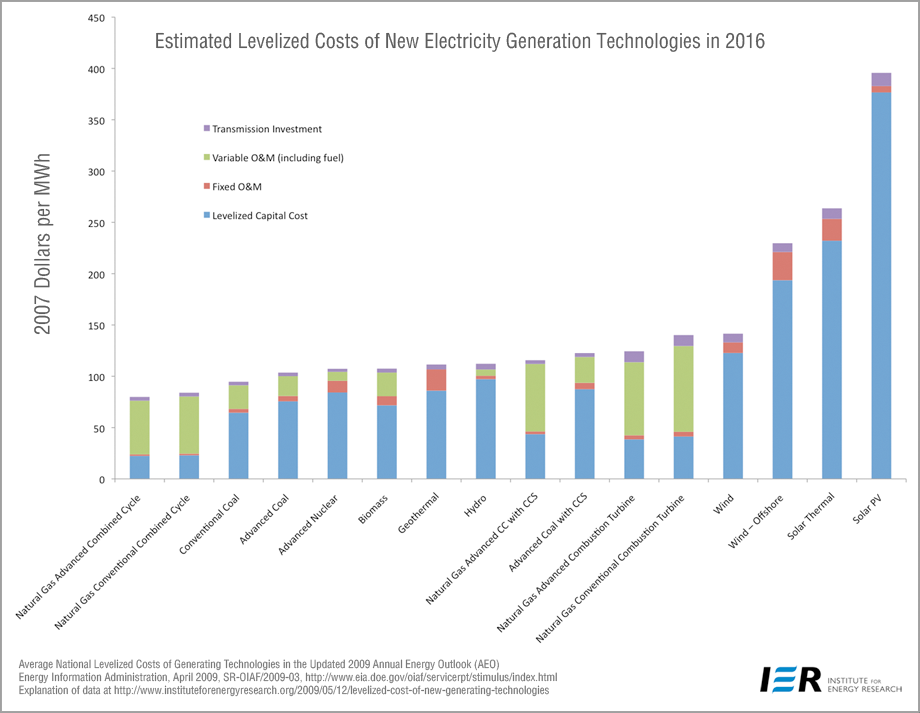
The electrical cost problem, identified by Citigroup is a different issue. Both the Energy Information Agency projections and the SCANA projections show that the long term projected costs for nuclear power, although high, is lower than their cost projections for renewables.

PV advocates bitterly object to this to the high estimates of PV cost, and insist that the cost of PV panels is going to rapidly sink to virtually nothing for vast amounts of power. Solar advocates have been telling us similar stories since the 1970's, and PV is still outrageously expensive. The PV industry is highly dependent on subsidies for their living, but the need the sky high costs are falling stories to justify more subsidies.

In a some what longer term more advanced nuclear technology, holds the potential to bring nuclear costs down and lower the cost of electricity. The lure of lower electrical costs, should be enough to lure the advanced industrial states of North America, Eastern Asia, and Europe into investing in advanced nuclear R&W. I have repeatedly argued that a form of advanced nuclear technology that uses fuel dissolved in liquid salts holds the key to lowering nuclear costs. Policy makers should be highly motivated to uncover and sponsor research into such promising options, but as David Walters recently observed in a comment on Nuclear Green,
What is common about countries really engaged in nuclear energy deployment is the goals they really set for themselves: S. Korea, China and India. I expect Vietnam as well. These projects become points of national pride.
The failure to develop promising nuclear technologies, which potentially hold the key to lowering energy costs, in the face of of an unprecedented global energy crisis is a matter of national shame. It is utterly shameful than the American Energy Secretary, a Nobel Prize winning physicist, is so poorly informed about this option. Unfortunately the United States and Western Europe face the current energy crisis without a since of national pride. We will pay a high cost for this failure to take pride in ourselves, for this failure to believe in ourselves, and the high cost of electricity will be the least of the costs we pay.

Friday, December 18, 2009

India moves ahead with an ambitious nuclear program to combat global warming

More evidence is emerging that the Nuclear Power Corp. of India (NPCIL) is planning to finance future nuclear construction through debt financing. Both local and international sources will be tapped. NPCIL plans to raise at least $6.5 billion from local sources, and another 3 billion euros from international lenders. Local funding will also include equity from NPCIL and at least three Indian partners. Three Billion is being raised locally to finance 4 locally designed 700 MW PHWRs. Another $3.5 billion is being sought to pay for 2 larger Russian PWRs to be built at Kudankulam. In addition equity financing for Indian Nuclear development is expected to come from Large Indian businesses, including the Oil Corporation of India, The National Aluminium Company, and NTCPL.

Indian nuclear developments could have an impact on global carbon emissions. Indian PricewaterhouseCoopers Pvt., Executive Director, A.V. Kameswara Rao, told Bloomberg,
The spending is justified considering nuclear power will help reduce India’s spending on oil and coal imports, . .
Indian plans include the construction of as many as 14 Russian Reactors, partially financed by "soft loans" from Russia, and partially by funds from local sources. The Russian reactor projects are but a small part of the Indian nuclear plans which will eventually require vast financial resources for their completion.

Indian Nuclear plans are exceedingly ambitious and the Indians have started a huge infrastructure program. Bharat Heavy Electricals (BHEL), is owned by the Indian Government, and already supplies 80% of the heavy equipment for India's national nuclear power program. BHEL plans to spend $7.5 billion in two years building plants to supply components for both local and foreign designed reactors to be built in India, In addition, BHEL plans a further joint venture with NPCIL intended to supply even more components to for reactor construction, and is involved in a further joint venture with NPCIL and an as of yet unnamed European partner to build generator turbines for new Indian Reactors. A further BHEL joint venture with Heavy Engineering Corp (HEC) will produce castings and forgings for nuclear power plants, BHEL is also engaged in talks with British Sheffield Forgemasters International Ltd and Japan's Kobe Steel exploring the possibility of even more joint ventures for nuclear forgings. Still other joint ventures and agreement involving BHEL will be announced. All in all it appears that BHEL and NPCLI plan to invest $50 Billion during the next five years, to expand the Indian nuclear manufacturing base. This would be astonishing, but investment of this size are probably being matched by China.

The current indian plan calls for the construction of up to 40 GW of foreign reactors, in the next 22 years. Although India has developed excellent nuclear technology, will use the foreign designed reactors to jump start the expansion of the Indian post-carbon power industry. In addition, the purchase of foreign designed reactors will provide India with a stream of reactor uranium. The uranium plays a major role in future Indian nuclear plans. The so called nuclear waste from the India's foreign designed Light Water Reactors will play a critical role in India's nuclear future according to current Indian plans. NPCIL plans to use plutonium from the light water "spent fuel stream" to fuel its new generation of Fast Breeder Reactors, which will in turn transmute thorium into the U-233 that will power the next generation of Indian Light Water Reactors.

Now contrast these and many other documented Indian developments with the following statement from nuclear critic Steve Thoma, and his associates Mycle Schneider, Antony Froggatt, and Doug Koplow,
In 2006 the chairman of the Nuclear Power Corporation of India (NPCI) told reporters that 62 reactors with a combined capacity of 40 GW would be operating by 2025.342 There is no evidence of how the country would enable an annual increase of 1,850 MW every year between 2008 and 2025. . . .

Considering its poor past industrial record, it remains to be seen whether the Indian nuclear sector will be up to its own expectations in the future. Foreign assistance could make a difference to some extent. . .
In other words, "those poor darkie Indians don't have a clue about what they are doing with nuclear technology. They need all of the help they can get." This statement was commissioned by the then Green dominated German Federal Ministry of Environment, Nature Conservation and Reactor Safety. Who says that the spirit of Nazi racism is dead in Germany?

It is clear then that the India Government plans to become a global leader in the peaceful uses of nuclear power, and sees nuclear technology as its preeminent tool in that struggle. While India advances its capacity to produce a post carbon energy sector, it is also laying the groundwork for a revolutionary change in the lives of hundreds of millions of its people. and for India to become one of the great powers of the 21st century.

Thursday, December 17, 2009

If Most of What I Know Comes from Google, Why Do I Know More Than Eric Schmidt?

Eric Schmidt gets nuclear costs wrong
I am looking at a presentation that says Eric Schmidt is wrong about the relative costs of nuclear and renewables. Way, way, way wrong. This is not one of those phonied up, propaganda extravaganzas by Mark Cooper, or Amory Lovins. No this is an honest to God presentation by a utility company to some bankers. The Utility, the South Carolina based SCANA, tell the banker, Wells Fargo, hey we believe that over the next 40 years we can deliver nuclear generated electricity for less than electricity generated by any other source. Less than electricity produced by combined cycle gas. less than biogas, less than chicken shit (if you don't believe me, check out the presentation), less than coal, less than on shore wind, less than off shore wind less than photovoltaics.

According to SCANA, nuclear generated electricity will cost just 58% of the cost of wind generated electricity, 26% of offshore wind generated electricity, and just 12% of electricity generated by photovoltaics. In case you think that SCANA has some pro-nuclear prejudice against renewables, you should also know that SCANA is also in the natural gas business. SCANA distributes natural gas to much of South Carolina, as well as parts of North Carolina and Georgia. Renewables are good for the natural gas business, because renewables need natural gas backups. What SCANA tells Wells Fargo is not the sort of ideological driven green propaganda we hear from Eric Schmidt.

The SVANA cost estimates are consistent with the 2016 levelized cost estimates of of the Energy Information Agency. They are consistent with the findings of Berry Brooks and Peter Lang. And they are consistent with my own studies of renewable cost. Although renewable advocates continue to tell us how high the price of future nuclear will be, they never balance this argument with a serious assessment of the cost of renewables. When confronted with evidence of real world renewable costs, renewable advocates tell us that renewable costs are going down all of the time, or that if you just through enough money in the form of government subsidies at renewables, the renewable cost liability will go away. The argument that renewable costs are declining is not born out by my own studies of wind and solar project costs. And renewables advocates won't tell us when renewables will be capable of surviving without massive subsidies.

Dr. Schmidt mistakenly failed to Google renewables cost, when he looked at the cost of nuclear power. Or perhaps he believed that he did not need to do so, because the experts he consulted that the cost problems of renewables were rapidly disappearing.

The devil in me wants to make fun of Eric Schmidt for his wrong headed pronouncement about nuclear costs as I have in the past. But Dr. Schmidt is a smart man, and maybe some day he will stop listening to Amory Lovins and Google the worlds "nuclear cost", find SCANA's data, and discover his mistake. If you humiliate an enemy, you may make him an enemy for a long time. Hopefully, Dr. Schmidt is a mature human being who can acknowledge his mistakes, and alter his views accordingly.

A tip of the hat to Steve Dardan for the Graphic, and for a link to a related presentation by Stephen A. Byrne, SCE&G's Senior Vice President Generation, Nuclear and Fossil Hydro. SCE&G is a subsidiary of SCANA.

Wednesday, December 16, 2009

The bad news about off shore wind cost

An estimated figure of 10 trillion dollars to be spent on AGW mitigation by 2030 is being talked about at the Copenhagen Climate change conference. Nicholas Stern, the Chief Economist of the World Bank, who has researched the cost of mitigation told The Sunday Telegraph,
we should be prudent with public finances, but if we were to ask future generations: would you rather have a desecrated earth or more debt, then the answer would be they would like to have more debt. You can get out of debt, but you can't get out of the other. It's one of the few cases where there's actually an argument for more borrowing. There's a logical justification to it.
I agree with Lord Stern's assessment, completely, but I wish to note, that the investment of 10 trillion dollars will not be the total cost of fighting AGW, and that if we are going to spend that much money, we should spend it on effective mitigation tools. In addition we should in our mitigation efforts also focus on improving the quality of life for the poorest 3/4ths of the world's population. This will require us to make wise investments.

Yet I do not see a passion for wise mitigation investments coming out of the Copenhagen conference, in fact very much the opposite seems to be the case. For example the New York Times carried a story about New Your city Mayor Bloomberg's flyover visit to the Danish Horn Rev 2 wind project. The Mayor is reported to have been very impressed, and called for the building of a similar facility off Long Island. Perhaps the Mayor was not well informed about the cost of electricity from the Horn Rev 2 facility. The facility costs 1 billion dollars and and has a rated capacity of 200 MWs of electricity. But its average output is only about a third of that, 34% to be exact. So one billion dollars gets you an average of 68.5 MWe of electrical output. Put another way, each watt of average electrical output from the Horn Rev 2 facility carries a capital costs $14.60.

Costs for thew German off shore Alpha Ventures wind farm suggests that German off shore wind is going to be extremely expensive as well. A year ago Der Spiegel reported that
German offshore Alpha Ventus is to cost €180 million ($282 million) to build -- nearly three times as much as a similar installation on land. . . . Maintenance . . . running makes up some 20 to 30 percent of total costs,
Alpha Ventures has a rated capacity of 60 MW, Now over a year later the total cost of the Alpha Ventures project is up too $357 million, or $5.95 per watt. The Germans appear to be guarding Alpha Ventures capacity factor as if the survival of Germany and of the German people were dependent on maintaining its secrecy. However we can infer from German statements about future German wind capacity factors that North Sea capacity factors, are on the south side of .40. Assuming a capacity factor of .40 we get an astonishing $15 per watt of real world average electrical output. The German Government has approved the building of as many as 2500 off shore windmills between now and 2030. But the German commitment to offshore wind may be wavering.

The United Kingdom expects to spend 100 billion pounds (around 160 billion dollars) by 2020 on 25 GWs of offshore wind schemes by 2020, according to the British Crown Estate's. That is $6.40 per name plate watt, but once we compute for capacity factor, it gets much more expensive, but even at $6.40 per watt, we are moving into the nuclear cost range. British offshore capacity factors estimates run from .20 to .40, but even if we take the top end of the range we get $16 investment dollars for every watt of output. But the cost of offshore wind doubled between 2003 and 2008, and we have no assurance that offshore wind cost will
not continue their rapid assent in the future, especially since there is a big push in Europe to build offshore wind facilities.

We also should note that the see environment is hard on machinery. We should note that the German Alpha Ventus project, maintenance is expected to run as high as 30% of the total cost of the project. In addition, the expected lifespan of offshore wind turbines runs to 25 years, but this is just a guess, and perhaps a very optimistic guess at that. The life expectancy of onshore windmills is around 16 years, based on actual experience, although manufacturers say they expect a 25 year life span. It is probably the case that offshore windmills will not survive as long as onshore windmills, 25 years may well be optimistic and is perhaps very optimistic. At any rate after a period of time generously estimated to be 25 years, windmills will have to be replaced, although presumably some of the investment, for example offshore electrical cables and the structural towers can be recycled. Perhaps the replacement would cost 50% or the original cost. The expenses would add very considerably to the long term cost of offshore wind.

“The reduction, due to the introduction of wind energy conversion systems, in the capacity of conventional plant needed to provide reliable supplies of electricity.”
The formula for calculating this suggests that if the British built 40 GWs of mainly off shore wind, they could retire 7 GW of fossil fuel generating capacity. Of course, if we replace those fossil fuel power plants with conventional reactors, we could do it with a one on one swap. Lets us assume that the reactors cost $8 billion, the cost of the 7 reactors would be $56 billion perhaps a fifth of the cost of the wind facilities. In addition the reactors will last for at least 60 years, verses a maximum of 25 years for the windmills, and the cost of maintaining the reactors would be far less as well. Question for the British politicians, "Which is the better deal for the British Electrical customers.

In addition David Milborrow notes
the effect of reducing the load factor on the remaining thermal plant, . . pushes up their generation costs.
At the beginning of this essay, I pointed to the importance of wise investment in AGW mitigation measures. I have in the course of this investigation uncovered evidence, based primarily on the European and particularly the European experience, that in terms of capacity factor and in terms of capacity credit, the cost of offshore wind is far higher than the cost of nuclear power. This is of course a case study and case studies in the United States though perhaps yielding somewhat different finding, are unlikely to yield different conclusions. My findings are entirely consistent with my over all contention that the cost of nuclear power is significantly lower than the cost of renewable generated electricity.

Followers

Blog Archive

Some neat videos

Nuclear Advocacy Webring
Ring Owner: Nuclear is Our Future Site: Nuclear is Our Future
Free Site Ring from Bravenet Free Site Ring from Bravenet Free Site Ring from Bravenet Free Site Ring from Bravenet Free Site Ring from Bravenet
Get Your Free Web Ring
by Bravenet.com
Dr. Joe Bonometti speaking on thorium/LFTR technology at Georgia Tech David LeBlanc on LFTR/MSR technology Robert Hargraves on AIM High