Saturday, January 31, 2009

Charles Julian Barton, Sr

Charles J. Barton, Sr.
Charles Julian Barton, Sr, a reactor chemistry pioneer, died of causes related to his advanced age at 1:40 AM on January 31, 2009 at the NHC Health Care Center in Oak Ridge. He had celebrated his 97th birthday on January 16th.

Dr. Barton was born on January 16, 1912, in the Campbell County town of Jellico, Tennessee. He was the son of Viola Hodsden Barton and Charles Lee Barton. Dr. Barton attended public school in Jellico until 1929 when he began studying at Cumberland College in Williamsburg, Kentucky. During his year as a Cumberland College student, he developed an interest in chemistry. The next year he transferred to the University of Tennessee in Knoxville where he obtained a BS in 1933 and an MS in 1934. He then went on to obtain a PhD in Analytical Chemistry from the University of Virginia in 1939.

Between 1934 and 1936, Dr. Barton worked as a chemist for TVA testing the quality of the cement that went into Norris Dam. After obtaining his PhD. He obtained employment in the rayon industry, and was a rayon chemist till 1946 when he took a job with International Minerals at a phosphate mine near Bartow, Florida. In 1948 he accepted an offer to join Warren Grimes’ chemistry group at Y-12, where his most notable assignment was the development of a technique for the separation of zirconium from hafnium. This was an important step to the development of the Light Water Reactors, because zirconium is essential for both Naval and civilian power reactor technology.

Dr. Barton was administratively transferred from Y-12 to ORNL in 1950, and went to work on the Aircraft Nuclear Propulsion project at the same time. Between 1950 and 1969 much of Dr. Barton’s ORNL research focused on molten salt reactor technology. His areas of interest were the chemistry and chemical problems related to molten salt reactors.

He was a true pioneer of Molten Salt Reactor chemistry. His pioneering efforts and accomplishments included:
1. Pioneering research on the NaF, ZrF4, UF4 salt mixture concept, and shared credit for the final reactor formula. This fuel formula was used in the revolutionary Aircraft Reactor Experiment, the pioneering molten salt reactor.
2. Shared pioneering research on the LiF, BeF2, UF4 salt mix, and the creation of the final formula. This is the salt formula used for the 1966 to ‘69 molten salt reactor experiment.
3. Pioneering research on chloride salts for reactor use. Chloride salts are promising safe alternatives to the dangerous metallic sodium used in fast breeder reactors.
4. Pioneering research on the use of plutonium as a MSR fuel. This research opened the door for using molten salt reactors to dispose of plutonium stockpiles left over from nuclear weapons, and for burning plutonium found in nuclear waste.
5. Pioneering research on the extraction of protactinium from blanket and core salts. This was a vital element in the use of molten salt reactors to efficiently convert thorium, an abundant element that presently goes to waste, into a nuclear fuel.
6. Pioneering research on the use of molten salts in a blanket to extract power from a thermonuclear reactor. This research opened the door to approaches to extracting energy from fusion machines.

In addition to these accomplishments, Dr. Barton made notable contributions to nuclear safety. When Dr. Barton was asked to perform plutonium chemistry in the mid 1950’s he learned of safety concerns with the then current methods of plutonium handling. He requested an expansion of his research assignment, to include improvements in plutonium handling technology and techniques. Dr. Barton successfully completed all of these assignments, and his findings pointed to long term improvement in worker and researcher safety, while handling dangerous material at AEC facilities. Dr. Barton went on to team with the late George Parker between 1960 and 1964 in the study of chemical aspects of reactor accidents. In that research Dr. Barton specialized in improving understanding of the transport of radioisotopes in the environment following reactor accidents. Dr. Barton’s research carried him to England where he studied the release of radioactive materials following the Windscale reactor fire.

During the late 1960’s Dr. Barton’s research shifted to safety issues stemming from the use of nuclear devices to stimulate the production of natural gas. Dr. Barton also undertook a pioneering study of the normal presence of radioactive radon that is naturally present in natural gas, and natural sources of radioactive radon found in many American homes.

Dr. Barton married Ruth Mae Grant in 1939. They were married for 64 years before Ruth died on December 26, 2003. They had three children, Charles Barton, Jr., of Dallas, Texas, David Grant Barton, of Greenville, Texas and the late Michael Lee Barton, of Quainton, England. In addition to his surviving sons, Dr. Barton is also survived by David’s wife, the Reverend Ann Barton, David’s son, Gregory Ross Barton, Greg’s wife Marci Welch, and their child, Ada Barton; David’s daughter, NPR journalist, Julia Barton, her partner Josh Sarantitus and their children, Zackery and Avi Sarantitus; Michael’s wife, Lorna Barton, who now lives in Columbia, South Carolina, and sons Blair Barton of Columbia, South Carolina, and Mathew Barton of North Carolina, and Matthew’s wife Kate. Dr. Barton married Anna Kate Teague, a family friend, in September 2004, and is survived by her. Family members say that the marriage brought Dr. Barton great happiness.

Dr. Barton was a community leader. He was an active member of Glenwood Baptist Church for many years, and later transferred his membership to the First Baptist Church of Oak Ridge before going on to become a founding member of Grace Covenant Church of Oak Ridge. Dr. Barton was involved in many community activities. In addition to his church work, he was active in the Clinton Baptist Association for many years. He helped to found Hope Cottage, originally a half way house for recovering alcoholics, which has now grown into Hope of East Tennessee. Dr. Barton also served for many years as a volunteer with the Contact Help Line. He also was a founding member of the Prisoners Aid Society of Tennessee. He was an active supporter of the reform of Tennessee's sales tax which he viewed as oppressive to poor of Tennessee. He also wrote extensively about his life experiences and travels in the Oak Ridger and in other local publications.

Funeral arrangements will be announced soon.

A number of stories related to Dr. Barton’s professional career and his scientific accomplishments can be found on the Internet blogs, Nuclear Green and Energy from Thorium.

Charles Julian Barton, Sr.

My father passed into a coma yesterday, and died at 1:40 AM EST this morning. He lived his life well. He lived with courage and moral vision. He died still looking forward to life, but accepting that it was not forever. It was a gift to those of us who loved him that he was with us for so long.

My father's Last Report

Last night I was awakened by the news that my father had lapsed into what was to prove a brief coma, that was to end with his death. I was unable to sleep, and my thoughts turned to my father's final unpublished report to the National Academy of Science.

During my father's (C.J. Barton, Sr.) last 18 months before his retirement much of his time was spent preparing a report for the National Academy of Science. The report encountered many objections from peer reviewers, and main objections focused on research that was being conducted at ORNL and which was reflected by the report. The topic of my father's report was the movement of radioisotopes in the environment, and ORNL research was clearly pointing at some of the human consequences for the energy policy choices of the Ford and Carter Administrations.

By the mid 1970's my father probably knew as much as anyone in the world about radio-isotopes in the environment. Indeed his knowledge of the topic was undoubtedly the reason why he had been chosen to write the report. During the years my father was George Parker's partner in nuclear safety research, Parker specialized in the study of how radioisotopes escaped reactors, while my father focused on what happen to them once they got into the environment. Even after he returned to Molten Salt research in 1964, my father was asked to study the movement of radioisotopes that had been released into the environment during cold war operations of the Oak Ridge facilities. Thus the study of radio isotopes in the environment, either from human sources or later from natural sources was my father's entry into the Health Physics and later the Environmental Studies division, as the Reactor Chemistry Division of ORNL fell apart.

My father, although close to retirement, was very enterprising in promoting the study of radiation from natural sources. It appears that he was one of the pioneer researchers on the problem of natural radon in the home. In addition to Radon from subsurface sources, my father noted that natural gas was a source of radon in the home. Indeed studies of the transport of radon into American homes through natural gas pipe lines does not appear to have progressed much beyond the point my father left it in the mid 1970's. Bob Moore was associated with my father in the natural gas research. In addition Moore was also involved in a better known ORNL research project that investigated radio isotopes in coal ash. My father would have been very interested in that line of research. These lines of ORNL research were perhaps what troubled the National Academy of Science reviewers.

My father defended his report vigorously and eventually the reviewers signed off on it, but the National Academy of Science appears to have never published it. At the very least my father was never told of its publication and it is not listed among my fathers professional papers listed on the Energy Bridge. Thus the report disappeared and I suspect was suppressed. Why you might ask?

The reason might be found in a couple of my father's post retirement papers which I believe reflected some of the thinking that went into his National Academy of Science report. What was on my father's mind was simple. People were and are far more likely to be exposed to radio isotopes from the burning of fossil fuels, coal and natural gas, than they were to be exposed to radio-isotopes from power producing reactors. The "Linear (No-Threshold) Hypothesis," holds that there is no lower limits to the damaging effects of radiation. Critics of nuclear power using the Linear Hypothesis often hold that even a tiny amount of radiation that escapes into the environment from power producing reactors has an adverse impact on human health. What my father, Bob Moore and other Oak Ridge scientists had shown was that far more radiation coming from radio isotopes like radon, was escaping into the environment and entering the bodies of people from fossil fuel burning, than was coming from nuclear reactors.

My father's research had shown that radioactive isotopes like radon were being transported through natural gas pipelines into homes all over the country. Other researchers had shown the presence of radioactive isotopes in coal fly ash, that was entering the lungs of people who lived in surrounding areas. From this information it was not difficult to calculate exposure rates and given the "Linear (No-Threshold) Hypothesis," the effects of radiation exposure from fossil fuel burning would be very predictable in terms of its health and mortality consequences.

The Linear (No-Threshold) Hypothesis, is itself questionable. There is powerful evidence when people are exposed to radiation from natural sources, there is a threshold below which no adverse health consequences can be observed. It is irrational to argue that radiation from natural sources is somehow different than radiation from reactors. Radiation is radiation. Thus my father's conclusion would have been that given the facts and the "Linear (No-Threshold) Hypothesis" radiation exposures from burning fossil fuels killed tens of thousands of people. The implications of my father's report then would have been to show that a transition to nuclear power could have a positive consequence for human health and might save the lives of tens of thousands of people every year.

In effect my father would have turned the reasoning of the enemies on its head, by showing that given their own beliefs about the health consequences of radiation , a far more serious radiation problem was caused by not turning to nuclear power and continuing to burn fossil fuels. Needless to say the coal barons, the natural gas producers and anti-nuclear leaders like Ralph Nader, Helen Caldicott, Amory Lovins and Joe Romm had an interest in seeing my father's report suppressed.

My father's conclusion would have been unacceptable to the fossil fuel lobby and their
political allies, the anti-nuclear movement. There would have thus been a powerful political interest in suppressing my father's National Academy of Science report, and as far as I can determine it was in fact suppressed. To say the least, my father's conclusions were buried.

Friday, January 30, 2009

Scientific American Hack David Biello Distorts Nuclear Technology

When I was a teenage boy I would walk to the library every month to read the latest issue of Scientific American. I would have never dreamed then that the then-august Scientific American would one day be reduced to the status of an anti-nuclear propaganda organ. Anti-nuclear hack and Scientific American Technical editor David Biello, an ex-Hollywood entertainment writer, is a big fan of the fanatic anti-nuclear blog Grist. He is a faithful redactor of the Grist line on Nuclear technology. Biello has turned Scientific American's electronic edition into a propaganda mouthpiece for the David Roberts/Joe Romm/Amory Lovins anti-nuclear party line. Biello, a journalism school graduate, clearly has little comprehension of nuclear technology. For example, in a January 27 article on spent nuclear fuel Biello talks about two options, sequestration, and "so-called fast-breeder reactors". So-called? Apparently Biello's comprehension of nuclear technology does not extend to understanding the management of neutrons in reactors. No doubt the concept of thermal breeding would mystify Biello.

Biello follows up his mention of the "so-called fast breeders" with an obligatory account of the 1995 shut down of the Japanese Monju LMFBR. Reader "bhoglund' caught an error in Biello's text that has since been corrected in the online article. The original text stated, according to bhoglund's comment, "... including a fire caused by a leak of its molten salt coolant, ..." That is right folks, Biello did not know the difference between Molten Salt and Liquid Sodium.

Now as my readers know I am not a big fan of sodium-cooled reactors, but Biello seems to think that they represent the only option in reactor disposal of nuclear waste, and of course they do not. CANDU reactor technology offers a second reactor option. And of course, Molten Salt Reactor/LFTR technology produces excellent synergies in for the disposal of reactor-grade plutonium and other nuclear waste actinides. Now why doesn't Biello know this? You would think that Scientific American could find a technology editor who actually knew something about nuclear technology, not some ignorant journalism school graduate.

Biello ritually recites every one of the obligatory anti-nuclear motifs. Guess who he consults on the Uranium availability question?
"The energy payback time of a nuclear power plant is at present about 11 years compared with natural gas at half a year, by 2070, Storm van Leeuwen found, the amount of energy it takes to mine, mill, enrich and fabricate one metric ton of uranium fuel may be larger than 160 terajoules—the amount of energy one can generate from it.
That is right, Biello uncritically quotes Jan Willem Storm van Leeuwen, who he describes as "energy and technology analyst at Ceedata consultancy in the Netherlands". Biello, of course did not Google "Ceedata consultancy" which appears to be nothing more than a front designed to add weight to Storm van Leeuwen exceedingly meager credentials. Nor did Biello google "Storm van Leeuwen" and "discredited" Bello goes along with the Ceedata consultancy gag, telling us that the us that "the Ceedata consultancy . . . advises European governments on nuclear issues . . ." well not quite, Storm van Leeuwen gets paid through an EU slush fund assigned to European Greens, for writing anti-nuclear propaganda. It is exceedingly damming to Biello's credibility that he relies on Storm van Leeuwen defective analysis of the EROEI of Uranium nuclear technology.
"The energy payback time of a nuclear power plant is at present about 11 years compared with natural gas at half a year," Storm van Leeuwen argues, when the full cost of decommissioning a nuclear power plant at the end of its useful life is included. "The cost in the U.K. for dismantling a reactor is now estimated at about 7 billion euros ($9.9 billion) per reactor of one gigawatt-electrical. That's before the first bolt has even been loosened."

And by 2070, Storm van Leeuwen found, the amount of energy it takes to mine, mill, enrich and fabricate one metric ton of uranium fuel may be larger than 160 terajoules—the amount of energy one can generate from it.
Biello offers a form of pseudo-balance to his account by noting that
one metric ton of natural uranium yields nearly 20,000 times as much energy as the equivalent amount of coal—the cheapest form of electric generation at present. In other words, one metric ton of uranium can produce the same amount of electricity generated by burning more than 19,000 metric tons of coal.
But as Robert Niles tells us
balance . . . ought to mean that truth gets treated like truth and lies get treated like lies.
Balance is only possible when you are sorting out lies from truth, not when you perpetuate them.

Biello does the usual anti-nuclear song and dance about nuclear safety. Thus fundamental nuclear safety concepts, like passive safety, inherent safety, defense-in-depth are simply ignored, while much of the article is devoted to the safety problems of the Davis–Besse reactor. Chernobyl and Three Mile Island are also discussed with emphasis on operator error. Biello claims that the Chernobyl reactor
exploded through its containment
as if the Chernobyl reactor had a containment structure. Needless to say, Biello does not discuss the history of nuclear safety, does not discuss the the lessons learn from the Three Mile Island and Chernobyl accidents. He does not discuss strategies designed to prevent human error from causing nuclear accidents. But we cannot expect an anti-nuclear hack to understand the difference between nuclear safety and talking about accidents including accidents that did not happen.

Update on my father

I received an update from David last evening. The reason for the belated nature of the update is clear. Daddy has been transfered to a skilled nursing care facility that does not have a wifi internet connection, so David can't email from Daddy's room. Here is what David
wrote:
Mid-afternoon yesterday (Wednesday), Daddy was transferred to NHC, a skilled nursing facility in Oak Ridge. He is in room 120, a semi-private room. The other bed in the room is unoccupied, so it's fairly comfortable now. The staff seems cooperative and attentive, but very much by the book.

They got Daddy out of bed for a couple of hours today, sitting up in a chair. He seems in good spirits and anxious to get better so that he can get out and go home. I was doing some stretching after I helped him with his breakfast and he indicated that he would like to join in. So we did some arm waving and stretching and he actually did some semi situps. He's been eating well here, finishing most of the food brought to him, and staying awake and alert more than he has for the last couple of days. He's a bit fatigued tonight, but ate almost all of his supper.

Hopefully, he will soon be able to get out of his room (in a wheeled chair) and participate in some of the activities they offer here. I purchased a TV for his room today, allowing Daddy and Anna Kate to indulge their CNN addiction. . . .

Thursday, January 29, 2009

Solar costs, and the future of electrical generation.

There is a considerable gap between the actual cost of solar thermal power generation systems and what we have been told to expect. When renewables advocates talk about ST costs, they talk about cost projects made several years ago that did not survive testing by recent cost realities. This gap between expectations and experience has been apparent in actual cost data for existing and projected solar thermal projects. I have pointed to the evidence on ST costs in a number of posts as data has become available. Solar thermal lags far behind nuclear in its ability to produce power on demand. In short, solar thermal ceases to be a bargain as soon as you want to switch the lights on.

The renewables crowd keeps telling us that this is about to be fixed. That the day of cheap solar thermal generated electricity on a 24 hour a day basis is said to be at hand. We know this must be so, because Joe Romm keeps telling us that solar thermal power is now base power. Unfortunately, many of us noticed some time ago that just because Joe Romm states something the proposition does not become fact.

Last year the sun shown on the solar thermal industry in California. PP&E handed out contracts to Solar Thermal manufacturers as fast as the applications flew though the door. This was occurring despite evidence of truly atrocious cost-to-capacity-factor ratios. The best I was able to determine facilities that generated on average 20% of their nameplate capacity were costing $4.00 a name-plate watt to construct. It is evidence of exactly how screwed up thinking about energy is in California is that there is not a ratepayers revolt against the solar thermal scam.

Last fall I called attention to Ausra, an ST business that had its origins in Australia. Ausra claims to be able to lower ST costs, including heat storage costs, through a series of low cost technological innovations. Ausra was the apparant darling of some California venture capital firms that were moving to become players in the the California renewables generating market. Ausra told the VC people that it could provide round-the-clock ST electricity at a cost that was too low to meter. That was the story, but my review of published cost data for Ausra's Barstow project was inconclusive, but suggested that matters might not be nearly as happy as Ausra claimed. Furthermore, a careful analysis of Ausra performance claims yield a remarkable amount of wiggle room, if those claims were ever brought up in court. Thus Ausra's low cost claims could be marked down as unconfirmed, pending further investigation. This judgment suggested that it would not be a good idea to invest the widows and orphans funds in Ausra just yet.

It is not surprising then that Ausra is retrenching.
Ausra's chairman, president and CEO, Robert Fishman now acknowledges that Ausra cannot raise the finances for a large project on the basis of his companies performance on its 5 MW pilot project. "That's simply not reality. The finance market will not support it." Fishman has not acknowledged Ausra's cost data from its Barstow pilot project, but clearly Ausra expectations are being trimmed, as is corporate staff.

It should be quite clear by now that California's most excellent renewables adventure is not going as well. Producing low cost renewable electricity in California is going to prove a tremendous bust. California is running out of good land-based wind resources and offshore wind resources will be quite expensive to exploit. The cost of Solar Thermal is quite outrageous given its truly modest capacity factor. Constructing a renewables system with adequate energy storage would carry a price tag that would be considerably higher that constructing a nuclear power generating system of similar capacity. Now conventional nuclear generating systems are hardly cheap, and conventional nuclear might not be the best long run fossil fuel replacement. A better solution is needed.

My readers by now know where this is headed. California's renewables subsidies could be better spent on LFTR technology. For what California will spend subsidizing overpriced pathetically inadequate renewables technology, California rate payers could have low cost electricity from safe, non-wasteful, sustainable generation-IV nuclear technology.

It will not happen of course. First, the renewables myth serves the interest of the fossil fuel producers. As long as there are the notion persists that renewables are the answer to peak fossil fuels and global anthropogenic global warming, the fossil fuel interests will continue see their products being burned to generate electricty. The renewbles crowd, Amory Lovins, Joe Romm, and David Roberts, may not be taking money under the table for the coal barons, but they are certainly serving the interest of coal by propounding their anti-nuclear ideology.

We are not yet ready to turn to advanced nuclear technology to do what renewables and conventional nuclear technology cannot do, that is take the world economy off its carbon habit. But the ability to do so, the ability to actually control carbon emissions while generating massive amounts of electricity, is about to be taken seriously. By 2012 low carbon power will be a matter of the most serious global concern. Athough our day has not yet arrived, it is coming. It is coming soon. The Sun probably is not going to shine on Ausra this year or the next.

Wednesday, January 28, 2009

Nuclear security

Information about the exact security of American reactors is not exactly bantied about on the Internet, but we can infer something from information passed on by Knoxville journalist Frank Munger who has long covered Oak Ridge affairs. These photos primarily reflect Y-12 security. At right we see security personel carrying a military style weapons. This is not quite armed to the teeth but far more firepower than you would find with a typical rent a cop. What you want to bet that the guards at Watts Bar Unit 1 carry the same sort of weapons?

Now the lady below is armed to the teeth. You have got to watch out for those East Tennessee women. I would only say the nicest things about the Tennessee Vols if I were talking to her. Wouldn't you? Now a Gatlin gun, that is impressive firepower. I would almost suspect that they have Stinger Missiles too. Shhh! I should not give too much away.

At any rate what we are looking at is some of the firepower that might be available to protect American reactors from terrorists attacks.

Update on Charles J. Barton, Sr.

Jamuary 28, 7:10 AM:
I just received an eMail from my brother David:
Greetings all:
It looks as if Daddy will be placed in a skilled nursing facility today. We're hoping that there is a place in a local facility, NHC, so that Anna Kate will not have to drive out of Oak Ridge to be with him. The initial placement will be for 20 days for rehab and physical therapy. After that we'll evaluate the longer term course.
He's eating well, sleeping very well. He sat up in a chair for about an hour last night, and the PT crew was able to get him walking for a short bit. So things are progressing.
I'll let you know when and where things are taking place. Hopefully the next facility will also have wireless internet, but I'm not going to bet on it.
Hope you are all are doing well.
db

Tuesday, January 27, 2009

My father's status

1/27/09, 8:59 PM
My father appears to continue to improve, so much so that discussions are now underway about whether he should have home nursing care, or go to a nursing facility upon release from the hospital.

Monday, January 26, 2009

Our day is coming soon


Posted in Honor of Kirk Sorensen.

Update on my father

I just received a call from my brother David. My father is still alive. David stayed up with him all night. Daddy talked a lot, but was not very coherent. David had not discussed prognosis with the Doctor. We talked about hospice care in the event of a hospital discharge. My feeling is that the end is very near.

Update 6:23 PM, 1/26/09: I just received the following email from David:
Daddy is doing well. I just left him sitting up in bed and Anna Kate feeding him mushy versions of chicken, potatoes and something that looks sorta greyish green. He was eating enthusiastically. Up to this point he has not been allowed anything by mouth. He looked much happier and immediately started dozing off in his normal way.

Don't know what the prognosis is for the immediate future. I suspect at least one more day in the hospital, and then probably home with nursing care. I couldn't get the doctor to call me today---I was asleep in the PM when he came to check on Daddy. I pulled the night shift after arriving from Dallas at 10:30 PM. Anna Kate had been up for 24 hours solid, so she promptly went home and slept for a good 10 hours. I'll be on night's again tonight, so if anyone wants to email, skype or chat, I'll be there, the hospital wireless network allowing.

The era of energy confusion

Current thinking about renewables is to say the least confused. The limitations and true costs of renewables are systematically ignored by psuco-scholars huxters like Mark Z, Jacobson. Is it any wonder then that the thinking of politicians about energy issues is distorted by myths and illusions. After believing for a generation that fossil fuels could solve our energy problems, we are finally becoming aware that this is not the case. Two threats, those of anthropogenic global warming and peak oil, appear to be bring the age of fossil fuels to an end. Resolution of long standing energy issues cannot be put off for much longer. Decisions must be made soon. But like a man waiking up from a drunken sleep, thinking about energy is at the moment amazingly confused and distorted. Consider the following pronuncement:
Because the production of nuclear weapons material is occurring only in countries that have developed civilian nuclear energy programs, the risk of a limited nuclear exchange between countries or the detonation of a nuclear device by terrorists has increased due to the dissemination of nuclear energy facilities worldwide. As such, it is a valid exercise to estimate the potential number of immediate deaths and carbon emissions due to the burning of buildings and infrastructure associated with the proliferation of nuclear energy facilities and the resulting proliferation of nuclear weapons. The number of deaths and carbon emissions, though, must be multiplied by a probability range of an exchange or explosion occurring to estimate the overall risk of nuclear energy proliferation. Although concern at the time of an explosion will be the deaths and not carbon emissions, policy makers today must weigh all the potential future risks of mortality and carbon emissions when comparing energy sources.

Here, we detail the link between nuclear energy and nuclear weapons and estimate the emissions of nuclear explosions attributable to nuclear energy.
First lets note the ambiguity of Jacobson's language. He speaks of a general class of "buildings and infrastructure". Now what they all have in common is their association "with the proliferation of nuclear energy facilities and the resulting proliferation of nuclear weapons." Here we run into a logical problem. Let me cite some examples of facilities that are clearly associated with the proliferation of nuclear weapons. K-25, the Hanford reactors and the Sevannah River reactors are all facilities associated with thre building of nuclear weapons, but technically not of their spread. Because these facilities did not contribute to the spread of nuclear weapons beyond the United States. Thus they do are not examples of the case which Jacobson wishes to make. Now conisder Watts Bar Unit 1, a nuclear power plant not a great many miles distant from the location of K-25. Now it would be absurd to assert that Watts bar Unit 1 has caused the spread of nuclear weapons to other countries. Thus Watts Bar Unit 1, is not an example of the case Jacobson is trying to make as well.

But Jacobson would appear to have us believe than notonly is Watts Bar Unit One linked to the spread of Nuclear weapons to other countries, but through this link will be a cause of a future nuclear exchange between unnamed countries.

Jacobson also relies on factually inaccurate arguments. for example he links the presence of civilian nuclear energy programs in countries with the emergence of military technology. In fact, there were no civilian nuclear energy programs in the United States in 1942, at the inception of the Manhattan poroject, and no Civilian nuclear Energy programs in the United Kingdom, The Societ Union, or the PRC prior to the emergence of their nuclear weapons programs. Other examples, including North Korea could be pounted too. Thus the Civilan energy program caused nuclear weapons simply is not credible, and would never be made by a person possessing the slightest shred of rationality. The detonation of nuclear weapons in a nuclear exchange has not been shown to be linked to Watts Bar Unit 1, in anyway, and further the nuclear exchange takes place only in Jacobson's imagination. The terrorist bomb also is a product of Jacobson's imagination, and Jacobson demonstrates no link between Watts Bar Unit 1, and the very unlikely acquisition of nuclear weapons by terrorists.

Thus Jacobson resorts to a factually incorrect, illogical, and wholely implausible argument to make the case that the acquisition of nuclear weapons by North Korea would be caused by say, the completion of Watts Bar Unit 2. What can be said about's Jacobson's argument? For that matter what can be said about the fact that virtually no one except Brian Wang and I have criticized it? People are either asleep, or have not awakened enough to distinguish between dreams and waking reality. Dreams do not obey the rules of logic or are they expected too. Jaconson applies the logic rules of dreams to his argument, and that appears to be assceptable to his still slumbering readers.

Those few of us notice, shake our heads and wonder. "If you cannot be saints of knowledge, then, I pray you, be at least its warriors."

Renewables in Fairyland

Yesterday I participated in a discussion on Rod Adams's Atomic Show. Part of the discussion focused on the inability of renewables to reliably deliver electricity when it is needed. Probably I wrote more about the problem than any other energy-related blogger on the internet, and renewables advocates, with the exception of Ed Ring almost completely ignore the problem. Today I have posted a brief discussion of materials issues effecting the production and cost of windmills.

You will never, never, never hear about such problems from renewables advocates. The
term renewables advocate almost always refers to husters who are totally lacking in intellectual integrity. The renewables advocates are selling green myths that have little basis in facts. In fact the community that supports renewables is a bunch of off-the-wall fairyland-based champions of unreality. Not only do they ignore obvious facts, but the offer the most gossamer of excuses for doing so. No pro-renewables argument is ever so ludicrous, or illogical that it isn't instantly bought by the entire crowd of pro-renewable idiots lock, stock and barrel.

For example renewables advocates point to a study by Stanford "researchers" Cristina Archer and Mark Z. Jacobson titled "Supplying Baseload Power and Reducing Transmission Requirements by Interconnecting Wind Farms. The claim is made that Archer & Jacobson demonstrate that Wind can provide practical base power. But Archer & Jacobson actually say that windmills at 19 highly selected locations in Oklahoma, Texas, Kansas and New Mexico, if linked, can be counted on to produce at least 21% of their rated power 81% of the time. This system would seem to possess some but not all characteristics of base generation capacity. Its down time cannot be scheduled to reflect low power demand, as true base power can. A glance at the Archer & Jacobson data set reveals huge weakness for the system. The system has no ability to produce electricity during daily peaks of summer electrical demand. Thus as electrical demand rises during the summer days, electrical generation drops sometimes to virtually nothing. Thus the so-called wind base generation system fails to provide electric when it is needed the most.

Finally, since "base" capacity is 21% of name plate capacity, the real cost of of "base" electricity is 5 times the cost of "nameplate" rated capacity. Thus if 1f a 1 MW electrical generator costs $2 million the cost of base capacity will be 5 x $2 million or $10 Million. This price comes in at the high end of nuclear range and the whole system is less capable than nuclear, since it can be counted on to not deliver electricity during periods of peak demand. Thus careful attention to Archer & Jacobson, far from revealing the advantages of wind, actually testify to its weaknesses.

This you are never going to hear from renewables advocates, who were either too lazy to look carefully and critically at the Archer and Jacobson study, or who are not smart enough to figure out the problems on their own. Indeed Archer and Jacobson do not focus on the enormous cost of their wind-based system or its inabiliy to produce electricity during periods of summer peak demand. But this sort of sloppy scholarship is the sort we have come to expect from California fairy-land renewables scholarship.

Wind and Neodymium

Jack Lifton's research on mineral resources make him an important figure in projecting the future of energy. Lifton spotted the Lemhi Pass thorium reserve discoveries early on, Lifton has recently focused on world rare earth production, and as Lifton has pointed out, rare earths will play important roles in the future of energy. Lifton pointed out the importance of the rare earth element neodymium for the wind generation industry.
There’s another rare earth metal that’s critically important to our society—neodymium. In 1984, General Motors and Sumitomo developed the neodymium iron boron alloy for permanent magnets, which is the basis of all modern electric motors because it allows you to make a very small electric motor with the highest possible power density. Neodymium total world production is less than 20,000 tons. That may sound like a lot to you, but it’s tiny. And the fact is it’s recently been projected that a single wind turbine electric generator producing 1 megawatt of electricity requires one ton of neodymium.
Lifton claims that some time between 2011 and 2013 China plans to stop exporting rare earths. At that point if no other source of rare earths is found, wind generation manufacturers would no longer have access to
neodymium magnets used in wind generators.

I have been unable to find independent verification of Lifton's claim that one ton of
neodymium or so is required for every MW of wind generating capacity. This is quite typical about renewables data sources. Renewables advocates almost always ignore questions about materials inputs into renewables technology. Most renewables advocates themselves have no idea what a rare earth is and what neodymium does in a generator. Lets face it, if all of the wind advocates left the country, the average IQ would go up substantially.

Substitution for
neodymium is possible in wind generators, but apparently at a price. Neodymium lowers magnet weight. Magnets built with alternative materials and alternative technologies weigh more. Heavier turbines will require more support, which means more concrete and steel in the support tower, and greater materials and construction cost for the wind turbine. Lifton's latest assertions about neodymium demonstrate that the implications of the renewables paradigm are poorly worked out, and there is a great deal renewables advocates don't know about the technology they are hyping.

Sunday, January 25, 2009

Update on Charles Barton, Sr.

I have a chance to talk with my father yesterday, and I talked to him about my Friday post on his pioneering molten salt research. We also discussed some of the other milestones in his life. During the conversation, my father had a little cough. This morning my brother David called to say that he had just talked to Daddy's wife, Anna Kate, who had just called him to say that Daddy had been hospitalized last night with a serious case of pneumonia. The hospital has been given a no heroic measures directive.

Saturday, January 24, 2009

450 comments

450 comments on my Oil Drum post.

"Environmentalists" and Environmentalism

My criticism of environmentalists has nothing to do with sound environmental policies and truly "green" technologies which I support. It has to do with the tendency of some environmentalists to set up shibboleths that are really detrimental to the environment and the well being of future human inhabitants of the earth. I am certainly not critical of environmentalists who are willing to talk rationally about nuclear power. What I object to is the environmentalists who simply raise one objection after another to nuclear power without ever thinking through the points that advocates make. I further object to the hyping of renewables, without an honest assessment of their limitations and costs, I am very much a thinking environmentalist, an environmentalist who believes that it is possible for the world to be a well-cared-for home for the human species for a long time to come. I also believe that the goals of environmentalism are wholly consistent with human prosperity, and that increasing the wealth and energy resources of society makes it far easier to realize environmental goals. Poverty leads to far more environmental destruction than wealth does.

Friday, January 23, 2009

Controlling the Future

The dialogue on my Oil Drum post was far more civil and to the point than previous discussions on nuclear power. I credit Gail the Actuary for running a tight ship. She made sure that discussion participants including me stayed in line. Since I wanted to educate, I greatly preferred a rational discussion to the craziness of some past arguments on nuclear power that I have been involved in. The critics of the LFTR were more circumspect, more willing to listen than past nuclear critics on the Oil Drum. I tried to separate the LFTR from other forms of nuclear power, and in the main I succeeded. I also appear to have solved the "we are running out of uranium" argument by presenting with evidence of the abundance of thorium. There were a few underhanded arguments, and tried to respond to them by letting the guys know that I was on to their game. One of the most striking aspects of the anti-nuclear side was the extent to which they consider giving people energy to be bad, and to have bad consequences.

It seems that a lot of people on the anti-nuclear side believe that it is inevitable that energy will be misused to cause human misery, and environmental degradation. The critics of the LFTR also used the "we are running out of resources" argument. We were told that the depletion of resources was a absolute certainty. Now it is clear that world supply of some resources - for example mercury - does not meet potential demand, so we see substitutions being made. (When was the last time you saw a Mercury thermometer?) We are probably going to start running out of oil soon, and that will be a big an painful fix, but the limitation of the oil supply has been known for over 50 years, and its remedy, has been known for just as long and is unacceptable too many people.

What struck me as the critics unpacked their argument was that most of them mistrusted the future, mistrusted the judgment of future people and their leaders. I would characterize the perspective as misanthropic. In this view human misery is caused by poor human judgment, technology, the availability of energy, and the impossibility of substituting common resources for scarce resources. The view is that people in the future will not have choices and indeed should not have choices because they will make wrong ones. Thus it was argued that if we develop the LFTR some future national leader will sell it to the wrong people, and the ability to make nuclear weapons will fall into the wrong hands. Then terrible things will happen, as if a future without reliable and inexpensive energy would be a good thing.

My view is quite different. I would like to leave to the people of the future the ability to make their their own decisions. Aside from that I wish them an unprecedented level of prosperity, which will open up to them far more opportunities than are available today in even advanced countries. People in the future will most likely make mistakes, but it is just possible that they will do fewer things wrong than right. That their judgment will prove correct more often than now. Above all else, I wish them the opportunity to make their own mistakes.

Thursday, January 22, 2009

The LFTR Advantage

My Oil Drum post has grabbed some attention. Oil Drum posts are widely reported by RSS feeds, and they are often echoed by other energy related blogs. This is the case for my latest post. The terms Liquid Thorium Fluoride Reactor, LFTR and LFTR paradigm are beginning to pop up on internet searches, independently of comments by the LFTR community of interest. There are not enough independent commenters yet, to give the story wings, but enough to be encouraged. I am vain enough to take pleasure at my name being bandied about on the Internet. My favorite comment comes from brickmuppet blog,
Nuclear Green Charles Barton, who seems to be either a cool curmudgeon, or a rational hippy, talks about energy policy and the terrible environmental consequences of not going nuclear.
Comments in response to my last Oil Drum post were not nearly as hostile as previous pro-nuclear posts drew. In no small measure this was because I made clear the distinction between LFTR technology and LWR technology. Some of the LFTR critics complained that the LFTR would create too much energy and therefore would lead to overpopulation, resource depletion and environmental problems. This is implausible. Poor people in underdeveloped economies increase their wealth by having children whose labor enriches their families. People in advanced economies increase their wealth through continued education that qualified them for better jobs. Educated women for the most part prefer holding jobs to having large families. The reproduction rates of many economically advanced countries is below population replacement levels.

Resource consumption drops in advanced economies with mature infrastructures. More emphasis is placed on convenience and portability than on material mass. I am writing on an iMac, a powerful computer not much larger or heavier than a LCD screen. The iMac also consumes less power, but possesses computing power that far exceeds that of massive super computers of a generation ago. That is in fact far more computing power than I really need. So am I going to buy a more powerful, lighter, and less power draining computer when it comes in the market? Yes! I am a citizen of an advanced civilization, a dedicated consumer of small resource consuming consumer items. Nothing would please me more that replacing my Honda Accord with a small two seater plugin hybrid, powered by a 400 HP electric motor.

All the critics of advanced, high energy economies scorn WalMart shoppers. They shop, of course, at REI. But let me ask this, how many WalMart shoppers are terrorists? If you are a terrorist aren't you going to prefer REI to WalMart? The best way to fight the spread of terrorism is to spread WalMarts to underdeveloped countries, and to provide local consumers with the electricity needed to plug in all those 42" LED TV sets. People who are watching 42" TV sets are not going out to riot, or set off truck bombs. Mark my words, the low energy route will encourage terrorism. The day everyone in the world shops at Walmart or Target and REI shuts down is the day when world peace will break out! That day is not going to come about because of windmills or photovoltaic technology, but can be produced by electricity flowing 24 hours a day, from LFTRs all over the world.

Tuesday, January 20, 2009

Oil Drum post

There is quite a lively discussion of my Oil Drum post going on this morning.

Monday, January 19, 2009

Oil Drum Post

My post is up on The Oil Drum.

Friday, January 16, 2009

Oil Drum Posts

My first Oil Drum post will go up on Monday.  I plan to cross post it to Nuclear Green, and Energy from Thorium.   

Today is my father's 97th birthday.  

Thursday, January 15, 2009

Blankets for Thermonuclear Reactors


One of my father's papers has just gone up on the Internet.
Contract No. W-7405-eng-26
REACTOR CHEMISTRY DIVISION
BLANKETS FOR THERMONUCLEAR REACTORS
C. J. Barton and R. A. Strehlow

Issued June 27, 1962
I. INTRODUCTION
Achievement of controlled thermonuclear power requires the solution of the very difficult problem of confining a stable energetic plasma. Concentration of research effort on this problem has resulted in little consideration of questions relating to energy extraction from a stable contained plasma. Many uncertainties exist regarding the design of a successful thermonuclear reactor but the fact remains that some fraction of the energy of thermonuclear neutrons must be removed or recovered as heat. Although this consideration alone makes necessary the presence of a heat recovery or removal blanket surrounding the reactor, the production of tritium is an equally necessary function of the blanket for a deuterium-tritium fueled (D-T) reactor. It is also essential that the highly energetic neutrons be prevented from damaging magnetic coil materials such as copper or sodium. The utilization of low-temperature superconducting coils will not, in itself, reduce the need for shielding. This report contains a brief discussion of thermonuclear reactions from the standpoint of energy recovery, a review of various blanket systems which have been suggested for use with thermonuclear reactors, some comments on problems connected with each type of blanket, and some suggestions for research on the blanket system presently considered most promising.

VI1 . CONCLUSIONS
Existing information indicates that molten LiF-BeF2 is a promising blanket material for removing energy from a thernonuclear reactor in the form of useful heat and for breeding tritium. It is also apparent that, in the interest of minimizing blanket thickness and of maximizing neutron multiplication, the possibility of including heavier elements such as lead, tin, barium, and zirconium in a fluoride salt mixture to be placed in one region of a blanket assembly should be considered. It is probably not too early to start to obtain information needed to determine the feasibility of employing molten fluorides in a thermonuclear reactor blanket. Some of the problems that need to be examined are: compatibility of molten fluorides with container and neutron multiplying materials and means of dealing with the corrosion problem resulting from charge imbalance accompanying tritium production, and solubility of tritium and tritium fluoride in molten LiF-BeF2. Due to lack of information on the configuration of a successful thermonuclear reactor, it seems obvious that it wauld not be profitable to attempt blanket design studies at the present time.

Note: My father did not open the door to thorium breeding in the blanket, but that would probably exceeded the expectation for the report. Clearly the door is cracked open, however.

Wednesday, January 14, 2009

Oil Drum Posts

I have been invited to write a post on Thorium for the Oil Drum.  I have already finageled a second post on the LFTR paradigm.  So I probably will not be posting on Nuclear Green or Energy from Thorium for a few days.

Tuesday, January 13, 2009

Choices and the Thorium Grand Plan

Creating a Thorium Grand Plan has been one of the major, ongoing projects of the Energy from Thorium discussion section.  At the moment that plan is far from complete, and perhaps the most significant reason why this is the case  is that participants in the discussion, including myself, have not yet asked the questions to which the plan must provide answers.  In order to do that, we need to cast the creation of the plan into a top down mode, beginning with plan goals, and then proceeding to identifying critical steps that would have to be taken in order to implement the plan goals.  

The Grand Thorium Plan can be seen as a response to the necessity replacing fossil fuel energy generation with energy generated by non-carbon based technology.  This choices is necessitated by a number of factors:  

First,
the burning of fossil fuels has a negative impact on human health, and fossil fuel pollution cost advanced societies tens if not hundreds of billions of  dollars in health related expenses.   These expense and the suffering which fossil fuel pollution related illnesses impose on their victims  are part of the hidden cost of the fossil fuel economy, cost which are not born by the free market.
Secondly,
the United States cannot afford to go on importing oil at its current cost. To do so would bring utter ruin to the American economy. Energy for the american economy must be found in local resources. Furthermore both renewable energy systems and energy systems based on conventional nuclear technology are far to expensive to be affordable within the expected time range for peak oil, a phenomena that will assuredly bring a drastic increase in the price of imported oil. It isnot clear when worlkd coal production may peak, but some authorities regard coal reserve figures as overstated, and that peak coal may be in the offing within the near future.

Thirdly,
the threat of of Anthropogenic Global Warming , tied to the burning of fossil fuels cannot be discounted. Scientific studies of the long term consequences of AGW point to issues that are rightly matters of serious concern, and could lead to significant, large scale and wide spread property damage, adversely impacting the economies of many countries. In addition to property damage AGW could lead to significant population displacement, through sea level rises, that could submerge many costal areas within the coming centuries, In addition, increasing desertification of many already arid areas, a phenomena anticipated by many climate models, could lead to a loss of water resources that make habitability of areas like Arizona, Nevada, and Southern California possible. Even if this threat is more unlikely than many scientists believe it is, it should not be disregarded. Indeed i personally believe that scientists have made a very compelling case that AGW is a reality that should not be ignored.
I set out the health and economic reasons for fossil fuel replacement. These reasons are universal and potentially effect everyone on earth. In addition to the reasons i have outlined, the ending of world wide poverty would require new and massive energy resources that can be deployed world wide.

Thus the goal of of the Grand Thorium Plan can and should be nothing less than the the reduction of world wide use of fossil fuels by as much as 80% to be accomplished by 2050, and the deployment of enough safe, non-polluting, sustainable and reliable energy sources that everyone in the world will have access to levels of energy now enjoyed in Western Europe. The Grand Thorium plan ought to be designed to assure that meetings these goals are a realistic possibility, through the use of thorium resources and through the implementation of advanced thorium energy technology. I realize that this is ann extremely ambitious undertaking, but I believe that these goals can be accomplished, provided that the implementation is guided by a radical shift of thinking to what I call the LFTR paradigm.

In the rest of this essay i want to focus on one problem that must be overcome if the full promise of the LFTR paradigm is to be realized. That is finding enough fissionable materials to quickly start a large number of LFTRs over a relatively short period of time. Although a well designed LFTR will create slightly more fissionable U-233 than it burns, the surplus will in no way allow for a rapid increase of new LFTRs, once the stock of available fissionable materials is exhausted. The available stock of fissionable materials would include the plutonium in post reactor Light Water Reactor fuel, stockpiled Pu-239 and U-235, that is surplus to current weapons requirements, and the possibile draw down of nuclear weapons to provide further fissionable material for reactor startup. In addition further U-235 resources are available. The Uranium in post-reactor fuel could be re-enriched, possibly using laser enrichment technology. In addition, old uranium mine tailings can be reprocessed for further uranium, and phosphate mine tailings can be processed in order to recover both uranium and thorium. Finally, so called "depleted uranium" still contains a significant amount of U-235.

Reprocessing depleted uranium in order to obtain enriched U-235 has a positive EROEI, and would not require new uranium mining. Furthermore, enough thorium is already above ground in the form of mine tailings that no thorium dedicated mining need be undertaken for several thousand years. Thus energy supplies would be assured for a period far longer that the fossil fuel era, and no environmental impact from mining. Further more, the sacrifice of large amounts of bomb grade nuclear materials to start LFTRs would decrease thew likelihood of nuclear war.

A major choice in reactor design, is the need to limit the start charge of each reactor as much as possible, in order to start as many reactors as possible within economic limits. Reactor scientist are aware that the use of graphite or heavy water moderators decreases the amount and concentration of fissionable materials needed to start a chain reaction.

French thinking about LFTR design - they call it the Thorium Molten Salt Reactor - advocates the use of unmoderated LFTRs. This would require a large start up charge, but the French probably have a large amount of reactor grade plutonium from their own nuclear waste that they would like to dispose of. For American deployment, as well as deployment in China, India, and the rest of Europe, the need to economize on the amount of fissionable material used in the start up charge, would require a moderated reactor design, even if the use of a graphite moderator leads to design compromises.

The rapid deployment requirement in order to meet projected goals necessitate factory manufacture of LFTRs. This in turn would allow an increase in labor productivity. For example current LWRs require about one man hour of labor for ever 100 Watts of installed generating capacity. A goal for factory manufactured LFTRs might be one man hour of labor for every thousand watts of installed generating capacity. Such productivity shifts would be possible together with an significant improvement in quality with the extensive use of automated production equipment. The design of a commercial LFTR should be undertaken with rapid, economical, and mistake free manufacture in mind, rather than production becoming an afterthought.

I have argued then that extremely ambitious goals for the Thorium Grand Plan should be set. These goals should include at least an 80% reduction of fossil fuel use by 2050, simply through the massive deployment of LFTR technology, and the ending of human energy poverty by 2100. While these goals may seem incredible and even insane, they are actually quite plausible within the LFTR paradigm. The shift from fossil fuels to a thorium based energy economy is whole consistent with improved human health, energy independence for many countries including the United States, and with a greatly diminished environmental impact compared to both fossil fuel and renewable generating systems. The decreased environmental impact would include an at least 80% world wide reduction in the use of fossil fuels by 2050. The whole scheme would not be impossibly expensive and would be sustainable for millions of years, if the future human population of the world chose to continue using it.  In such a future everyone can have air conditioning without guilt and at a reasonable energy cost. 

Monday, January 12, 2009

The Flawed Renewables Paradigm

When I first began thinking about renewable generation of electricity, the first question I asked was "how are you going to provide electricity when the sun is not shining, or the wind is not blowing?"  I got two different answers in response,  The first answer was that we will use the existing generating resources of the grid to bridge any gap when the wind does not blow and the sun does not shine.   The existing resources being "nuclear", a word that causes most renewable advocates to foam at the mouth whenever it is mentioned.  Almost all of  the grid resources that renewables advocates would depend on bun fossil fuels.  Coal, which every renewables advocate professes to hate, even though some of them take coal money to advocate something called carbon capture and sequestration, is marked by renewables advocates for replacement by renewables. Natural gas, which is after all a carbon based fuel, is almost always treated in the thinking of renewables advocates as an honorary renewables and carbon free resource.   Thus we have renewables advocates, in effect, arguing emitting CO2 is OK as long is prevents the use of new reactors in the generation of electricity.  

When I looked at the entire energy economy, I saw that there were areas where it would be very difficult to replace fossil fuel.  For example some cement manufacture require 1500 degrees C heat.  Advanced high temperature reactors produce 1000 C.  The theoretical maximum for LFTR's with carbon-carbon parts is somewhere around 1200 C.   Thus heat for cement manufacture, and other industrial processes, may have to come from natural gas.  Land transportation can be electrified.  Unless small reactor power plants for ships become a practical reality ocean going transportation may remain dominated by fossil fuel power for a long time.  Air transportation is heavily dependent on fossil fuel and if the air transport industry is to continue to exist, it may remain dependent on fossil fuels for a long time to come. Fossil fuel consumption may continue to be required for agricultural use.  Fossil fuels may continue to have a variety of military uses.  Thus if our goal is an 80% reduction in fossil fuel use by 2050, it is unlikely that much of the remaining 20% will be devoted to the generation of electricity.   Thus we will have to assume that the 2050 electrical system will have to do without any fossil fuel backup.  

In 2007 I looked at these facts and came to the startling conclusion that neither a renewable dominated electrical generation systems, nor a conventional nuclear dominated system was likely to be affordable as a replacement for the fossil fuel electrical generation.  In addition energy had to be found to power surface transportation.  Other energy gaps included a new technology for lower temperature industrial process heat, were not well filled.  

I found Robert Hargraves' Pebble Bed Reactor site.  I was impressed with the argument for factory production of  of Pebble Bed Reactors, but I knew of a radical reactor design that could be mass produced, and which in a number of ways was superior to the PBR, and which was amenable to mass production.  

But natural gas is not renewable, it is expensive, and when it is burned carbon dioxide gas is produced. There is something else about natural gas that renewables advocates will not tell you. When natural gas is burned radioactive gases such as radon get released. Now the big rap against nuclear power is the argument that the danger of releasing radioactive materials like radon is two great and thus nuclear power is toxic and dangerous. When renewable advocates tell you about how clean natural gas is they ignore the release of the very radioactive and toxic gas radon from natural gas powered plants, and the ignore the emissions of CO2 from the same natural gas fired generating facilities.

When it is pointed out to renewables advocates that their plan to use grid resources when mother nature fails to cooperate in the production of renewable generated electricity, they fall back on energy storage. Three schemes get mentioned: Battery storage, pump storage, and Compressed Air Energy Storage (CAES). In addition solar thermal electrical schemes may rely on energy storage in such media as molten salt, or pressurized water. All energy storage schemes are expensive, in fact so expensive that when the cost of the storage system and redundant generating capacity required to produce the energy to be stored, the cost of carbon free renewable systems almost invariably turns out to be higher than the cost of nuclear power. In addition the CAES solution requires the burning of natural gas.

Thus the renewables paradigm is either requires that we continue burning natural gas or turn to a storage solution that makes renewables produced electricity more expensive than nuclear power.  Thus renewable generated electricity either will not completely displace the use of carbon based fuels, or it displace them at a cost that is higher than new conventional nuclear power. It would be very damming if the cost of a carbon-free renewable system were to be higher than the cost of a conventional nuclear power system.  

The renewable paradigm yields the following operational hypothesis: "Renewable electrical sources can replace replace carbon emitting fossil fuel burning electrical generating systems at a lower cost than nuclear power."

The Null hypothesis would be: "Renewables can only replace carbon emitting fossil fuel burning electrical generating systems at a cost that is higher than nuclear power."

I have repeatedly tested the Null hypothesis on Nuclear Green using actual cost information from the renewables industry, and data on capacity from reliable sources.  When I had to make assumptions, I was if anything generous to the renewables industry, but it would have been unreasonable to assume that nuclear costs would be subject to inflation while renewables  costs would not be, unless it could be shown that renewables costs would not be subject to the same inflationary pressures  that nuclear costs would be.  That evidence has yet to emerge. Repeatedly. I have tested the null hypothesis in Nuclear Green case studies of renewables costs.   The null hypothesis tests have  shown that renewables cost data supports rather than falsifies the null hypothesis.  That is it has not been possible, using cost data and capacity factor data, to show that it would cost less to replace the fossil fuels electrical generating system with a renewable based system, than it would cost to replace it with a nuclear based generating system.  Thus the renewables paradigm fails the falsification tests.   Admittedly it is has not been possible to explore every possible renewables system, because in some cases there is not enough empirical data to construct a test, so while the range of possible renewable options has been shown to be very limited - for example wind, PV and most forms of ST have been shown to fail the falsification test - it has not yet been possible to run the falsification test on every form of  ST.  

I have performed falsification test on both state wide and national renewables plans.  The state plans were for wind generation in Texas, and the plan to produce 33% of California's electricity from renewable by 2025.   I also tested the Picken's energy plan, and the google energy plan. Both plans had nation wide scope, both plans contained significant flaws in addition to failing the falsification test for their renewables components.  It is clear then claims that the claim that a renewables based electrical generating system will cost less than a nuclear based electrical system is not not derived from facts.  

Thus renewables, at a cost that is lower than the cost of nuclear power, cannot fully displace the use of fossil fuels.   It would appear that the cost of fully replacing the use of fossil fuels in electrical generation would drive the cost of an all renewable electrical generating system  to a cost level that is higher than the cost of a nuclear based system.

Friday, January 9, 2009

The Inflationary Crisis of 2009

I would like to call my readers attention to a series of articles by  Nicholas Jones, a market analyst. Jones Is a classic economic liberal, which means that he opposes government intrusion into the market. I am not a classic liberal, but i am pessimistic about the current recovery strategy, and the current thinking about the nature of the problem  which seems to ignore the structural problems in the international economy.  Jones has written as series of essays on on Keynesian economics, which contain major flaws, but still would serve as a good read for anyone who wants to understand what is happening. (The essays can be found here, here and here.)   

Jones's major flaw is his failure to note that Lord Keynes would have disapproved of many of the policies that were justified by reciting his name. For example, Keynes would have opposed to the financing of the Vietnamese war by resorting to the printing press rather than raising taxes. Jones rightly points out the inflationary effect of that expediency. One might also point out the insane insistence of the Bush administration that it could get away with the same mistake. Jones mischaracterizes many bad policies as Kenysian, but they should not be laid at the feet of Lord Keynes.

I also think that Jones is right that the government cannot spend its way out of the emerging depression I would point to one exception, that would be spending directed toward correcting the structural defects of the national and international economy. Building windmills in Kansas, is not going to save our ass, but shifting TV manufacturing back on shore might. The problems of the American based auto manufacturers are partly a consequence of the structural problems, and it is probably better to help them survive, although a tour through bankruptcy court might be required.

Finally Jones points to the most problematic part of the spend out of depression strategy initiated by the Bush Administration, but which is about to be followed by the Obama Administration, such a policy can lead to further structural problems, and quite possibly the collapse of the dollar.

Jones quotes Professor Willem Buiter of the London School of Economics:
There will, before long (my best guess is between two and five years from now) be a global dumping of US dollar assets, including US government assets. Old habits die hard. The US dollar and US Treasury bills and bonds are still viewed as a safe haven by many. But learning takes place
We are living in troubling and even frightening economic times.  

Update: Although the Fed and the government are following policies that will be inflationary in the long run, prices are not going up, and people are acting like the money supply is drying up.  This paradox is explained by the decreasing velocity of money.  Economic blogger STOCK SHOTZ calls out attention to the recent reported drop of the M 1 multiplier. The money being added to the economy is not freeing up the money supply, and thus the velocity of money continues to drop, this could change rapidly as inflation sets in. People will rush out to spend money as soon as it is in hand during a period oh high inflation.

Peter Moricl on the Growing Depression

Even though Nuclear Green is an energy blog, I am taking note of the ongoing economic crisis because it effects everything including the future of the energy economy. The crisis is the culmination of trends that have been developing for some time.  

Peter Morici has a good account of the problem:
The trade deficit, which in recent years has topped 5 percent of GDP, is a huge drain on demand for U.S. goods and services. Imports exceeding exports by 5 percent requires Americans to consume 105 percent of what they produce to keep the economy going. Essentially, Chinese, Saudi royals and other foreign sovereigns and private investors have been buying the bonds that permit Americans to borrow to consume more than they produce. Foreign lenders bought Treasury securities and collateralized debt obligations that fueled the housing bubble, reckless lending against home equity, and foolish household borrowing. That house of cards has collapsed, and without a sizeable reduction in the trade deficit, a sustainable growth path for U.S. GDP is not possible.

Oil imports and trade with China account for 90 plus percent of the trade deficit. Policies that conserve oil, boost domestic energy production, and redress the trade deficit with China are urgently needed. While needed, projects to boost alternative energy sources will hardly quickly help oil imports, and the diplomacy, favored by both Bush and Obama, have failed to persuade China to stop subsidizing its exports, undervaluing its currency and manipulating the rules of free trade. Chinese mercantilism is rocking Midwestern manufacturing, while both the Bush Administration and government in waiting behave as if this is a grand chess match for global diplomats with no urgency.

Moricl believe that the new Obama team may not be up to the challenge. The problems are structural and will not yield to a job stimulus approach:
Reflating the economy through huge government spending and budget deficits, without addressing trade with China and oil imports, would not create enough good paying jobs to reverse the downward slide in workers wages.

To stop the destruction of good paying jobs, Obama must push through an infrastructure-focused stimulus package to soften the impact of the recession and stem jobs losses, and at the same time, he must fashion policies to unlock credit markets, reduce oil dependence and fix trade with China.
Because American workers are so heavily leveraged with debt, any downward slide of wages will mean that many workers will be unable to pay their debt, which in turn will lead to more losses for banks, and will also effect the international institutions that have invested in American Mortgage debt. In addition an enormous personal debt, including credit card debt stands at risk. Once a highly leveraged debt based economic system begins to fail, the leverage begins to work inexorably to destroy the wealth that it built.

The resulting wreckage will force a radical rebuilding that will leave precious little capital available to pay for the rebuilding of the energy system we need during the next 40 years. This is one reason why low cost nuclear power generating system will be an absolute necessity. The Liquid Fluoride Thorium Reactor system provides an elegant paradigm for rebuilding the America energy system, and indeed represents the only high energy option we may be able to afford. If the United States does not find its way to the LFTR paradigm, its citizens are likely to discover the extent which the Low energy renewables/energy efficiency approach will fail to supply enough energy and will lead to widespread misery at a level that is almost inconceivable now.

Wednesday, January 7, 2009

The Crash of 2008 Continues

476,000 jobs were lost in November. 693,000 more american jobs disappeared in December, Increasing according to a closely watched survey of business employment. Thus during the last 2 months of 2008, 1,119,000 fewer Americans had jobs than in October. It should be noted that typically there is an employment surge as business add temporary employees to handle the Christmas buying surge. Not this year. Not maybe for many years to come.

Nuclear Nonsense from Sovacool and Cooper: Part II

The big message of anti-nuclear fanatics at the moment is the costs of new nuclear facilities. Sovacool & Cooper jump right in:
Nuclear plants are grotesquely capital intensive and expensive at almost all stages of the fuel cycle, especially construction, fuel reprocessing, waste storage, decommissioning, and R&D on new nuclear technology. These exceptionally high costs are connected, in part, to the history of nuclear power itself, as neither the United States nor France—two countries largely responsible for developing nuclear power—pursued nuclear power generators for their cost effectiveness.
Now current reactors produce electricity is at a very low cost. These arguments are usually quite superficial and do not engage in good faith efforts to compare nuclear costs with other with the cost of producing electricity from other post-carbon electrical sources. Indeed advocates of all renewable generation systems almost never discuss the current or future costs of those systems. Indeed they often ignore the current price of renewable facilities, and usually ignore the cost of redundancy and energy storage, as well the cost of building new grid extensions. For example California plans a
$3.3 billion initiative aiming to install 3,000 MW of new grid connected solar capacity over the following decaide
That means that for every 1000 MWs of solar generating capacity added to the California electrical system the state will be spending $1100 million. Renewables advocates often speak of a smart grid, without saying what a smart grid system will cost. While a smart grid will undoubtedly enhance the current grid system, it will not compensate for the limitations of renewables geneerating systems, and impliminting a smart grid system will carry substantial costs.

I have attempted at Nuclear Green to report on current renewables cost, with some systamatic attemptes to estimate the cost of building a reliable base power or a reliable peak power source given the cost of current renewable technology. I have also indicated that future costs arevery uncertain because of the sudden and drastic economic crash of 2008, a crash whose magnitued we are just now beginning to appreciate.

Sovaciool and Cooper offer us the following statement on nuclear costs:
New evidence suggests that the estimate of $2000 per installed kW reported by the industry is extremely conservative and woefully out of date. Researchers from the Keystone Center, a nonpartisan think tank, consulted with representatives from twenty-seven nuclear power companies and contractors, and concluded in June 2007 that the cost for building new reactors would be between $3600 and $4000 per installed kW, with interest.167 Projected operating costs for these plants would be remarkably expensive: 30¢/kWh for the first thirteen years until construction costs are paid followed by 18¢/kWh over the remaining life-time of the plant.168 Just a few months later, in October 2007, Moody’s Investor Service projected even higher operating costs, an assessment easily explained by the quickly escalating price of metals, forgings, other materials, and labor needed to construct reactors.169 They estimated total costs for new plants, including interest, at between $5000 and $6000 per installed kW.170 Florida Power & Light informed the Florida Public Service Commission in December 2007 that they estimated the cost for building two new nuclear units at Turkey Point in South Florida to be $8000 per installed kW, or a shocking $24 billion.171 Most recently, in early 2008, Progress Energy pegged its cost estimates for two new units in Florida to be about $14 billion plus an additional $3 billion for transmission and
distribution (“T&D”).172
Note that this discussion notes that overnigh costs in 2007 were estimated to run perhaps $4000 per kw of generating capacity. The assumption is that it would be outrageous to pay so muchy money for electrical generating capacity. But is it? Consider the cost of solar thermal power. In a small solar thermal facility under construction in Spain 2008 was reported by the Guardian to cost 80 Millions Euros, ($108 Million) and to produce a maximim of 20 MWs of power. Now it would take a facility that was 50 times larger to produce the same power output as a typical reactor. How much would it cost to produce reactror size outputs? If we uped the output of our solar facility to 1000 Million watts the resulting building cost would be $5.4 billion. If we tacked on the grid connection cost of $1.1 Billion, our costs now run runs to$6.5 billion. But such a facility would have a capacity factor of around .20 verses a capacity factor of .92 for the reactor. That means that the solar facility produces only 22% of the electricity the reactor does on an annual basis. In order to produce the same amount of electricity we will have to enlarge our solar field to 4 1/2 times times the size of the original facilityfacility and add some form of over night storage for the extra heat. This would cost somewhere between 20 and 25 billion dollars, and does not include the S1.1 billion extra for the grid hookup. Now that is grotesquely capital intensive.

We see that even without inflation that duplicating the power output with some solar thermal technologies will be far more expensive than nuclear. I as of yet have not written off all solar thermal technologies, but some are clearly extremely expensive, and likely to become for so if the 2002 to 2007 inflation in power generating facilities construction costs emerges again in a few years. It should be noted that no solar thermal technology has yet been proven to be cost competitive with nuclear on the basis of actual construction costs for actual rather than theoretical capacity. Nuclear facilities produce over 90% of their rated power over a year while solar facilities produce power, 18% to 22% of their rated power annually. Thus in order to produce as much power as a nuclear facility, the power gathering field has to be enlarged by at least a factor of 4, and expensive heat storage technology has to be added to the solar facility. Thus while solar technology is cheaper by rated capacity, but rated capacity is highly deceptive. Solar facilities only produce at rated capackty for a short period a day, and generate no electricity at all for most of the day. It is not cheaper if measured by actual power output to build solar facilities rather than reactors.

Sovacool & Cooper devote most of their discussion of cost to a discussion of cost over runs in reactor discussion, that is remarkably devoid of insight into the cause of those over runs. Reactor construction costs drop with serial production of reactors. Also the purchaser's familiarity with reactor construction is important. Finally, a large construction project like building a reactor, requires great managerial skills. In order to control shus a large and complex process, managers themselves need specialized training.

In fact, during the first nuclear era, relatively unskilled managers, were overwealmed with their assignments. No less that four reactor manufacturers vied for sales of evolving reactor designs. In many cases the detailed construction design was incomplete when the reactor construction began, and the design was revised during construction, requiring that completed parts of the facility already completed be torn down and rebuilt. After Three Mile Island, changing safety regulations required major design changes to facilities already under construction. Often this ment that much of the reactor and its facilities had to be torn down and rebuilt for a second time. Prolonging the construction project meant that interest was accruing without any revenue, thus money had to be borrowed to pay interest.

There are of course lessons from the experience that could be learned. Sovacool & Cooper who only talke the most superficial of looks learn none. But the French, the Japanese, and the South Koreans did. They used mature reactor designs, which already contained advanced safety features. Construction managers were well trained, and reactor construction projects were completed on time or sooner and at or under budget. thus contrary to Sovacool & Cooper the pattern of cost over runs appears to be be a localized problem in North America.

Is it possible then for American reactors be built on time and within their budgets? Certainly, but the reactor builders need to larn the lessons. One of the roles of scholars in studying the history of technology is to point out useful lessons to be learned. However, anti-nuclear fanatics like Sovacool & Cooper refuse to even consider the possibility that cost management lessons are available from the history they recite. Hidden in their argument is a profound contempt for history and the possibility that human practices can evolve and change as people face problems and overcome them.

Sovacool & Cooper commit a second intellectual failure, they ignore the construction cost inflation that occurred between 2002 and 2007. During that time, enoumous construction projects in Asia, drained huge amounts of resources from the construction industry, doubling the cost of energy related construction during those years. This effected not only the price of nuclear power plans, but also the price of coal fired power plants, and wind generators as well. Reactor construction cost estimates from 2008 usually assumed a continuation of the similar inflation patterns out to 2012, the earliest date which new reactor construction could begin in the United States. The same inflation pattern that was projected to effect the cost of nuclear construction would have undoubtedly effected the cost of solar and wind projects as well, and at least to the same degree. Thus the cost differential for unit of power produced between nuclear renewables would still hold.

However, the great economic crash of 2008 has already greatly impacted the pace of new construction world wide. The following chart illustrates the dramatic economic drop that occurred during the last year:
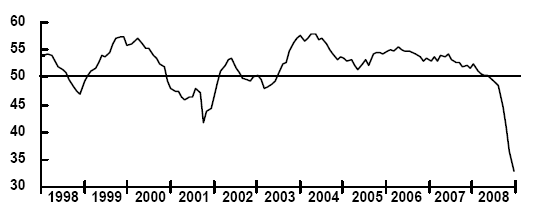
It would appear that the crash of 2008 will require sometime before complete recovery commences. It is not clear how long the period of negative or depressed economic growth will last, but one impact of any economic downturn as drastic as the one we just experienced, will be a lowering of the cost of all new electrical generating facilities, including the cost of reactors. I will not fault Sovacool & Cooper for their failure to notice this, since I made assumptions of continued cost inflation until recently.

Sovacool & Cooper point to factors such as "operational learning" which they describe as
a feature not well suited to rapidly changing technology . . .
But it is far from clear how much a factor "operational learning" will be in new reactor costs. Recent changes inb reactor technology are evolutionary rather revolutionary in nature. The Light water reactor is a mature technnology, that is not rapidly changing. Furthermore, new American reactors will be based on designs that will be built elsewhere first. Thus much of the cost of "operational learning" will be born by the Chinese, the Japanese, the Fins, and the French. Sovacool & Cooper also note
difficulty in standardizing new nuclear units
A problem which I already touched on, but that problem may well be a thing of the past. First Many power producers appear to be focusing on a relatively few designs. The Westinghouse AP-1000 is particularly attractive, and China has already standardized the Ap-1000 as its standard reactor design. Numerous American power producers are considering the AP-1000 and it is also under consideration in England.

Sovacool & Cooper also focus on the cost of fuel reprocessing. The principle economic argument against reprocessing nuclear fuel is that it is cheaper to mine new uranium, enrich it, and run it through a once through cycle, and then designate it nuclear waste. But in terms of power production cost, recycling nuclear fuel would add very little to final electrical costs. Sovacool & Cooper do not understand this. They assert,
Researchers have recently proposed a newer method of reprocessing called uranium extraction plus (“UREX+”), which keeps uranium and plutonium together in the fuel cycle to avoid separating out pure plutonium. This method, however, is both unproven and absurdly expensive. The DOE estimated in 1999 that it would cost $279 billion over a 118-year period to fully implement a reprocessing and recycling program for the existing inventory of U.S. spent fuel relying on UREX+.
Is $279 billion spread over 118 years absurdly expensive? We have an annual expense of 2,364,000,ooo a year which seems like a lot of money, but the total sum is less than what the United States paid for imported oil in 2007. But the energy return on the investment in nuclear fuel recycling would be many times higher than the energy return on dollars spent for imported oil. Further more dollars spent on recycling American nuclear fuel are not spent on imported fuel. Money spent on energy producing industrial process in the United States is money that is not lost to the American economy. Economic multipliers would come into play, further lowering the real economic cost of fuel reprocessing.

Reprocessing is also economically rational because it is cheaper and safer to recycle used nuclear fuel than to treat it as nuclear waste than to place it into long term storage. U-235 and plutonium found in nuclear fuel can used to fuel two types of Generation IV reactors, The Liquid Fluoride Thorium Reactor, and the Intrigel Fast Reactor. Contrary to Sovacool and Cooper's claim that
Generation IV reactors entailed much higher reprocessing and disposal costs compared to conventional recycling and fuel disposal . . .
the LFTR reprocesses fuel internally, and can be used as a means of disposing of nuclear waste from other reactors. In fact, as I note elsewhere on this blog, uranium and plutonium from nuclear waste can be used as a starter charge, for new LFTRs. Used this way, the cost of reprocessing "spent nuclear fuel", which Sovacool & Cooper also state to be $5 billion a year, would far more than pay for itself in terms of the energy reprocessing would return to the economy. This is one of the many instances in which the Sovacool & Cooper analysis goes completely astray by its failure to put the facts into context.

Sovacool & Cooper and make the cost of long term storage of "nuclear waste" an issue. i personally would regard the disposal of spent reactor fuel a tragedy, since 99% of the potential energy in uranium goes unused in reactors. Sovacool & Cooper, obcessed as they are in demonstrating their case against nuclear power at every turn fail to compare the cost and benefits of reprocessing with the cost and benefits of long term storage.

Sovacool & Cooper raise and misrepresent the question of nuclear decommissioning. First Sovacool & Cooper misinform us on the lifetime of nuclear plants:
Nuclear plants often have an operating
lifetime of forty years.Iin fact it is at least 60 years with another 20 opening up as a possibility. Thus the statement that
In most cases, the decommissioning process takes twice as long as the time the reactor is actually in use
is inaccurate no matter what its source. Their statement that reactor decommissioning
costs anywhere from $300 million to $5.6 billion.
reports fact but ignores that nuclear decommissioning costs are set asside during the 60 to 80 years that a reactor is operated, and thus does is already paid for when decommissioning begins. Paying decommission cost does not pose a serious burden on rate payers, because decommissioning costs are only a very tiny fraction of each cent paid for electricity. Sovacool & Cooper appear to feel uncomfortaboe withtheir cost od decommissioning in the united States, because they includ a discussion of the cost of decommissioning, for British zreactors, and a second discussion of the cost of decommissioning K-25 a World War II era, weapons related industrial facility in Oak Ridge.

Sovacool & Cooper also provide a wholly wrong headed analysis of nuclear research and development. Thus their assessment of Generation IV nuclear technology simply groups all generatiohn IV together as a group and characterized them. This is most unfortunate in the case of the LFTR because of its radical difference from other reactor technologies. Thus many things that Sovacool & Cooper say about GenerationIV Nuclear technology are not true of LFTR technology. This is especially hard to explain becaus Ben Sovacool is familiar with my blog, Nuclear Green afnd has commented on it on a number of occasions. Ben is also aware of Energy from Thorium, a blog that has what can only be described as a tremendous factual basis. Asside form category errors, Sovacool & Cooper offer the argument that sinceGenerationIV Reactors need to be researched before they aree built, they shouldnot be researched. Is there an explanation for this circular conclusion? yes, It is clear that Socacool & Cooper regard any reactor belonging to the generation IV reactor class as bab, bab, bad.

Finally we have the matter of subsidies. First I should note a distinction between the civilian nuclear industry and the civilian nuclear power industry. The Civilian nuclear Industry is a refers to all research conducted to on topics deemed to be of use to civilians. This might include everything form the peaceful uses of nuclear explosions, to the use of radioisotopes in medicine, the use of radiation to trigger genetic mutations in plants, the study of Carbon-14 inthe atmosphere, and many other research issues not directly baring on nuclear power. Secondly, it should be observed that many of the so called civilian research projects had secret military purposes. The distinction between civilian and military research was nearly as hard and fast as it would appear. For example the first civilian nuclear power plant, the Shippingport Reactor, was actually a Naval Reactor. During its history the Navy used the Shippingport reactor for expeeriments. The Navy exercized a great deal of controlover the USAEC during the 1950's, 60's and 70's. and many of what might appear to be civilian research decisions were actually made for military purposes. Thus for example the decision to research the liquid Metal Fast Breeder reactor rather than the safer and largely waste free molten salt reactor, appears to have been made with an eye to the production of plutonium for military purposes. Plutonium is a relatively unsatisfactory thermal reactor fuel, but PU-239 is a preferred weapons material.

Direct research in support of the civilian power industry has been quite small. The Federeal government spent about 5.8 billion dollars developing the civilian version of the light water reactor. This was the largest single subsidy which it provided the civilian nuclear power industry. A second significant subsidy will come into force during the next decade when the Federal government is committed to cosign loans worth 18 Billion Dollars for the Nuclear power industry. It is frequently argued that the Anderson-Price Act is a subsidy to the nuclear power industry. But in fact the the Anderson-Price Act indemnifies the nuclear Industry for at least$10 Billion in the event of a nuclear accident, and leaves open the possibility of an even higher bill to reactor owners, if the total recovery costs exceeds $10 Billion.

Unlike the renewables, the nuclear power industry does not get any tax breaks on its power production. Nor does federal government pay part of the capital costs of nuclear projects. Where then is the huge subsidy to the nuclear power industry that Sovacool & Cooper go on and on about. The huge nuclear subsidy is an urban myth perpetuated by anti nuclear fanatics. the truth is that high priced, low performance renewables can't cut it in the open market where nuclear is doing just fine. With out their subsidies renewable owners would simply fold their tents and slip into the night.

Followers

Blog Archive

Some neat videos

Nuclear Advocacy Webring
Ring Owner: Nuclear is Our Future Site: Nuclear is Our Future
Free Site Ring from Bravenet Free Site Ring from Bravenet Free Site Ring from Bravenet Free Site Ring from Bravenet Free Site Ring from Bravenet
Get Your Free Web Ring
by Bravenet.com
Dr. Joe Bonometti speaking on thorium/LFTR technology at Georgia Tech David LeBlanc on LFTR/MSR technology Robert Hargraves on AIM High